
Closing the windows during an air quality alert is usually the right first move. It is not a complete sleep plan. A bedroom can keep smoke or smog out and still become hot, stale, humid, or CO₂-heavy enough to make sleep lighter and the next morning worse.
Use the AQI level as the starting point, then adjust for your room: whether you have a HEPA purifier, whether your HVAC can filter outdoor air, whether you can monitor CO₂, and whether heat or humidity is becoming its own sleep problem. The goal is not a perfectly sealed bedroom. The goal is a room that reduces the dominant exposure tonight without creating a different one by 3 a.m.
| AQI level | Bedroom priority tonight | Filtration | Windows and ventilation | CO₂ awareness | Humidity and comfort | Sensitivity adjustment |
|---|---|---|---|---|---|---|
| Good | Keep the usual sleep routine stable. | Use normal HVAC filtration or a purifier if you already run one. | Open windows if outdoor temperature, noise, pollen, and safety make that helpful. | No special CO₂ action unless the room often feels stale. | Aim for a comfortable middle range rather than very dry or damp air. | Sensitive sleepers can keep a purifier on low for consistency. |
| Moderate | Reduce preventable bedroom sources before sleep. | Run a HEPA purifier in the bedroom if available, especially during the hour before bed. | Ventilate earlier in the day if outdoor conditions are better; avoid last-minute window opening if pollution is rising. | If windows stay closed all night, a CO₂ monitor can show whether the room is becoming stale. | Use humidification or dehumidification gently; avoid pushing the room to either extreme. | People with asthma, pregnancy, cardiovascular disease, older age, or high symptom sensitivity should behave as if the level were one tier worse. |
| Unhealthy for Sensitive Groups | Shift from comfort-first to exposure reduction. | Run a HEPA purifier with the bedroom door mostly closed long enough to clean the room before bedtime. | Keep windows closed during the evening peak unless indoor CO₂, heat, or safety makes brief controlled ventilation necessary. | Watch for CO₂ climbing above roughly 1,000–1,200 ppm if you can measure it; use controlled ventilation when outdoor air permits. | Keep the room cool enough for sleep while preventing dampness around windows, bedding, and walls. | Use a simplified AQI >100 plan if you want a shorter decision path. |
| Unhealthy | Protect the sleep room as a clean zone. | Use the best available filtration: HEPA purifier, upgraded HVAC filter if compatible, or both. | Keep windows closed while outdoor air is poor. If ventilation is needed for CO₂ or heat, do it briefly, deliberately, and preferably when outdoor readings are lower. | A sealed bedroom may reduce particles while raising CO₂; do not ignore morning headache, stuffiness, or repeated awakenings. | Avoid adding moisture blindly. Target a moderate feel, not a rainforest or desert. | Move pets, smoky clothing, and dusty textiles out of the bedroom if they are adding particles. |
| Very Unhealthy | Reduce exposure and prevent the room from overheating or becoming stale. | Run HEPA filtration continuously in the bedroom and avoid activities that stir dust. | Do not use casual window airing before sleep. If heat makes the room unsafe, use filtered cooling, relocate to a cleaner/cooler room, or follow public-health guidance. | If CO₂ becomes high and outdoor air remains very poor, the tradeoff is no longer a simple sleep-hygiene decision. | Control humidity enough to prevent clammy bedding and condensation. | Vulnerable people should follow health-alert instructions rather than trying to fine-tune the room alone. |
| Hazardous | Treat the alert as a health-protection event, not a bedroom optimization problem. | Use available filtration, but do not assume a small purifier makes the room safe. | Keep outdoor air out unless authorities advise otherwise or safety requires ventilation. | CO₂, heat, and medical symptoms all matter; seek safer indoor air if your room cannot manage them. | Prioritize safe temperature and medical guidance over comfort tweaks. | Follow local emergency and public-health guidance, especially for children, older adults, pregnancy, and cardiopulmonary disease. |
Why a sealed bedroom can still sleep badly
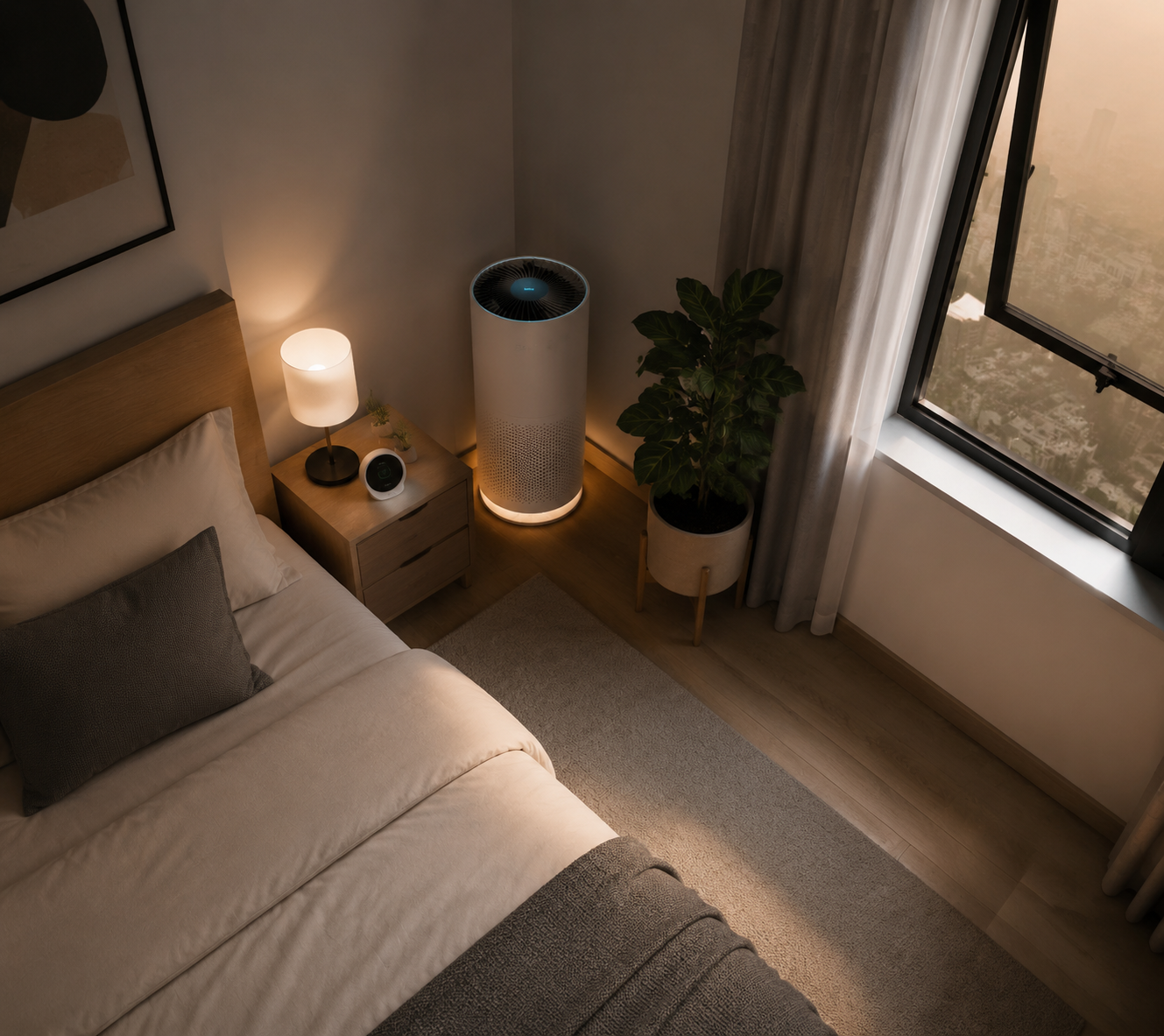
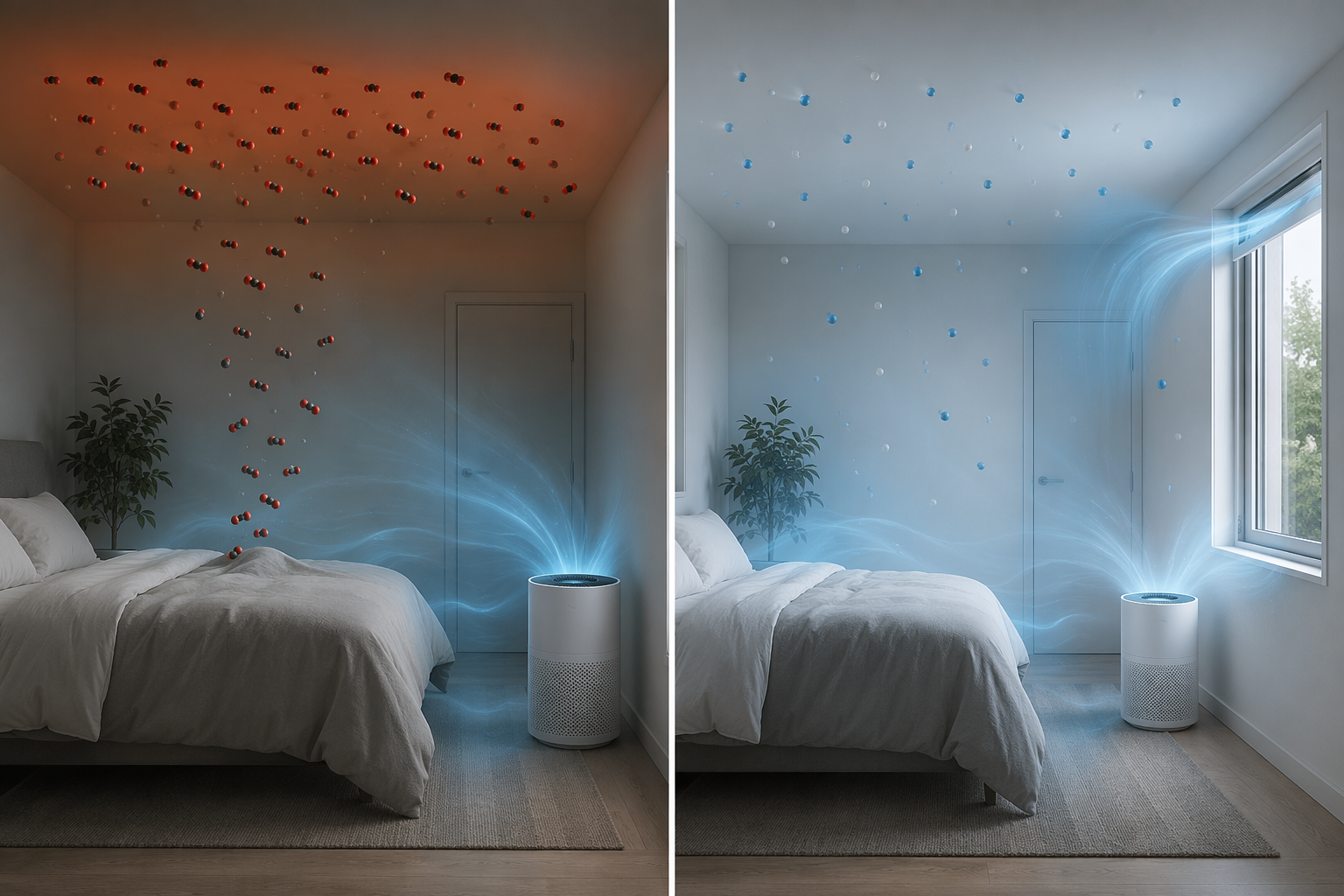
The common instinct during smoke or smog is to close everything, tape the gaps, run the purifier, and call the room fixed. That can be necessary when outdoor particles are high. It can also trap exhaled CO₂, body heat, moisture, and indoor particles from bedding and floors.
The best direct sleep evidence for filtration is useful but modest. In a 2-week randomized crossover pilot study of 30 adults, HEPA air purification increased total sleep time by 12 minutes per night and time in bed by 19 minutes per night compared with placebo filtration.[1] That is not a miracle claim. It is a good reason to run a real purifier when particles are the main problem, especially because the intervention is low-effort once the device is in the room.
The tradeoff becomes sharper when particles and CO₂ are considered together. A 2026 bedroom study of 163 young adults found that higher bedroom PM2.5 was associated with a lower proportion of deep sleep, and that high CO₂, around 3,961 ppm, amplified the negative association between PM2.5 and next-day physical performance compared with low CO₂, around 445 ppm.[2] The sample was narrow—young undergraduates—so it should not be stretched into a universal rule for every household. It is still a strong warning against treating a closed bedroom as harmless just because the window is shut.
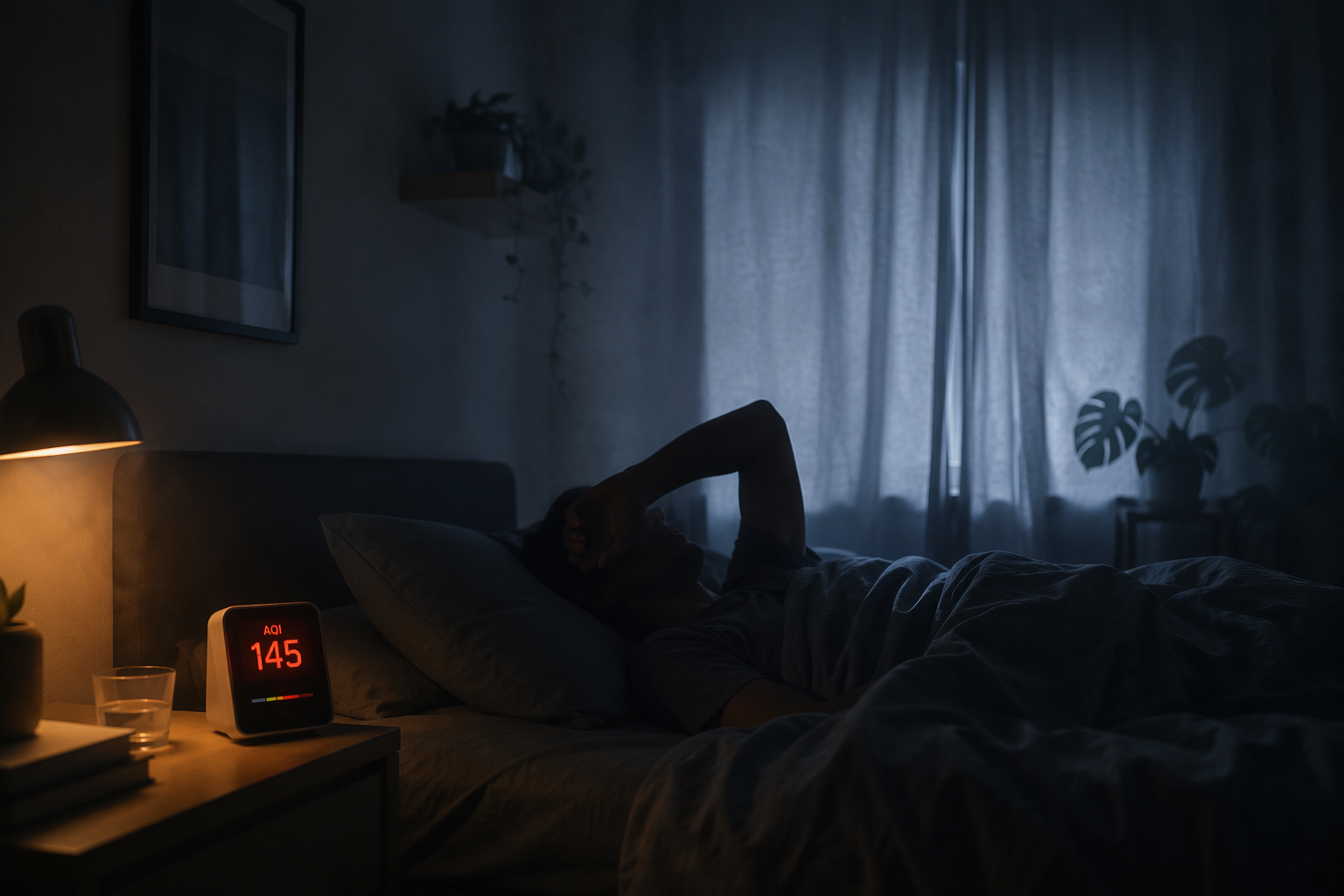
The same study reported that CO₂ above 1,200 ppm was associated with higher apnea-hypopnea index and more micro-arousals, and that deep sleep dropped by about 4.3% per 100 ppm CO₂ increase above roughly 1,000 ppm.[2] In practical terms, a room that feels stale in the morning may not be a minor comfort issue. It may be the cost of protecting against outdoor pollution without giving the room any controlled way to breathe.
Set up the bedroom before the evening peak
The hours before bed matter because the bedroom is not starting from zero. Particles come in through windows and doors, but they also ride in on clothing, hair, pets, bedding, and the dust already sitting on soft surfaces. If you wait until lights-out to solve the room, the purifier is working against both outdoor air and whatever the evening routine just stirred up.
A practical sequence works better than a pile of tips:
- Check the AQI trend before dinner, not only at bedtime. If the air is worsening, plan to close the room early.
- Reduce sources: no candles, incense, smoking, frying, aerosol sprays, or dusty cleaning in or near the bedroom.
- Change out of smoky or outdoor clothes before sitting on the bed. Shower or rinse hair if you have been outside during heavy smoke.
- Run the purifier in the bedroom with the door mostly closed before sleep, then keep it running overnight at the quietest effective setting.
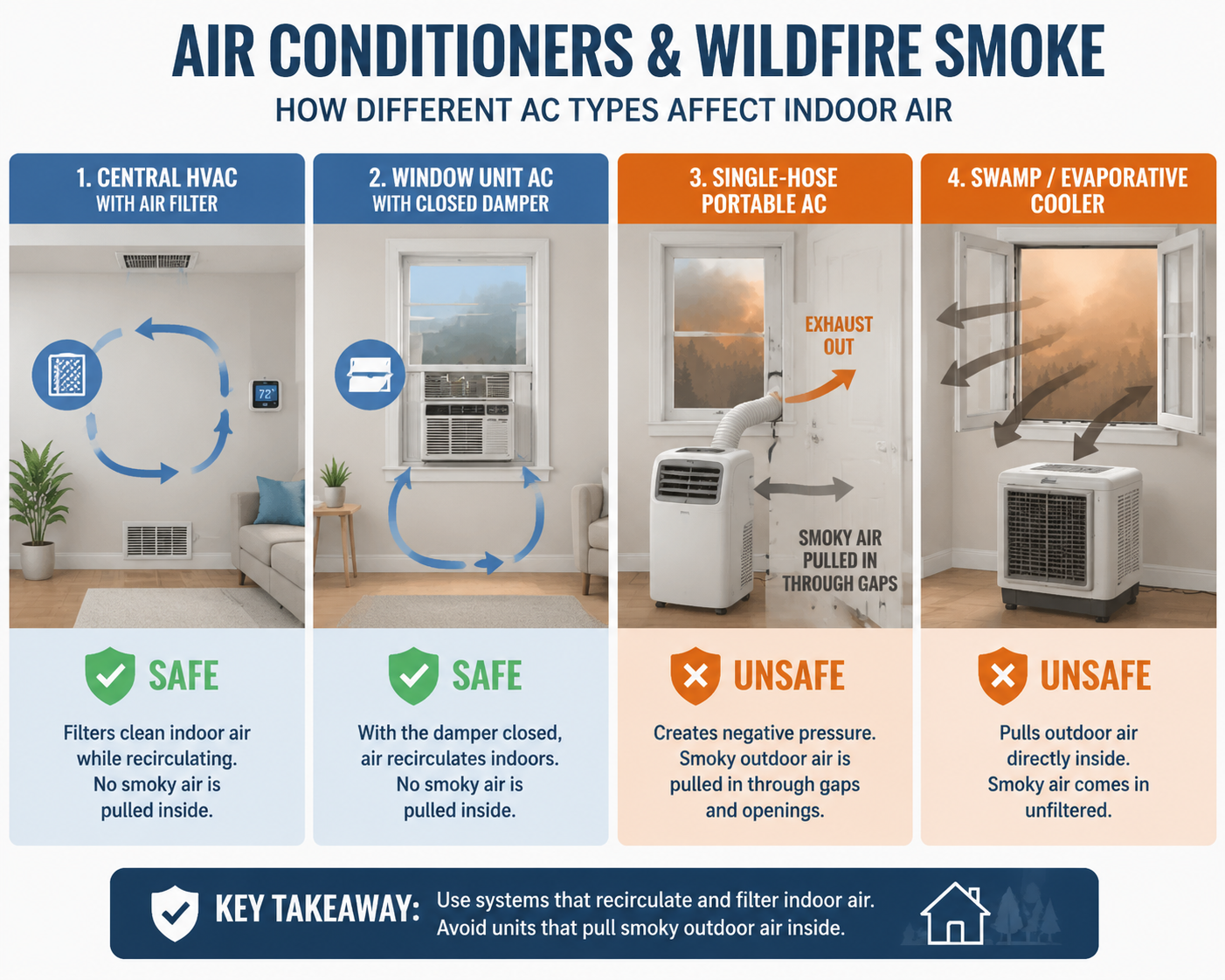
- Use HVAC fan and filtration only if your system is designed for it and the filter is installed correctly; a leaky or overloaded setup can disappoint.
- Avoid opening the window casually right before bed when outdoor pollution is elevated or rising.
That last point matters because indoor particle patterns are not always intuitive. PurpleAir reports that indoor PM2.5 concentrations are typically highest between 9 and 11 p.m., which makes the familiar “just crack the window before sleep” habit riskier during an alert than it feels.[3] If you need outdoor air for heat or CO₂, make it a measured choice: short duration, lowest available outdoor reading, purifier running afterward, and no illusion that the window opening was free.
The bed itself can re-stir particles
The mattress is not just a passive surface. A PurAir article, citing research on particle re-aerosolization, notes that movement during sleep can raise mattress-level particulate matter to as much as 20 times ambient room-air levels.[4] That source is not the same kind of evidence as a peer-reviewed sleep trial, so it should not carry the whole argument. It is enough to justify ordinary, low-regret cleaning: keep outdoor clothes off the bed, wash bedding in hot water when fabric care allows, use a HEPA vacuum if you have one, and keep pets out of the bedroom during heavy-alert nights if they have been outdoors.
Use CO₂ as a ventilation signal, not a reason to ignore smoke
A CO₂ monitor is not an air-quality oracle. It does not tell you PM2.5, ozone, NO₂, or smoke chemistry. Its value during an air quality alert is narrower and useful: it tells you whether your sealed bedroom is becoming stale enough that the protection strategy may be creating a sleep problem of its own.
If CO₂ stays near ordinary indoor levels and the room feels comfortable, keep the windows closed during poor outdoor air and let filtration do its job. If CO₂ climbs above roughly 1,000–1,200 ppm and you are waking with headache, stuffiness, or restless sleep, decide whether controlled ventilation is safer than continued sealing. On a Moderate or Unhealthy for Sensitive Groups night, a short ventilation window earlier in the evening may be reasonable if outdoor readings are improving. On a Very Unhealthy or Hazardous night, the better answer may be relocation to a cleaner room, filtered cooling, or public-health guidance rather than opening a window into heavy smoke.
Without a monitor, use cruder signals. A closed, small bedroom with two people, a shut door, no mechanical ventilation, and a long night is more likely to accumulate CO₂ than a larger room with filtered central air exchange. Morning dullness is not diagnostic, but it is a clue worth combining with the night’s AQI, room temperature, and whether the purifier was actually sized for the space.
Humidity has a middle, not a moral position
Air-alert advice often drifts into blunt humidity rules: dry the room out, or add moisture because smoke irritates the throat. The 2026 bedroom study points to a more boring and more useful answer. Next-day endurance peaked around 60% relative humidity, while both lower and higher humidity were associated with performance decline.[2]
That does not mean every bedroom should be forced to exactly 60%. It means extremes deserve suspicion. Very dry air can aggravate irritation for some sleepers. Damp air can make bedding clammy, increase condensation risk, and create conditions that favor mold. During an alert, humidity control should support sleep and cleanliness, not become another aggressive project.
- If the room feels dry and irritating, use a clean humidifier gently and avoid visible condensation.
- If the room feels damp or smells musty, dehumidify, cool, or change rooms rather than adding more moisture.
- If you use a humidifier, clean it carefully; dirty humidification is not a sleep intervention.
- If heat and smoke collide, prioritize safe cooling. A room that is clean but too hot to sleep in is still a failed bedroom.
For the specific problem of hot smoke-season nights, use a dedicated heat-and-smoke plan rather than trying to solve both with window timing alone: how to sleep during summer heat and wildfire smoke.
What the pollution-sleep evidence can and cannot tell you
Air pollution and sleep are linked in population research, but the evidence is not as clean as a bedroom checklist can make it sound. A 2020 systematic review reported that high NO₂ exposure was associated with about 60% higher odds of low sleep efficiency, and high PM2.5 exposure with about 50% higher odds.[5] The same review rated only 6 of 22 included studies as moderate certainty and none as high certainty, so these findings should be read as concerning associations, not proof that tonight’s AQI will cause a specific sleep outcome for every person.[5]
That uncertainty changes the tone, not the direction. You do not need perfect causal evidence to avoid unnecessary indoor particles, run a purifier you already own, keep smoky clothes off the bed, or notice when a sealed room is making you wake up foggy. These are low-regret adjustments. The mistake is promising that any one of them guarantees sleep.
If you want the longer physiology of smoke, airway irritation, inflammation, and sleep disruption, use the companion background piece on how wildfire smoke affects sleep. If your sleep disruption feels tied to fear, evacuation memories, or repeated disaster alerts rather than the air itself, the psychological toll of wildfire smoke deserves separate attention.
Adjust the plan for the room you actually have
A freestanding HEPA purifier in a small bedroom is different from central HVAC filtration in a large open-plan home. A room with a leaky old window is different from a tight apartment with no fresh-air supply. Use the table as the first pass, then modify it with these constraints.
| Your setup | What to change tonight |
|---|---|
| You have a HEPA purifier | Place it in the bedroom, keep intake and outlet unobstructed, run it before bed, and avoid turning it off once the room is occupied. |
| You have central HVAC filtration | Use the highest-rated filter your system can safely handle, make sure it is seated correctly, and avoid assuming HVAC filtration cleans a closed bedroom quickly. |
| You have no purifier | Prioritize source control, keep windows closed during poor outdoor air, reduce dust disturbance, and consider sleeping in the room with the least outdoor leakage. |
| You have a CO₂ monitor | Use it to detect stale-room tradeoffs; do not use it as a substitute for PM2.5 or AQI information. |
| You do not have a CO₂ monitor | Pay attention to room size, number of sleepers, door position, morning headache, and whether the room feels stuffy after several closed-window nights. |
| You are highly sensitive or medically vulnerable | Move one AQI tier more cautious and follow health guidance from local authorities or your clinician. |
When AQI is above 100 and you do not want this much detail, use the shorter companion guide to sleeping during an air quality health advisory. The more detailed protocol here is most useful when conditions keep changing or when the first obvious move—closing the window—has started to create new problems.
When to stop optimizing and escalate
A sleep article should not overrule an air-quality emergency. If the AQI is Hazardous, if public-health officials advise staying indoors or relocating, if you have chest pain, severe shortness of breath, confusion, worsening asthma symptoms, or another urgent symptom, the question is no longer how to tune the bedroom for sleep. Follow local guidance and seek medical help when needed.
Also stop blaming the air if poor sleep continues after conditions improve. A few bad nights during smoke, smog, or an inversion can be situational. Persistent insomnia, repeated awakenings, panic at bedtime, or daytime impairment after the alert ends needs broader sorting. Start with a can’t-sleep self-triage guide if the pattern outlasts the air-quality event.
For tonight, match the AQI level to the room. Close the window when outdoor air is the bigger threat. Run filtration early enough to matter. Keep an eye on CO₂, heat, and humidity so the protected room does not become a stale one. Good sleep during an air quality alert usually comes from that layered balance, not from one heroic move.
References
- Can air purification improve sleep quality? A 2-week randomised-controlled crossover pilot study, PubMed, 2022.
- Association of bedroom particulate matter, sleep quality and next-day physical performance, Nature Scientific Reports, 2026.
- Indoor Air Quality: Why PM2.5 Peaks at Night, PurpleAir.
- Can Air Pollution Affect Your Sleep Quality?, PurAir.
- The effect of air pollution on sleep quality: a systematic review and meta-analysis, PMC, 2020.


Comments
Join the discussion with an anonymous comment.