
Sleep disruption during and after hurricanes often feels unlike ordinary insomnia because the night itself has changed. The room may be hot, damp, loud, overlit, or unsafe. The body may keep scanning for danger after the danger has passed. Or the storm may have landed on a sleep system that was already quick to react to stress.
Those are not three poetic ways to say “stress.” They are different pathways, and they call for different responses. Trauma-induced hyperarousal can fragment sleep from the inside. Environmental disruption can prevent sleep from stabilizing from the outside. Pre-existing sleep reactivity can make one person’s sleep unravel under pressure while another person, in the same storm track, recovers faster.
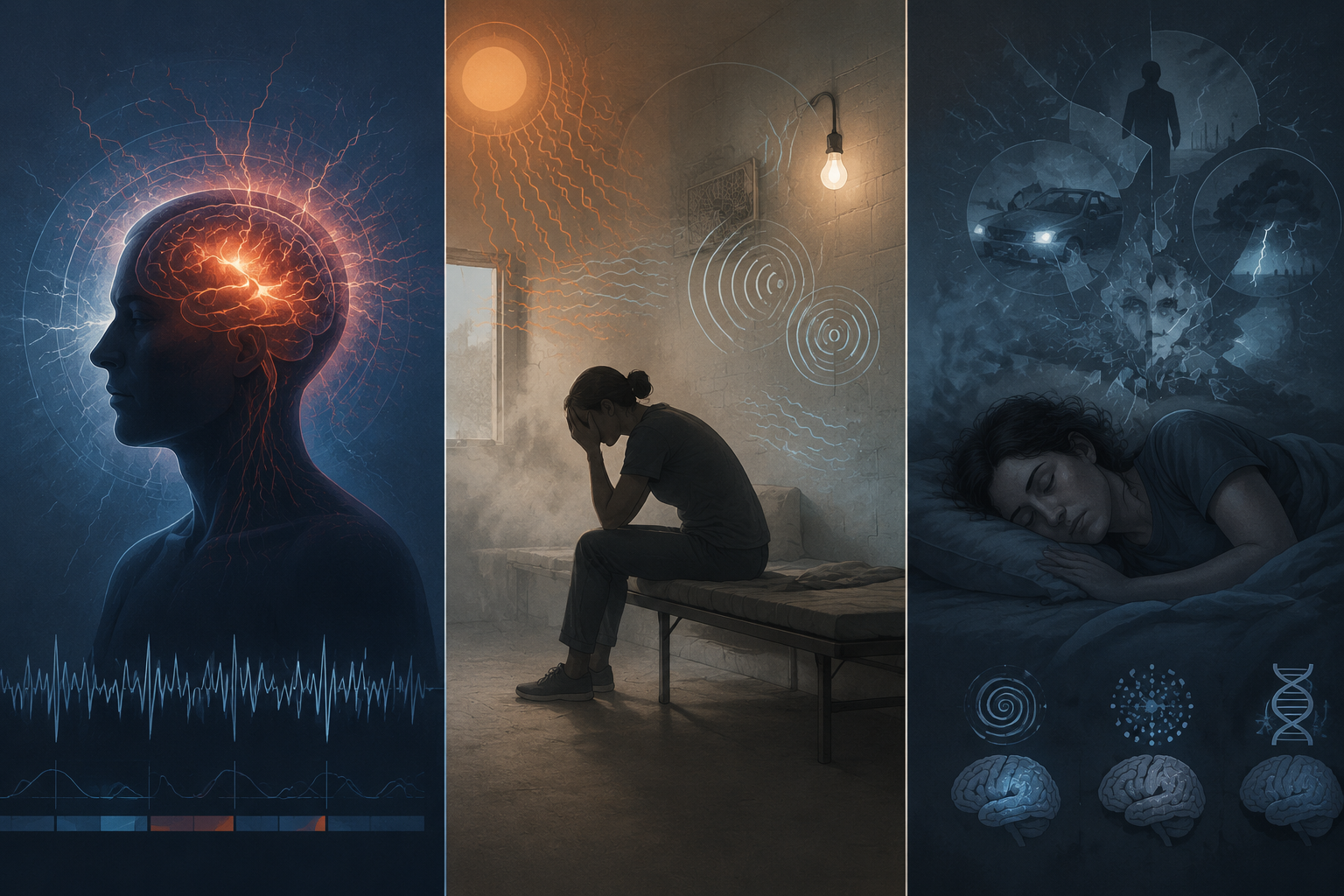
| Dominant pathway | What tends to drive the sleep problem | What the first question should be |
|---|---|---|
| Trauma-induced hyperarousal | The nervous system stays on guard; sleep becomes fragmented, shallow, or dream-disturbed | Am I waking as if my body is responding to threat, memory, or reexperiencing? |
| Physical environmental disruption | The sleep setting is unsafe, unstable, hot, noisy, bright, crowded, damp, smoky, or poorly ventilated | Would my sleep improve if the sleep environment became safer and more controllable? |
| Pre-existing sleep reactivity | The person’s sleep was already sensitive to stress before the storm | Have bad dreams, light sleep, or stress-related insomnia been part of my pattern before? |
The timing still matters. Trouble may start before landfall, peak during watches and warnings, or persist after power returns and debris is cleared. For that phase-by-phase picture, how hurricane anxiety disrupts sleep at every phase is the companion question. Here, the more useful question is mechanism: what is keeping the sleep system from downshifting?
When trauma changes the texture of sleep
After Hurricane Andrew, researchers studied sleep in survivors with polysomnography rather than relying only on symptom reports. The sample was small: 54 hurricane victims and 9 comparison subjects. That matters; it should not be inflated into a population-wide estimate. But the finding is still important because the sleep disturbance was visible inside sleep architecture. Hurricane survivors showed more arousals, more entries into Stage 1 sleep, and a positive correlation between REM density and reexperiencing symptoms.[1]
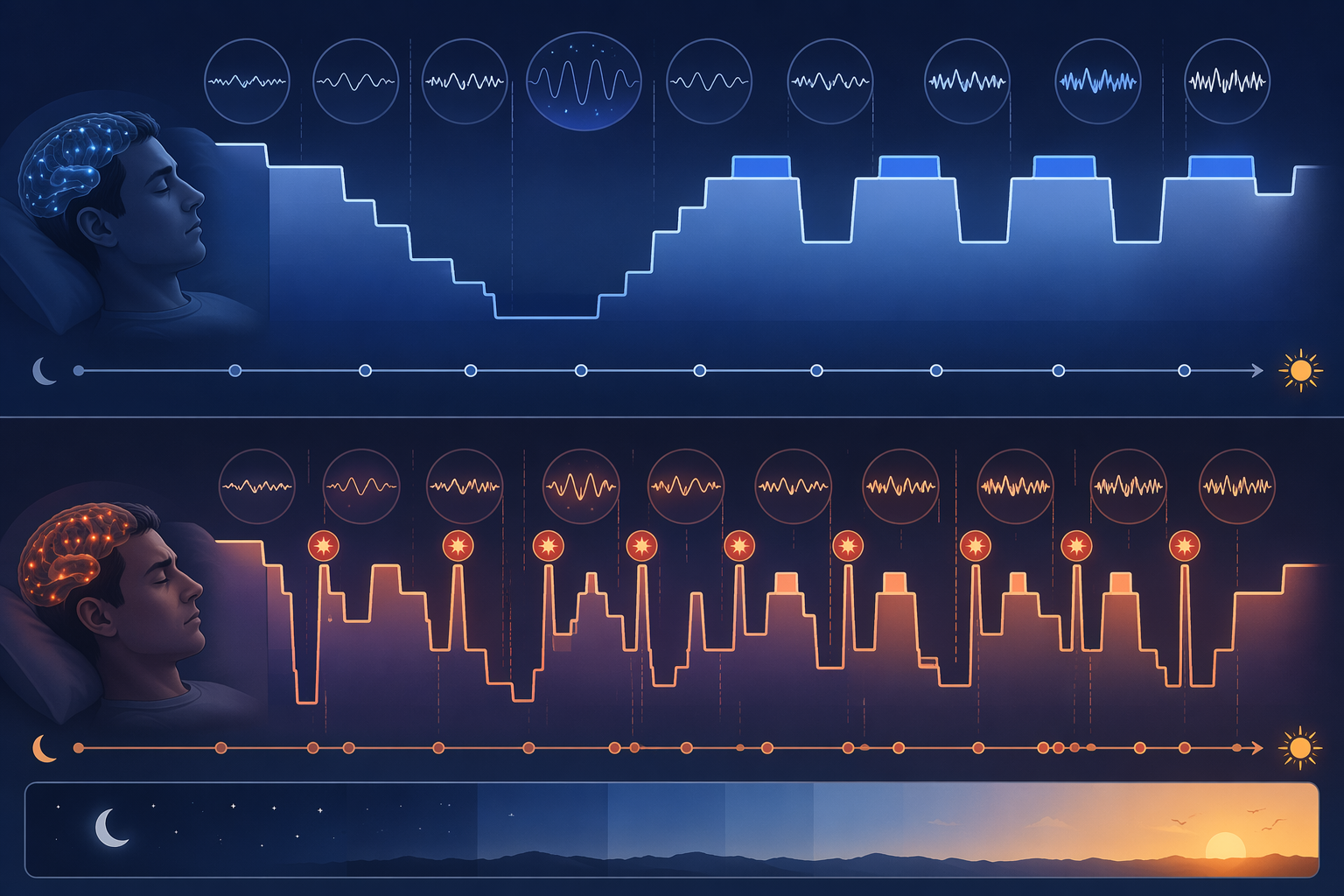
That is a different finding from “people slept badly after a hurricane.” More arousals mean sleep is being repeatedly interrupted. More Stage 1 entries suggest the sleeper is being pulled back toward lighter sleep. The REM-density link matters because REM sleep is one place where emotionally loaded memory and dreaming can become clinically noisy. A person may describe this as “I slept, but it didn’t count,” or “I kept waking before I knew why.” The sleep record gives that complaint physiological shape.
This is where trauma language is useful, but only if it stays precise. PTSD is strongly tied to sleep disturbance: a 2023 review reports that up to 90% of people with PTSD report sleep disturbances, and about 70% of those diagnosed with PTSD experience insomnia.[2] Those numbers explain why trauma-related sleep problems deserve serious attention. They do not mean every person who sleeps poorly after a hurricane has PTSD.
Hyperarousal often shows up as sleep that will not hold. The person may fall asleep out of exhaustion and then wake abruptly. They may wake to ordinary sounds as if they are warnings. They may dread the first heavy rain after the storm, not because they are choosing to “think negative,” but because the brain has learned that weather noise can require action. In some people, dreams or partial awakenings carry pieces of the event; in others, the body wakes first and the story arrives later.
For readers who want the machinery behind this, the question sits close to sleep architecture and to the nighttime conflict between alerting systems and sleep-promoting systems. It is not a character flaw when a nervous system trained by danger keeps interrupting sleep. It is also not something that always resolves just because the person is told the storm is over.
The sleep environment may still be doing harm
Before deciding that a survivor’s insomnia is mainly trauma-driven, ask where the person is actually trying to sleep. A bedroom without power in July is not the same sleep setting as the bedroom before the storm. A relative’s couch, a shelter cot, a car, a hotel room shared with children and pets, or an apartment with a damaged roof can keep the nervous system alert for reasons that are entirely current.
Heat is not a small comfort issue when sleep is already fragile. The body needs to shed heat as it moves into sleep. When the room stays hot, damp, and still, the person may doze and wake in cycles without ever getting a stable stretch. Add generator noise, hallway light, phone alerts, unfamiliar voices, the need to protect belongings, and the calculation of whether a door locks properly, and the problem is no longer “relaxation.” The sleep setting is withholding the conditions sleep normally depends on.
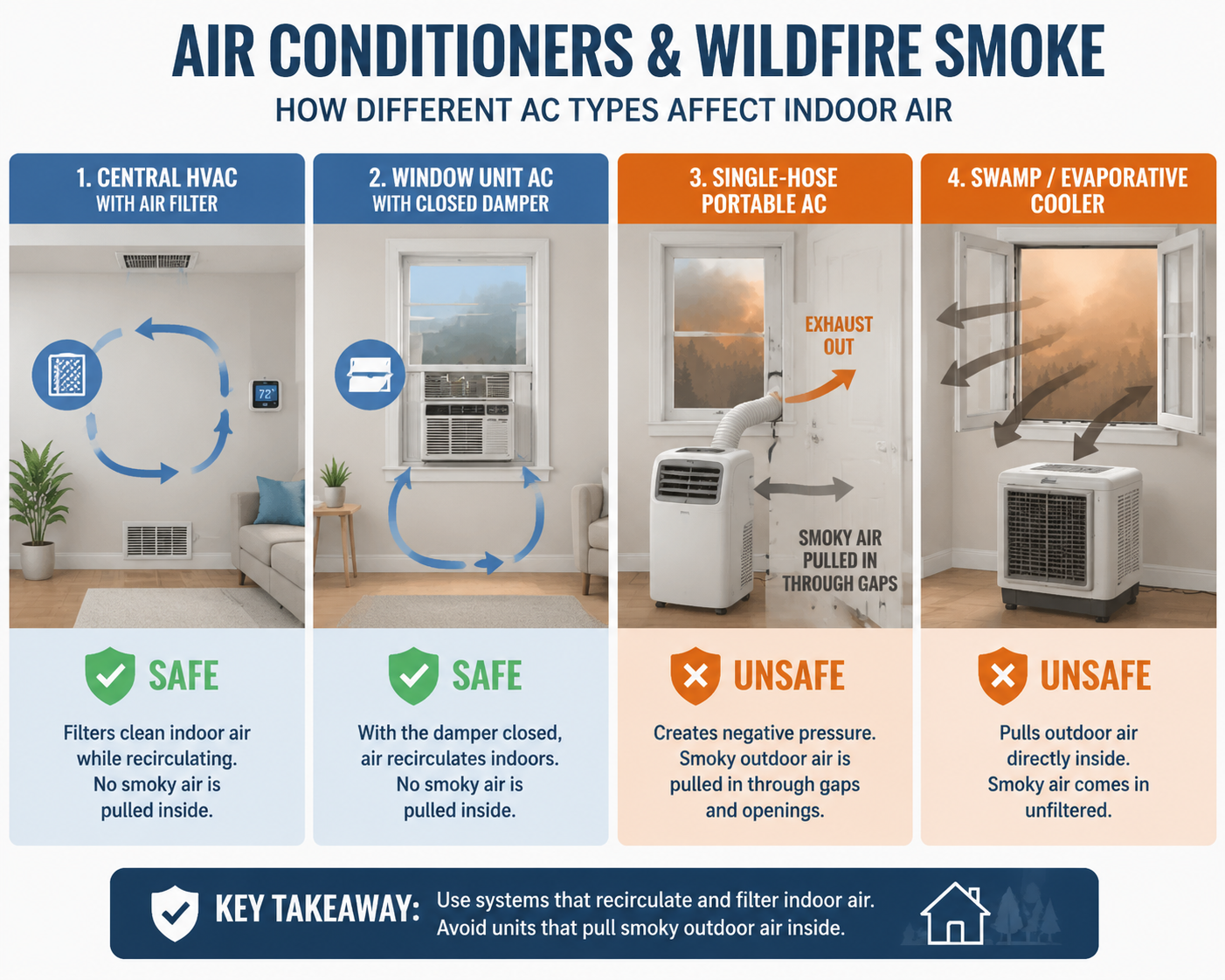
Air quality belongs in the same conversation. Mold, smoke, cleaning chemicals, dust, fuel fumes, and poor ventilation can make breathing feel effortful or irritating at night. Someone with asthma, chronic sinus problems, sleep apnea, or a child sleeping beside them may stay half-awake because the room itself feels untrustworthy. In that situation, sleeping during an air quality health advisory becomes more relevant than another lecture on worry control.
Shelter sleep is often described as merely uncomfortable, which understates the issue. A crowded room changes privacy, temperature control, light exposure, noise exposure, infection concerns, medication routines, and nighttime safety. Older adults may be navigating unfamiliar bathrooms. Parents may be sleeping lightly because a child could wander or wake frightened. A person using medical equipment may be monitoring power access. These are practical sleep disruptions, not decorative details around the “real” psychological event.
Environmental disruption can also mimic hyperarousal. If every truck outside sounds like a branch cracking, that may be threat learning. If the person wakes because the shelter lights never dim and the cot hurts their hip, that is a different problem. Many nights include both. The distinction still matters because the countermeasure changes: a safer sleeping arrangement, cooling plan, air-quality adjustment, or noise-and-light boundary may do more than trauma processing for that particular night.
Some sleep systems are stress-reactive before the first warning
The Hurricane Andrew work also pointed to a vulnerability that patients often recognize before clinicians ask about it: pre-hurricane tendencies toward bad dreams and interrupted sleep helped identify people at risk for posttraumatic morbidity.[1] That does not make the person weak. It means their sleep system may have been a sensitive instrument before the storm struck.
Sleep reactivity is the tendency for sleep to become disturbed under stress. Two neighbors may evacuate from the same block, wait through the same alerts, and return to the same cleanup. One sleeps heavily from physical exhaustion. The other develops weeks of conditioned wakefulness: bed becomes the place where the body rehearses damage, insurance calls, medication refills, and the next forecast cone. The difference is not simply attitude. It is vulnerability plus exposure.
A practical history matters here. Did stress disrupt your sleep before hurricane season? Did you have bad dreams, frequent awakenings, or long periods of lying awake during earlier life stress? Did your sleep become fragile after medical problems, caregiving, job loss, or another emergency? If so, the storm may not be the first cause of insomnia; it may be the latest and strongest trigger. For a deeper explanation of this pathway, sleep reactivity is the concept to learn.
This pathway changes the interpretation of “I should be over it by now.” A highly sleep-reactive person may continue sleeping poorly after the roof is patched and the refrigerator is restocked because the insomnia has become self-maintaining. The storm opened the door, but conditioned arousal, irregular sleep timing, long wakeful periods in bed, and fear of another bad night may now be carrying the problem.
Responder sleep is a related but separate warning
People deployed into hurricane response face another version of the problem: prolonged duty can compress sleep while cognitive and emotional demands stay high. In a Coast Guard responder study of 2,695 personnel, sleep deprivation, defined as 5 or fewer hours per night during deployments longer than 2 weeks, was associated with elevated odds of depression, difficulty concentrating, and confusion.[3]
That responder finding should not be pasted onto every hurricane survivor. A deployed responder, an evacuated older adult, and a parent managing a dark house with children are not the same exposure group. The useful lesson is narrower: when sleep loss is sustained during high-demand conditions, mood and thinking can deteriorate in ways that affect judgment, patience, driving, medication management, and recovery work.
How to sort the dominant mechanism
Most people will not fit into one clean box. The point is to identify what is doing the most work right now. A person in an unsafe, hot, noisy room may also be grieving. A person with trauma nightmares may also be breathing moldy air. A person with a long history of stress insomnia may also be sleeping beside a charging phone that keeps sounding alerts. Sorting the dominant pathway prevents the response from becoming too narrow.
- Hyperarousal is more likely dominant when awakenings feel threat-linked, dreams or images replay parts of the event, the body jolts awake, or ordinary storm cues trigger a danger response.
- Environmental disruption is more likely dominant when sleep improves in a safer, cooler, darker, quieter, better-ventilated place, even if worry remains.
- Sleep reactivity is more likely dominant when stress has repeatedly caused insomnia before, or when the storm has passed but the bed has become a conditioned place for wakefulness.
- Mixed cases are common when the person has trauma symptoms, unstable housing, and a history of stress-sensitive sleep.
This sorting also helps with treatment expectations. A 2023 review notes that sleep disturbances often do not remit after trauma-focused PTSD treatment alone.[2] That is not a reason to dismiss trauma treatment. It is a reason to avoid assuming that trauma care automatically fixes insomnia, nightmares, circadian disruption, shelter-related sleep loss, or conditioned wakefulness.
When insomnia treatment belongs in the plan
If the sleep problem persists after the immediate emergency, or if it begins to create fear of bedtime, daytime impairment, unsafe driving, medication errors, or worsening mood, it deserves direct attention. Cognitive behavioral therapy for insomnia, or CBT-I, has evidence for sleep disturbance comorbid with PTSD; a meta-analysis found large effects on sleep outcomes in this setting.[4]
CBT-I is not a pep talk about sleep hygiene. It is a structured insomnia treatment that works with sleep timing, conditioned arousal, time awake in bed, beliefs about sleep, and the behaviors that keep insomnia going. For readers trying to decide whether symptoms have crossed from a temporary rough patch into an insomnia disorder, an insomnia FAQ can help with thresholds. For treatment updates, current guidance on sleeping problems at night is the more treatment-focused next stop.
The clinical decision is not trauma care or sleep care. Some people need both. If nightmares, reexperiencing, avoidance, or persistent threat responses are prominent, trauma-focused care may be necessary. If insomnia has become self-sustaining, sleep-specific care may also be necessary. If the person is still sleeping in unsafe or unstable conditions, environmental repair is not optional background work; it is part of the sleep intervention.
The countermeasure depends on the pathway
If the dominant problem is unsafe or unstable sleep conditions, start there: safety, cooling, ventilation, light control, noise reduction, medication access, and a sleeping place where the person does not have to monitor every sound. If the dominant problem is hyperarousal, trauma-informed care and sleep-specific strategies may need to run together. If the dominant problem is persistent insomnia or high sleep reactivity, CBT-I and clinical evaluation become more relevant than another set of generic relaxation tips.
Hurricane sleep disruption is often real in more than one way at once: in the room, in the nervous system, and in the person’s prior vulnerability. The first useful move is to stop treating all post-storm sleeplessness as the same problem.
References
- Sleep events among victims of Hurricane Andrew — PubMed, 1995.
- Sleep Disturbances in Posttraumatic Stress Disorder: Updated Review and Implications for Treatment — PMC, 2023.
- Sleep deprivation and psychological distress among Coast Guard responders to Hurricanes Katrina and Rita — PubMed.
- Treatment of Sleep Disturbances in Posttraumatic Stress Disorder: A Systematic Review and Meta-Analysis — PubMed, 2015.
Comments
Join the discussion with an anonymous comment.