The strange part is not that a hurricane keeps Floridians awake. The strange part is how often sleep starts to fracture before there is a hurricane at all.
On July 16, 2026, Florida weather coverage described an NHC-tracked disturbance near the Gulf side of the state with low development odds — including a 10% near-term chance and a 30% chance over the next several days — while still warning about heavy rain in parts of Florida [1][2]. That is exactly the kind of forecast that can feel out of proportion at bedtime. A low-chance system should not, on paper, be enough to make someone reopen the cone graphic three times, clench their jaw, and wake at 2 a.m. listening for rain.
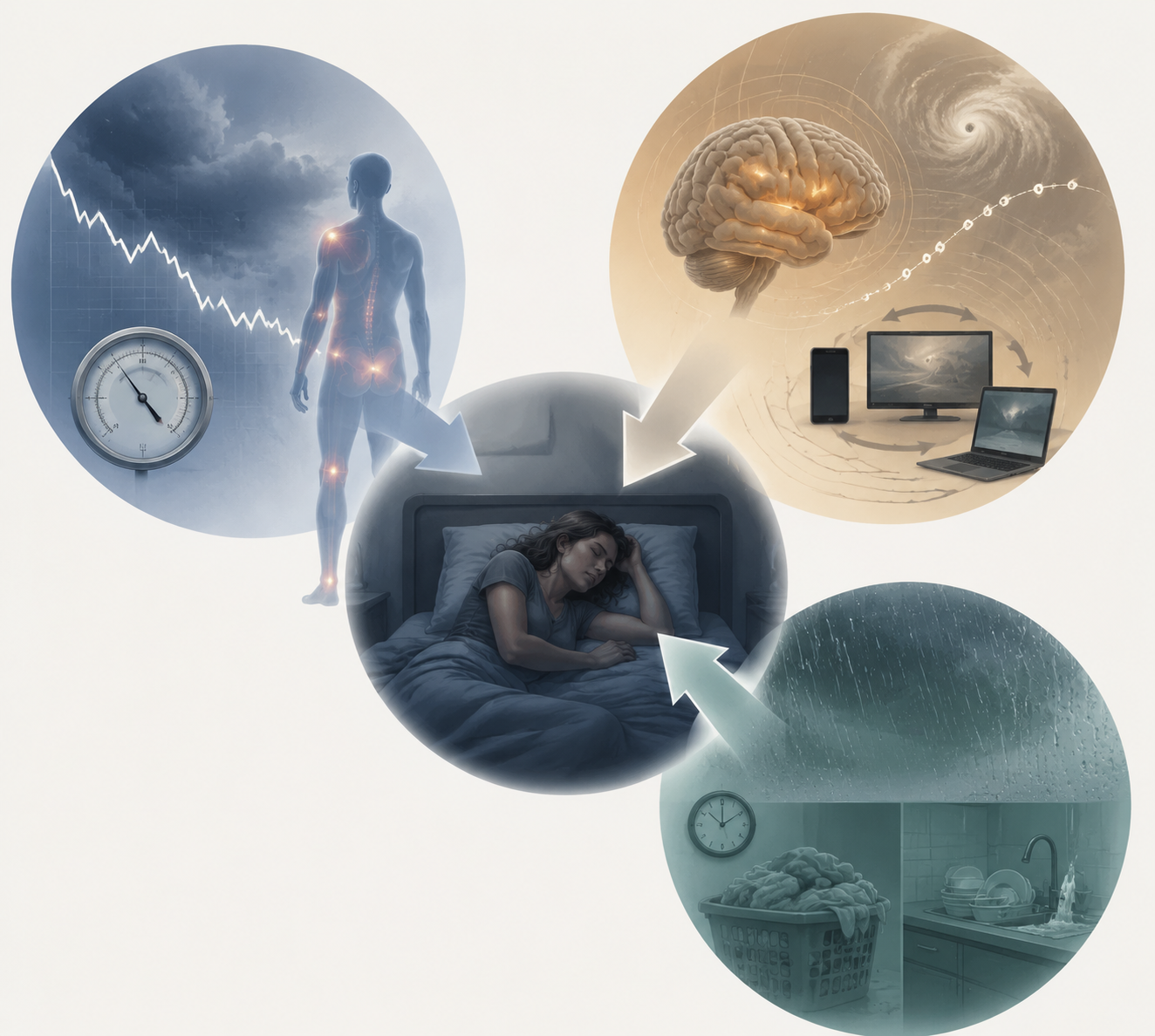
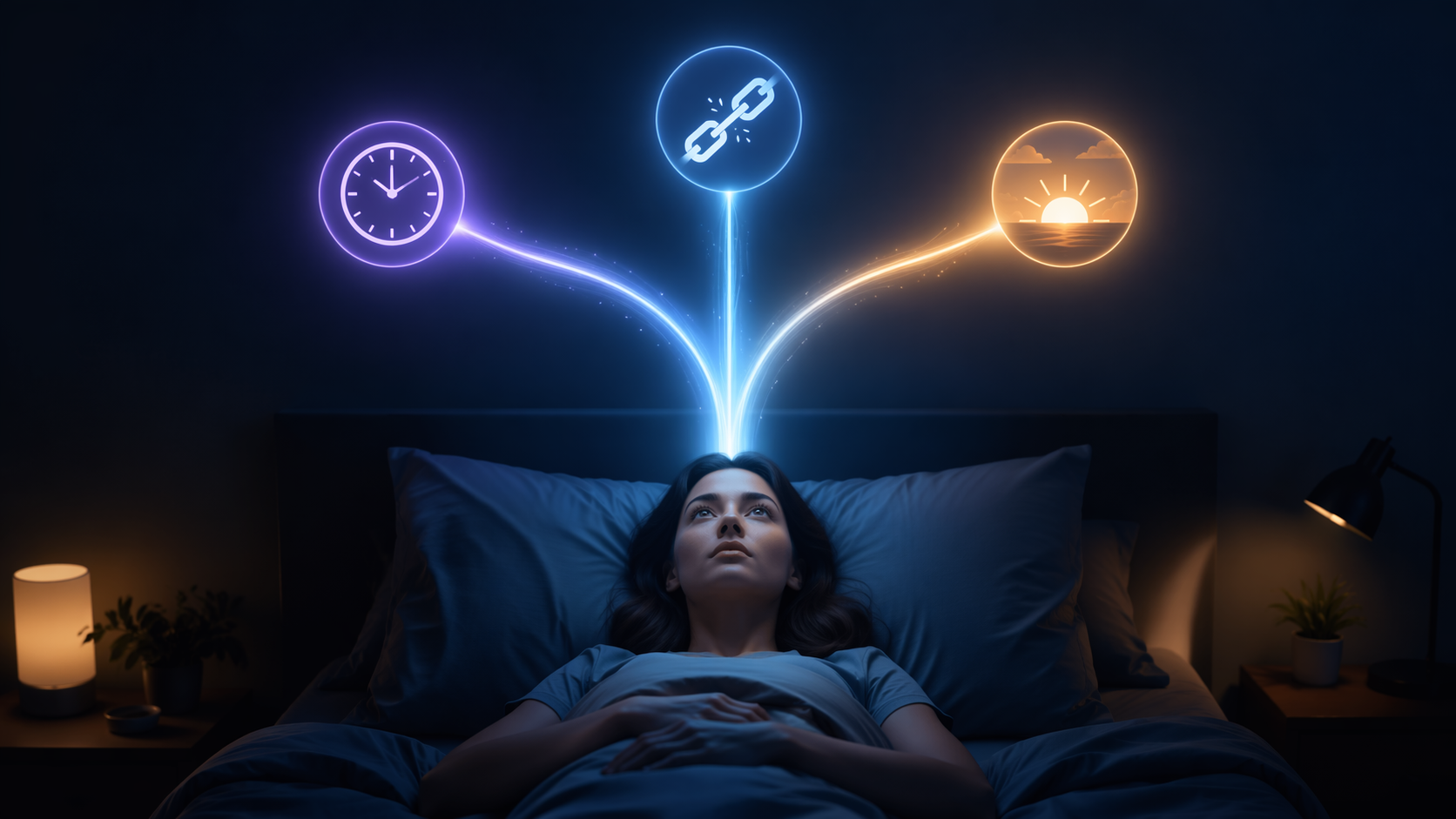
But the sleep impact of an NHC disturbance near Florida is not governed by storm naming rules. The body does not wait for a depression, a tropical storm, or a landfall forecast. Sleep can be disturbed when three pathways arrive together: physical weather-related sensations, anticipatory threat monitoring, and the nighttime environment of a house preparing for uncertainty.
Low formation odds are not low nervous-system odds
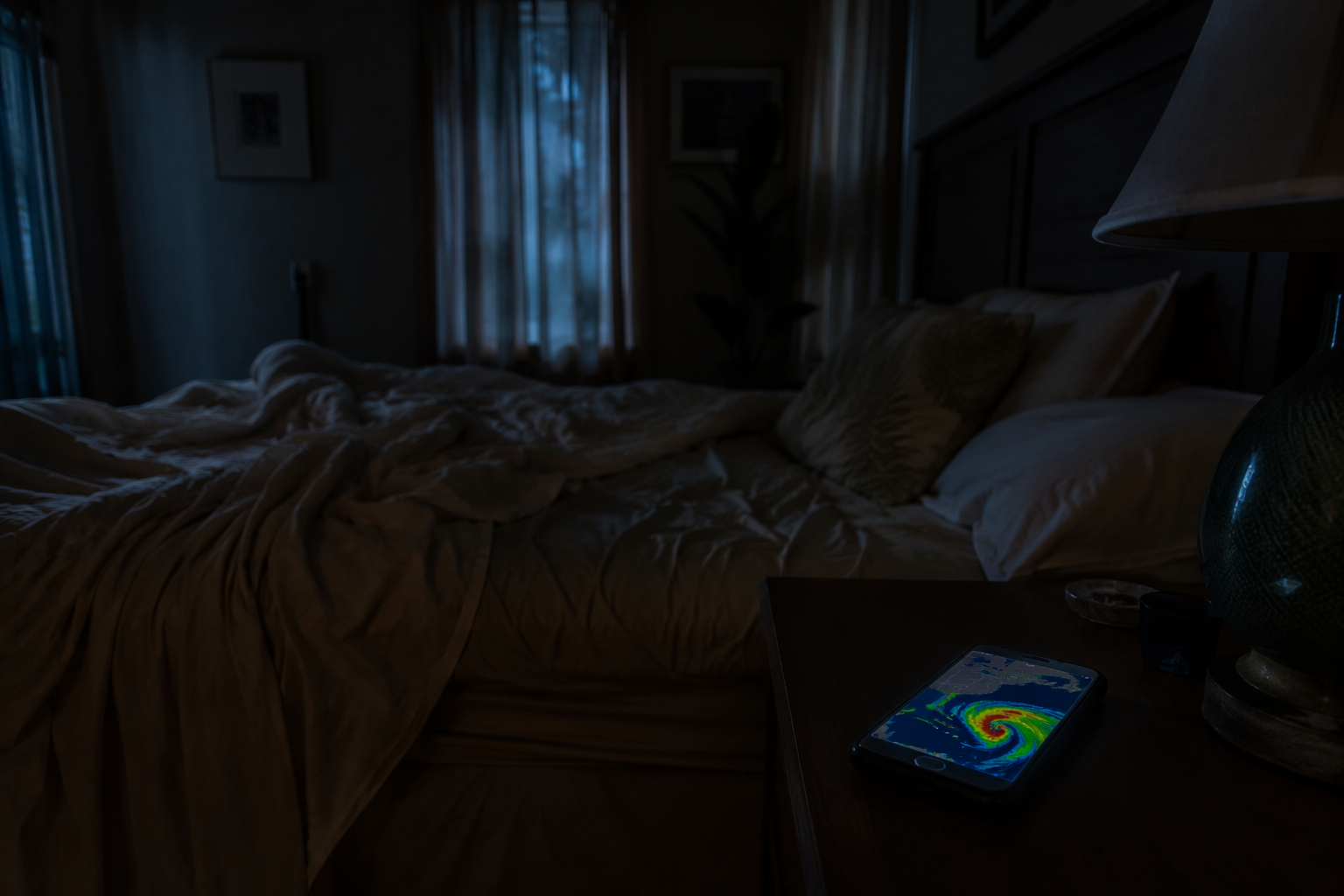
A 10% or 30% formation chance is a meteorological probability. It tells you something about whether a disturbance is expected to organize into a tropical cyclone within a defined forecast window. It does not measure whether your bedroom will be humid, whether your phone will keep lighting up, whether your past storm memories will become active, or whether your body will interpret the evening as safe enough for deep sleep.
That distinction matters because sleep is not just a reaction to objective danger. It is a state the brain permits when internal and external cues feel stable enough. A disturbance offshore can change those cues before it changes the official storm map. The air feels heavier. Rain bands start and stop. Local alerts become more frequent. One family member asks whether the generator has gas. Someone else says it is probably nothing. Both may be true, and neither settles the nervous system.
The mistake is treating the forecast percentage as if it should directly set the intensity of the body’s response. It rarely works that cleanly. A low-probability weather event can still carry high personal salience in a state where many residents have already lived through evacuation decisions, roof damage, flooding, power loss, insurance disputes, or the long sound of wind against windows.
The strongest pathway is psychological, but not imaginary
The most useful correction to the “you should be used to this by now” idea comes from research on repeated hurricane exposure. In a JAMA Network Open study of 1,637 Florida residents, Garfin and colleagues found that cumulative exposure to hurricanes was associated with greater mental health symptoms over time, not simple habituation [3]. In plain terms, living through more storms did not reliably make people calmer about the next one.
That finding fits what many people notice but hesitate to say: experience can sharpen vigilance. A person who has seen a “minor” forecast turn inconvenient, or an inconvenient storm turn destructive, may not respond to the next disturbance as a blank slate. The NHC update is not just new information. It can become a retrieval cue.
Sleep is especially vulnerable to that kind of cueing. After Hurricane Andrew, researchers found measurable differences in sleep among people exposed to the disaster, including links between REM sleep features and reexperiencing symptoms [4]. That is a more precise claim than saying storms make people “stressed.” It means disaster exposure can show up in the architecture of sleep itself, where memory, emotion, and threat processing are already active.
For some Floridians, a disturbance announcement starts a checking loop. The first check is reasonable: Where is it? What are the odds? Is my county in the rain forecast? The second check may still be reasonable, especially if the NHC has updated. By the fifth or sixth check, the phone is no longer just delivering information. It is training the brain to keep sampling for threat.
That loop has a sleep cost. More checking can raise arousal. Higher arousal makes body sensations louder. Louder body sensations make the next check feel necessary. A person lying in bed may then mistake normal nighttime awakenings for proof that something is wrong. The forecast has not changed, but the nervous system has.
This is where the language needs to stay calibrated. Ordinary storm-season vigilance is not the same as post-traumatic stress disorder, and one restless night during hurricane season is not chronic insomnia. At the same time, disaster-related sleep disruption is recognized by sleep medicine and mental health sources as a real consequence of catastrophic events, especially when people have direct exposure or repeated exposure [5].
Recent Florida storms have kept that distinction from being theoretical. Reporting after Hurricanes Helene and Milton described a visible mental health toll among residents dealing with repeated storm threats, displacement, damage, and recovery stress [6]. Those experiences do not disappear when the next advisory says “low chance.” They become part of the background against which the next advisory is read.
When vigilance crosses into clinical territory
A bad night after an NHC update can be normal. Repeated nightmares, panic that feels uncontrollable, avoiding sleep because dreams feel threatening, or insomnia that continues well after the weather threat has passed belongs in a different category. Clinical sources discussing hurricane trauma commonly describe significant PTSD symptoms among a substantial minority of directly affected people, with sleep disturbance among the core features [7]. The exact risk varies by exposure, prior trauma, losses, displacement, and support, so it should not be turned into a prediction for every resident.
The practical difference is duration and impairment. If storm-season alertness rises for a night and settles when the forecast settles, that is arousal doing what arousal does. If sleep remains broken, daily functioning drops, panic escalates, or the body reacts as if the storm is present long after the immediate threat is gone, professional support is not overreacting.
The body may be responding to the weather before the map looks serious
The physical side is harder to assess with the same confidence, because some claims about storm-related body changes are supported more indirectly than the hurricane-exposure research. Still, it is plausible that weather shifts around a tropical disturbance can add friction to sleep.
Barometric pressure is the most discussed mechanism. Secondary sleep-health summaries describe pressure drops before storms as a possible contributor to tissue expansion, nerve or joint irritation, headache, and changes in sleep-related hormones such as melatonin [8]. Those claims should be treated as plausible contributors rather than a simple formula. A pressure drop does not mean everyone will sleep poorly, and it does not prove that every ache or 3 a.m. awakening came from the atmosphere.
What matters for a sleeper is the accumulation of small irritants. A knee aches more than usual. Sinuses feel full. The room feels damp even with the air conditioner running. Daytime drowsiness appears, but nighttime sleep is shallow. None of these sensations has to be dramatic to matter. Sleep can be derailed by low-grade discomfort when the brain is already monitoring for threat.
Humidity deserves its own place in Florida. Heavy, wet air can make a bedroom feel less breathable and less thermally stable. For people with asthma, allergies, congestion, snoring, or sleep apnea risk, humidity and storm-related indoor conditions may increase awakenings or make sleep feel less restorative. The disturbance does not need to become a named storm for the sleeping environment to become harder to regulate.
The house changes before the storm arrives
The environmental pathway is less mysterious, and often underestimated. A disturbance near Florida changes the house. Not always dramatically, but enough.
| Cue | How it can disturb sleep |
|---|---|
| Intermittent heavy rain | Creates unpredictable noise that can repeatedly pull the brain toward lighter sleep |
| Humidity and indoor dampness | Makes temperature regulation harder and can worsen congestion or discomfort |
| Phone alerts and forecast updates | Interrupt wind-down and reinforce threat monitoring |
| Preparation tasks | Push chores, decisions, and family logistics into the evening |
| Power insecurity | Adds practical worry about cooling, medical devices, food, work, and communication |
Some of these cues are sensible. It is not irrational to charge devices, check flashlights, move patio furniture, or ask whether prescriptions are filled. The sleep problem begins when those tasks happen late, repeatedly, and without a stopping point. The bedroom becomes an extension of storm preparation.
Rain noise is a good example. Many people like steady rain at night. Tropical rain is not always steady. It can arrive in bands, slap windows, stop suddenly, then return hard enough to make the house sound different. That irregularity is more alerting than soothing, especially when the mind has already been told to watch the Gulf.
Why the three pathways reinforce each other
The most common mistake is looking for one cause. Was it anxiety? Was it pressure? Was it the rain? In real bedrooms, those lines blur.
A person notices a headache as pressure changes. Because an NHC disturbance is in the news, the headache feels less random. That interpretation raises arousal. Higher arousal makes the rain sound sharper and the phone harder to ignore. A late alert leads to another forecast check. The new forecast has not become alarming, but now the person is fully awake.
Someone with prior storm damage may follow a different route. The first update is manageable. Then a local post mentions flooded streets from a previous year. The body remembers the cleanup, the insurance calls, the smell of wet drywall, or the night without air conditioning. Bedtime arrives, and the person is not thinking in a dramatic way. The body is simply not convinced the night is safe.
This is why low odds can still produce a real sleep effect. The odds belong to storm formation. The sleep disruption belongs to a system made of memory, sensation, weather, household logistics, and uncertainty.
A calibrated way to handle the night
The answer is not to stop checking the weather. In Florida, that advice is too neat to be useful. The better question is when checking is serving preparedness and when it is feeding the loop.
- Check the official forecast at planned times, then let the next update wait unless an alert requires action.
- Move preparation earlier in the day: charging devices, checking supplies, clearing outdoor items, and confirming family plans.
- Separate “watching” from “winding down” by keeping radar loops and social feeds out of the last stretch before bed when possible.
- Treat body sensations as information, not proof of danger: discomfort can be real without being an emergency signal.
- If panic, nightmares, or insomnia persist after the weather threat passes, consider clinical support rather than trying to out-discipline the reaction.
Grounding can help when the nervous system is already activated. Baylor College of Medicine describes the 5-4-3-2-1 technique: name five things you can see, four you can touch, three you can hear, two you can smell, and one you can taste [9]. It is not a cure for hurricane season. It is a way to give the brain present-tense sensory evidence when it has started living in the forecast.
If your sleep breaks before a storm forms, that does not mean you are irrational. It means probability, memory, body state, and environment have reached the bedroom at the same time. Take the disruption seriously enough to reduce the loop, but not so catastrophically that one bad night becomes another threat to monitor.
References
- NHC disturbance off Florida's Gulf coast with 10%/30% formation odds, Orlando Sentinel, July 16, 2026
- NHC disturbance off Florida's Gulf coast with heavy rain forecast, WESH, July 2026
- Cumulative Exposure to Hurricanes and Mental Health in a Representative Sample of Florida Residents, JAMA Network Open, 2022
- Sleep and posttraumatic stress disorder in victims of Hurricane Andrew, PubMed
- Sleep problems after catastrophic events, American Academy of Sleep Medicine
- After Helene and Milton, mental health toll in Florida, NBC News
- Hurricane PTSD, Florida Coast Counseling
- How Barometric Pressure Affects Sleep, Amerisleep
- How to cope with pre-storm anxiety, Baylor College of Medicine
Comments
Join the discussion with an anonymous comment.