
Trazodone occupies an odd place in adult insomnia care. It is not approved by the FDA as an insomnia drug, yet it has become the most frequently prescribed medication for insomnia in the United States: one analysis found that trazodone accounted for 26% of insomnia prescriptions, compared with 20% for zolpidem, and low-dose trazodone dispensing among adults under 65 rose 85.6% from 2011 to 2018.[1]
That would be less troubling if the evidence were merely incomplete but leaning favorable. It is not. The American Academy of Sleep Medicine guideline recommends that clinicians not use trazodone for sleep-onset or sleep-maintenance insomnia in adults.[2] The American College of Physicians also placed cognitive behavioral therapy for insomnia, not medication, as the initial treatment for chronic insomnia.[3] A Cochrane review found no significant difference in sleep efficiency compared with placebo, and an AAFP review of seven randomized controlled trials involving 429 adults found fewer nocturnal awakenings but no improvement in total sleep time, sleep efficiency, or sleep latency.[4][5]
So the practical question is not whether trazodone can ever make someone drowsy. It plainly can. The question is whether that drowsiness translates into reliable, meaningful sleep improvement without leaving the patient paying for it the next morning.

Why trazodone became the workaround
The popularity is not hard to understand. Trazodone is generic, familiar, inexpensive, and not scheduled as a controlled substance. It does not carry the same cultural alarm as benzodiazepines, and it is not one of the Z-drugs that many clinicians have learned to approach carefully, especially in older adults.
That makes it attractive in the exam room. A patient has not slept. The clinician wants to avoid a medication with obvious dependence concerns. The pharmacy can fill trazodone cheaply. The prescription feels conservative.
But “not controlled” is not the same as “low risk,” and “not a benzodiazepine” is not a sleep outcome. This is where the shortcut becomes easy to miss. A medication can avoid one category of harm and still create another: unsteadiness when standing, next-day fog, slowed reaction time, or a fall in a person who already had little margin for error.
Dose also matters for how people talk about the drug. For insomnia, trazodone is commonly used at lower doses such as 25 to 100 mg; for depression, antidepressant dosing is much higher, often described in the range of 150 to 600 mg.[6] That distinction prevents one kind of confusion, but it should not create another. A lower insomnia dose may reduce some risks, but it does not erase next-day impairment.
The evidence problem is bigger than one disappointing trial
Guidelines do not reject trazodone for chronic insomnia because a single study looked bad. They reject it because the benefits that matter most to patients have not been shown convincingly enough: falling asleep faster, staying asleep longer, improving sleep efficiency, and waking with better function rather than just more sedation.
The AASM guideline judged the evidence insufficient to support trazodone for either sleep-onset or sleep-maintenance insomnia.[2] Cochrane’s review found no significant improvement in sleep efficiency compared with placebo, while also noting that the evidence base was low quality and heterogeneous.[4] The AAFP review found a narrower signal: fewer nocturnal awakenings, but no improvement in total sleep time, sleep efficiency, or sleep latency.[5]
That narrower signal matters. If someone wakes less often but does not sleep longer, fall asleep faster, or function better the next day, the result may not match what they thought they were being prescribed. Insomnia treatment should not be judged only by whether a drug produces heaviness at bedtime.
A 2023 clinical appraisal by seven sleep specialists from Stanford, Harvard, Northwestern, and UCSF captured the divide neatly: after reviewing the evidence, five of seven agreed trazodone should not be first-line for insomnia, yet 67% of surveyed clinicians disagreed.[7] The appraisal itself should be read with a caveat because it was funded by Idorsia Pharmaceuticals, which makes daridorexant. Still, the split it describes fits the larger pattern: routine use has outpaced the evidence.
For readers trying to place trazodone among broader insomnia options, the more useful comparison is not “trazodone versus nothing.” It is where trazodone sits in the treatment hierarchy alongside CBT-I and guideline-supported medication choices. A broader overview of CBT-I, sleep medication, or both is the right place to start when the problem is chronic insomnia rather than a short, situational sleep disruption.
The adult risk picture starts the next morning
The most ordinary trazodone risks are not dramatic, but they are exactly the kind that change a morning. StatPearls describes common dose-dependent adverse effects including drowsiness, dry mouth, and orthostatic hypotension, with the blood-pressure effect related to alpha-1 adrenergic blockade.[6]
Orthostatic hypotension means blood pressure can drop when a person stands. In a chart, that is a side effect. In a bedroom at 5:40 a.m., it is the few seconds between sitting up and finding the floor with one foot. Add residual drowsiness, a dark hallway, a bathroom trip, or bifocals on the nightstand, and the “gentle” sleep prescription begins to look less gentle.
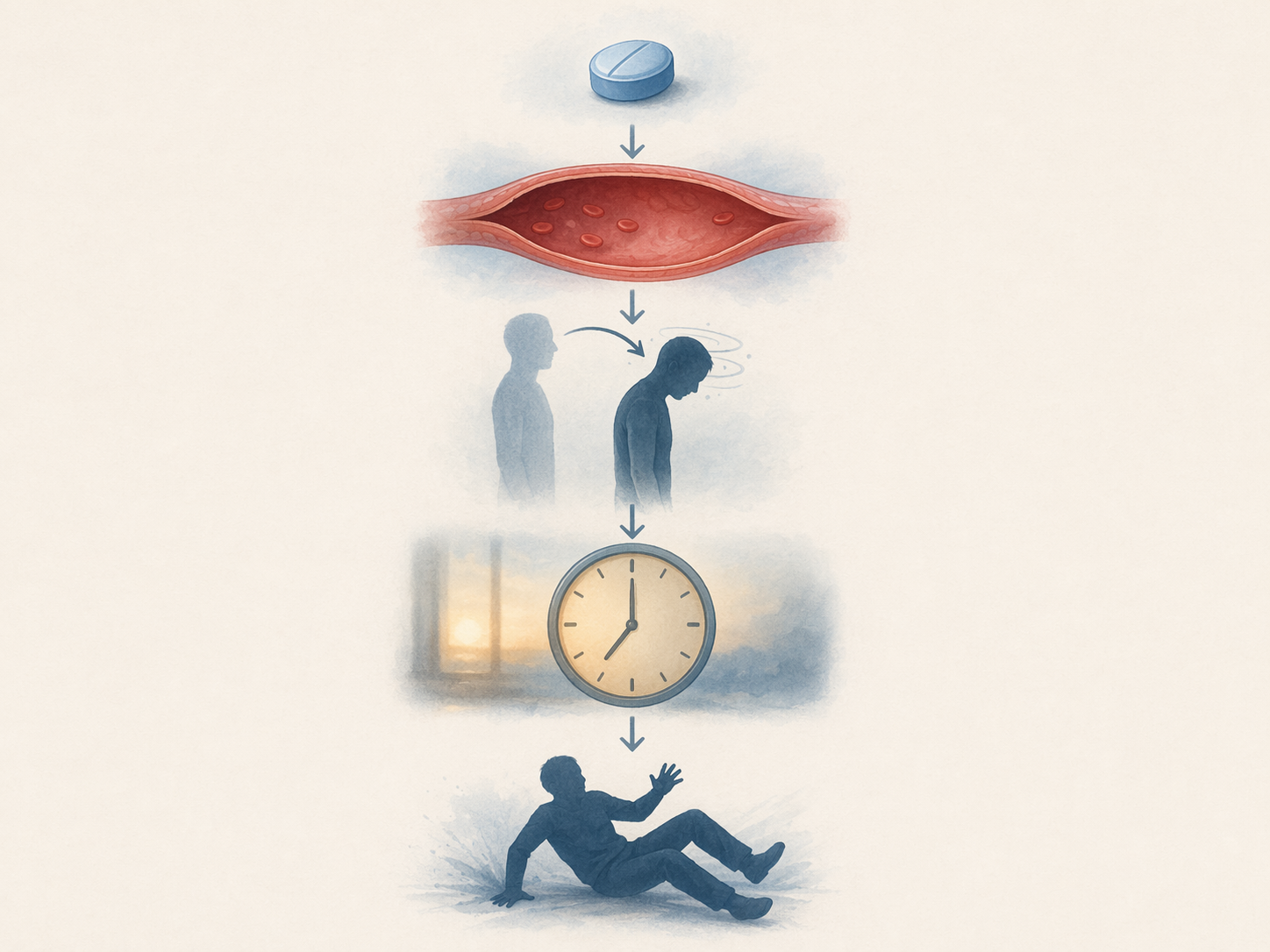
Low-dose use does not remove the concern. A double-blind study of adults with primary insomnia found that 50 mg trazodone produced cognitive and motor impairments that persisted at three weeks.[8] That is the kind of finding patients may misread in real life. They may blame the insomnia, aging, stress, or a bad night, when part of the morning fog may be pharmacologic.
| Risk adults notice | Why it matters |
|---|---|
| Morning grogginess | Can blur whether the person is still sleep-deprived or medication-impaired |
| Orthostatic symptoms | Can make standing from bed or a chair feel lightheaded or unstable |
| Cognitive and motor slowing | Can affect driving, work tasks, balance, and reaction time |
| Falls | Can turn a sleep prescription into an injury risk, especially in older adults |
Falls are the safety signal that should slow the prescription down
The most concrete safety anchor comes from older adults. A 2022 retrospective cohort study in BMC Geriatrics examined 1.7 million Medicare beneficiaries with a mean age of 75. Trazodone was associated with 5.27 falls per 100 person-years, higher than zolpidem immediate-release at 2.99 and comparable to benzodiazepines at 3.85. Compared with matched controls, trazodone had an adjusted odds ratio of 2.34 for falls.[9]
That study cannot prove trazodone caused the falls. It was retrospective and observational, and residual confounding is possible: people prescribed trazodone may have differed from controls in illness severity, frailty, psychiatric comorbidity, or other factors not fully captured in claims data. That caveat is important. It is also not a reason to wave away the signal.
The same study reported that all-cause mortality among insomnia-treated patients who fell was highest in the trazodone group, at 0.4%.[9] Again, association is not causation. But for an older adult, the relevant clinical question is rarely “Can we prove the pill caused this fall?” It is “Was this person already vulnerable enough that adding a sedating, blood-pressure-lowering drug made the morning more dangerous?”
This is why trazodone deserves the same careful conversation as other sedating sleep medications in later life. The safer label often attached to it is too blunt. For older adults or anyone with prior falls, low blood pressure, balance problems, nighttime bathroom trips, neuropathy, sedating co-medications, or alcohol use, the practical risk is not theoretical.
Older patients and caregivers may also need a wider deprescribing conversation, especially when a medication started as a short-term workaround has become a standing nightly habit. The case for deprescribing sleep medication in older adults applies to trazodone as much as to drugs with more familiar reputations.
The rarer risks should be mentioned, not inflated
Trazodone also carries less common but serious risks. StatPearls lists priapism, estimated at about 1 in 1,000 to 1 in 10,000, QT prolongation especially in overdose, serotonin syndrome, and the FDA boxed warning for suicidal thinking in young adults.[6]
These are not the main reason most adults should pause before using trazodone for chronic primary insomnia. For day-to-day prescribing, the more common problems—drowsiness, orthostatic hypotension, cognitive slowing, and falls—usually carry the heavier practical weight. But the rarer risks are a reminder that trazodone is still an antidepressant with systemic effects, not a neutral sleep supplement.
When trazodone may still be a reasonable choice
The evidence against routine trazodone for chronic primary insomnia should not be stretched into a rule that no patient should ever receive it. The better distinction is whether insomnia is the main diagnosis being treated, or whether the sleep complaint is part of a broader psychiatric picture where trazodone has a more coherent role.
- Comorbid depression with insomnia, when an antidepressant effect is part of the treatment goal.
- Depression-related insomnia in a patient already using an SSRI or SNRI, when the prescriber is deliberately managing both mood and sleep symptoms.
- PTSD-related nightmares or sleep disturbance, where the clinical context differs from uncomplicated chronic insomnia.
Those lanes still require monitoring. A reasonable prescription is not the same as an unattended prescription. The patient should know what benefit is being sought, what adverse effects would count as a reason to stop or change course, and when the medication will be reassessed.
For a person with chronic primary insomnia and no depression, PTSD-related nightmares, or related indication, the burden of justification is higher. Guideline-supported options and behavioral treatment belong in the decision before routine off-label trazodone. For a broader map of medication choices, an evidence-tier approach to choosing home medicine for sleep is more useful than sorting drugs by how harmless they sound.
What to ask before taking trazodone for sleep
The most useful conversation is specific. “Is trazodone safe?” is too broad. “Why trazodone for me, given my diagnosis and risks?” is harder to dodge and more likely to produce a real plan.
- Why is trazodone being chosen instead of CBT-I or another guideline-supported insomnia treatment?
- Is the prescription mainly for insomnia, or is depression, SSRI/SNRI-related insomnia, or PTSD-related sleep disturbance part of the reason?
- What fall risks apply: age over 65, prior falls, low blood pressure, nighttime bathroom trips, balance problems, alcohol use, or other sedating medications?
- What should count as next-day impairment: grogginess, slowed thinking, dizziness on standing, unsafe driving, or unsteadiness?
- When will the dose, benefit, side effects, and need for continuing be reassessed?
For most adults with chronic primary insomnia, trazodone should not be the first stop. Its widespread use reflects convenience and familiarity more than strong insomnia evidence. If it is used, the prescription should be narrow, explained, monitored, and revisited—especially when the person taking it is the one who has to stand up in the dark the next morning.
References
- Assessment of Trends in the Prescription of Medications Used for Insomnia in the United States, 1999-2018. JAMA Internal Medicine. 2020.
- Clinical Practice Guideline for the Pharmacologic Treatment of Chronic Insomnia in Adults: An American Academy of Sleep Medicine Clinical Practice Guideline. American Academy of Sleep Medicine. 2017.
- Management of Chronic Insomnia Disorder in Adults: A Clinical Practice Guideline From the American College of Physicians. American College of Physicians. 2016.
- Trazodone for insomnia in adults. Cochrane Database of Systematic Reviews. 2018.
- Is trazodone effective and safe for treating insomnia?. American Family Physician. 2023.
- Trazodone. StatPearls. 2024.
- Should Trazodone Be First-Line Therapy for Insomnia? A Clinical Suitability Appraisal. Journal of Clinical Medicine. 2023.
- Trazodone in primary insomnia: a double-blind, placebo-controlled study. Journal of Clinical Sleep Medicine. 2011.
- Falls, healthcare resources and costs in older adults with insomnia treated with zolpidem, trazodone, or benzodiazepines. BMC Geriatrics. 2022.


Comments
Join the discussion with an anonymous comment.