
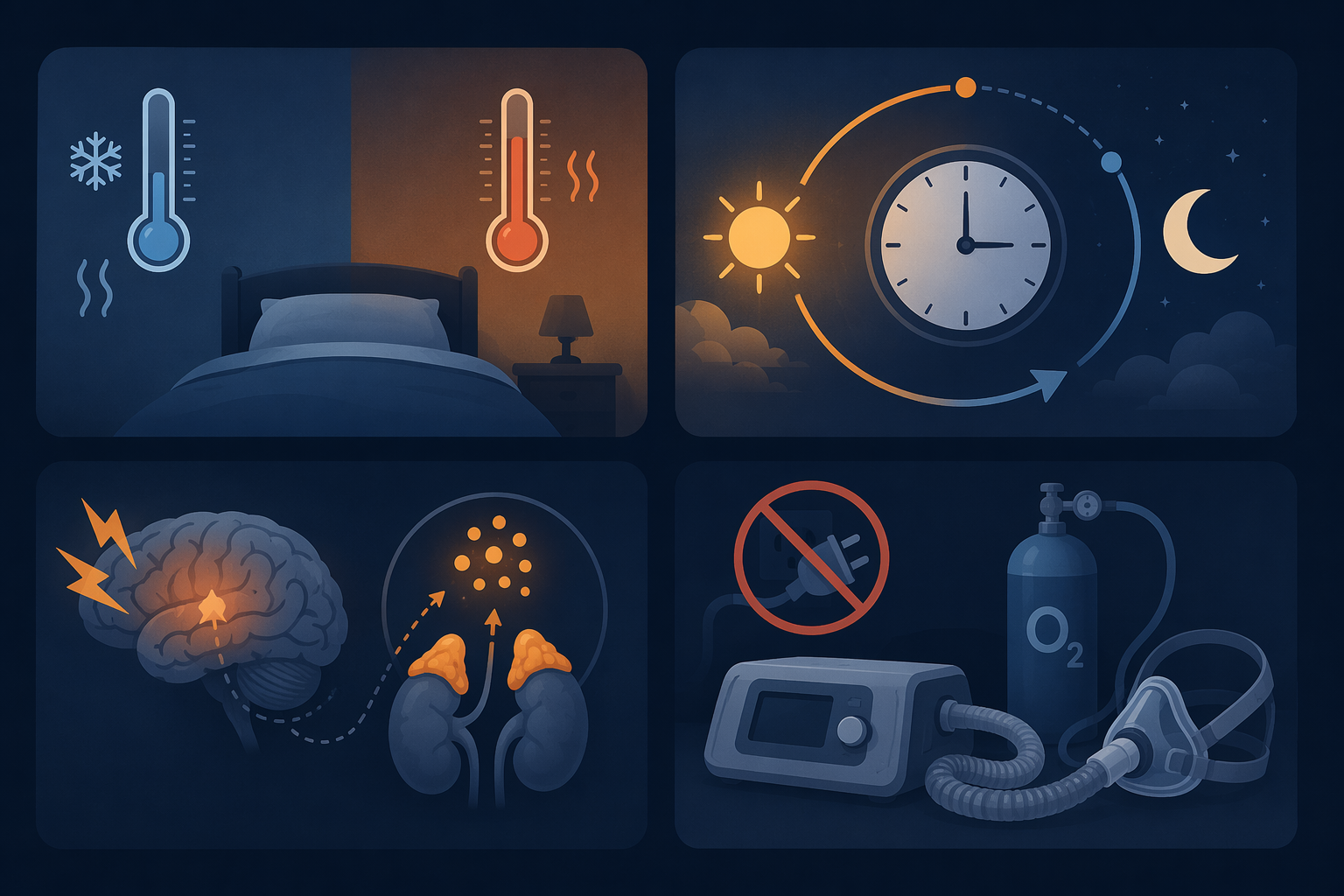
If a storm, equipment failure, or local grid problem caused a power outage today, the sleep impact is usually not just “worrying in the dark.” A blackout can disturb sleep through four overlapping routes: the room stops helping your body cool down, light cues change abruptly, stress chemistry rises, and powered medical devices may stop working. A narrative review on power outages and sleep describes these same pathways: temperature disruption, circadian disruption, stress-related arousal, and interruption of electricity-dependent health equipment.[1]
That distinction matters at 2 a.m. because each route calls for a different response. If the room is hot and airless, a calming exercise will not fix the heat load. If someone uses CPAP, oxygen, or another powered device, a paperback and a flashlight are not enough. And if the room is comfortable but your body is still on alert, the problem may be the stress system rather than the mattress.
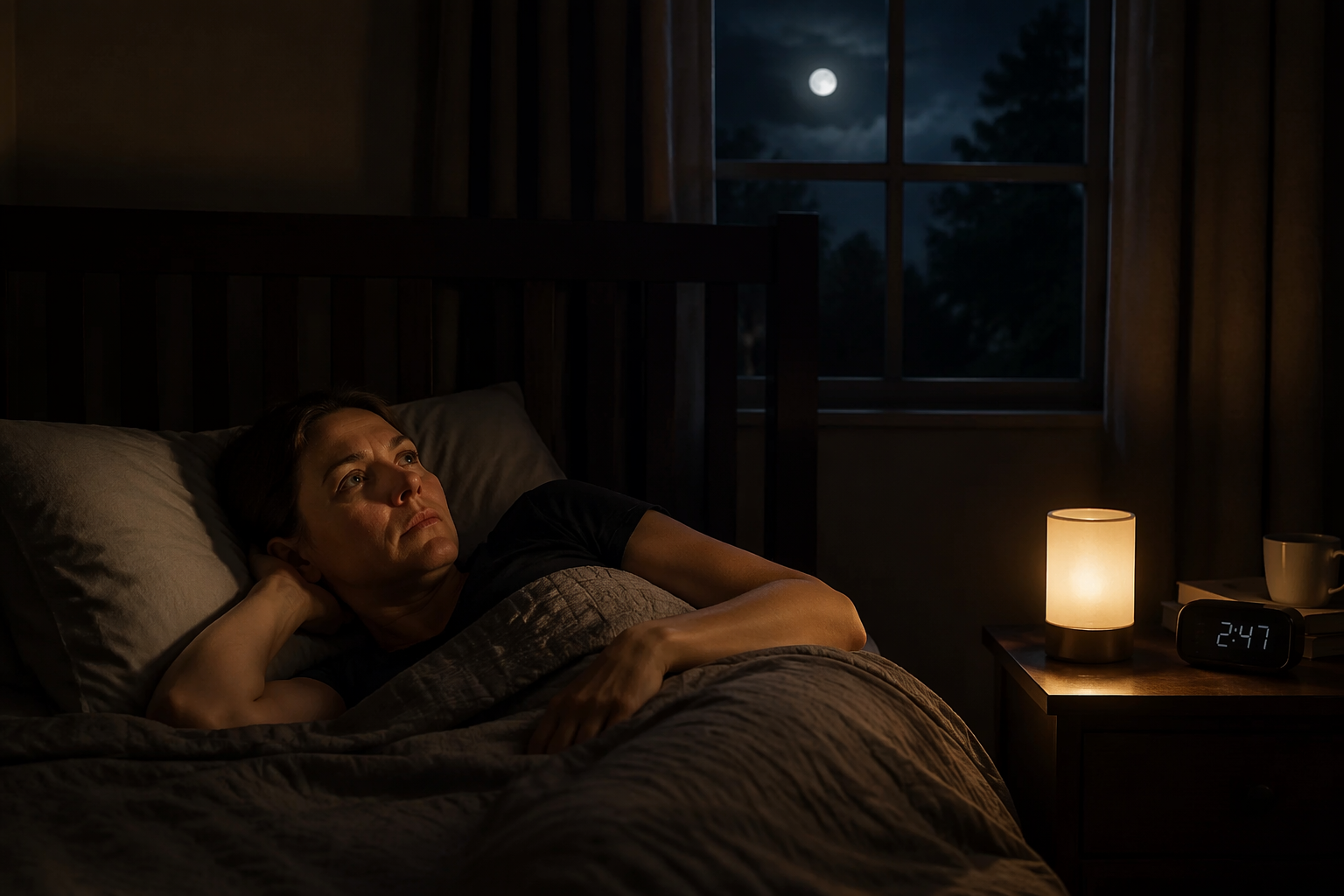
First, rule out the kind of sleep problem that is not safe to sleep through
A power outage becomes medically urgent when sleep depends on equipment that needs electricity: CPAP or BiPAP machines, oxygen concentrators, nebulizers, suction devices, electric beds, refrigeration for some medicines, or charging for mobility and communication devices. In New York City, 7.6% of households reported using electric medical equipment, which is a reminder that “the lights went out” is a health-access issue for many homes, not only an inconvenience.[2]
If breathing support is affected, do not treat the night as an insomnia experiment. Use the backup power source if it is available, switch to an approved alternate power option, contact the equipment supplier or clinician if you have instructions to do so, and seek emergency help if breathing becomes difficult, oxygen needs cannot be met, or the device user is becoming confused, unusually sleepy, or distressed. The Centers for Disease Control and Prevention advises people who rely on battery-dependent assistive technology or medical devices to have a power-outage plan and to contact local health departments, fire departments, or emergency medical services when help is needed.[3]
The four pathways behind blackout insomnia
| Pathway | What changes during an outage | What to try tonight |
|---|---|---|
| Temperature dysregulation | Heating, cooling, fans, or ventilation stop supporting the normal pre-sleep body-temperature drop. | Move to the most stable room, adjust bedding by layer, cool skin safely in heat, and conserve warmth in cold. |
| Circadian misalignment | Normal evening light cues disappear or are replaced by harsh flashlights and phone screens. | Use dim warm light for necessary tasks, then protect darkness when you are ready to sleep. |
| Stress-induced arousal | Uncertainty, noise, heat, caregiving duties, and safety checks activate alertness. | Reduce unknowns, assign tasks, use slow breathing, and choose a low-stimulation routine. |
| Medical-device failure | CPAP, oxygen, nebulizers, or other devices may stop, shortening or endangering sleep. | Use backup power, lower optional power draw when approved, and escalate quickly if breathing support is compromised. |
These pathways often arrive together. A warm bedroom can make a person restless, restlessness can raise anxiety, anxiety can make every sound from the street feel important, and one adult may be trying to solve all of this while checking on a child, an older relative, or a device battery. The research does not give a clean percentage for how much each mechanism contributes in a given home, so the useful move is to identify the dominant pathway and act there first.
Temperature: when the room stops cooperating
Sleep onset depends partly on a small drop in core body temperature. The power-outage sleep review describes a roughly 1°F decline in core temperature as part of the normal transition into sleep; when HVAC, fans, or safe ventilation fail, the bedroom may stop supporting that drop.[1] In summer, the body is trying to release heat into a room that may be getting warmer and more humid. In winter, the problem reverses: cold stress can keep the body working to preserve heat instead of settling.
Hot-weather countermeasures should focus on reducing heat stored near the body, not creating a perfect bedroom. Move to the lowest safe level of the home if it is cooler, or to an interior room that has held a steadier temperature. Open windows only if outdoor air is cooler and safe; otherwise, trapping hotter outdoor air can make the room worse. Use loose, breathable sleepwear, remove unnecessary bedding, and consider a damp sheet or cloth on the skin if the air is not so humid that evaporation becomes useless. Amerisleep’s outage guide also recommends approaches such as damp-sheet cooling and choosing an interior-room setup when electricity is unavailable.[4]
In cold weather, the task is to create a small warm zone without overheating or introducing unsafe combustion. Layer bedding instead of using one heavy cover, because layers can be removed as the night changes. Keep socks or an extra layer near the bed; warming the feet can help some people feel ready for sleep because distal warmth supports heat redistribution away from the body core. A hot-water bottle can help if it is safely filled, sealed, wrapped, and kept away from anyone who cannot move it independently; the same Amerisleep guide notes hot-water-bottle use as one low-tech option during outages.[4]
The uncomfortable middle ground is often the hardest: the bedroom is not dangerously hot or cold, but it is stale, heavy, and wrong. In that case, do not keep fighting the original sleep setup out of habit. Move the mattress, sleep on a lower floor, split up household members by thermal need, or use a living room that holds temperature better. The goal is not elegance; it is reducing the physical signal that keeps the brain monitoring the room.
Light cues can help or disorient
A blackout changes light timing abruptly. That can be helpful if the usual evening is full of bright overhead light and phone scrolling; complete darkness is one of the cues that supports circadian timing. But outages rarely deliver peaceful darkness only. They also bring flashlights in the hallway, phone screens used as work lights, emergency vehicle lights outside, and repeated checks of utility updates.
Light affects the circadian system through the brain’s timing center, the suprachiasmatic nucleus. The Sleep Foundation notes that blue light exposure in the evening can delay melatonin production by about 30 to 90 minutes, while darkness helps signal that it is time for sleep.[5] During an outage, the mistake is often using the brightest, bluest available light for every task and then expecting the body to fall asleep immediately afterward.
Use light in two modes. For safety tasks, use enough light to prevent falls, medication errors, or device mistakes. For sleep tasks, switch to the dimmest warm light that works: a warm battery lamp, a flashlight bounced off a wall, or a headlamp angled away from faces. If a phone must be used, reduce brightness, use a warmer display setting if available, and avoid letting it become the household lantern.
This is where the blackout paradox belongs. If the room is temperate, everyone feels safe, and no one is waiting on medical equipment, the sudden absence of artificial light may help some people sleep. That does not make outages good sleep medicine. It means the light pathway can sometimes improve while the temperature, stress, or device pathway worsens.
Stress: when the body stays on watch
The stress pathway is not imaginary, and it is not solved by being told to relax. A power outage removes control: you may not know how long it will last, whether the basement is taking water, whether the phone will hold a charge, whether the food is safe, or whether someone’s device battery will make it through the night. The Casey review identifies stress-related activation as one way outages can disturb sleep, including activation of the hypothalamic-pituitary-adrenal axis, the system involved in cortisol release and physiological alertness.[1]
A clinical observation from the IIS Sleep Institute after the April 28, 2025 Iberian blackout reported an insomnia spike associated with anxiety reactivity after the event.[6] That observation should not be stretched into a universal rule that every blackout causes insomnia, but it fits what many people recognize: once the house feels uncertain, the brain starts treating bedtime as a monitoring shift.
The fastest non-electric intervention is to reduce uncertainty in a visible way. Decide who is checking the utility update and when. Put the flashlight in the same place each time. Set aside water, medication, device cords, and shoes before trying to sleep. If children are awake, give them a simple script: the power is out, the adults have checked the important things, and the next check is at a set time. This does not remove the outage; it stops the brain from reopening the whole problem every few minutes.
For the body itself, choose a routine that lowers stimulation without pretending nothing is wrong. Slow breathing with a longer exhale, a familiar paperback, a quiet audio file if battery life allows, or a repeated flashlight-and-book routine can give the nervous system something predictable. Avoid turning the outage into a rolling household conference unless a real safety decision is needed. One adult can take the next watch; everyone else does not have to remain chemically awake with them.
Medical devices: when the bedside machine goes quiet
Medical-device interruption is the pathway with the least room for improvisation. CPAP therapy may prevent repeated airway collapse in obstructive sleep apnea; oxygen concentrators and nebulizers may be part of respiratory disease management; other devices may support mobility, communication, or medication safety. The sleep effect can be immediate, but the risk is broader than poor sleep.
Casey et al. cite evidence that chronic obstructive pulmonary disease hospitalizations increased by 23% during power outages, underscoring why respiratory vulnerability changes the stakes of a blackout night.[1] This does not mean every CPAP user will have an emergency during every outage. It does mean households with respiratory equipment need a more serious plan than “try to sleep without it.”
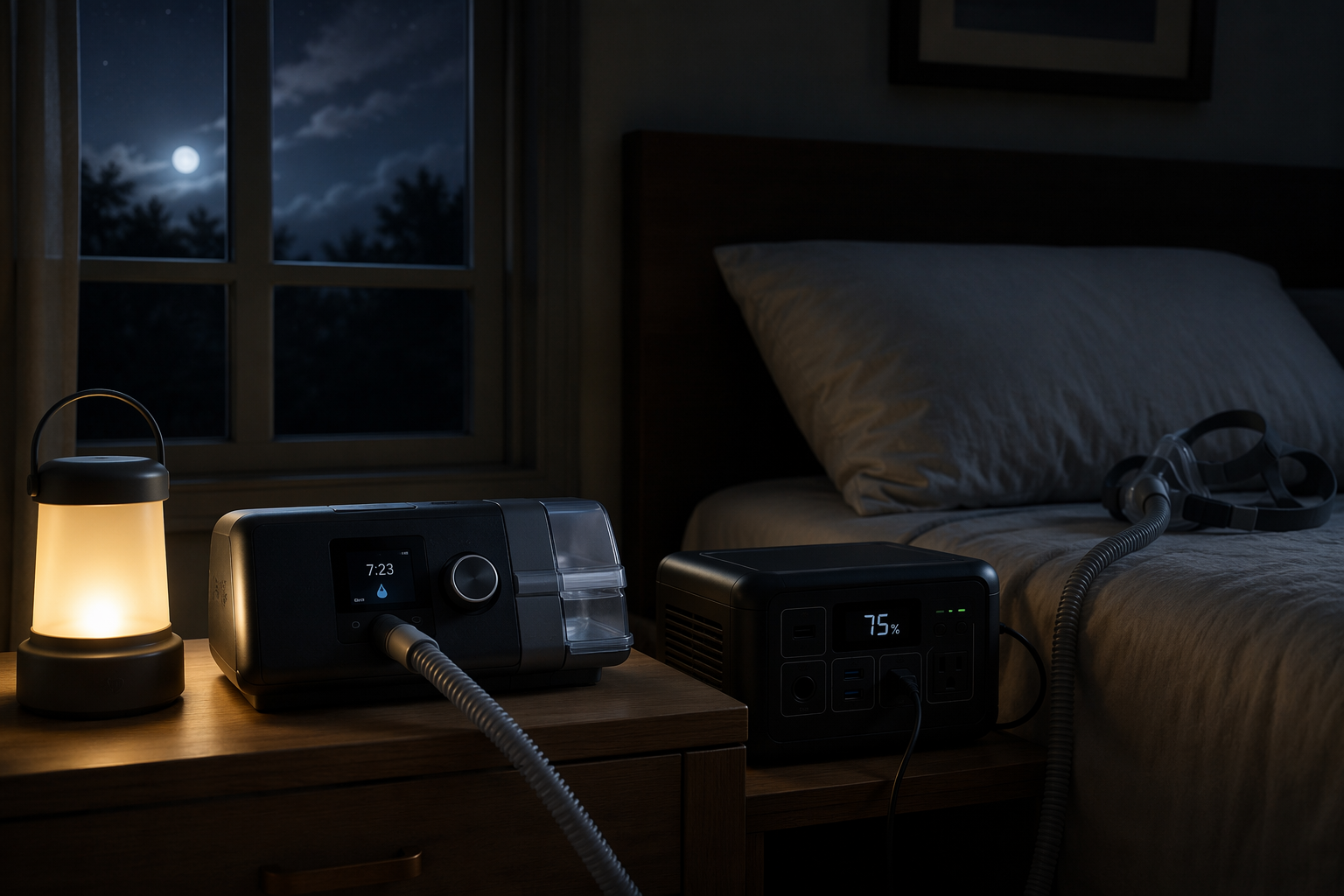
For CPAP users, the practical hierarchy is straightforward: use a manufacturer-compatible battery or power station if available; use a DC car adapter only if it is approved for the machine and the setting is safe; preserve charge by disabling nonessential power draws if that is appropriate for your therapy. Aeroflow Sleep reports that turning off heated humidification can extend CPAP battery life from about 8 hours to 10 to 12 days, depending on the setup and battery.[7] That range is large because devices, pressures, batteries, and humidifier settings differ, so it should be treated as planning guidance, not a guaranteed runtime.
Do not run fuel-burning generators indoors, in garages, or near windows to power sleep equipment. Do not use a car as a power source in an enclosed space. If the only way to run a breathing device creates carbon monoxide risk, it is not a safe workaround. The CDC’s outage guidance emphasizes carbon monoxide prevention and safe generator use, along with planning for medical-device power needs.[3]
If there is no safe backup and the device is medically necessary, the next step is escalation, not endurance. Call the equipment provider’s emergency line if one exists, contact local emergency services or a local health department resource, or relocate to a powered site if that is part of the household’s plan. The person who needs the device should not be left to “see how the night goes” while everyone else tries to sleep.
Why this deserves a household sleep plan, not just a storm plan
It is tempting to treat a blackout night as rare and therefore not worth planning around. The trend argues against that. SunergyHub, summarizing U.S. outage data, reports that average outage duration reached about 11 hours per customer in 2024, up from about 5.5 hours in 2022; it also reports that weather caused about 80% of outages and that outage frequency doubled from 2000–2009 to 2014–2023.[8] Climate Central similarly reports that weather-related power outages are rising in the United States.[9]
Those numbers are context, not a prediction for tonight. Your local outage may last 20 minutes or through the morning. But sleep planning changes when overnight outages are plausible rather than exceptional: the bedside battery, the warm lamp, the printed device instructions, the car adapter, the extra blanket, and the known cooler room become health tools, not prepper theater.
Preparedness is also uneven. The New York City data story notes that only 58% of U.S. households have basic outage preparedness.[2] A household can be generally competent and still not have the one thing that matters at midnight: the correct CPAP cable, charged battery, non-blue light source, or safe plan for a medically fragile sleeper.
A practical plan for tonight
Start with the pathway that carries the highest consequence, not the one that is most annoying. If a medical device has stopped and the person depends on it for breathing, oxygen, medication delivery, or safe positioning, solve that first. If no device is involved, look at the body: too hot, too cold, too much light at the wrong time, or too much alertness.
- If temperature is the problem: move rooms, adjust layers, cool skin safely in heat, or create a warmer microclimate in cold.
- If light timing is the problem: use dim warm light for tasks, avoid bright phone light, and return to darkness when ready for sleep.
- If stress is the problem: assign the next check, put essentials in one place, and use a quiet routine that does not keep restarting the emergency.
- If equipment is the problem: use approved backup power, conserve optional power draw when appropriate, and escalate if breathing support cannot continue safely.
One poor night of sleep is usually recoverable, but sleep disruption has real short- and long-term health consequences when it becomes repeated or severe.[10] After the power returns, make one upgrade while the memory is still specific: charge the battery pack, label the CPAP adapter, place a warm-light lamp by the bed, move extra bedding where it can be found in the dark, or write the phone number for the device supplier on paper. The next outage does not need to find the household solving the same problem from zero.
References
- Power Outages and Community Health: a Narrative Review, PMC
- Power outages, NYC Health
- What to Do to Protect Yourself During a Power Outage, Centers for Disease Control and Prevention
- How to Sleep Comfortably Without Electricity, Amerisleep
- Light and Sleep, Sleep Foundation
- Cómo el apagón del 28 de abril afectó al sueño, IIS Sleep Institute
- 5 Ways to Power Your CPAP Machine When the Power Goes Out, Aeroflow Sleep
- Blackout Statistics, SunergyHub
- Weather-Related Power Outages Rising, Climate Central
- Short- and long-term health consequences of sleep disruption, PMC
Comments
Join the discussion with an anonymous comment.