
A bottle can say “natural medicine for sleep” and still leave the most important questions unanswered. Was this product reviewed before it reached the shelf? Does each tablet contain the dose on the label? Is it meant for the kind of sleep problem you actually have, or only for a narrower problem that sounds similar at 10 p.m.?
That is the part the front label rarely clarifies. “Natural” is a marketing word, not a regulatory guarantee. In the sleep aisle, products that sit a few inches apart may belong to very different legal categories: prescription sleep drugs, over-the-counter sleep drugs, and dietary supplements. They are not checked the same way before sale, and the difference is not academic when the product is something you swallow before becoming unconscious for several hours.

Three Sleep Products, Three Different Levels of Checking
The cleanest way to read a sleep-aid label is to stop with the mood words and first identify the category.
| Product category | What it usually means | What to watch |
|---|---|---|
| Prescription sleep drugs | FDA-approved drugs reviewed for safety and effectiveness for specific uses before marketing. | They can still cause side effects, dependence concerns, next-day impairment, and interactions; approval is not the same as harmless. |
| OTC sleep drugs | Nonprescription drugs such as doxylamine or diphenhydramine that are handled through FDA monograph standards for recognized active ingredients and manufacturing expectations. | They have a longer regulatory and safety history than many supplements, but they are not ideal for everyone and can be inappropriate for some people. |
| Dietary supplements | Products such as many melatonin, valerian, ashwagandha, magnesium, and blended “sleep support” formulas sold without FDA pre-approval for effectiveness. | The manufacturer is responsible for safety and labeling; dose accuracy and benefit are not verified by FDA before the bottle reaches the shelf. |
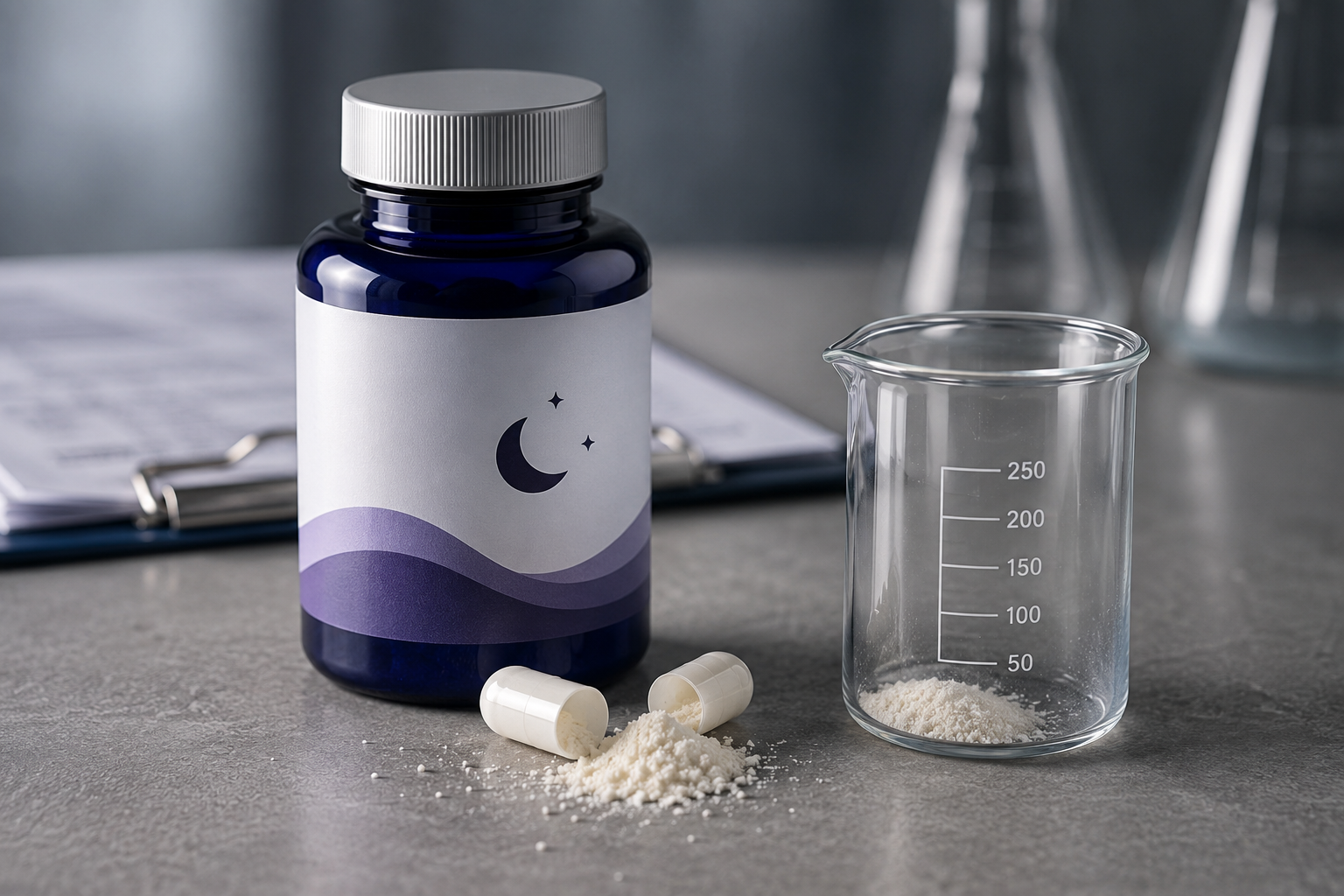
That third category is where many “natural” sleep aids live. The FDA can act after problems appear, and manufacturers are still legally responsible for what they sell. But that is not the same as a pre-sale review showing that the product works for insomnia, that the stated dose is accurate, or that the finished bottle has been independently tested before you buy it. Johns Hopkins Medicine and Harvard Health both warn that melatonin supplement content has been found to vary sharply from the amount printed on the label, with products ranging from 83% less to 478% more than labeled.[1][2]

That number does more than make a regulatory point. It changes the physical reality of the dose. A shopper may think they are choosing a low-dose melatonin tablet and instead get much less, or several times more, than expected. If the product also contains other sleep-support ingredients, the front label may be even less useful than it looks.
What FDA Does Not Check Before a Supplement Is Sold
A dietary supplement does not need FDA approval for insomnia, sleep quality, sleep onset, or nighttime relaxation before it appears online or in a pharmacy. The company can sell it as long as it follows supplement rules, avoids disease-treatment claims, and includes the familiar disclaimer that the statement has not been evaluated by the FDA when making structure-function claims.
That disclaimer is easy to ignore because it is printed like legal wallpaper. It matters. A phrase such as “supports restful sleep” is not the same as “treats chronic insomnia,” and it does not mean the agency has reviewed clinical trial evidence for that finished product. The burden starts with the manufacturer, not with an FDA reviewer looking at the product before it reaches the aisle.
This is why two bottles with the same ingredient can deserve different levels of trust. One may have been tested by an independent program for identity, strength, and contaminants; another may rely entirely on the brand’s own quality controls. The words “natural,” “plant-based,” “non-habit forming,” or “clinically studied ingredient” do not answer the dose-accuracy question.
Third-party verification is the practical workaround, not a perfect substitute for drug approval. USP, ConsumerLab, and NSF testing can help identify products whose labels more reliably match their contents. But participation is voluntary. A verified seal can be meaningful; the absence of a seal does not automatically prove a product is bad, and the presence of a pretty badge that merely resembles a verification seal is not enough. The useful question is specific: who tested this finished product, and what did they test for?
The consumer-protection gap is not the same as proof that every supplement is dangerous. A 2025 scoping review of 51 randomized controlled trials on over-the-counter products for insomnia found that most products showed mild, transient side effects during short-term use, while also noting that long-term safety data remains thin, especially across herbal sleep supplements.[3] That is the sober version of the problem: not panic, not reassurance, but uncertainty shifted toward the buyer.
Melatonin Is Common, but Its Best Use Is Narrower Than Its Popularity
Melatonin is the ingredient most likely to blur the line between a supplement and a sleep drug in people’s minds. It sounds familiar, the body makes it, and the bottles are often cheap. Nearly two-thirds of American adults have tried melatonin, according to Sleep Foundation reporting from 2025.[4] That level of use can make the product feel settled.
The evidence is more selective. The American Academy of Sleep Medicine distinguishes chronic insomnia from circadian rhythm sleep-wake problems; its public guidance says melatonin is not recommended for chronic insomnia, while melatonin may have a role for certain circadian rhythm disorders.[5] That distinction is easy to lose on a label that says “sleep support.” A person whose sleep schedule is shifted is not necessarily in the same situation as a person who lies awake for months despite adequate opportunity to sleep.
Dose makes the mismatch worse. If a product’s actual melatonin content can run far below or far above the stated amount, then even a careful buyer may not be repeating the same experiment from night to night across brands. A person may conclude “melatonin does not work for me,” or “I need more,” when part of the experience may be label unreliability rather than a clear response to a known dose.
For melatonin, the most useful first question is not whether it is natural. It is what problem is being treated. Jet lag, delayed sleep timing, and chronic insomnia are not interchangeable targets. If the problem is ongoing insomnia, repeated dose changes from one supplement bottle to another can quietly postpone the care that has better support, including cognitive behavioral therapy for insomnia and medical evaluation for conditions that mimic or worsen insomnia.
Ashwagandha Shows Why “Sold Here” Is Not the Same as “Settled Everywhere”
Ashwagandha has moved from stress formulas into sleep blends, usually with language about calm, relaxation, or adaptogenic support. The regulatory story is messier than the shelf display suggests. The NIH Office of Dietary Supplements notes that Denmark banned ashwagandha in 2023 because of concerns including possible abortifacient effects and thyroid or hormone disruption.[6]
That does not mean a Danish action automatically proves every ashwagandha product on a U.S. shelf is dangerous. Countries use different safety thresholds, different review processes, and different policy tools. It does mean the ingredient cannot be treated as a neutral relaxation herb whose risk profile has been fully settled just because it is available in American stores.
The NIH also notes limits in the evidence base, including uncertainty about how well some findings generalize to U.S. adults when studies are drawn largely from Indian populations.[6] That is not a reason to dismiss all research from elsewhere. It is a reason to be careful about turning early or context-specific findings into broad promises for anyone with sleep trouble.
Valerian Is a Reminder That Herbal Does Not Mean Interaction-Free
Valerian has the older, more herbal-looking reputation: roots, teas, capsules, and a long history around restlessness and sleep. That history may explain why people reach for it, but history does not remove the need to check interactions.
A 2024 literature review describes case reports involving valerian interactions with benzodiazepines, excessive drowsiness, and rare hepatotoxicity.[7] Case reports are not frequency estimates; they cannot tell a buyer how often a rare reaction happens. They do show the wrong assumption to make. A supplement can be herbal and still matter to the liver, to sedation, and to other drugs that act on the nervous system.
This matters most for people who already take sedatives, anti-anxiety medications, antidepressants, alcohol at night, or multiple supplements with overlapping calming claims. Stacking products is one of the easiest ways to turn a vague label promise into an actual next-morning problem.
OTC Sleep Drugs Are More Regulated, Not Automatically Better
It is tempting to turn this into a simple hierarchy: prescription drugs are serious, OTC drugs are moderate, supplements are suspect. That is too neat. Doxylamine and diphenhydramine, the antihistamines found in many OTC sleep products, have recognized active ingredients, enforced manufacturing standards, and a longer safety record than many herbal sleep supplements.[3] Those are real advantages when the comparison is label reliability and regulatory oversight.
They can still be the wrong choice for a given person. Antihistamine sleep aids may cause next-day grogginess and can be inappropriate for some medical situations or medication combinations. The point is not that FDA-regulated means gentle. The point is that the category tells you what has been checked, what has been standardized, and where the remaining risk sits.
A Better Way to Read a Natural Sleep Aid Label
A label can be calming by design and still evasive in substance. Before buying a supplement for sleep, slow the decision down to a few concrete checks.
- Identify the category first: dietary supplement, OTC drug, or prescription drug. The word “natural” does not answer this.
- Look for independent verification from a reputable program such as USP, ConsumerLab, or NSF, and make sure the seal refers to testing rather than general branding.
- Match the ingredient to the sleep problem. Melatonin for circadian timing is a different question from melatonin for chronic insomnia.
- Check the full Supplement Facts panel, not just the front label. Blends can hide overlapping sedating ingredients behind friendly names.
- Treat pregnancy, liver disease, thyroid conditions, sedative medications, psychiatric medications, and heavy alcohol use as reasons to ask a clinician before experimenting.
- Do not let rotating supplements become the long-term plan for chronic insomnia.
The last point is where the aisle can do the most quiet damage. A short trial of a sleep supplement is one thing. Months of trying new capsules while the underlying insomnia hardens into a pattern is another. Chronic insomnia deserves assessment: medications, pain, sleep apnea, restless legs, anxiety, depression, alcohol, caffeine timing, shift work, and conditioned wakefulness can all sit behind the same complaint of “I can’t sleep.”
A natural sleep supplement may be accessible, inexpensive, and reasonable for some people in limited circumstances. It should still be treated for what it is: an unapproved sleep product whose dose may not be independently verified unless someone other than the seller has tested it. That is not a scare tactic. It is the minimum amount of skepticism a tired buyer deserves.
References
- “Natural Sleep Aids: Home Remedies to Help You Sleep” — Johns Hopkins Medicine
- “Supplementing your sleep” — Harvard Health
- “Over-the-counter products for insomnia in adults: A scoping review of randomised controlled trials” — ScienceDirect, Sleep Medicine, 2025
- “Natural Sleep Aids: Which Are the Most Effective?” — Sleep Foundation
- “Missing the mark with melatonin: Finding the best treatment for insomnia” — AASM
- “Ashwagandha: Is it helpful for stress, anxiety, or sleep?” — NIH Office of Dietary Supplements, 2025
- “Herbal and Natural Supplements for Improving Sleep: A Literature Review” — PMC

Comments
Join the discussion with an anonymous comment.