
At a weekend tournament, injury prevention is usually easy to spot. There are stretching lines, taped ankles, hydration reminders, cleats being checked, and a coach correcting landing form before the first whistle. Sleep rarely gets the same treatment. It is treated like a private household problem, somewhere between homework and phone rules, even though the athlete on the field is carrying that sleep debt into every sprint, jump, cut, collision, and recovery window.
The clearest research signal is not subtle: in a prospective study of adolescent athletes, sleeping fewer than 8 hours per night was associated with about 1.7 times higher odds of sports injury than sleeping at least 8 hours. The same study also found that each increase in school grade was associated with about 1.4 times higher injury odds, which matters because older students often carry heavier academic, social, travel, and training demands at the same time.[1]
That does not mean one short night automatically causes a sprained ankle. It does mean that the importance of sleep for teenage athletes belongs in the same injury-prevention conversation as workload, technique, rest days, equipment, and concussion awareness. A tired teen athlete is not simply less enthusiastic. The systems that keep movement precise, reactions fast, and tissue repair on schedule are all sleep-sensitive.
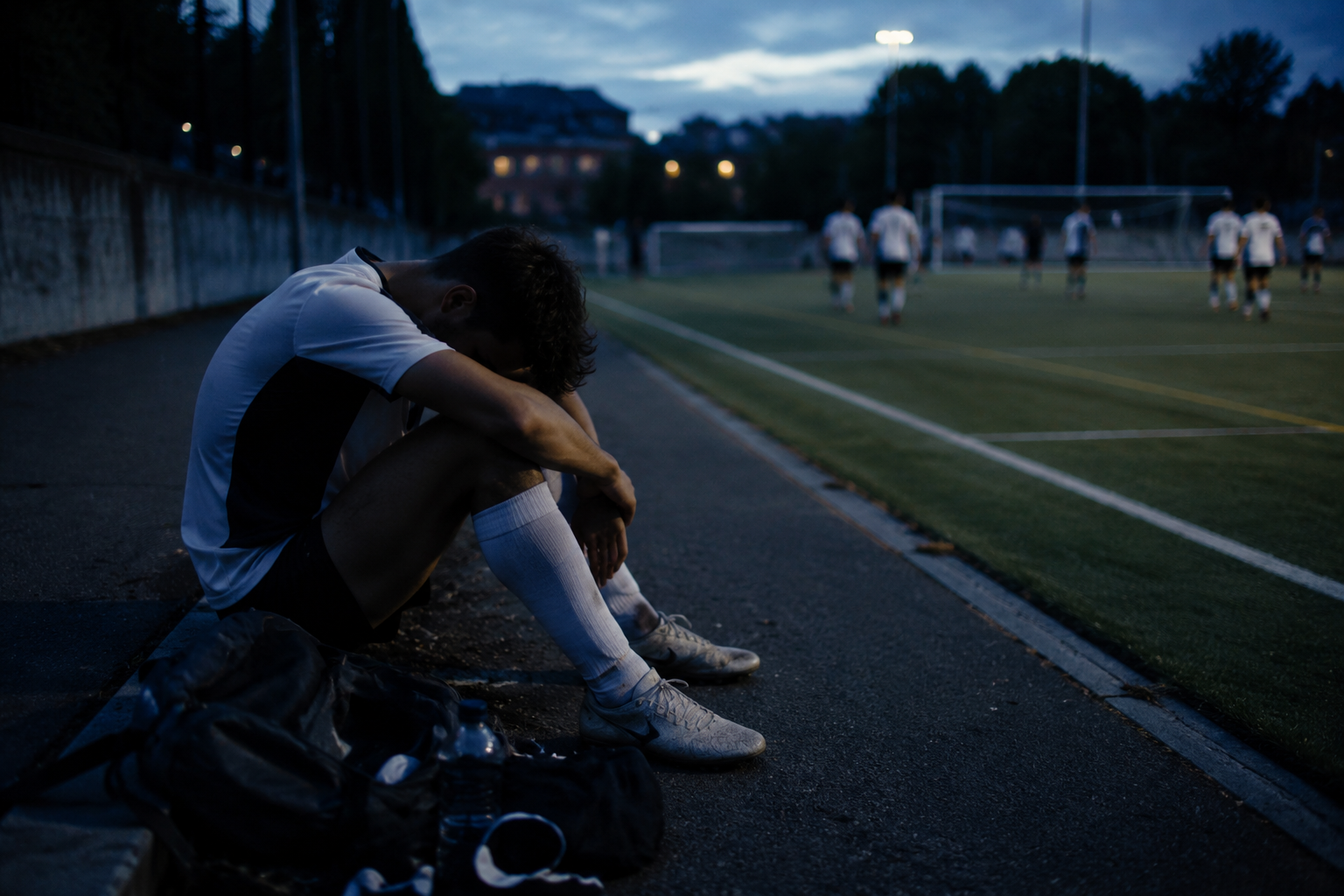
The 8-Hour Line Is Not a Moral Test
The Milewski study is useful because it gives parents and coaches a practical threshold. Fewer than 8 hours was the risk zone; 8 or more hours was the comparison group.[1] That is easier to act on than a vague reminder that teenagers “need more sleep,” but it should not be twisted into a blame game.
Most adolescents are not sleeping in ideal conditions. CDC Youth Risk Behavior Survey data show that 70% to 89% of adolescents get inadequate sleep, depending on grade and survey year.[2] That range is too large to treat as a few careless athletes making poor choices. Early school start times, late practices, travel games, homework, jobs, social pressure, and family schedules all push against the sleep teenagers biologically need.
The National Sleep Foundation and the American Academy of Sleep Medicine both place healthy teen sleep needs around 8 to 10 hours per night, with the AASM recommending 8 to 10 hours for 13- to 18-year-olds.[3][4] For many families, that number can feel almost fictional during a school sports season. Still, “hard to reach” is not the same as “not relevant.” If an athlete is regularly below 8 hours, the research gives coaches and parents a reason to treat that as a meaningful exposure, not just a lifestyle imperfection.
Why Tired Teen Athletes Get Hurt More Easily
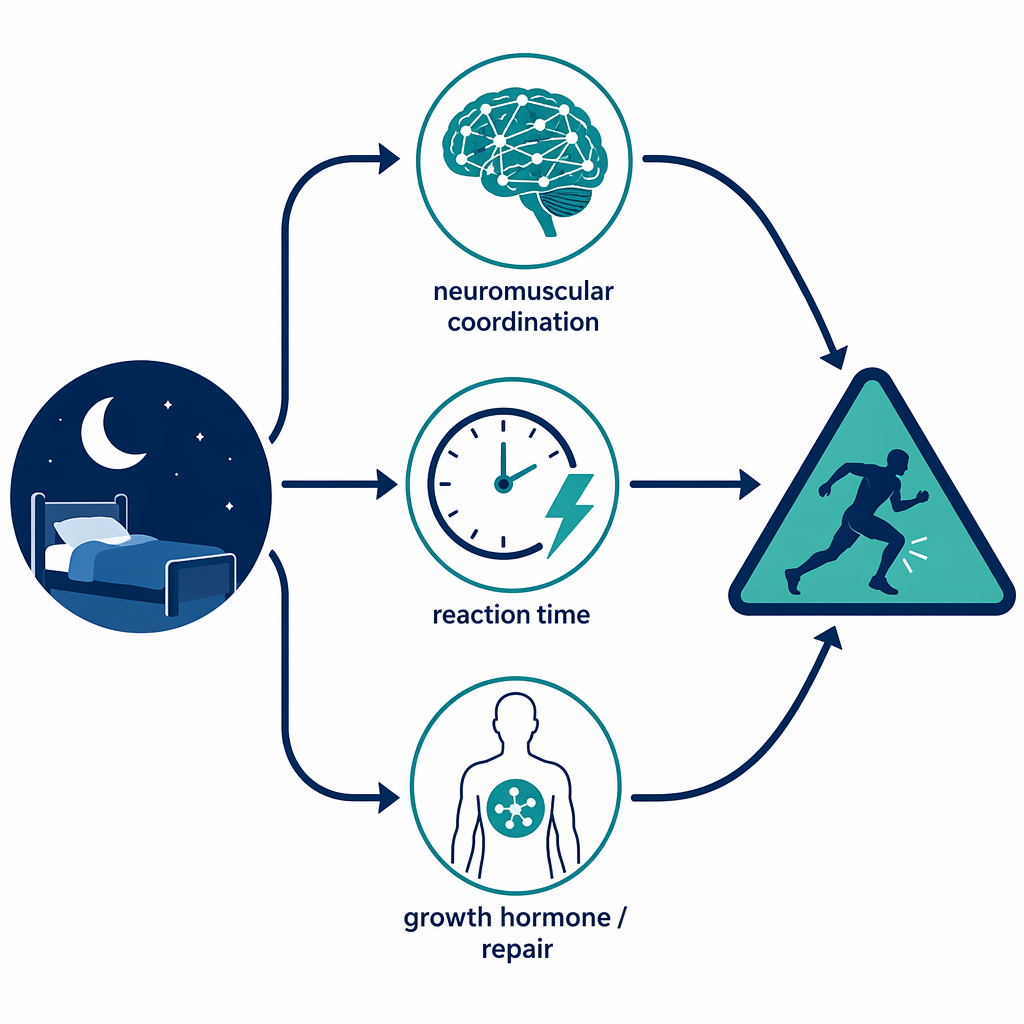
The injury-risk finding becomes more believable when it is connected to what sleep loss does inside a developing athlete. Sports injuries often happen in small windows: a foot lands a little late, a knee collapses inward, a player reacts half a beat slowly, or a tired body uses a messier movement pattern after repeated drills. Sleep deprivation makes those small windows more dangerous.
Reaction Time Slips Across the School Week
In adolescent athletes, sleep pressure can accumulate over ordinary school days, not just during dramatic all-nighters. Suppiah and colleagues studied teen athletes and found progressive psychomotor vigilance decline across the school week.[5] Psychomotor vigilance is the kind of alertness that shows up when an athlete must notice, decide, and move quickly. On a field or court, that can mean tracking a ball, adjusting to contact, reacting to an opponent’s cut, or bracing before landing.
This is where sleep deprivation stops sounding like a general wellness issue and starts sounding like sports safety. A late reaction is not always visible as fatigue. A coach may see hesitation, sloppy footwork, or poor effort. A parent may see a teenager dragging through the car ride home. The athlete may feel normal because tired has become the baseline. But the nervous system still has to make fast decisions under load.
For a deeper look at the brain side of that problem, the companion article How Sleep Deprivation Impairs Your Brain explains why attention, inhibition, and reaction speed are so vulnerable to lost sleep.
Coordination Becomes Less Reliable
Teen athletes do not only need strength; they need timing. A safe landing depends on the hips, knees, ankles, trunk, and visual system working together. A cut in soccer or basketball is not just a leg movement. It is perception, balance, force control, and decision-making compressed into a fraction of a second.
When sleep is short, neuromuscular coordination can become less dependable. The athlete may still be able to run hard and compete, which is why this risk is easy to miss. But the margin for clean movement narrows, especially late in practice, late in a game, or late in a tournament day. The practical concern is not that every tired athlete looks obviously impaired. It is that tired bodies may make riskier movement choices before anyone labels them tired.
Adult athletes face a related problem, but teenagers are not just smaller adults. Their training histories are shorter, their bodies are still changing, and their school-week sleep pressure is unusually high. For an adult comparison, see How Poor Sleep Increases Your Risk of Sports Injury.
Repair Depends on Deep Sleep
The injury conversation should also include what happens after practice. Training creates stress in muscles, tendons, bones, and connective tissue. The body adapts during recovery, and sleep is one of the main places that recovery work is organized.
Growth hormone is especially relevant because it supports tissue repair after training and competition, and its secretion occurs almost exclusively during N3 deep sleep.[6] If a teen athlete repeatedly cuts sleep short, the problem is not only feeling tired the next day. The athlete may also be spending less time in the sleep stage most tied to the hormonal environment for repair.
That mechanism does not prove that every injury began with missed deep sleep. It does explain why sleep should not be separated from workload. A hard practice, a late game, a long drive home, and a short night are not independent events from the body’s perspective. They stack.
For more on the recovery side, How Sleep Quality Drives Muscle Repair and Recovery follows the deep-sleep and growth-hormone pathway in more detail.
What the Research Can and Cannot Prove
The 1.7x finding is important, but it is still an association.[1] The Milewski study cannot prove that short sleep alone caused the injuries. Athletes who sleep less may also have heavier training loads, more competitive schedules, more academic stress, different sport exposures, or grade-related pressures that raise injury risk in other ways.
That caveat should make the interpretation more precise, not less useful. If short sleep travels with high workload, late practices, long commutes, and academic strain, then sleep is still part of the risk pattern that adults can see and discuss. The wrong move is pretending the only valid injury-prevention inputs are the ones that happen during practice.
There is another limitation: pediatric athlete sleep research is smaller and less settled than many adult sports-performance topics. A review of sleep and injury in pediatric and adolescent athletes notes that available studies often have small samples and that findings from adult athletes cannot simply be pasted onto youth athletes.[7] That matters because adolescence brings growth, puberty, changing circadian timing, school schedules, and developing movement patterns into the same picture.
| What the evidence supports | What it does not prove |
|---|---|
| Fewer than 8 hours of sleep is associated with higher sports injury odds in adolescent athletes. | That sleep loss is the only cause of a specific injury. |
| School-week sleep pressure can worsen psychomotor vigilance in teen athletes. | That every tired athlete will look obviously impaired. |
| Deep sleep supports the hormonal environment involved in tissue repair. | That one good night fully cancels a season of accumulated sleep debt. |
| Teen athletes need pediatric-specific judgment. | That adult athlete sleep findings apply automatically to adolescents. |
The Concussion Signal Belongs in the Same Conversation
The main injury story is not a concussion story, but head injury cannot be left outside the frame. Raikes and colleagues found that adolescent athletes with moderate-to-severe insomnia had a 3.13 times higher risk of incident concussion.[8] That is a serious adjacent signal, especially in sports where contact, falls, or aerial play are routine.
This should not be read as proof that insomnia causes every concussion. Concussions have many immediate causes: collision mechanics, sport type, position, rule enforcement, prior history, and chance. But poor sleep and insomnia can affect alertness, reaction time, and decision-making, which are exactly the capacities athletes rely on when avoiding or preparing for contact.
Once a concussion occurs, sleep becomes part of recovery rather than just prevention. The follow-up path is How to Rebuild Sleep Quality During Concussion Recovery, where the question shifts from injury risk to symptom management and return-to-learn or return-to-play decisions.
What Parents and Coaches Can Actually Do With This
The practical target is not perfection. A blanket demand that every teen athlete get 9 to 10 hours every night may be biologically reasonable and logistically crushing. The more useful question is whether the adults around the athlete can identify the repeated under-8-hour nights and stop treating them as invisible.
- Before high-load practices, ask about sleep the same way coaches ask about soreness, hydration, or pain.
- Watch for risk stacking: late game, short night, early class, tournament travel, then another intense session.
- Treat repeated sleep under 8 hours as a reason to reconsider volume, not as a character flaw.
- Build recovery days around actual school demands, not just the official practice calendar.
- After concussion or suspected concussion, route sleep problems into the recovery discussion instead of waiting for them to resolve on their own.
For families trying to understand why adolescent sleep can be so hard to protect, A Developmental Roadmap for Your Child's Sleep Health Journey gives the broader developmental context. Teen sleep is shaped by biology and schedule, not only by willpower.
The athlete still needs strength work, skill work, warm-ups, good coaching, safe equipment, and appropriate medical care. Sleep does not replace any of those. It belongs beside them. Under 8 hours is a meaningful risk zone, and closing that gap across a season may be one of the most overlooked injury-prevention moves available to teenage athletes.
References
- Chronic Lack of Sleep is Associated With Increased Sports Injuries in Adolescent Athletes, Journal of Pediatric Orthopaedics, 2014
- Sleep and Sleep Disorders, Centers for Disease Control and Prevention
- National Sleep Foundation Recommends New Sleep Times, National Sleep Foundation
- Recommended Amount of Sleep for Pediatric Populations: A Consensus Statement of the American Academy of Sleep Medicine, Journal of Clinical Sleep Medicine, 2016
- Sleep Characteristics of Elite Adolescent Athletes and the Effect of a Sleep Education Program on Sleep and Performance, Pediatric Exercise Science, 2016
- Physiology, Growth Hormone, StatPearls
- Sleep and Injury Risk in Pediatric and Adolescent Athletes: A Narrative Review, PMC
- Insomnia and Risk of Concussion in Adolescent Athletes, Sleep Medicine, 2019

Comments
Join the discussion with an anonymous comment.