
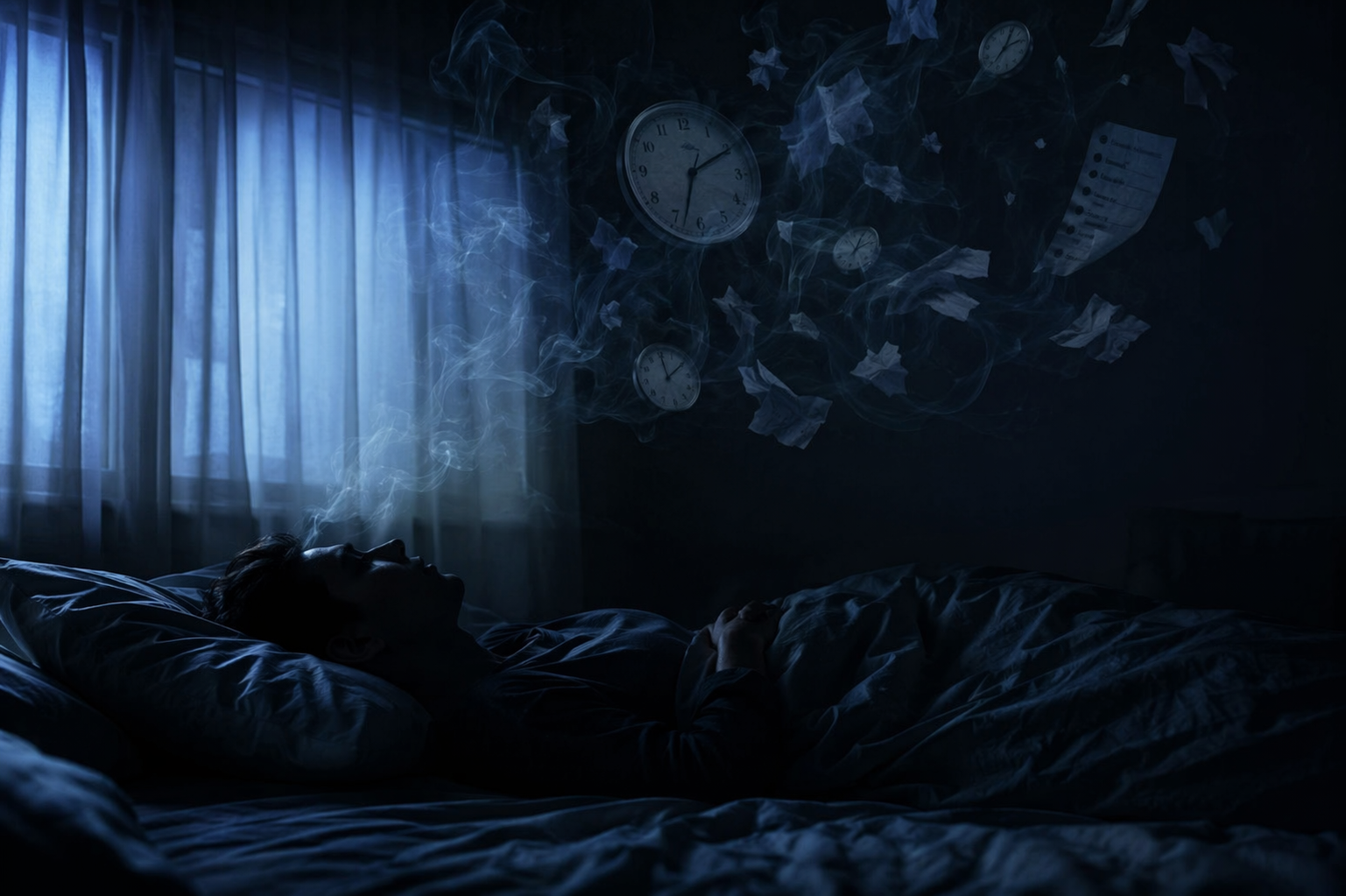
Sleep for injury recovery in athletes is not just about feeling rested before the next lift, match, or practice. It sits inside a feedback loop: poor sleep raises injury susceptibility, and once an athlete is hurt, pain and stress make sleep harder to protect. In a training room, that loop looks familiar. The athlete is technically cleared for modified work, but the ankle throbs at night. The shoulder feels manageable during treatment, then wakes them at 2 a.m. The knee is improving on the table, while the sleep log shows four broken hours.
The strongest sports-sleep findings do not prove that one extra hour in bed mechanically prevents every sprain or strain. They do make the pattern hard to ignore. A review cited by the American College of Sports Medicine reported that athletes sleeping less than 7 hours had a 1.7-times higher injury risk, and it also described a prospective NCAA male basketball cohort in which each additional hour of sleep was associated with about a 43% lower next-day injury risk.[1] That basketball figure is striking, but it should stay in its lane: one cohort, one sport context, and an association rather than a universal law.
Adolescent athlete data points in the same direction. Milewski and colleagues found that young athletes who slept less than 8 hours per night were 1.7 times more likely to sustain an injury than those who slept at least 8 hours.[2] In a later adolescent athlete analysis, athletes averaging more than 8 hours of sleep had 61% lower odds of a new injury compared with shorter sleepers.[3] For coaches, those numbers are useful because they are concrete. For athletes, they are useful because they move sleep out of the “nice if you can get it” category and into the injury-management conversation.
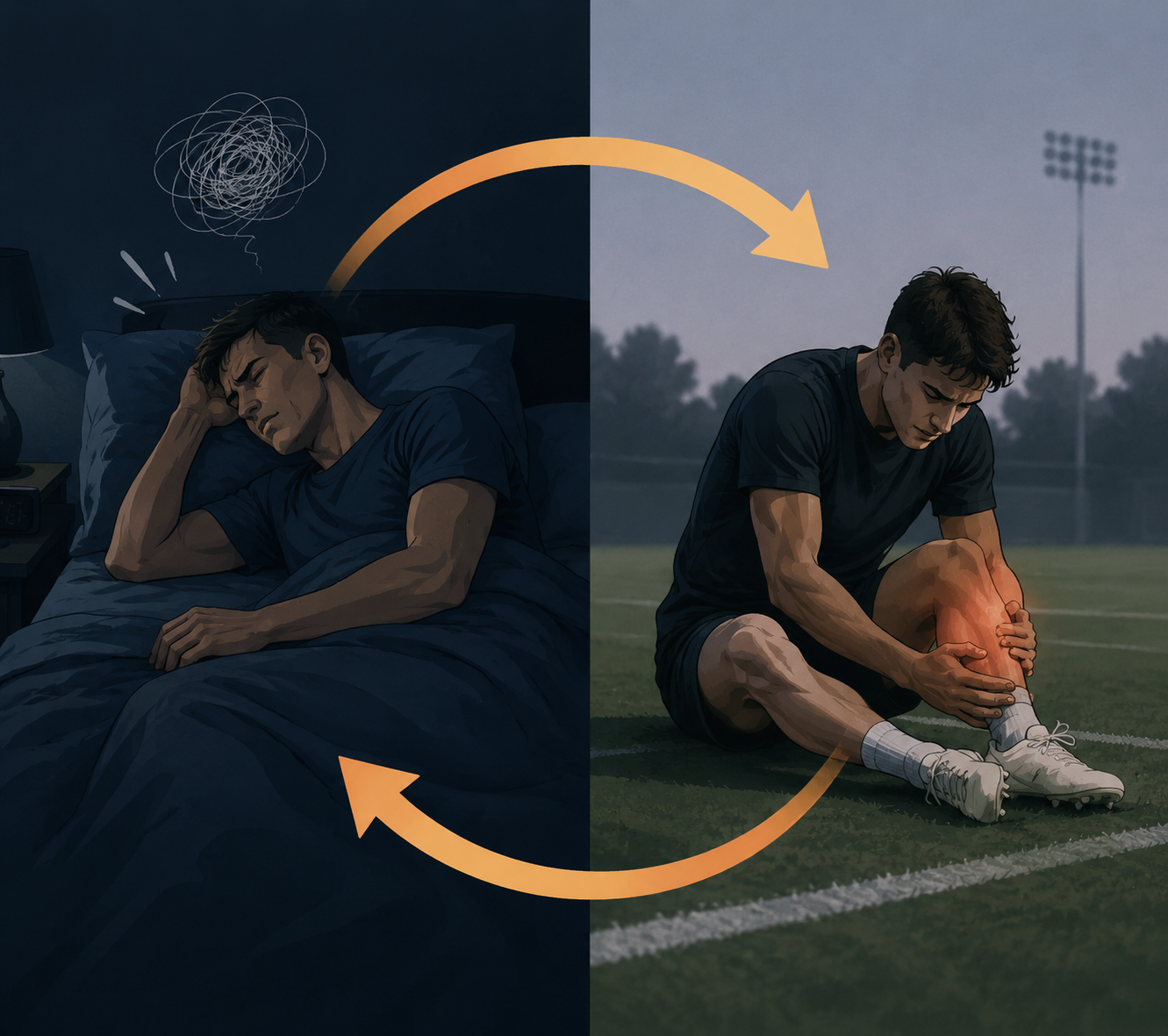
The Loop Starts Before the Injury
Sleep loss does not need to create a dramatic collapse to matter. In sport, small deteriorations accumulate: a slower first step, a late landing correction, a delayed read on contact, a cut made with less trunk control than usual. The athlete may still look competitive. They may still pass the eye test. But the nervous system is managing high-speed decisions with less margin.
That is why the sleep-to-injury side of the loop is plausible even when the epidemiology cannot isolate every causal link. Reaction time, attention, and neuromuscular control are part of how athletes avoid awkward positions and absorb force. When sleep is shortened or fragmented, the athlete is more likely to arrive late to a movement problem. In collision, jumping, sprinting, and cutting sports, late is not always visible on film until it becomes a rolled ankle, a hamstring grab, or a shoulder taking force in a compromised position.
For a deeper look at the sleep-to-injury direction, see how poor sleep increases your risk of sports injury. The important point here is that injury risk is only the first half. Once tissue is damaged, the same sleep system that may have contributed to the injury now becomes part of the recovery environment.
Damaged Tissue Changes the Sleep Problem
A healthy athlete trying to optimize sleep is dealing with a different problem than an injured athlete trying to sleep through pain. The healthy athlete may need a better schedule, less late caffeine, or fewer bright screens at night. The injured athlete may need all of that, plus a way to stop the body from treating the bedroom like another treatment table.
Doherty and colleagues studied 338 athletes and found that 64–65% scored 5 or higher on the Pittsburgh Sleep Quality Index, a threshold commonly used to indicate poor sleep quality.[4] Their sleep diary data also showed that injury was directly cited as a reason for nocturnal awakenings, and pain was reported by about half of athletes.[4] Injury accounted for 4% of diary-recorded awakenings, which sounds small until you think about what that number represents: not general restlessness, not poor habits, but awakenings the athlete specifically connected to being hurt.[4]
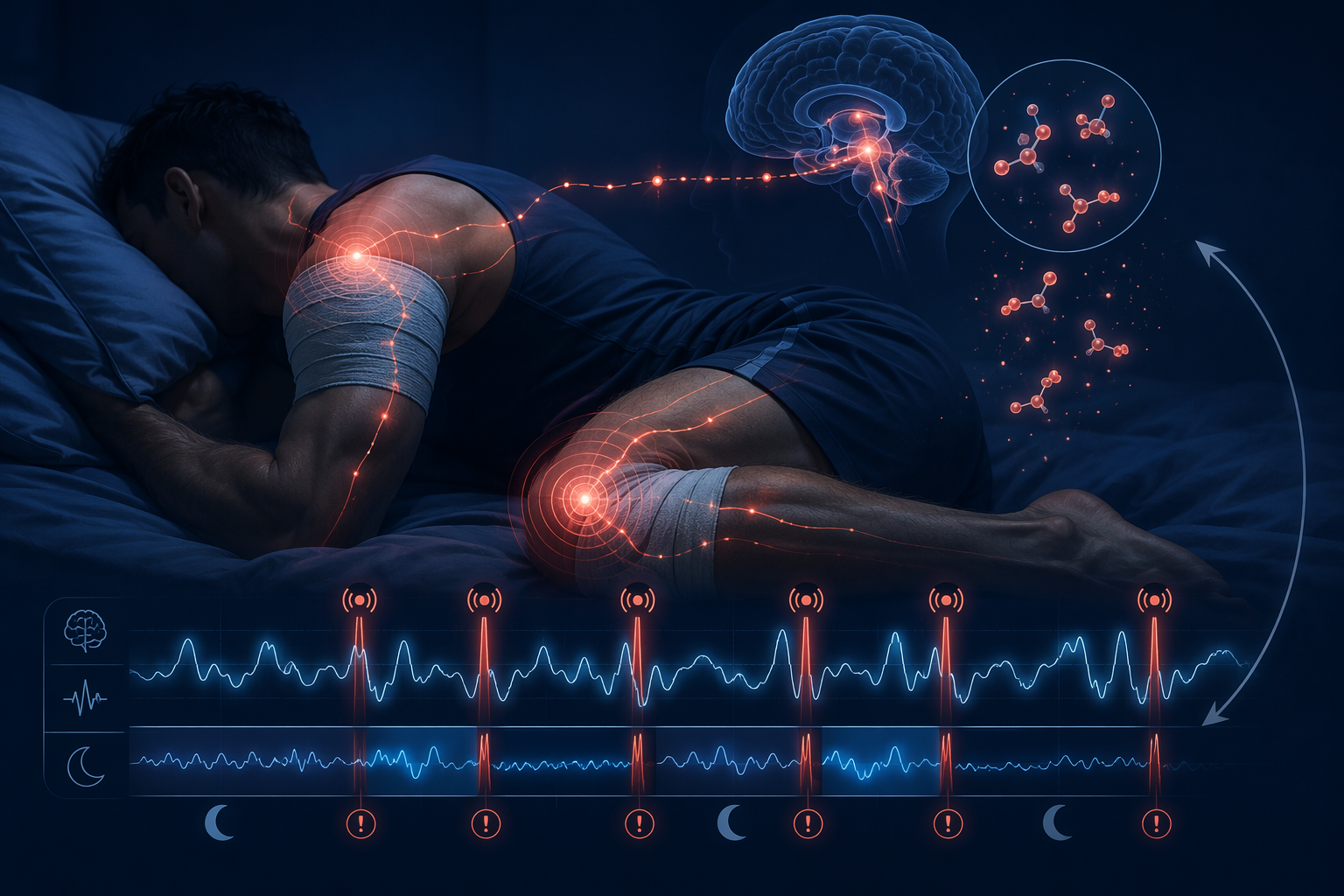
That distinction matters. If an athlete is waking because a tendon, joint, bruise, or surgical site keeps signaling threat, the solution is not simply telling them to be more disciplined about bedtime. Pain can fragment sleep architecture, pulling the athlete away from the deeper stages that recovery depends on. The athlete may spend enough time in bed to look compliant on paper while still missing the consolidated sleep that makes the next day’s rehab more tolerable.
Why Sleep Affects Repair, Not Just Readiness
The recovery side of this loop is biological, not motivational. Sleep loss is associated with elevated cortisol and pro-inflammatory markers such as IL-6 and CRP, and those changes can interfere with the environment needed for tissue repair.[5] Slow-wave sleep is also a primary window for growth hormone release, which supports muscle repair and collagen synthesis.[5] That does not mean sleep is a magic tissue-regeneration button. It means sleep helps set the hormonal and inflammatory conditions in which repair work happens.
For an athlete with a soft-tissue injury, that environment is not a side issue. Muscle, tendon, ligament, and connective tissue adaptation all require repeated repair signals, adequate loading, nutrition, and time. If sleep is short or broken, the athlete may show up to rehab with more pain sensitivity, poorer mood, reduced attention, and less tolerance for progressive loading. None of those signs proves that healing has stopped. They do tell the staff that the athlete is recovering under more physiological friction.
The same logic applies after heavy training blocks and minor injuries that never receive a formal diagnosis. Athletes often describe these as “just tight,” “just sore,” or “not enough to miss practice.” Sometimes that is accurate. Sometimes it is compensation with a good attitude. If the athlete is also sleeping poorly, the margin between tolerable soreness and a more meaningful breakdown narrows.
For more detail on the repair mechanisms, how sleep quality drives muscle repair and recovery goes deeper into the growth hormone, muscle-repair, and recovery-quality side of the discussion.
Where the Feedback Loop Shows Up in Real Recovery
The loop usually does not announce itself as one clean problem. It shows up as a cluster: pain at night, anxiety about losing position, irregular treatment times, missed school or work, altered training identity, and a schedule that no longer matches the team’s rhythm. The athlete who used to fall asleep after practice may now be less physically tired, more mentally wired, and more aware of every sensation from the injured area.
| Loop segment | What changes | What staff should notice |
|---|---|---|
| Poor sleep before injury | Reaction time, attention, and movement control may suffer | Late decisions, sloppy landings, reduced coordination under fatigue |
| Injury event or tissue irritation | Pain, swelling, guarding, and stress increase | More nighttime discomfort and more daytime compensation |
| Sleep after injury | Awakenings and lighter sleep become more likely | Athlete reports being in bed but not restored |
| Rehab response | Pain sensitivity, mood, and load tolerance may fluctuate | Progression stalls despite reasonable treatment work |
A common mistake is treating those pieces separately. The strength coach sees reduced output. The athletic trainer hears pain complaints. The athlete worries about playing time. The coach sees inconsistency. If nobody asks about sleep, one of the loop’s active drivers remains invisible.
Breaking the Cycle Starts With the Problem That Is Actually Waking the Athlete
Generic sleep hygiene has a place, but injured athletes rarely need a laminated list of perfect behaviors. They need the first loose link in the loop identified. Is the athlete waking because the shoulder position hurts? Because the knee stiffens after two hours? Because they are taking long daytime naps after treatment? Because they are lying awake replaying the injury or worrying about selection? Each problem calls for a different adjustment.
Reduce pain-related awakenings
The most direct sleep intervention may be better overnight positioning. A shoulder athlete may need support that prevents rolling onto the injured side. A knee athlete may need a position that reduces pressure and stiffness without forcing the joint into an irritating angle. A rib, hip, or back injury may require trial and error because the first comfortable position is not always the one that stays comfortable three hours later.
Pain timing also matters. If symptoms reliably spike at night, the medical staff needs to know that, not just the daytime pain score during rehab. The question is not only “How does it feel during treatment?” but “What wakes you up, and when?” A short sleep diary can be more useful than a vague morning report, especially when the athlete wants to appear fine.
Athletes with recurring nighttime leg pain have their own set of possible contributors, including load, cramping, and local irritation. Why athletes get nighttime leg pain can help separate those patterns from general poor sleep.
Protect sleep opportunity during rehab
Injured athletes often lose the structure that used to anchor sleep. They may not travel with the team, may train at odd times, or may sit through long treatment windows that push meals, homework, film, or work later into the evening. If rehab makes the athlete’s day less predictable, sleep opportunity shrinks even before pain enters the picture.
The fix is not complicated, but it has to be deliberate. Treatment times should not always take the last available slot if that pushes the athlete into a late-night recovery scramble. Return-to-play plans should include sleep timing the same way they include loading progressions. If an athlete needs more time in bed during a high-pain phase, that is not laziness. It is recovery logistics.
Manage the stress that keeps the system alert
Injury stress is not abstract. Athletes may be worried about scholarships, contracts, starting spots, selection, body composition, or simply being left out. That stress can keep the nervous system alert even when the injured tissue is quiet enough to sleep. The athlete then wakes unrefreshed, tolerates rehab poorly, and becomes more stressed about slow progress.
Coaches and support staff can reduce some of that load by making the recovery plan legible. The athlete should know what is being watched, what must improve before the next step, and what symptoms should be reported rather than hidden. Uncertainty is not always avoidable, but silence from staff often makes it worse.
Adjust training expectations when sleep is poor
Poor sleep should not automatically cancel rehab. It should change the conversation about load. A badly slept athlete may still complete mobility work, low-risk strength work, treatment, or technical review. They may not be the right athlete for an aggressive jump in running volume, contact exposure, or high-speed change-of-direction work that day.
This is where sleep becomes a readiness signal, not a moral grade. If an athlete reports repeated awakenings from pain, the staff can hold the line on the long-term progression while reducing the day’s most reactive demands. That kind of adjustment is not soft. It is how good rehab rooms avoid pretending that every cleared activity carries the same risk under every recovery condition.
A Practical Check-In for Athletes and Staff
The simplest useful screen is not a perfect wearable score. It is a few consistent questions that connect sleep to symptoms and loading. Ask them often enough to see a pattern, but not so often that athletes learn to give automatic answers.
- How many times did the injury wake you last night?
- Was the problem falling asleep, staying asleep, or waking too early?
- Did pain, stress, schedule, or environment seem most responsible?
- Did today’s pain or stiffness feel different after poor sleep?
- Should today’s rehab load stay planned, shift lower risk, or wait for reassessment?
Those questions do not diagnose a sleep disorder, and they do not replace medical care for severe pain, suspected complications, or persistent insomnia. They do keep the injury-sleep loop visible. The athlete is no longer just “not recovering well.” There is a trackable pattern that can be discussed, modified, and, when needed, escalated.
The Judgment Call
Sleep will not prevent every injury. It will not guarantee faster healing, erase bad luck, or turn an unsafe return-to-play decision into a safe one. The evidence is not precise enough to say that every athlete in every sport crosses the same risk threshold at 7 or 8 hours.
But the loop is real enough to respect. Short or fragmented sleep can make athletes more vulnerable through slower reactions, poorer control, and a less favorable repair environment. Injury can then degrade sleep through pain, stress, and repeated awakenings. Ignoring sleep during injury recovery leaves one of the loop’s active drivers untouched.
References
- Sleep and Athletic Performance: The Effects of Sleep Loss on Exercise Performance, and Physiological and Cognitive Responses to Exercise, American College of Sports Medicine.
- Chronic Lack of Sleep is Associated With Increased Sports Injuries in Adolescent Athletes, PubMed, 2014.
- The Association Between Sleep and Injury in Adolescent Athletes: A Systematic Review and Meta-analysis, PubMed, 2021.
- Sleep and Recovery in Team Sport: Current Sleep-Related Issues Facing Professional Team-Sport Athletes, PMC, 2021.
- Sleep and Muscle Recovery: Endocrinological and Molecular Basis for a New and Promising Hypothesis, PMC.
Comments
Join the discussion with an anonymous comment.