
Yes: sleep helps knee injury recovery. It is not just the blank space between icing, elevation, medication, and physical therapy. During deep non-REM sleep, the body releases growth hormone pulses that support tissue rebuilding; blood flow helps deliver oxygen and nutrients to damaged structures; and sleep-linked immune regulation helps keep inflammation and pain from taking over the recovery process.[1]
That matters for a sprained knee, a repaired ACL, a meniscus injury, a strained quadriceps or hamstring, and the long, awkward weeks after knee surgery. The specific diagnosis changes the rehab plan, but the injured knee still depends on the same basic biology: cells need signals, materials, circulation, and a tolerable inflammatory environment in which to rebuild.
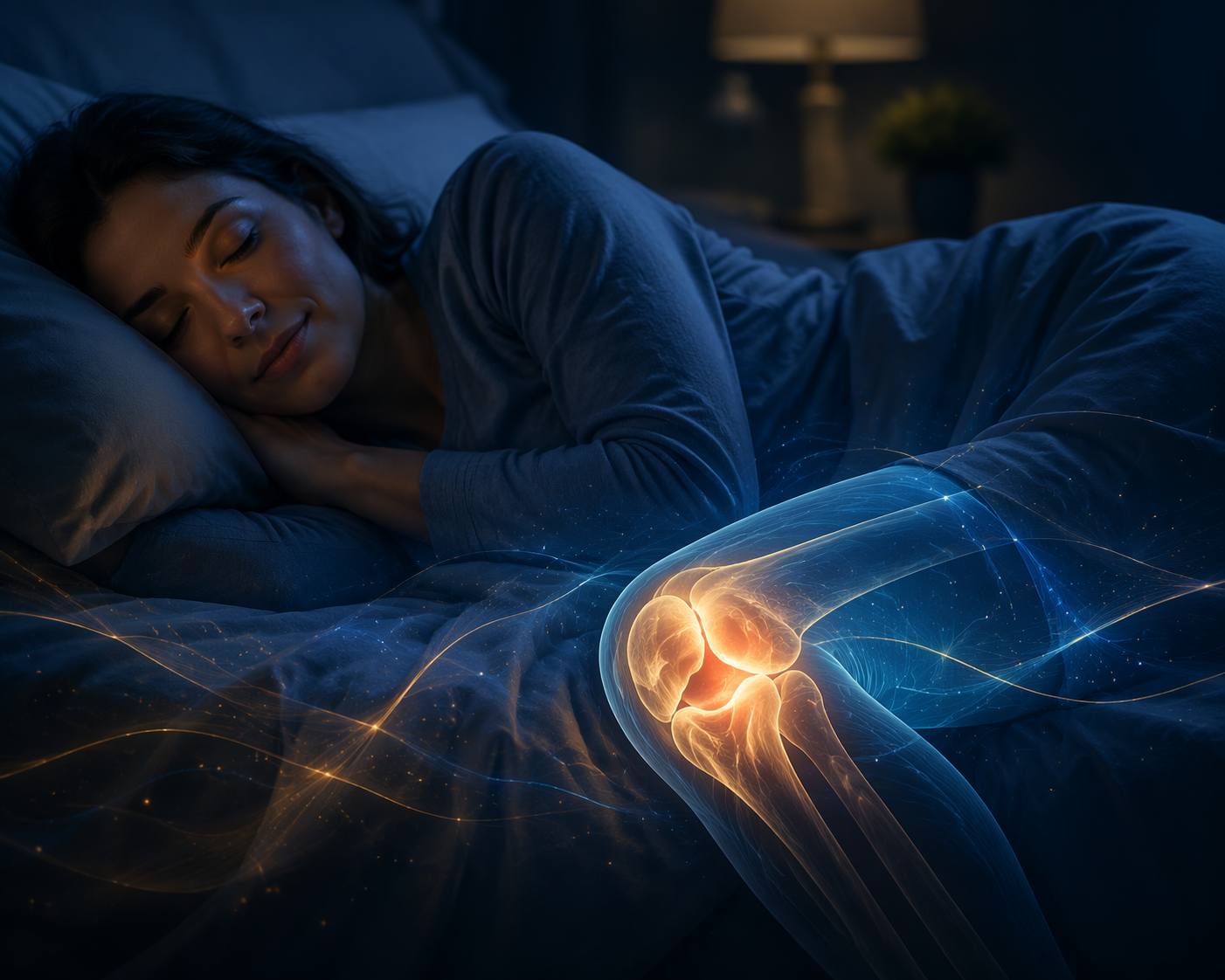
The Knee Does Some of Its Repair Work While You Are Asleep
Knee recovery is often discussed as if the active parts happen only while awake: you protect the joint, reduce swelling, attend physical therapy, walk correctly, and avoid doing too much too soon. Those are real interventions. But sleep is one of the times when the body shifts toward repair in ways that are difficult to replace with daytime willpower.
The most important sleep stage for this discussion is deep non-REM sleep, also called slow-wave sleep or NREM stage 3. In that stage, the pituitary gland releases growth hormone, a signal involved in muscle repair, cellular regeneration, and collagen-related healing in connective tissues such as tendons and ligaments.[1]
Collagen is especially relevant around the knee because ligaments, tendons, meniscal tissue, joint capsule structures, and surgical repair sites all depend on organized connective-tissue remodeling. Sleep does not magically knit a torn ligament back together overnight, and it does not override the mechanical limits set by a surgeon or physical therapist. It does, however, support the hormonal and cellular environment in which that remodeling has to occur.
Why Deep Sleep Is the Main Repair Window
Growth hormone release is not evenly spread across the night. It is closely tied to slow-wave sleep, which is usually concentrated earlier in the sleep period. That is why a recovery plan that treats sleep only as total hours in bed can miss something important: fragmented sleep, delayed sleep timing, or repeated awakenings may reduce access to the deep-sleep periods when these pulses are strongest.[1]
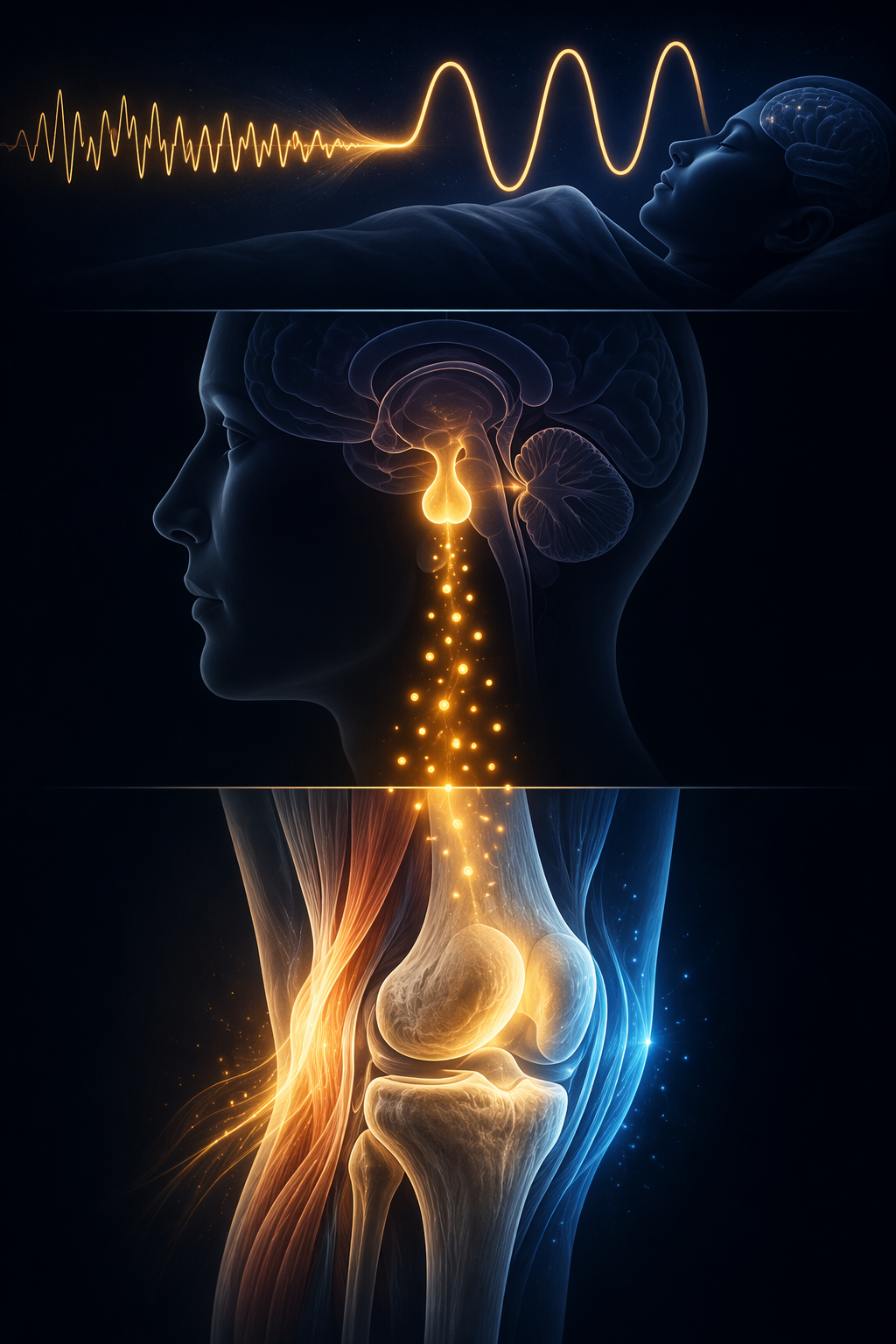
A 2025 UC Berkeley report on work from the Yang Dan lab described a brain-to-hormone pathway that helps explain this connection: sleep-wake circuitry influences growth hormone release, and even moderate sleep disruption attenuated the growth hormone pulse in the study model.[2] The primary Cell paper mapped a neuroendocrine circuit for sleep-dependent growth hormone release.[3]
The caveat is important. That study was conducted in mice, not in adults recovering from knee surgery or a sports injury. It should not be read as a human knee-rehab trial. Its value is more specific: it gives a plausible biological route from sleep architecture to anabolic repair signaling, and it supports the idea that disrupted sleep is not neutral for tissue recovery.[2][3]
For a knee injury, that route matters because the joint is not recovering as one simple object. Muscle around the knee may be inhibited or weakened after injury. Tendons and ligaments may be strained, torn, or surgically reconstructed. The joint lining may be inflamed. Bone and cartilage may be involved in some injuries or procedures. Growth hormone is not the only repair signal in that system, but it is one of the reasons deep sleep deserves a place in the same conversation as rehab adherence and load management.
Blood Flow Supplies the Repair Site
The second mechanism is less dramatic but still practical: circulation. During deeper sleep stages, blood flow to muscles increases, helping deliver oxygen and nutrients needed for tissue repair and cell regeneration.[1] Around the knee, that delivery system supports the surrounding muscles and soft tissues that have to recover enough to tolerate progressive loading.
This does not mean sleep can solve the vascular limits of every knee structure. Some tissues, such as parts of the meniscus and articular cartilage, have limited blood supply compared with muscle. But even then, the recovery process still depends on the broader system: swelling control, muscle function, immune regulation, and the body’s capacity to remodel tissue over time.
Poor Sleep Can Keep Inflammation and Pain Turned Up
Inflammation is necessary after injury. It helps start cleanup and repair. The problem is not inflammation itself; the problem is inflammation that stays too high, lasts too long, or amplifies pain enough to interfere with movement, rehab, and daily function.
Sleep helps regulate that system. OrthoCarolina’s clinical overview notes that prolactin released during sleep helps regulate inflammation.[1] A perioperative sleep review also describes the relationship between sleep disruption, inflammatory signaling, and postoperative recovery concerns, including pain and immune effects.[4]
When sleep is insufficient, inflammatory markers such as interleukin-6 and C-reactive protein can rise.[4] For a person with a swollen, painful knee, that is not an abstract lab issue. Higher inflammatory tone can mean more discomfort, worse perceived stiffness, and a lower tolerance for the exercises that are supposed to restore range of motion and strength.

This is where sleep starts to affect recovery twice. It may influence tissue repair directly through hormonal, vascular, and immune pathways. It also changes the patient’s ability to participate in recovery. A painful night can make the next day’s physical therapy session feel harder before any measurable change in tissue healing has occurred.
What the Numbers Can and Cannot Prove
Once the mechanisms are in view, the quantified claims make more sense. The Physio Clinic in Australia reports that a single night of sleep deprivation can slow tissue repair processes by approximately 18%.[5] Alpine Fit summarizes evidence suggesting that sleep deprivation can slow injury recovery by up to 30%, though the available source materials did not independently verify the original methodology behind that specific figure.[6]
| Finding | What It Measures | How to Read It for Knee Recovery |
|---|---|---|
| About 18% slower tissue repair after one night of sleep deprivation | A short-term tissue-repair effect reported by The Physio Clinic | Useful as a warning that even acute sleep loss can affect repair biology, not as a precise prediction for every knee injury |
| Up to 30% delayed recovery with sleep deprivation | A summarized injury-recovery delay claim reported by Alpine Fit | Directionally relevant, but should be treated cautiously because the original methodology was not independently verified in the supplied materials |
| 1.7 times higher injury risk in adolescent athletes sleeping less than 8 hours | Association between short sleep and injury risk in a youth athlete population | Supports the sleep-injury relationship, but does not prove an adult knee tear heals 1.7 times differently |
The adolescent athlete finding comes from Milewski and colleagues, who reported that athletes sleeping less than 8 hours per night had 1.7 times greater injury risk.[7] That is about injury risk, not healing speed. It is also a youth sports population, not a sample of adults after meniscus surgery or knee replacement. Still, it fits the broader pattern: sleep loss changes the body in ways that matter for musculoskeletal resilience.
The cleanest conclusion is narrower than the most dramatic version of the claim. Sleep supports knee recovery through mechanisms that are biologically relevant to tissue repair, inflammation, pain, and rehabilitation capacity. But direct experimental evidence for every adult knee sprain, ligament injury, meniscus tear, and post-surgical pathway is limited. Much of the evidence comes from related areas: athlete injury studies, perioperative sleep research, pain research, and mechanistic sleep biology.[4][7]
Why One Bad Night Is Different From Sleep Debt
Knee injuries often create exactly the conditions that make sleep worse. Pain wakes people up. Swelling makes positioning awkward. Braces, pillows, medications, anxiety about reinjury, and interrupted routines all compete with sleep at the moment recovery needs it most.
One bad night is not a failed recovery. It is a setback to recover from. The more meaningful risk is cumulative sleep debt: repeated short or fragmented nights that keep cutting into deep sleep, raising pain sensitivity, and making rehab harder to perform consistently.
That distinction matters because panic does not help healing. If pain disrupts sleep after surgery or injury, the first response is not to assume the repair is ruined. It is to treat sleep disruption as a recovery variable worth addressing, just as swelling, range of motion, and exercise tolerance are worth addressing.
How Much Sleep Is Enough During Knee Recovery?
For most adults, the practical target remains 7 to 9 hours per night.[1] During knee recovery, that range is less about chasing a perfect number and more about protecting enough sleep continuity for deep non-REM sleep, growth hormone release, immune regulation, and next-day rehab capacity.
Timing also matters. Because the growth hormone pulse is tied to slow-wave sleep, and slow-wave sleep tends to be concentrated in the earlier part of the sleep period, consistent bedtimes may help preserve the part of the night most closely linked with repair signaling.[1] A person who spends 9 hours in bed but wakes repeatedly from pain may not be getting the same recovery value as someone sleeping fewer hours with better continuity.
This is not a full insomnia plan, and it should not replace medical follow-up. Persistent sleep disruption after a knee injury may need a practical sleep-hygiene review, pain-control adjustment, brace or pillow-positioning changes, or professional help for insomnia. The point is simpler: if sleep is repeatedly broken, it belongs in the recovery conversation rather than being dismissed as an unfortunate side effect.
The Right Claim Is Strong, but Not Magical
Sleep helps knee injury recovery because it protects several repair processes at once: growth hormone signaling during deep sleep, circulation that supports tissue metabolism, and inflammatory regulation that affects pain and rehab tolerance. Those mechanisms make sleep an active recovery window, not just a polite recommendation added after the real treatment plan.
It does not replace orthopedic care, physical therapy, surgical follow-up, medication guidance, or load management. A reconstructed ligament still needs protection. A swollen knee still needs appropriate evaluation. A painful postoperative night may need clinical troubleshooting. But when the question is whether sleep actually helps the injured knee recover, the answer is yes — and the best-supported standard is to treat 7 to 9 hours of consistent, reasonably uninterrupted sleep as part of the recovery plan, not as optional downtime.
References
- Sleep: The Secret Ingredient of Injury Recovery, OrthoCarolina
- Sleep strengthens muscle and bone by boosting growth hormone levels, UC Berkeley News, 2025
- Neuroendocrine circuit for sleep-dependent growth hormone release, Cell, 2025
- Sleep in the perioperative period, PMC, 2021
- The Physio Clinic injury recovery sleep resource, The Physio Clinic Australia
- Essential Sleep for Injury Recovery, Alpine Fit
- Chronic lack of sleep is associated with increased sports injuries in adolescent athletes, Journal of Pediatric Orthopaedics, 2014




Comments
Join the discussion with an anonymous comment.