
Hot weather starts damaging sleep before the first long stretch of wakefulness. To fall asleep, the body has to move heat away from its core. One of the quiet signs that this is happening is distal vasodilation: blood flow increases in the hands and feet, turning the limbs into heat-shedding surfaces. That cooling shift is not decorative comfort; it is part of the normal thermoregulatory pattern that helps sleep begin and remain organized through the night.[1]
A hot room pushes against that shift. If the surrounding air, bedding, and skin microclimate are already warm, the body has fewer places to send excess heat. The person in bed may describe the result as “I just couldn’t get comfortable,” but the sleep problem is more specific than discomfort. Heat makes it harder to shed body heat at the same time sleep is asking the body to do exactly that.
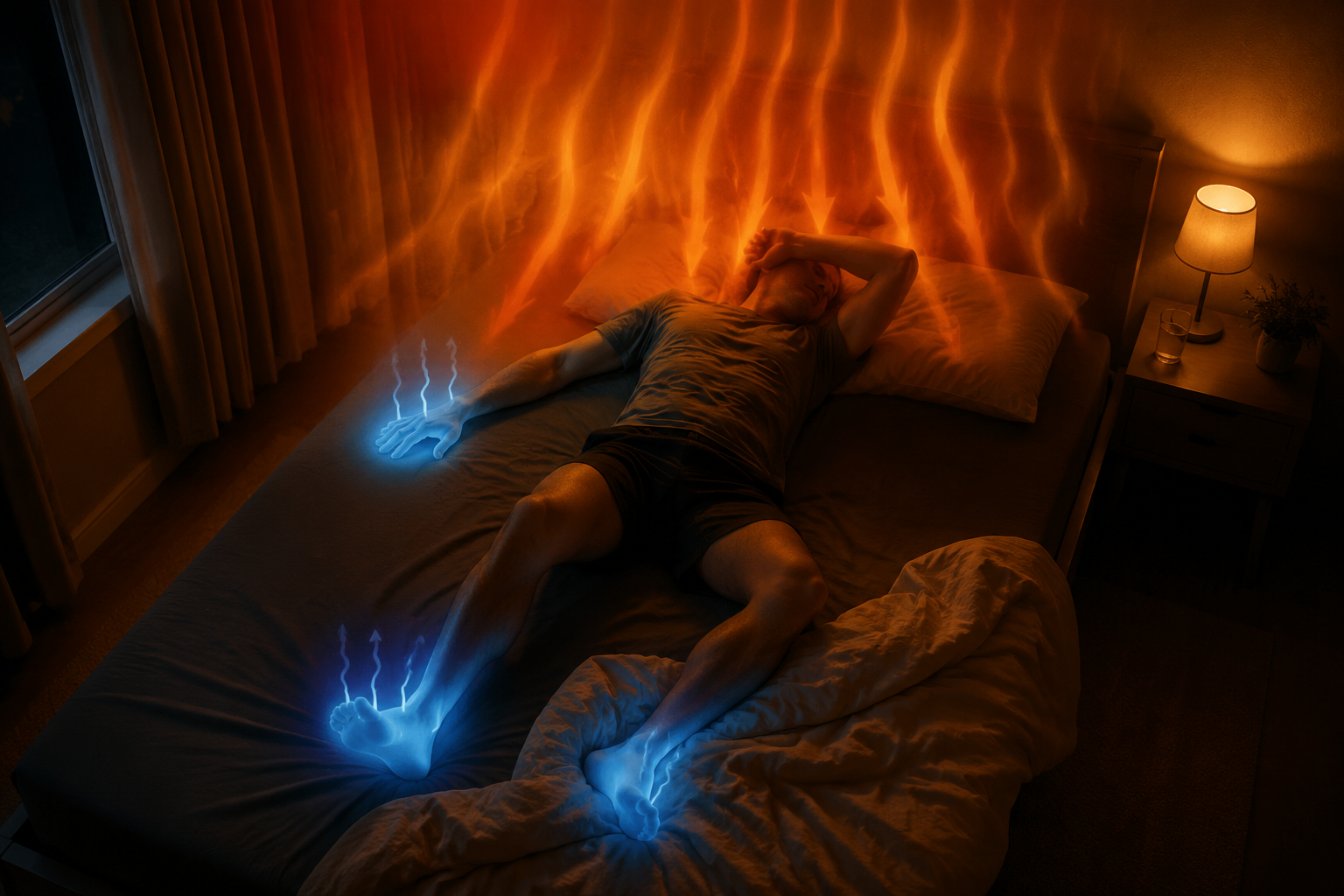
Heat interferes with the cooling cascade sleep depends on
Sleep is not a passive state that begins once the bedroom feels pleasant enough. In the hours around sleep onset, thermoregulation changes in a coordinated way: core body temperature tends to fall, distal skin temperature rises, and heat loss through the extremities helps the body enter sleep. Okamoto-Mizuno and Mizuno describe this relationship directly: easier sleep onset is associated with increased heat dissipation from distal skin regions, while heat exposure disrupts sleep continuity and stage distribution.[1]
That is why a hot bedroom can feel so unfair. You may be exhausted and still wide awake because fatigue and thermoregulation are not the same system. Sleep pressure can be high, but if heat loss is blocked, the body has to negotiate with an environment that is working against the physiological entrance ramp into sleep.
Temperature-number advice can be useful only if it is kept in its place. The American Heart Association cites an optimal bedroom range of 60°F to 67°F and reports that sleep efficiency can fall by 5% to 10% when temperature rises from 77°F to 86°F, citing a 2023 Science of the Total Environment study.[2] Those numbers help show the stakes, but they do not explain why one night at 80°F can be survivable while another feels impossible. Humidity, bedding, air movement, body size, age, medication, and sleep stage all change how much thermal stress the sleeping body actually experiences.
The damage is visible in sleep architecture, not just sleep satisfaction
When heat disrupts sleep, the most useful question is not simply whether sleep was “good” or “bad.” Heat changes the shape of the night. The thermal-environment review describes a consistent pattern under heat exposure: wakefulness increases, slow-wave sleep decreases or becomes more fragmented, and REM sleep decreases.[1]
| Part of the night | What heat tends to do | Why it matters |
|---|---|---|
| Sleep onset | Makes heat loss through the hands and feet less effective | The body has a harder time making the cooling shift that normally helps sleep begin |
| Wakefulness after sleep begins | Increases waking and sleep fragmentation | The sleeper may technically fall asleep but keep surfacing through the night |
| Slow-wave sleep | Reduces or fragments deep sleep | The most consolidated deep-sleep periods become more vulnerable to interruption |
| REM sleep | Reduces REM under heat exposure | Late-night sleep can feel thin or unrestorative even after several hours in bed |
The distinction matters because many people judge a hot night by whether they eventually fell asleep. That is too crude. A person can fall asleep at midnight, wake repeatedly after 2 a.m., lose consolidated slow-wave sleep, and have shortened REM periods before morning. In ordinary language, that becomes “I slept, but it didn’t count.” Physiologically, the complaint makes sense.
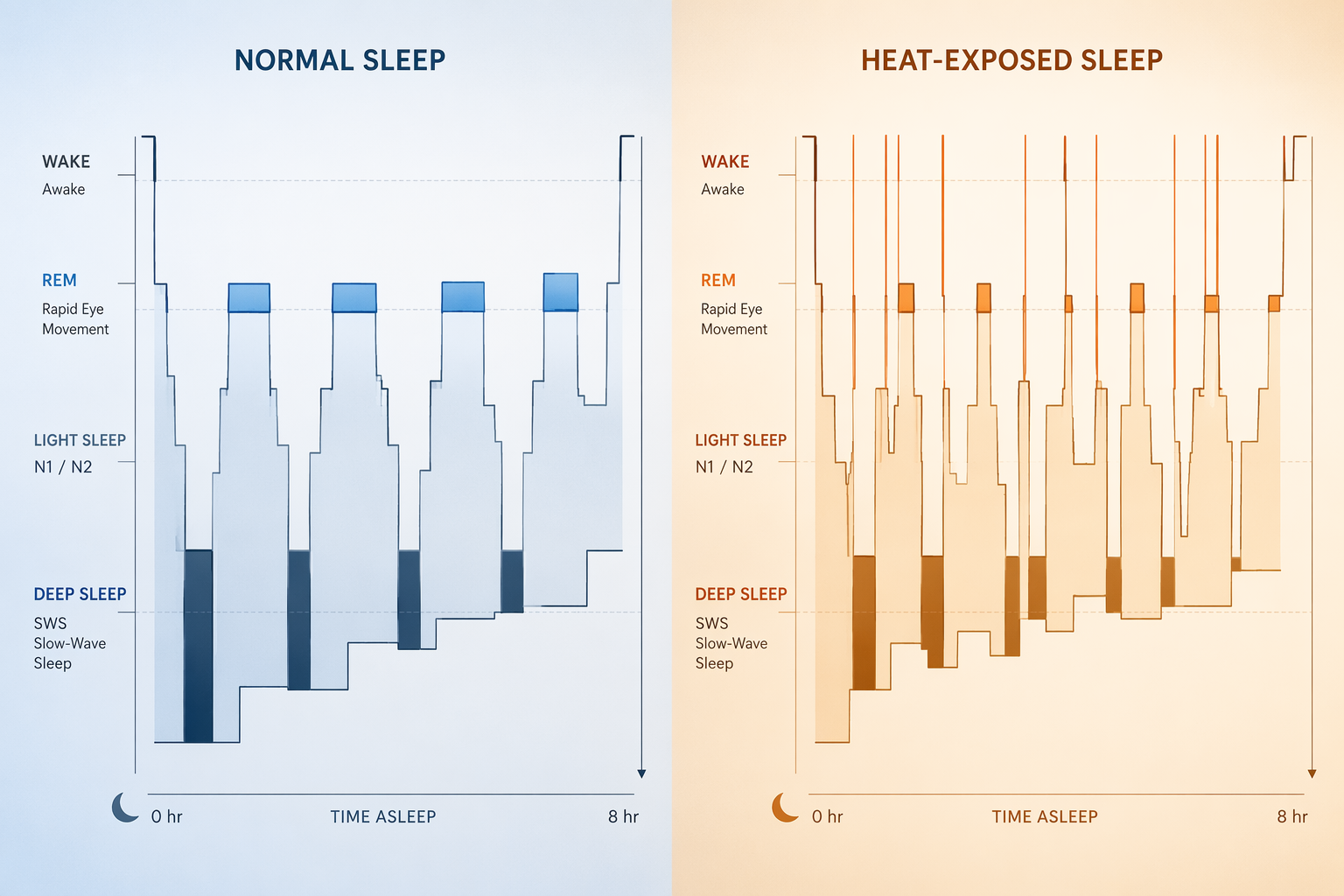
Wakefulness is the most obvious signal
Heat increases wakefulness because the sleeping body keeps being pulled back into regulation. If the room and bedding keep adding thermal load, the nervous system cannot simply ignore it. The person may throw off covers, turn the pillow, search for a cooler patch of sheet, or wake without any clear thought at all. Those behaviors are visible; the underlying problem is that the body is still trying to defend heat balance.
This also explains why the worst part of a hot night is often not the first half-hour. Some people do fall asleep, especially when sleep pressure is strong. The failure appears later, as repeated awakenings and lighter sleep. In the review literature, heat exposure is tied not only to delayed or impaired sleep initiation but also to increased wakefulness after sleep onset.[1]
Slow-wave sleep is vulnerable because it depends on stability
Slow-wave sleep is the deep, highly synchronized portion of non-REM sleep. It is not just “being very asleep”; it is a distinct stage pattern that tends to dominate earlier in the night. Heat does not have to keep someone awake all night to injure this part of sleep. Repeated arousals and thermal stress can reduce or fragment slow-wave sleep, leaving the night less restorative even when total time in bed looks adequate.[1]
That is one reason summer sleep can produce a particular kind of frustration: the clock says there was enough opportunity, but the architecture was disturbed. Eight hours in a warm bed is not automatically eight hours of well-structured sleep.
REM sleep often takes the late-night hit
REM sleep is also thermally delicate. During REM, thermoregulatory responses are altered compared with wakefulness and non-REM sleep, which helps explain why heat exposure can reduce REM rather than merely making it feel less pleasant.[1] Because REM periods tend to lengthen later in the night, a bedroom that stays hot until morning can make the final hours of sleep feel especially poor.
This is where “I woke up tired” becomes more than a vague complaint. If heat has increased wakefulness, broken slow-wave sleep, and reduced REM, the sleeper has not merely endured an uncomfortable environment. The night’s internal organization has changed.
Humid heat is worse because sweat stops doing its job as well
Dry heat and humid heat are not equivalent sleep exposures. In heat, the body leans on evaporation: sweat has to leave the skin and evaporate for cooling to occur. High humidity weakens that route. The air is already holding more water vapor, so sweat lingers rather than evaporating efficiently.
Okamoto-Mizuno and Mizuno note that high relative humidity can suppress evaporative heat loss and discuss hidromeiosis, a reduction in sweating that can occur during prolonged sweating, particularly when relative humidity is above about 70%.[1] That does not mean every humid bedroom produces the same biological response, or that 70% is a personal danger line for every sleeper. It means humidity can interfere with one of the body’s main cooling defenses at the exact time sleep is depending on heat loss.
Bedding makes this more complicated. The body does not sleep in open air; it sleeps inside a small climate formed by mattress, sheets, clothing, skin, and room air. The review cites a bed-climate range of roughly 32°C to 34°C and 40% to 60% relative humidity as the range the body tends to maintain under bedding, though that figure comes from earlier engineering and ergonomics literature rather than large sleep-stage trials.[1] The useful point is not to turn those values into a bedside rule. It is to notice that the sleeper is managing a microclimate, not just the thermostat reading across the room.
This is why a bedroom can read as moderately warm while the bed feels oppressive. A thick mattress, dense foam, heavy bedding, or still air can trap heat and moisture close to the body. The thermostat sees the room. The skin experiences the bed.
Older sleepers have less margin
Heat is not evenly distributed as a sleep burden. Older adults often start from more fragile sleep: more awakenings, less consolidated sleep, and, in many cases, less slow-wave sleep even before temperature is added. Mild heat can therefore remove sleep quality from a smaller reserve.
A study of older men found that mild heat exposure increased wakefulness and reduced REM sleep. Slow-wave sleep was not further reduced in that study, but the authors noted that slow-wave sleep was already decreased with age.[3] That narrower finding is important: the study does not prove that every older adult loses the same sleep stage in every heat wave. It does show that REM can be measurably vulnerable even under mild heat in an older sample.
For an older person lying awake in July, this should not be framed as poor discipline or failure to adapt. The body may simply have less physiological buffer. A younger sleeper may lose some sleep and recover quickly; an older sleeper may feel the same thermal stress as a sharper decline in next-day function because the night had less room for disruption.
Repeated hot nights do not reliably train the body out of it
One of the most useful findings in the thermal sleep literature is also one that should be handled carefully. The Okamoto-Mizuno and Mizuno review reports that sleep did not adapt after five or more days of heat exposure under controlled conditions.[1] That matters because people often assume that the third or fourth hot night should be easier if they are simply patient enough.
The finding does not prove that no one adapts to any real-world heat wave. Laboratory heat exposure is more controlled than ordinary life, where nights may cool, humidity may shift, people may change bedding, and air movement may vary. But it does argue against the casual reassurance that the sleeping body will automatically get used to repeated hot nights. Under the studied conditions, the architecture of sleep did not simply normalize with several consecutive exposures.
If sleep keeps breaking down across a hot week, the problem is not necessarily anxiety about sleep, lack of toughness, or dependence on cooling. Heat can remain a direct physiological obstacle even after multiple nights.
Cooling helps when it restores heat removal
The practical implication is straightforward but often misdirected. The goal is not to chase a perfect bedroom number or buy every cooling product on the market. The goal is to reduce the thermal load that blocks heat loss from the body and the bed microclimate.
Sometimes that means room cooling. Sometimes it means humidity control, lighter bedding, more air movement, or changing the materials closest to the skin. The mechanism is the filter: an intervention is relevant if it helps the body shed heat or prevents the bed from trapping heat and moisture.
Targeted bed cooling belongs in that category when it is treated as physiology rather than luxury. A 2025 bed-cooling study reported that targeted cooling in overheated bedrooms restored total sleep time to baseline.[4] That does not make bed cooling a universal answer, and total sleep time is not the same as a full sleep-architecture repair. It does support the larger point: cooling the sleep surface can matter because the bed is part of the body’s heat-removal environment.
Hot weather sabotages sleep quality by blocking the cooling cascade that helps sleep begin and stay organized. Humidity compounds the blockade by weakening evaporative cooling. Deep sleep and REM are especially exposed to the consequences, and repeated exposure does not reliably train the body out of the problem under the controlled conditions studied.
References
- Effects of thermal environment on sleep and circadian rhythm, Journal of Physiological Anthropology, 2012.
- Keep Your Cool: Sleep tips for hot summer nights, American Heart Association, August 2025.
- Effects of mild heat exposure on sleep stages and body temperature in older men, PubMed.
- ScienceDirect article S0360132326000193, ScienceDirect, 2025.


Comments
Join the discussion with an anonymous comment.