

Search for “home remedies for sleep” and you will usually get a friendly pile of tea, lavender, magnesium, melatonin, tart cherry juice, breathing exercises, and sometimes CBD, all presented as if they belong in the same evidence basket. They do not. Nearly two-thirds of American adults have tried melatonin, and Americans spend an estimated $67 billion a year on sleep aids, a figure that can include over-the-counter medicines, supplements, devices, and related products—not just kitchen-cabinet remedies.[1] That combination matters: exhausted people are spending money in a market where popularity often travels faster than precision.
The useful question is not “natural or not?” It is: what sleep problem are you trying to solve, and does this remedy have evidence for that problem?
First, separate occasional sleep trouble from chronic insomnia
Home remedies can be reasonable for occasional or mild sleep trouble: a stressful week, travel, a late-night schedule drift, or a bedtime routine that has become too bright, too stimulating, or too irregular. Acute insomnia is generally short-term, lasting less than 3 months. Chronic insomnia is different: ongoing trouble falling asleep, staying asleep, or waking too early, with daytime impairment, over a longer period.
That distinction changes the whole ranking. A 2025 scoping review in Sleep Medicine looked across 51 randomized controlled trials of over-the-counter products for insomnia and found that many studied products showed positive effects, with valerian and melatonin having the most substantial evidence among the OTC products reviewed. But the review also found that study quality varied and effects were generally modest, so it should not be read as “supplements treat insomnia.”[2]
For chronic insomnia, cognitive behavioral therapy for insomnia—CBT-I—is the first-line treatment recommended by the American Academy of Sleep Medicine, and Mayo Clinic describes CBT-I as the preferred treatment approach, typically delivered over several sessions rather than as a one-night trick.[3][4] Some CBT-I components can be practiced at home, but that does not make chronic insomnia a supplement-shopping problem.
A practical evidence tier for home remedies
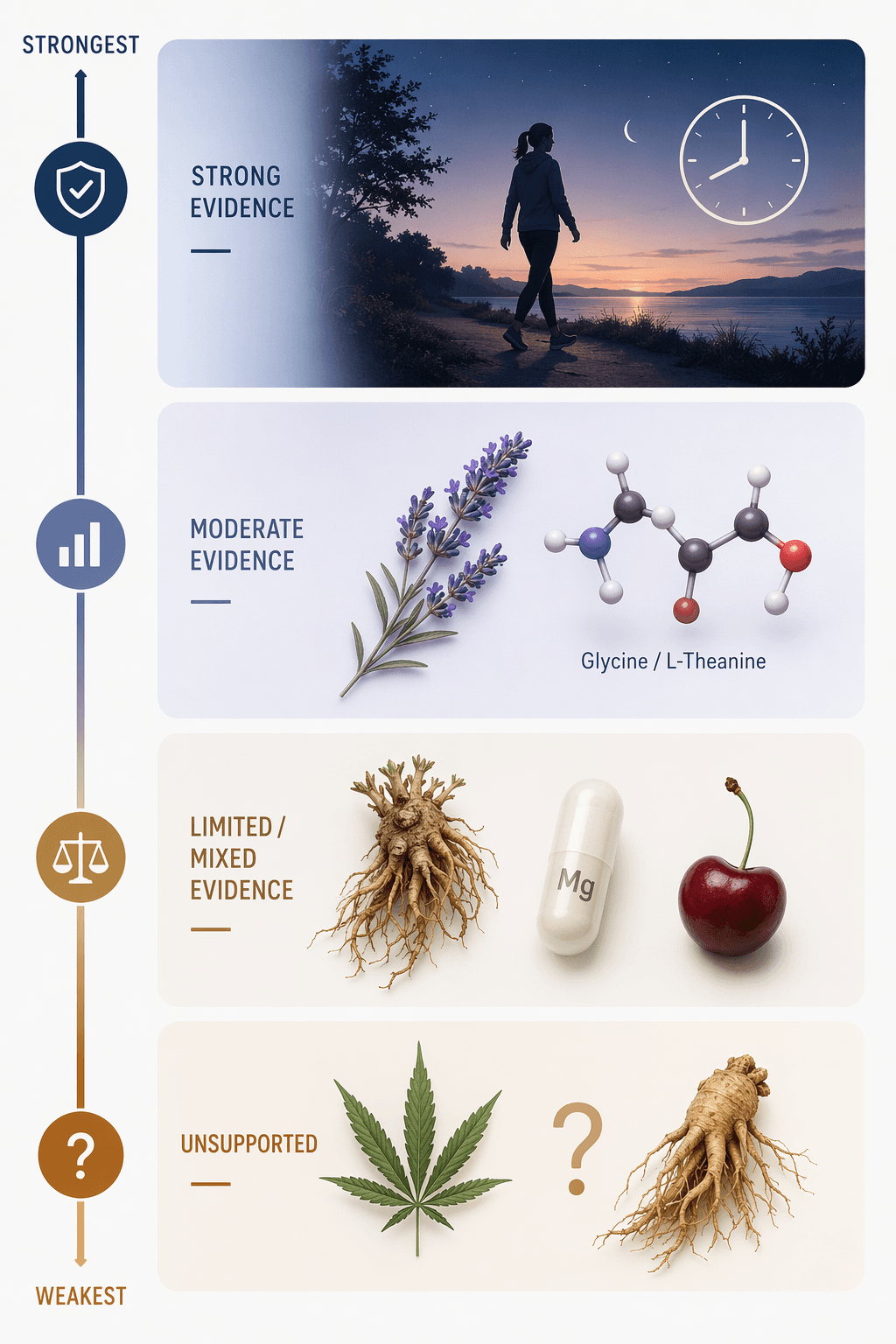
Here is the short version before the details. The tiers are not a moral ranking. They are a way to keep a lavender scent cue, a circadian-timing tool, and an insomnia treatment from being treated as the same kind of thing.
| Evidence tier | Best fit | Examples | Main caution |
|---|---|---|---|
| Strong or clinically grounded | Chronic insomnia support, conditioned arousal, circadian timing, general sleep health | CBT-I components such as stimulus control and sleep restriction; melatonin for circadian misalignment; regular exercise | Melatonin is not a general insomnia cure; CBT-I techniques may need guidance if sleep is severely restricted |
| Moderate, narrower evidence | Mild sleep difficulty, sleep quality, sleep maintenance, pre-bed calming cue | Lavender aromatherapy; glycine 3g before bed; L-theanine for sleep maintenance | Studies are smaller; effects are likely modest and complaint-specific |
| Limited or mixed | Selected people who tolerate them and understand the uncertainty | Valerian; magnesium; chamomile; tart cherry juice | Evidence may be small, inconsistent, indirect, or tied to specific populations |
| Insufficient direct sleep evidence or higher concern | Not a first choice for insomnia self-treatment | CBD for sleep; kava; adaptogens marketed for sleep | Marketing often outruns direct sleep-specific evidence and safety review |
Strongest: behavioral sleep tools and circadian timing
Stimulus control: boring, specific, and more serious than it sounds
The most useful “home remedy” for many people is not something swallowed. It is retraining the bed to mean sleep instead of effort.
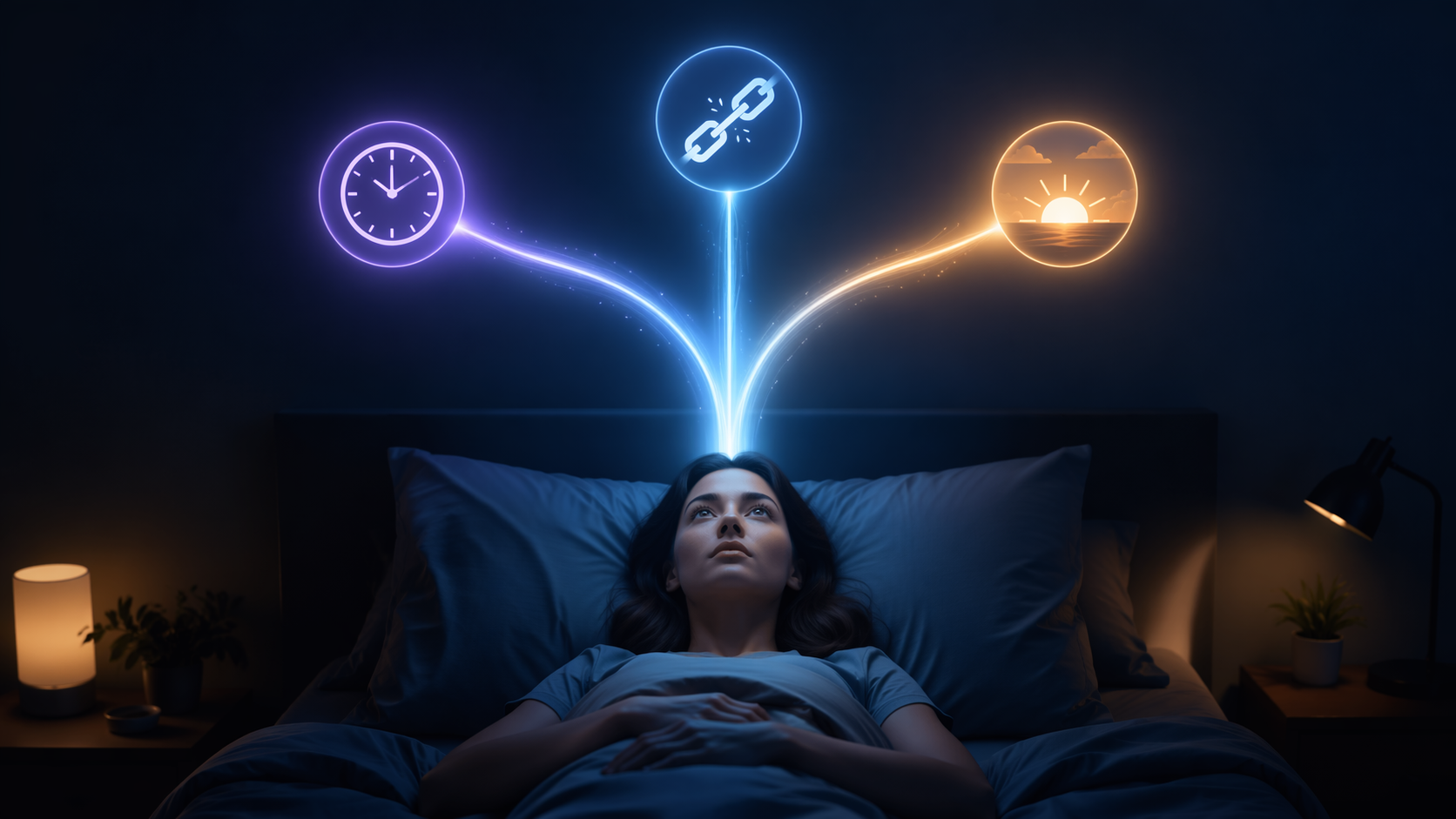
Stimulus control is a CBT-I component. The familiar rule is to get out of bed if you are not asleep after about 20 minutes, do something quiet and non-stimulating in dim light, and return only when sleepy. The point is not to punish wakefulness. It is to stop the bed from becoming the place where you rehearse tomorrow, check the clock, and prove to yourself that sleep will not come.
This is where many remedy lists go soft. They call everything “sleep hygiene,” then move quickly to products. Actual behavioral treatment is more structured than “relax before bed.” CBT-I often includes stimulus control, sleep restriction or sleep compression, cognitive work around sleep worry, and regular wake timing. The AASM guideline supports behavioral and psychological treatments for chronic insomnia, while Mayo Clinic describes CBT-I as helping people identify and replace thoughts and behaviors that cause or worsen sleep problems.[3][4]
If your main pattern is lying awake in bed for long stretches, start here before adding another capsule. For a fuller explanation of what belongs under sleep hygiene versus behavioral insomnia treatment, see what sleep hygiene actually means.
Melatonin: strongest when the clock is the problem
Melatonin is often used as if it were a gentle sleeping pill. Its better-supported role is narrower: helping shift circadian timing. That means it may be more relevant for jet lag, delayed sleep phase, shift-related timing problems, or a sleep schedule that has drifted later—not for every person who wakes at 3 a.m. or lies awake because they are anxious.
The 2025 scoping review’s finding that melatonin and valerian had the most substantial evidence among OTC insomnia products is worth taking seriously, but with the review’s own limits attached: trial quality varied, and the overall signal does not turn melatonin into a broad treatment for chronic insomnia.[2] If the problem is timing, melatonin may be the right tool. If the problem is conditioned arousal, pain, untreated sleep apnea, alcohol-related sleep fragmentation, or chronic insomnia, it may simply be the most familiar tool.
There is also a dose-and-label problem hiding under the word “natural.” With supplements, the amount on the bottle is part of the decision, and product quality can vary. Melatonin may also be inappropriate or require clinician input for children, pregnancy, some neurologic conditions, people taking interacting medications, and older adults with higher fall or next-day grogginess concerns. For a closer look at how melatonin differs from antihistamine sleep aids and valerian, see OTC sleep medicine ingredients.
Exercise: not a bedtime hack, but a durable sleep support
Regular exercise is not as clickable as a new supplement, but it belongs in the stronger tier because it improves the conditions sleep depends on: circadian regularity, mood, metabolic health, and sleep pressure. The useful target often cited in public health guidance is about 150 minutes per week of moderate-intensity aerobic activity, with muscle-strengthening activity on at least 2 days per week.[5]
The timing does not need to be precious for everyone. Some people sleep poorly after vigorous late-night workouts; others do fine. If you are troubleshooting, move intense exercise earlier and keep evening movement gentler. A walk after work may do more for sleep over time than a complicated bedtime stack.
Moderate evidence: useful for some complaints, not interchangeable
This middle group is where a careful reader can avoid two mistakes: dismissing everything because the studies are not huge, or buying everything because each option has a plausible mechanism. The fit matters.
Lavender aromatherapy: more cue than cure
Lavender aromatherapy has a reasonable evidence story for subjective sleep quality and pre-sleep calming, especially when used as part of a repeated bedtime routine. Its advantage is that it does not require sedating yourself. Its limitation is just as important: a scent cue is not an insomnia treatment, and it will not fix circadian delay, restless legs, untreated sleep apnea, or a schedule that gives you 5 hours in bed.
If it helps, it may help partly because the brain learns the sequence: dim light, familiar scent, lower stimulation, bed. That is not fake. It is also not proof that every lavender-branded product has a meaningful pharmacologic effect.
Glycine: a specific dose with a narrower promise
Glycine is more interesting than many sleep supplements because the commonly discussed bedtime dose is specific: 3 grams before bed. The proposed appeal is not heavy sedation but support for sleep quality and possibly next-day fatigue in some people. That makes it a targeted option for someone with mild sleep dissatisfaction, not a substitute for CBT-I when insomnia is persistent.
As with any supplement, the practical question is whether the possible modest benefit is worth the cost, the added complexity, and any personal medical considerations. People who are pregnant, managing chronic disease, or taking multiple medications should not treat amino-acid supplements as automatically consequence-free.
L-theanine: most plausible when the problem is staying settled
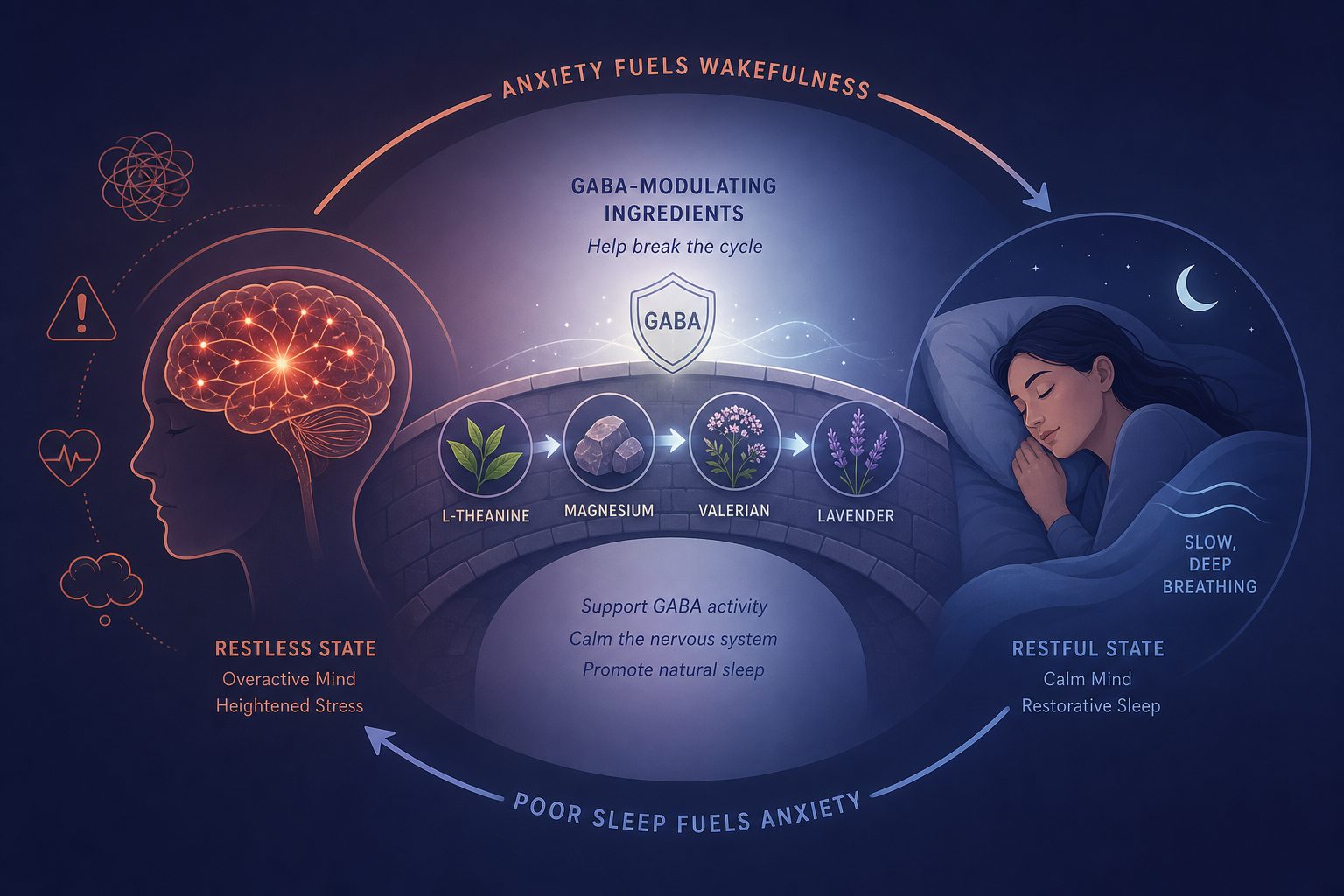
L-theanine is often discussed for relaxation without strong sedation. In sleep terms, it may be a better conceptual fit for sleep maintenance or a too-alert nervous system than for a severely delayed sleep schedule. If your issue is that you do not feel sleepy until 2 a.m., a circadian approach is more logical. If your issue is light, restless sleep during a stressful period, L-theanine may be more plausible.
This is the broader point behind supplement matching: mechanism should follow the complaint. A guide organized by the specific sleep problem—not by whatever ingredient is trending—is usually more useful. For that approach, see how to choose a sleep supplement based on your specific sleep problem.
Limited or mixed: familiar remedies with smaller claims
Valerian: studied more than most herbs, still not a clean answer
Valerian deserves more attention than chamomile or tart cherry juice because it has been studied more directly as a sleep aid. In the 2025 scoping review, valerian and melatonin had the most substantial evidence among OTC insomnia products.[2] That is not the same as saying valerian reliably treats insomnia.
The problem is consistency. Herbal preparations differ, doses differ, trial quality differs, and the effects—when present—may be modest. Valerian may be a reasonable short-term experiment for an otherwise healthy adult with mild sleep-onset trouble who understands the uncertainty. It is a weaker choice for someone with chronic insomnia, complex medication use, liver concerns, pregnancy questions, or next-day impairment.
Magnesium: tempting, especially if the number is quoted without the fine print
Magnesium is one of the easiest remedies to oversell because the story sounds biologically tidy: muscles, nerves, relaxation, deficiency. The sleep evidence is much less tidy.
As summarized in secondary reporting of the evidence, older adults in a small set of low-quality trials fell asleep about 17 minutes faster on average with magnesium.[6] That is concrete enough to matter to a tired person. It is also too fragile to turn into “magnesium works for insomnia.” The population was specific, the trial base was small, and quality concerns stay attached to the estimate.
Magnesium may make more sense when there is a plausible reason to suspect low intake or when a clinician has identified deficiency. It is less compelling as a blanket sleep remedy for a healthy adult whose main issue is revenge bedtime scrolling, circadian delay, or conditioned arousal. It can also cause gastrointestinal side effects and may be inappropriate with certain kidney problems or medications.
Chamomile and tart cherry juice: gentle does not mean proven
Chamomile tea may be a perfectly decent bedtime ritual. Warm liquid, a familiar taste, and a repeated cue can help some people downshift. But the direct sleep evidence is limited, and the main benefit may be the routine rather than a strong sedative effect from chamomile itself.
Tart cherry juice is often marketed around melatonin content and recovery claims. The sleep-specific evidence is not strong enough to make it a priority remedy for insomnia. It also adds sugar or calories unless chosen carefully, which may matter for some people. If you like it and tolerate it, fine; it should not outrank stimulus control, regular wake time, light management, or a better-matched supplement.
Unsupported or not first-line: CBD, kava, and adaptogens for sleep
CBD is everywhere in sleep marketing, but “people feel relaxed” is not the same as direct, durable evidence for insomnia. Products also vary widely, and the practical questions—dose, purity, drug interactions, next-day effects, and legal or workplace testing concerns—are not small details.
Kava raises a different concern: even if someone is using it for anxiety-related sleeplessness, safety issues make it a poor casual sleep remedy. Adaptogens are even broader. A product marketed for stress resilience may have little direct evidence that it improves sleep onset, sleep maintenance, or insomnia severity.
This is where “over the counter” can mislead. It does not mean a product has been proven to treat insomnia, and it does not mean the risk profile is trivial. For more on that regulatory difference, see what “over the counter” actually means for sleep aids.
The placebo and ritual effect is real—but it has limits
Sleep is unusually responsive to expectation and conditioning. National Geographic’s reporting on sleep aids makes this point bluntly through sleep experts: rituals can work because the brain learns cues, and Michael Grandner cautions that “insomnia is a medical condition” while supplements “don’t treat medical conditions.”[1]
That is not an argument against rituals. It is an argument for knowing what part of the ritual is doing the work. A cup of chamomile tea may help because it marks the start of the night. Lavender may help because it has become paired with lights out. A supplement may appear to help because taking it reduces worry and creates a sense of control. Those effects can be useful, especially during temporary stress.
They can also keep a person stuck if the real problem is chronic insomnia, untreated sleep apnea, depression, pain, medication side effects, alcohol use, hot flashes, restless legs, or a circadian rhythm disorder. A calming ritual should lower the friction around sleep, not replace diagnosis when the pattern is persistent.
How to choose what to try first
Start with the sleep complaint, not the remedy.
| If your pattern is... | Prioritize first | Be cautious about |
|---|---|---|
| You are wide awake in bed and the bed has become a place of effort | Stimulus control, regular wake time, CBT-I-based strategies | Adding supplement after supplement while continuing long wakeful periods in bed |
| Your sleep schedule has drifted late, or travel/shift timing is the issue | Light timing, wake-time consistency, melatonin only if it fits the circadian problem | Using melatonin as a general sedative |
| Stress is temporarily making sleep lighter or more fragile | A repeatable wind-down routine, lavender cue, possibly L-theanine or glycine if appropriate | Mistaking short-term stress sleep for chronic insomnia self-treatment |
| You are an older adult considering supplements | Safety review, medication interaction check, behavioral options first | Magnesium, antihistamines, sedating herbs, or multi-ingredient products without guidance |
| Sleep trouble is lasting, worsening, or affecting daytime functioning | Clinical evaluation and CBT-I access | Continuing to rotate OTC products instead of treating insomnia as a health condition |
For a symptom-matching approach to non-drug strategies, see how to fall asleep based on what’s actually keeping you awake. If you are comparing supplements specifically, the best sleep supplement depends on the sleep problem, not on the longest list of ingredients.
When home remedies are no longer the right frame
Consider medical guidance if sleep trouble lasts for weeks and keeps returning, causes daytime sleepiness or impairment, worsens mood, leads to drowsy driving, or comes with loud snoring, gasping, restless legs, pain, panic, medication changes, pregnancy, or significant health conditions. Older adults should be especially cautious with sedating products and multi-ingredient sleep aids; a safety hierarchy matters more than a “natural” label. See sleep aids for older adults for that risk-focused view.
If the question has shifted from “What can I try tonight?” to “Why can’t I sleep anymore?” the better next step is evaluation, not another bottle. A practical triage guide is here: when trouble sleeping at night warrants a doctor’s visit.
The priority rule is simple enough to keep at 2 a.m.: match the remedy to the sleep problem, start with the strongest and safest behavioral options, treat supplements as targeted tools rather than insomnia treatment, and get help when the pattern is chronic, worsening, or medically complicated.
References
- Do natural sleep aids actually work? — National Geographic.
- Over-the-counter products for insomnia: A scoping review of randomized controlled trials — Sleep Medicine, Elsevier, 2025.
- Behavioral and psychological treatments for chronic insomnia disorder in adults: an American Academy of Sleep Medicine clinical practice guideline — Journal of Clinical Sleep Medicine, American Academy of Sleep Medicine, 2021.
- Insomnia treatment: Cognitive behavioral therapy instead of sleeping pills — Mayo Clinic.
- Adult Activity: An Overview — Centers for Disease Control and Prevention.
- Magnesium for Sleep — Sleep Foundation.

Comments
Join the discussion with an anonymous comment.