
The light is out, the house is quiet, and there is no work alarm waiting in the morning. That ought to make sleep easier. Instead, retirement math starts moving across the ceiling: the grocery bill that used to fit more comfortably, the insurance notice still on the kitchen table, the account balance that has to last longer than anyone can confidently picture.
For many retirees, inflation stress is not a daytime worry that politely stops at bedtime. In Schroders' 2026 U.S. Retirement Survey, 28% of retired Americans said they had lost sleep worrying about their financial situation. In the same survey, 90% were at least slightly concerned that inflation would erode the value of their savings, 49% said their expenses were higher than expected, and 58% said they did not know how long their savings would last.[1]

Those numbers matter because they name the condition under the complaint. Inflation-related sleep problems in retirement are not only about prices. They are about uncertainty that has nowhere to go once the day is over. A person can be sensible, frugal, and well past the age of careless spending, and still lie awake because the margin feels thinner than it did a few years ago.
The fear of running out is especially hard to put down. Allianz Life reported in 2026 that 67% of investors said they were more worried about outliving their savings than about dying, a record high in that survey. That figure is not retiree-only data, so it should not be treated as a direct measure of retired households. Still, it captures the emotional shape of the worry: longevity, once hoped for, begins to look like a bill that has not yet arrived.[2]
Why Financial Worry Gets Louder at Bedtime
Bedtime gives the mind two things financial anxiety likes: quiet and no immediate action. During the day, a retiree can call an office, look for a document, compare a bill, or ask a spouse where the password is. At midnight, the same questions remain open, but the useful tools are gone. The brain keeps working anyway.
Sleep depends on a shift away from alert problem-solving. Financial threat pulls in the opposite direction. The mind begins rehearsing numbers, testing worst cases, and trying to produce certainty before morning. That mental activity is cognitive arousal: the thinking version of being on guard. The body can follow with stress physiology, including heightened alertness when it should be preparing for sleep.
A Rice University study helps explain this pathway, though it should be applied carefully. The study looked at Army and Air National Guard service members, not retirees. It found that economic stress predicted more bedtime stress behaviors, and those behaviors predicted more insomnia symptoms, lower sleep satisfaction, and greater daytime impairment.[3] The population is younger and employed, but the bedtime mechanism is recognizable: money stress follows people into bed, and what happens in bed can carry into the next day.
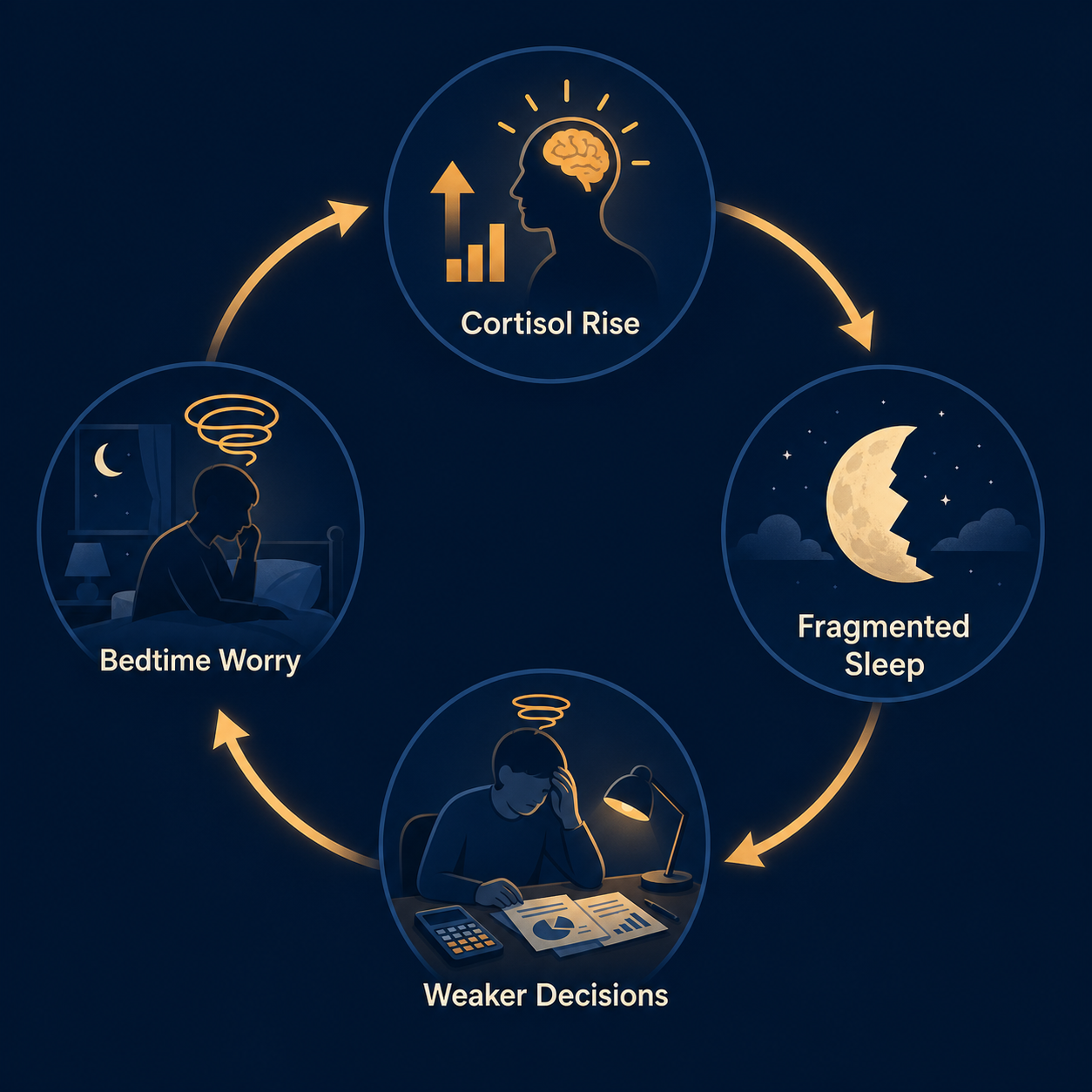
In retirement, that pathway can be especially sticky because the threat feels ongoing. A single unexpected repair bill may disturb sleep for a few nights. Inflation pressure is different. It changes the meaning of ordinary purchases. A receipt is not just a receipt; it becomes a small forecast. A Medicare notice is not just paperwork; it becomes evidence that the household may need another recalculation.
The Loop: Worry, Fragmented Sleep, Harder Decisions
The first part of the loop is familiar: inflation makes future expenses feel less predictable, and the brain tries to solve that uncertainty at night. The second part is more damaging. Rumination does not merely delay sleep. It can fragment the night, making sleep lighter, shorter, and less restorative.
After a poor night, the very tasks that might reduce the worry become harder. Comparing plan options, calling a financial adviser, reading benefits paperwork, or deciding whether to delay a purchase all require attention, working memory, and emotional steadiness. Poor sleep weakens those capacities. The spreadsheet looks more threatening. The phone call feels more tiring. A spouse's attempt to postpone the conversation can sound dismissive, even if it is meant kindly.
That is how a practical concern becomes a sleep condition. The problem is not that the retiree worries too much. The problem is that the worry has been assigned to the wrong shift. Nighttime becomes the household's unofficial finance office, but it is the worst office in the house: no records spread out, no fresh attention, no professional help available, and a tired brain treating every unknown as urgent.
Economic hardship and sleep difficulty also have older-adult evidence beyond inflation surveys. In a 2019 study using data from adults 60 and older, sustained poverty was associated with 71% to 78% increased odds of difficulty falling asleep.[4] Poverty is not the same as inflation worry, and the study should not be stretched into saying that today's price increases directly cause insomnia in every retiree. It does support a narrower and important point: when economic strain is sustained, sleep initiation in older adults suffers.
Retirement Can Loosen the Sleep Schedule Just When Stress Tightens
Work can be exhausting, but it often provides one useful sleep anchor: a fixed wake time. Retirement removes that anchor for many people. Without a consistent morning obligation, bedtime can drift later, wake time can vary, and naps can lengthen after a bad night. Brandon Peters, MD, writing for Verywell Health in January 2026, notes that retirement-related schedule variability can worsen insomnia and that a consistent wake time is one of the most effective single interventions.[5]
This is where advice can easily sound insulting if it is delivered too soon. A steady wake time will not lower the grocery bill. It will not tell anyone how long a portfolio will last. But it does protect the sleep system from becoming even more unstable while the financial questions are being handled.
Think of the wake time as a rail, not a cure. If the night was poor, getting up at roughly the same time helps preserve sleep pressure for the following night. Sleeping late may feel like repayment, but it can make bedtime less predictable and give worry a wider stage the next evening.
What to Do Tonight When Money Thoughts Start Running
The first job is not to solve retirement finances at 2 a.m. The first job is to stop training the bed to become the place where financial threat gets rehearsed. These steps borrow from behavioral sleep medicine and CBT-I principles, without pretending that a breathing exercise can make inflation irrelevant.
- Keep tomorrow morning's wake time steady. Choose a time you can live with most days, including after a bad night.
- Move financial thinking out of bed. If a money worry appears, write a brief note such as "call about premium" or "ask adviser about withdrawal rate," then close the notebook.
- Use stimulus control. If you are awake and increasingly alert, get out of bed and do something quiet in dim light until sleepiness returns.
- Do not open account balances, news, or budgeting apps in bed. Those tools invite the brain to work when it needs to stand down.
- Keep the intervention boring. The goal is not to feel inspired; it is to reduce arousal enough for sleep to return.
A written note helps because it gives the brain a receipt. The worry has not been ignored; it has been assigned a time and place. That small distinction matters. Many people stay awake because they are afraid that if they stop thinking, they will forget something important. A notebook by the bed can hold the task without requiring the whole body to remain on alert.
The note should be plain, not a midnight budget session. "Check Part D notice Tuesday" is useful. A full recalculation of life expectancy, inflation, taxes, and home repairs at 2:17 a.m. is not. When the mind tries to continue the meeting, the answer is the same each time: this has been recorded; the meeting is tomorrow.
During the Day, Give the Worry an Appointment
Worry scheduling can sound too tidy for real financial strain, but its purpose is practical. A retiree who is worried all day and awake half the night is not getting more financial control. They are losing the attention needed to make the next decision.
Set a daily or several-times-weekly money window, preferably not in the evening. Use it for the concrete tasks that keep returning at night: opening one piece of mail, making one phone call, checking one bill, locating one password, writing down one question for a planner or trusted family member. Stop at the appointed time, even if the whole problem is not solved.
| When the worry appears | What to do with it | Why it helps sleep |
|---|---|---|
| At bedtime | Write one brief task and leave it for the scheduled money window | Reduces the need to keep rehearsing the thought |
| During a planned daytime window | Open documents, make calls, compare options, or ask for help | Moves problem-solving into a time when the brain can actually work |
| After the window closes | Keep a running list for the next appointment | Prevents financial work from spreading across the whole evening |
The household may need a rule here. If two people share the finances, the person who wants to postpone the discussion and the person who wants to solve it immediately both need a visible next step. "Tomorrow" is often too vague. "Tomorrow at 10, we call the insurer and then stop" is easier for the nervous system to believe.
Lower Arousal Without Pretending Relaxation Solves the Budget
Relaxation practices are useful when they are given the right job. Their job is not to convince a retiree that financial worry is irrational. Their job is to help the body leave emergency mode after the practical work has been scheduled.
A short wind-down routine can be enough: dim lights, no financial news, no account checking, the same quiet sequence each night. Some people do well with slow breathing, a body scan, prayer, calm music, or reading something undemanding. The method matters less than the repetition and the absence of fresh financial input.
Naps deserve a careful look. After a broken night, a long afternoon nap can feel necessary. For some older adults, a brief planned rest may be manageable. But if naps keep pushing bedtime later or making the first half of the night restless, they are feeding the loop. The question is not whether napping is good or bad in the abstract; the question is whether it is protecting tonight's sleep pressure or stealing from it.
Alcohol is another common but unreliable shortcut. It may make sleep onset feel easier, but it can worsen sleep quality later in the night. Sedating medications and over-the-counter sleep aids also deserve caution in older adults. Many can increase risks such as falls, confusion, or next-day impairment, and geriatric prescribing standards including the Beers Criteria flag multiple sedating drugs as potentially inappropriate for many older patients. Chronic insomnia is better approached first with CBT-I or CBT-I-informed care, with medication decisions handled by a clinician who knows the person's full health picture.
Turn the Undefined Fear Into a Daytime Plan
The deeper interruption happens when financial dread becomes more specific. Specific does not always mean pleasant. It may reveal a gap, a tradeoff, or a decision that has been avoided. But specific worry is less likely to roam the house at night than undefined worry.
The Schroders finding that 58% of retirees do not know how long their savings will last is a sleep-relevant number, not just a planning statistic.[1] "I don't know" is hard to sleep beside. A person may not need a perfect projection, but they do need fewer blank spaces. That may mean meeting with a fiduciary adviser, using a conservative withdrawal estimate, reviewing fixed and flexible expenses, or asking an adult child or trusted friend to sit through the paperwork without taking over.
A useful first pass is modest. List the expenses that truly cannot move, the expenses that can be adjusted, the dates when benefits or withdrawals arrive, and the decisions that require outside help. Do not try to solve the rest of retirement in one sitting. The aim is to replace a foggy threat with named questions.
- What has gone up and by roughly how much?
- Which bills are fixed, and which have options?
- What decision needs a professional answer?
- What can wait until the next scheduled money window?
- Who else needs to know the plan, passwords, or due dates?
This is not positive thinking. It is containment. The brain sleeps better when it trusts that unfinished business has a daytime container. The financial problem may still be real, but it no longer has permission to run the household from the pillow.
When to Treat It as Insomnia, Not Just Stress
A few bad nights during a financial scare are common. The concern grows when sleep disruption becomes patterned: long sleep onset most nights, repeated awakenings with money thoughts, dread of bedtime, heavy daytime fatigue, irritability, or trouble handling ordinary decisions. At that point, the sleep problem deserves its own care, even while the financial work continues.
CBT-I is the first-line behavioral treatment framework for chronic insomnia because it addresses the habits, conditioned arousal, and sleep scheduling patterns that keep insomnia alive. For retirees, that may include stimulus control, sleep scheduling, reducing time awake in bed, managing naps, and challenging catastrophic bedtime thoughts without dismissing the real financial facts.
Medical review also matters when sleep changes quickly or comes with symptoms such as loud snoring, breathing pauses, restless legs, depression, medication changes, pain, or frequent nighttime urination. Inflation anxiety may be the loudest worry in the room, but it is not the only possible cause of poor sleep in later life.
The cleanest plan works at both ends of the loop. At night, protect the bed from rumination: steady wake time, no account checking, brief written capture, stimulus control, and a wind-down routine that lowers arousal. During the day, reduce the uncertainty that keeps returning: scheduled money windows, named questions, shared paperwork, and professional help when the decisions are too consequential to carry alone.
Inflation worry may not disappear quickly. Prices may still feel high, and some decisions may remain uncomfortable. But retirees sleep better when nighttime is no longer the place where unsolved financial questions are allowed to run the whole household.
References
- Study Reveals How Retirees Are Responding to the Affordability Crisis, Schroders, 2026.
- The 5 biggest financial concerns for retirees, according to new research, CBS News, 2026.
- Losing sleep over money: Rice study reveals how financial stress follows workers to bed, Rice News, December 2025.
- Economic Hardship and Sleep Problems among Older Adults: A Longitudinal Study, PubMed Central, 2019.
- How Retirement Can Ruin Your Sleep and Provoke Insomnia, Verywell Health, January 2026.






Comments
Join the discussion with an anonymous comment.