
For many adults, heart attack risk is highest in the first few hours after waking, when the body shifts from sleep into daytime physiology. Blood pressure rises, stress hormones climb, and the cardiovascular system starts doing more work. That morning pattern is familiar enough that “heart attack risk” and “waking up” often get discussed together.
Obstructive sleep apnea complicates that picture. In people with untreated OSA, the danger does not appear to sit only at the edge of morning. A newer line of research points to a nighttime vulnerability during sleep itself: blood vessels may function worst around the middle of the biological night, even when researchers control for meals, activity, and sleep timing. That does not mean a heart attack is “scheduled” for 3 a.m. It means the body’s internal clock may help explain why heart attack risk in sleep apnea has a different timing pattern than the one usually described for the general population.
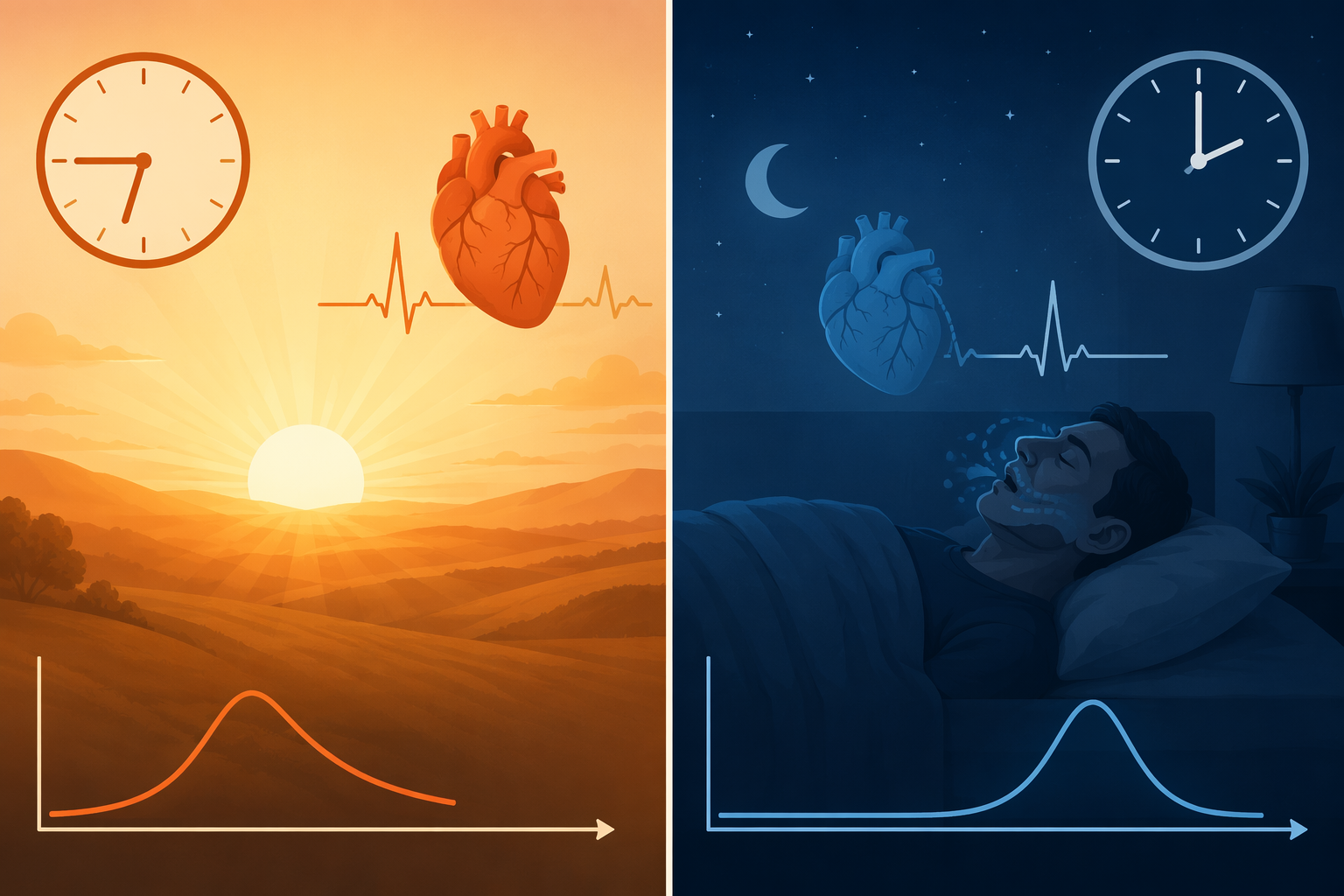
The timing puzzle: morning risk for many people, nighttime risk in untreated OSA
The usual morning peak has a straightforward explanation: the transition into wakefulness is not gentle for the cardiovascular system. The circadian system helps coordinate a morning rise in cortisol and catecholamines, the heart works against increasing blood pressure, and blood vessels move into a more active daytime state. For a person with vulnerable arteries, that transition can be a risky window.
Sleep apnea adds a different stress pattern. During obstructive apneas, the airway repeatedly collapses or narrows, oxygen levels can fall, carbon dioxide can rise, and the brain has to push the body toward brief arousal to restore breathing. Those events can activate the sympathetic nervous system, raise blood pressure, and disturb sleep architecture. But apnea events alone have never fully explained the timing question: why would cardiovascular events in this group cluster during the hours when the person is supposedly resting?
| Group | Typical timing pattern | What the timing suggests |
|---|---|---|
| General population | Heart attacks peak in the first few hours after waking | The wake transition and morning circadian surge matter |
| People with untreated obstructive sleep apnea | Vulnerability appears to shift into the sleeping hours | Nighttime physiology, repeated breathing stress, and circadian vascular control may overlap |
That distinction matters because it changes the way the risk should be explained. A person with OSA is not just “snoring harder” at night. Their blood vessels may be entering the most unfavorable part of their daily rhythm at the same time their breathing is repeatedly interrupted.
What the OHSU study actually tested
The clearest recent evidence comes from Oregon Health & Science University, where researchers studied 12 adults with untreated obstructive sleep apnea in a tightly controlled inpatient protocol. The study ran for five days and used 10 sleep-wake cycles, while controlling meals, exercise, and sleep timing. Researchers measured blood vessel function across the day with non-invasive ultrasound and found the worst vascular function around 3 a.m. The key conclusion was that the impairment was driven by the circadian system, not by apnea events alone.[1]
The small sample deserves attention, not dismissal. Twelve people cannot represent every age, body size, medication pattern, OSA severity level, or cardiovascular history. The authors themselves called for replication before clinical protocols change.[1] At the same time, the design answers a question that messier real-world studies often cannot answer: what happens when researchers reduce the usual noise from food timing, daytime activity, and ordinary sleep schedules?
That is why the 5-day, 10-cycle protocol is more than a technical detail. If blood vessel function worsens at night in a regular home setting, it is difficult to know whether the cause is late meals, inconsistent sleep, apnea severity, fragmented sleep, stress, medication timing, or the internal clock. By controlling daily inputs, the researchers could look more directly at circadian influence. The result points to the body clock as an active contributor to overnight vascular impairment in untreated OSA.[1]
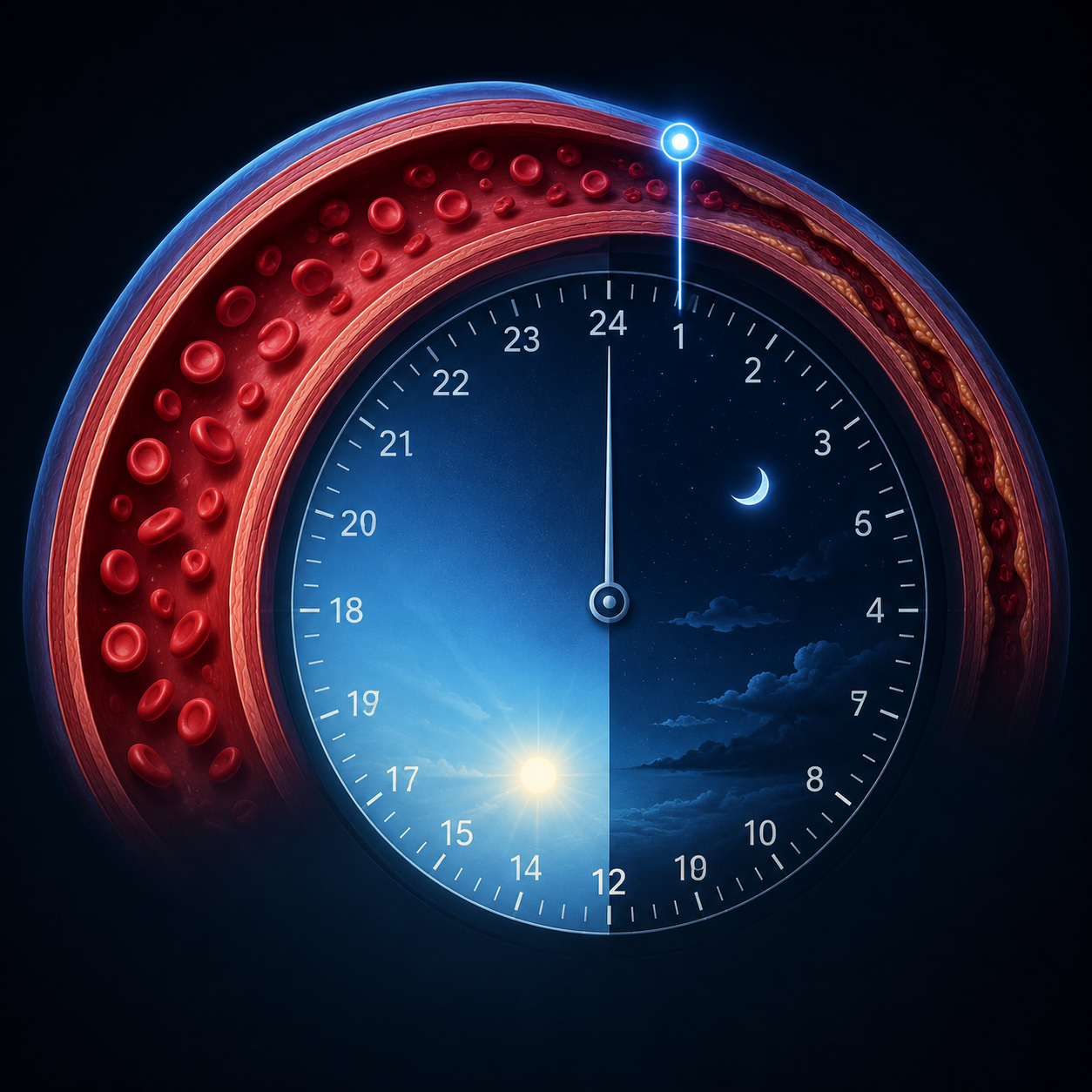
What “vascular impairment” means in plain terms
Blood vessels are not rigid pipes. Healthy arteries widen and narrow in response to changing demand. When you stand up, exercise, digest a meal, cool down, heat up, or sleep, the vessel wall helps regulate blood flow and pressure. One way researchers assess vascular health is by testing how well a vessel dilates when it should.
In the OHSU study, nighttime impairment meant that blood vessels were less able to perform that adaptive function around the biological night’s vulnerable window. This is not the same as observing a heart attack. It is a measurable change in vascular behavior that could make an already stressed cardiovascular system less resilient when other pressures arrive.
For someone with untreated OSA, those pressures can arrive repeatedly. The airway closes or narrows. Oxygen may drop. The chest works harder against a blocked airway. The brain pushes the body toward arousal. Blood pressure and sympathetic activity can surge. If blood vessels are also at their circadian low point for function, the nighttime risk pattern becomes less mysterious.
The mechanism is best read as a bridge, not a prediction. A 3 a.m. vascular low point does not tell an individual patient that 3 a.m. is their personal danger hour. It helps explain why a population with untreated sleep apnea may not follow the general morning-risk pattern. The body is resting in one sense, but the cardiovascular system is not necessarily protected.
The internal clock is not just about feeling sleepy
Circadian rhythm is often reduced to bedtime preference: early bird, night owl, jet lag. The cardiovascular version is more consequential. The brain’s master clock helps coordinate 24-hour patterns in hormones, blood pressure, body temperature, alertness, metabolism, and vascular tone. A fuller explanation of that system belongs in a circadian rhythm mechanisms guide, but the sleep apnea point is narrower: the clock appears to shape how blood vessels behave overnight.
This is also why “the apnea events did it” may be an incomplete answer. Breathing pauses matter. Oxygen drops matter. Arousals matter. But the OHSU finding suggests they occur on top of a daily vascular rhythm that may already be unfavorable during the biological night. The overlap is the concern.
That overlap may be especially relevant for people who have been diagnosed but are not treating OSA consistently. Cardiovascular risk is often described as a long-term consequence of untreated sleep apnea, which can sound abstract. The circadian finding gives the risk a more concrete shape: every untreated night may include periods when breathing instability and vascular vulnerability coincide.
Why one sleep study number may not capture the whole risk
A separate 2026 finding adds an important complication: sleep apnea severity can vary substantially from night to night. People with moderate-to-severe OSA whose apnea severity fluctuated substantially across nights had 45% higher odds of heart attack or stroke, according to data cited in a 2025 Biomedicines review.[2]
That does not prove that variability itself causes the events. It does mean a single diagnostic label, or even one night’s apnea-hypopnea index, may not fully describe cardiovascular exposure. A person might have some nights with fewer obstructive events and other nights with heavier breathing disruption, more oxygen stress, different sleep position, alcohol exposure, nasal congestion, medication effects, or REM-heavy sleep.
This is where consumer detection tools can be helpful but limited. FDA-cleared smartwatch notifications may prompt someone to seek evaluation, and they may reveal that breathing irregularity is not a one-night curiosity. They do not replace a clinical diagnosis or a treatment plan. Readers trying to understand screening options can start with a practical overview of FDA-cleared sleep apnea notifications, then bring the results to a clinician rather than treating the device as the final answer.
What this does and does not change for someone with OSA
The practical message is not to lie awake monitoring the clock. Anxiety at 3 a.m. is not treatment, and the study does not support that kind of personal prediction. The better use of the finding is to take untreated OSA seriously as a nighttime cardiovascular stressor, not only as a source of snoring, fatigue, or morning headaches.
If OSA is suspected but not diagnosed, the next step is proper evaluation. If OSA is diagnosed but treatment is inconsistent, the next step is not to improvise around the airway. Some popular shortcuts can be risky in people with unrecognized or untreated sleep apnea; mouth taping with sleep apnea is a good example of a trend that can make breathing problems harder to manage if the underlying condition is not addressed.
Treatment decisions still depend on the person: OSA severity, oxygen drops, symptoms, anatomy, cardiovascular history, sleep position, and tolerance of therapy. Some people have positional OSA, where events are worse on the back, and may need a different discussion than someone whose events occur across positions. A sleep-on-back decision framework can help readers understand why position matters, though it should not be used to self-clear moderate or severe OSA.
People who work nights or rotating shifts have another layer to discuss with a clinician. Circadian timing affects more than sleepiness, and a shifted schedule may change when the biological night occurs. Readers with persistent insomnia, sleepiness, or rotating schedules may find the broader shift work disorder context useful, especially if apnea symptoms are also present.
The calibrated takeaway
The new research does not prove that every person with sleep apnea faces a heart attack at night. It does not make 3 a.m. a clinical alarm time. It does not replace established diagnosis and treatment pathways. The OHSU study was small, and its controlled setting needs replication in broader real-world populations.[1]
What it does provide is a credible mechanism for a pattern patients often find confusing: untreated obstructive sleep apnea may be especially dangerous during sleep because the internal clock can drive overnight vascular impairment at the same time breathing events are stressing the cardiovascular system. That is a sharper explanation than “sleep apnea is bad for the heart,” and it is enough reason not to treat nighttime breathing pauses as harmless just because they happen while the rest of the body appears to be at rest.
References
- Study: Body’s circadian rhythm may increase overnight cardiovascular risk in people with sleep apnea, OHSU News, November 17, 2025.
- Biomedicines review citing forthcoming 2026 night-to-night variability data, Biomedicines, 2025.
Comments
Join the discussion with an anonymous comment.