
The annoying thing about a sports injury is how often it arrives after a completely ordinary week. Same route. Same lifting plan. Same pickup game. No dramatic mistake, no heroic workout, no obvious explanation. The calf goes tight anyway, the tendon starts talking, the ankle rolls on a landing that should have been routine.
When active adults look backward, they usually audit the visible parts of training first: shoes, mileage, warmups, strength work, technique, court surface, bad luck. Those all matter. But the sleep-and-injury signal is now too consistent to treat sleep as background noise. In prospective research, the risk signal shows up before the injury happens, not only after pain starts disrupting nights.
A 2024 review for the American College of Sports Medicine reported that athletes sleeping fewer than seven hours per night had about 1.7 times the risk of musculoskeletal injury compared with athletes sleeping seven hours or more.[1] In NCAA Division I basketball players, each additional hour of sleep was associated with a 43% lower odds of injury the next day.[2] In a six-month prospective running study summary, each one-point worsening in sleep quality was associated with a 36% increase in running-related injury risk.[3]
Those numbers are not interchangeable. They come from different sports, age groups, sleep measures, and injury definitions. Still, they point in the same direction with enough force to change how a runner, lifter, or recreational athlete should think about risk. Sleep is not a soft add-on to the real injury-prevention work. It is one of the conditions under which that work either holds up or starts to fail.

The Injury Signal Is Strongest When Sleep Is Measured Before the Injury
The most useful sleep-and-injury studies are prospective: they measure sleep first, then watch what happens. That design does not prove every injury was caused by a bad night, but it avoids the weakest version of the argument, where an injured athlete sleeps poorly because pain, stress, or reduced activity has already entered the picture.
The ACSM review’s 1.7-times figure matters because it frames sleep duration as a risk exposure, not merely a wellness preference. Below seven hours, injury risk was meaningfully higher for musculoskeletal injuries.[1] That does not mean seven hours is a magic shield. It means the common habit of shaving sleep to preserve training volume is not neutral.
The basketball finding is sharper because it looked at next-day injury odds. In NCAA Division I players followed across two seasons, each additional hour of sleep was associated with a 43% reduction in injury odds the following day.[2] For a team athlete, that is easy to picture: one tired practice, one late rotation, one awkward landing, one contested rebound where the body is a fraction behind the play.
The adolescent athlete data points in the same direction. In research summarized in the athletic-performance sleep literature, adolescent elite athletes averaging more than eight hours on weeknights had 61% lower odds of new injury than those sleeping less.[2] This is not a perfect match for a 38-year-old recreational runner with a desk job, but it is still hard to dismiss. Tendons, muscles, reaction time, and decision-making do not become unrelated to sleep just because the athlete is no longer on a school team.
The running evidence adds a useful correction to the hour-counting habit. A six-month prospective study summary reported that worsening sleep quality, not just short sleep, tracked with running-related injury risk: each one-point worsening in sleep quality was associated with a 36% increase in injury risk.[3] That is the kind of finding recreational runners should notice, because many do not report extreme sleep deprivation. They report fragmented sleep, inconsistent timing, early alarms, travel, stress, and the occasional heroic long run after a bad night.
| Evidence | What It Measured | Main Risk Signal | How to Read It |
|---|---|---|---|
| ACSM review | Sleep duration and musculoskeletal injury risk | Fewer than 7 hours linked with about 1.7x higher injury risk | A broad risk estimate; useful for seeing that short sleep is not a minor exposure |
| NCAA Division I basketball | Sleep and next-day injury odds | Each added sleep hour linked with 43% lower next-day injury odds | A short-term signal; especially relevant to practices, games, and hard sessions |
| Adolescent elite athletes | Weeknight sleep duration and new injury | More than 8 hours linked with 61% lower odds of new injury | Strong but youth-heavy evidence; not automatically identical to adult recreation |
| Recreational running study summary | Sleep quality and running-related injury over six months | Each one-point sleep-quality worsening linked with 36% higher injury risk | Important because quality and fragmentation can matter even when duration looks acceptable |
| Composite sleep-profile approach | Duration, quality, timing, and consistency together | Poor Sleepers linked with 1.78x higher injury odds and 68% injury probability | A reminder that the injury-relevant sleep signal is broader than hours alone |
How a Bad Night Becomes a Bad Landing
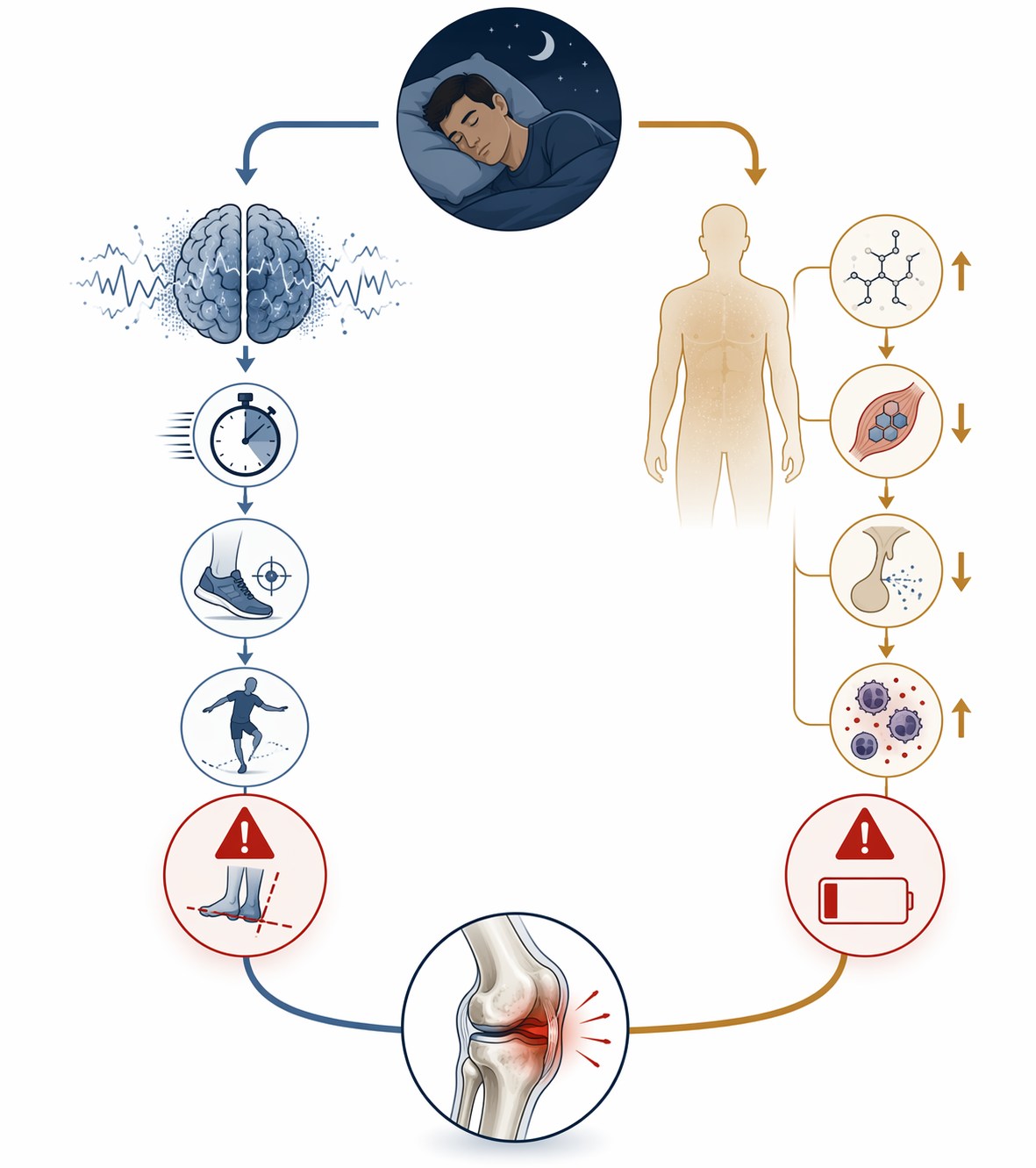
The first pathway is not mysterious: sleep loss makes the nervous system less reliable. Reaction time slows, attention drifts, decision-making worsens, and motor control becomes less precise.[2] In normal life, that might mean forgetting why you walked into a room. In sport, it can mean planting the foot a little late, bracing a little softly, or choosing the wrong movement under pressure.
Most recreational injuries are not cinematic. They are small timing failures under load. A runner clips the ground when fatigue and poor coordination change stride mechanics. A lifter loses position in the last reps of a set. A basketball player lands with the knee caving inward after reacting late to contact. None of these requires sleep to be the only cause. Sleep just has to make the margin for error smaller.
This is where the brain side of sleep deprivation stops being abstract. If the body has to absorb force, choose a movement, and stabilize a joint in a fraction of a second, then slower processing and poorer motor control are injury-relevant. The deeper cognitive mechanisms are covered in more detail in How Sleep Deprivation Impairs Your Brain, but the practical point for training is simpler: coordination is part of recovery, not just strength.
The Recovery Environment Changes Too
The second pathway is slower and easier to ignore. Poor sleep changes the internal environment in which tissues are trying to repair, refuel, and adapt. Reviews of sleep and athletic performance describe links between sleep restriction and elevated cortisol, altered inflammatory markers including IL-6 and CRP, and disrupted growth hormone secretion.[2] That is not a recipe for connective tissue becoming invincible under repeated loading.
The glycogen finding makes this less vague. In work summarized in the athletic-performance literature, Skein and colleagues reported that after sleep deprivation, muscle glycogen resynthesis was lower: 209 mmol·kg⁻¹ dry weight compared with 310 mmol·kg⁻¹ dry weight after normal sleep.[2] For an endurance athlete or field-sport player, that matters because the next session may begin with less fuel restored than the training plan assumes.
A tired athlete can still complete the workout. That is part of the problem. The watch records the miles, the log records the sets, and the athlete gets the satisfaction of not skipping. But if fuel restoration, hormonal signaling, inflammation, and neuromuscular control are all worse than usual, the same workout is not the same stimulus. It is a higher-risk version of it.
Duration Is Only One Part of the Sleep Signal
The easy advice is “get eight hours.” Sometimes that is exactly the right starting point, especially for the athlete living on five or six. But injury risk does not appear to care only about total time in bed. The evidence base uses different sleep measures: duration cutoffs, subjective quality ratings, insomnia symptoms, daytime sleepiness, actigraphy, and multidimensional sleep profiles. That makes direct comparison messy, but it also makes the practical message better.
That is why the sleep-profile approach is useful. In work combining duration, quality, timing, and consistency, “Poor Sleepers” had 1.78 times higher injury odds and a 68% injury probability. The point is not that every adult needs a formal score. It is that a stable seven and a half hours is not the same sleep exposure as seven and a half hours broken by awakenings, shifting bedtimes, and early-alarm debt.
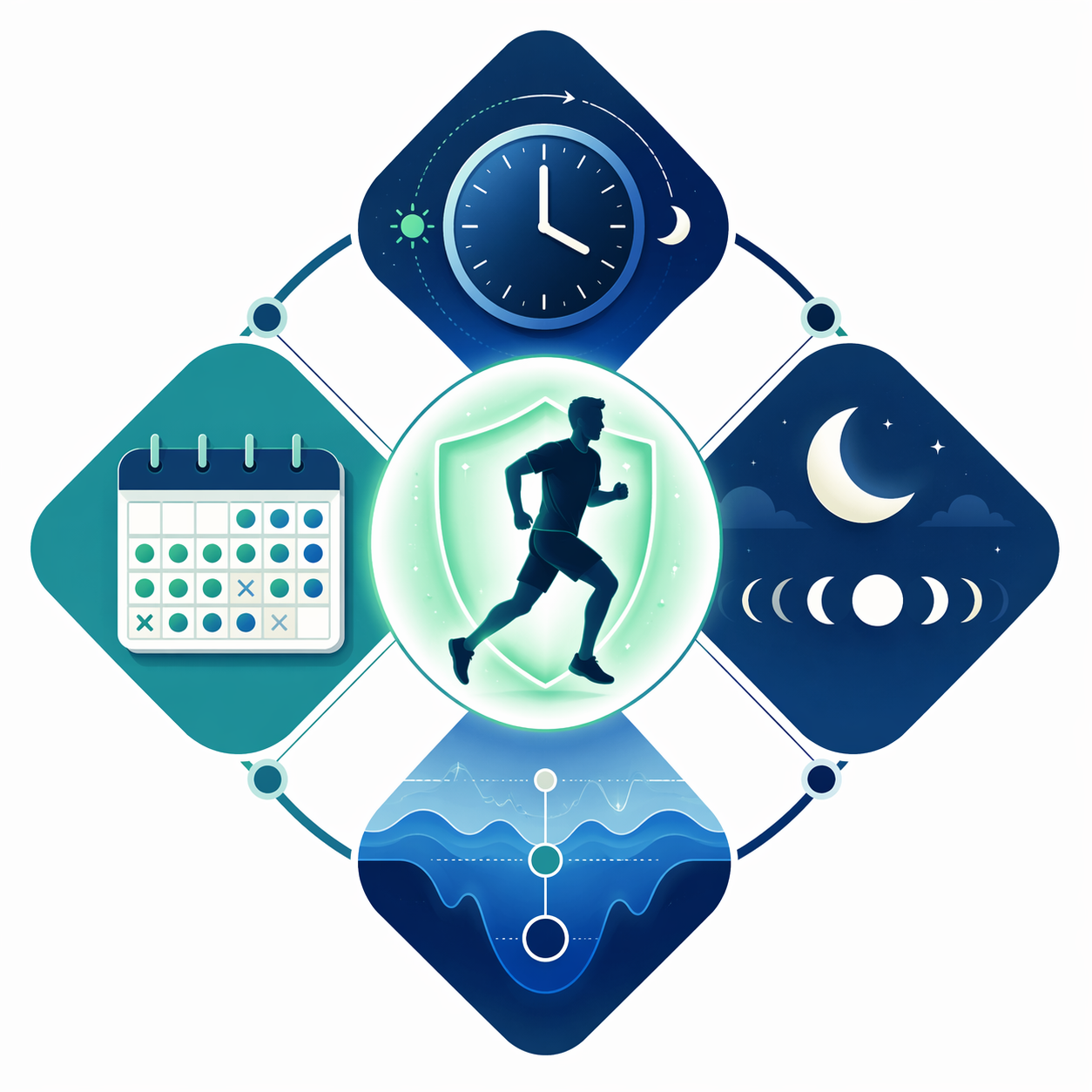
That broader view also protects against a common mistake: treating one good night as a full reset. If several nights were short or fragmented, the next hard session may still carry more risk. The body does not negotiate with the spreadsheet just because the planned workout says tempo run, heavy squats, or league game.
What Active Adults Should Watch Before Training Hard
For recreational athletes, the point is not to build a professional recovery department. It is to stop separating sleep from load management. If sleep has been poor, the same training load may deserve a different decision.
- If sleep drops below your normal baseline for several nights, reduce the ambition of the next high-intensity session.
- If sleep quality is poor even when hours look adequate, treat that as a real recovery warning rather than a technicality.
- If a bad night comes before a session with speed, jumping, heavy loading, or technical fatigue, be more conservative than you would be before easy aerobic work.
- If soreness, coordination, mood, and sleep all worsen together, do not solve the problem by adding more discipline to the same plan.
- If poor sleep is persistent or insomnia-driven, sleep hygiene alone may not be enough.
Routine-building still helps, especially when the problem is inconsistent timing, late caffeine, light exposure, or revenge bedtime delay. A structured starting point is Sleep Hygiene Fundamentals. But if the pattern looks like chronic insomnia — long sleep latency, repeated awakenings, early waking, and distress despite adequate opportunity to sleep — then behavioral treatment belongs in the conversation. CBT-I is the more relevant tool than another generic bedtime tip.
Where the Evidence Is Strong, and Where It Is Not
The honest version of this argument has boundaries. Much of the strongest prospective evidence comes from adolescent, collegiate, and competitive athlete populations. Recreational adults are not identical to those groups. They may have different training loads, injury histories, jobs, stress exposure, alcohol use, and sleep schedules.
Measurement also varies. A study using a duration cutoff is not asking the same question as a study using a sleep-quality scale or an actigraphy-based profile. That is why the exact effect sizes should not be stacked as if they all measure the same exposure. They are better read as converging signals: when sleep is shorter, worse, or more disrupted, injury risk tends to rise.
Causality can also run both directions. Poor sleep may increase injury risk, and injury can clearly worsen sleep afterward through pain, stress, reduced activity, or anxiety about return to sport. The prevention case rests on the prospective pattern and the plausible mechanisms, not on the fantasy that sleep explains every sprain, strain, or tendon flare.
There is a small concussion-related signal as well, but it should stay small for now. In a study of 190 athletes, insomnia and daytime sleepiness were examined as risk factors for sports-related concussion.[4] That is worth watching, especially because reaction time and attention are relevant to contact and collision sports, but the musculoskeletal injury evidence is stronger and should carry more weight for most active adults.
Sleep Belongs in the Same Conversation as Load
None of this makes sleep more important than progressive loading, strength work, warmups, technique, nutrition, or sensible return-to-play decisions. Injury risk is not a single-variable problem. But sleep is modifiable, it affects both the brain and the recovery environment, and the prospective risk signal is large enough to matter.
For the ordinary athlete trying to keep moving, that changes the question before a hard session. It is not only “Can I do the workout?” It is “What version of me is doing it?” If the answer is the version running on short, fragmented, or inconsistent sleep, the injury-prevention system is already compromised before the first rep.

Comments
Join the discussion with an anonymous comment.