
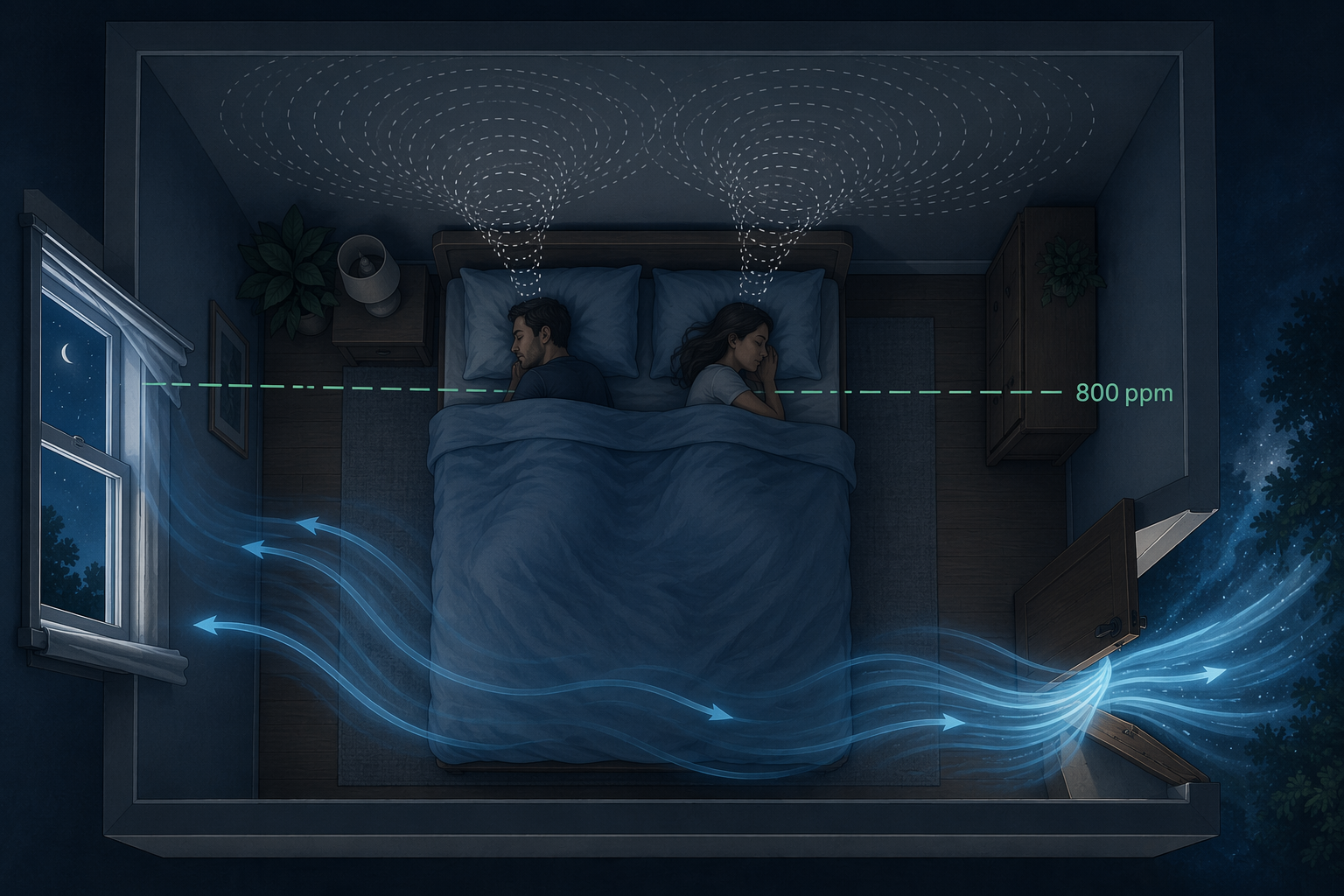
Picture the bedroom after the lights go out: door closed, windows shut because the street is loud or the air outside is bad, two adults breathing in a room that looks completely normal. Nothing smells wrong. Nobody wakes up thinking, “The ventilation is failing.” Yet a CO₂ monitor on the nightstand can show the room climbing past 800 ppm before midnight and staying there for hours.
For sleep and brain health, the most useful starting point is not a supplement, a sleep tracker score, or a promise that one bedroom change prevents Alzheimer’s disease. It is a number: keep bedroom CO₂ at or below 800 ppm overnight when you can. A 2025 ASHRAE-sponsored systematic review of 17 studies and 22 datasets concluded that bedrooms should be kept at or below 800 ppm, which corresponds to about 8 liters per second per person of outdoor air — roughly double current minimum residential ventilation standards.[1]
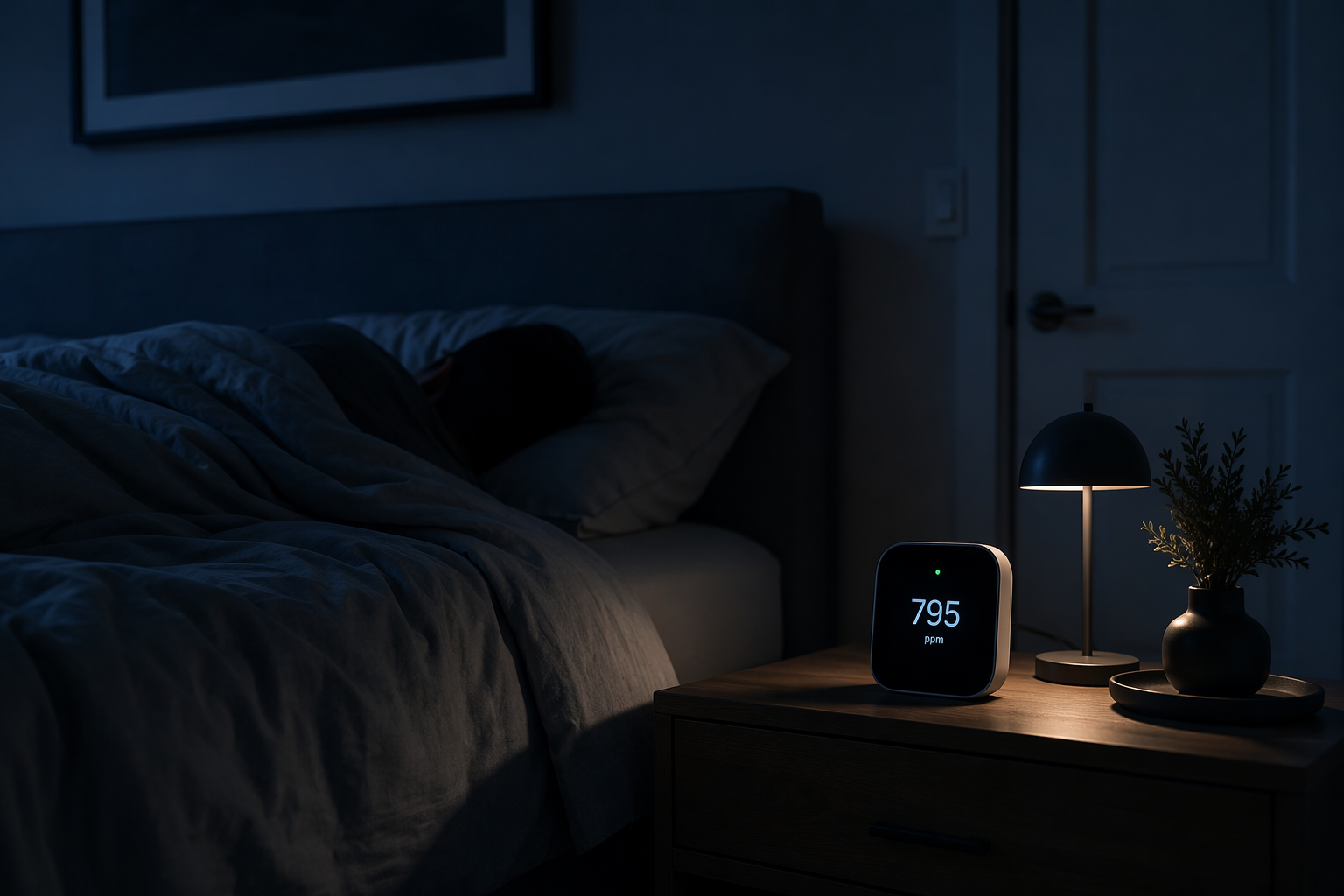
That number is easy to misuse. It does not mean 801 ppm is dangerous while 799 ppm is safe. It does not prove that CO₂ itself is neurotoxic at levels commonly reached in bedrooms. It is better understood as a practical ventilation target: when CO₂ rises, it is telling you that exhaled air and other human bioeffluents are not being diluted fast enough.
That distinction matters because many people sleep with windows closed for good reasons. A 2022 Sleep Foundation survey found that 53.2% of U.S. adults sleep with windows closed, with security and noise among the barriers.[2] Add wildfire smoke, summer heat, ground-floor privacy, or a baby asleep down the hall, and “just open a window” stops being advice and starts being a scold.
Why 800 ppm Is a Reasonable Bedroom Target
The strength of 800 ppm is not that it is a magic biological border. Its strength is that several lines of evidence point in the same direction: sleep tends to look better at lower bedroom CO₂, controlled experiments show measurable sleep changes as CO₂ rises, and deep sleep is one of the periods when the brain’s waste-clearance biology becomes most relevant.
The ASHRAE-sponsored review is the load-bearing piece because it translates a messy bedroom problem into a target ordinary people can test. If the room is below 800 ppm most of the night, ventilation is probably doing a decent job diluting occupant-generated pollutants. If it spends hours above that level, the room is giving you feedback: the air exchange is not keeping up with the sleepers.[1]
This is also why the number is useful even when the health question is long-term and uncertain. Dementia develops over years, and no study in the research summarized here follows people’s bedroom CO₂ readings for decades and then measures dementia incidence. But sleep is a nightly exposure. If a closed room repeatedly pushes sleep in the wrong direction, and the fix is visible on a small screen, it deserves attention before it becomes a medical claim it cannot yet support.
What Happens to Sleep as Bedroom CO₂ Rises
A controlled sleep-lab study by Kang and colleagues gives the threshold some texture. Compared with 750 ppm, exposure at 1,000 ppm was associated with a 1.3% drop in sleep efficiency and 5 more minutes awake, with a linear relationship across conditions.[3] A single night with 5 extra minutes awake is not a crisis. Repeated across many nights, it is the kind of small decrement that people rarely notice directly but may feel as lighter sleep, more morning fog, or a greater need to catch up.
Zhang and colleagues reported related findings linking elevated CO₂ with reduced slow-wave sleep and lower sleep efficiency.[4] The slow-wave part is where the brain-health question stops being a vague wellness phrase. Slow-wave sleep is not just “good sleep” in a generic sense; it is the sleep context most often discussed in relation to the glymphatic system, the brain’s waste-clearance pathway for proteins including amyloid-beta and tau.
The dementia bridge should be kept narrow. A 2023 JAMA Neurology study reported that each 1% decline in slow-wave sleep was associated with a 27% increased risk of dementia.[5] That does not prove bedroom ventilation prevents dementia. It does make reduced slow-wave sleep a more serious signal than a bad sleep score on an app.
There is also cognition evidence from outside the bedroom. In the Harvard office-worker study by Allen and colleagues, a 400 ppm increase in CO₂ was associated with a 21% decrease in cognitive scores across all domains.[6] Office performance is not the same as sleeping brain physiology, so this study should not carry the dementia argument. It does add one more piece to the practical picture: indoor CO₂-associated conditions can coincide with measurable brain-performance changes.
The Alzheimer Case Is Human, Not Definitive
One case report is worth mentioning because it is exactly the kind of thing families remember. In a REHVA Journal report, an Alzheimer patient’s nocturnal restlessness — including snoring, apnea, and panic episodes — was absent when bedroom CO₂ stayed below about 750–800 ppm, and returned when ventilation was reduced.[7]
That is not a clinical trial. It is one patient, observed under changing ventilation conditions. It cannot tell us how often this happens or whether the same response would appear in other patients. Still, it is hard to ignore because the endpoint was not abstract. Someone was restless at night, the air was changed, and the night changed with it.
Measure First, Then Ventilate
The first practical step is to stop guessing. CO₂ is invisible, and comfort is a poor detector. A room can feel cool and quiet while ventilation is weak. A nondispersive infrared, or NDIR, CO₂ monitor gives you the overnight curve: when CO₂ starts rising, how high it gets, whether it crosses 800 ppm, and whether a door crack or fan actually changes the graph.
Place the monitor near breathing height but not directly in the stream of your breath. A nightstand is usually more useful than a high shelf. Check the full overnight pattern, not just the number when you wake up. A bedroom that peaks at 900 ppm for 20 minutes is a different problem from one that sits at 1,300 ppm from midnight until morning.
| Overnight CO₂ pattern | What it usually means | First adjustment to test |
|---|---|---|
| Mostly below 800 ppm | Ventilation is likely adequate for this target | Keep the setup and recheck during hotter, colder, or smoky weather |
| Rises above 800 ppm after the door closes | The room is not getting enough fresh air for the number of sleepers | Crack the door, add a transfer path, or increase mechanical ventilation |
| Stays high all night | Air exchange is persistently too low | Test a larger opening, cross-ventilation, HVAC fan changes, or dedicated ventilation |
| Improves only when a window is open | Outdoor air helps, but the solution may be weather- or safety-limited | Look for filtered or mechanical options for bad-air, heat, noise, or security nights |
Brand names are less important than sensor type and repeatability. Devices such as Aranet4 or Airthings View Plus are common examples of consumer monitors that can show real-time CO₂ trends, but the useful feature is the same: an NDIR sensor and a display or app that lets you see the overnight pattern.
Ventilation Options for Real Bedrooms
If the CO₂ line climbs past 800 ppm, start with the least disruptive change that produces a measurable drop. For some rooms, cracking a window is enough. For others, cracking the bedroom door works better because it connects the room to a larger air volume. If there are two openings, cross-ventilation can move air with a smaller gap than one wide-open window.
A fan can help mix air, but it does not create outdoor air by itself. If the fan only stirs the same closed-room air, the CO₂ graph may barely change. Use the monitor to see whether the fan is moving air through an opening or merely making the room feel less stagnant.
Mechanical systems deserve a look if your home has them. Some HVAC setups can run the fan, increase outdoor-air intake, or work with an energy-recovery or heat-recovery ventilator. The exact controls vary, and renters may have fewer options, but the test is still simple: change one setting for a night and compare the CO₂ curve.
The hard nights are the ones that force trade-offs. Wildfire smoke, heat waves, outdoor noise, and security concerns can all push people toward sealed bedrooms. On poor-air nights, pair this CO₂ target with guidance for sleeping during an air quality health advisory rather than treating an open window as the only acceptable answer. During hot spells, the trade-off may be between ventilation and overheating; practical cooling steps from excessive heat warning sleep tips or cooling the body without AC can make a smaller ventilation opening tolerable.
Closed-window seasons are also when bedroom air problems stack. Heat and smoke can lead people to seal the room, while two sleepers keep adding exhaled air through the night. If that sounds familiar, the broader problem is covered in how summer heat and wildfire smoke affect sleep; here, the CO₂ monitor gives you the bedroom-specific feedback.
What Not to Read Into the Number
Keeping bedroom CO₂ below 800 ppm is a risk-reduction target, not a dementia-prevention treatment. The evidence supports a cautious chain: higher bedroom CO₂ indicates inadequate ventilation; controlled studies associate higher CO₂ with worse sleep efficiency, more wake time, and less slow-wave sleep; slow-wave sleep is tied to brain-clearance biology and dementia risk. The chain is plausible and useful, but it is not the same as direct proof that a CO₂ monitor prevents cognitive decline.
That is still enough to act on. Many prevention discussions ask people to change everything at once: diet, exercise, stress, alcohol, social life, supplements, devices. Bedroom CO₂ is smaller and less glamorous. It asks for one overnight measurement, one ventilation adjustment, and another measurement to see whether the room changed.
If you already know that bedroom air affects sleep, this is the measurable version of that idea. If you want the broader sleep-air-quality context, start with how air quality silently affects your sleep quality. For this particular lever, the next step is narrower: check your overnight CO₂, notice whether it crosses 800 ppm, and adjust ventilation based on the reading rather than on guesses.
References
- Waseda University / ASHRAE 1837-RP (2025), Waseda University, 2025,
- Open Window May Be Better for Sleep, But We Keep It Closed, Sleep Foundation, 2022,
- Kang et al. 2024 dose-response data, Building and Environment,
- Zhang et al. 2023 sleep-quality findings, Building and Environment,
- Deeper Sleep, Sharper Brain, Alzheimer's Information Site / JAMA Neurology, 2023,
- Allen et al. 2016 Harvard CO2-cognition study, PMC, 2016,
- Effect of CO2 on restlessness of an Alzheimer patient, REHVA Journal, 2015,
Comments
Join the discussion with an anonymous comment.