
The best sleep tracking watch in 2026 is not the watch with the prettiest sleep score. It is the one whose weakness you can live with. If sleep apnea notifications matter, the shortlist narrows fast to Apple Watch or Samsung Galaxy Watch because those are the smartwatch lines with FDA-authorized sleep apnea features in the current comparison tables from the American Academy of Sleep Medicine.[1] If sleep-wake accuracy matters more than screening, Apple has the strongest published case among mainstream watches. If uninterrupted overnight wear matters, Garmin’s battery life changes the equation before you even open the sleep chart.
| If your top sleep priority is… | Start with… | Why | Main compromise |
|---|---|---|---|
| FDA-authorized sleep apnea notification | Apple Watch Series 9–11, Ultra 2; Samsung Galaxy Watch 7, 8, Ultra | Apple and Samsung are the only watches in this group with FDA-authorized apnea notification features in the AASM comparison. | Neither diagnoses sleep apnea; both have protocol and eligibility limits. |
| Best published sleep-wake agreement vs PSG | Apple Watch | In a 2024 PSG comparison, Apple Watch Series 8 had 93% sleep-wake agreement and κ=0.60 in healthy adults. | Deep sleep classification was weak, and the study did not test every 2026 model. |
| Battery life and nap tracking | Garmin Venu 3 or similar Garmin models | Garmin’s multi-day battery makes overnight tracking easier to sustain, and current models include nap detection. | Published staging evidence is weaker than Apple’s, and there is no FDA apnea authorization. |
| Fitbit-style sleep interpretation on a smartwatch | Google Pixel Watch 3 | Fitbit-powered sleep estimates remain useful for broad patterns and total sleep time. | No FDA-authorized apnea notification, and algorithms remain proprietary. |
| Analog look, long battery, basic overnight metrics | Withings ScanWatch 2 | Hybrid design and long battery appeal to people who dislike full smartwatches. | No REM tracking and no FDA-authorized apnea notification. |
That table is the honest version of the buying decision. A watch can be good enough at finding your sleep window and still be unreliable at telling you exactly how much deep sleep you had. A watch can have an important FDA-authorized nudge for possible sleep apnea and still be a mediocre sleep-stage teacher. Those are not small distinctions when people are using these charts to decide whether they slept “well.”
What “best for sleep tracking” actually means
For a shopper, “sleep tracking” usually means several different jobs bundled into one nightly report: detecting when you were asleep, estimating sleep stages, flagging breathing irregularities, tracking SpO2 and heart-rate patterns, noticing naps, and turning all of that into a score that feels actionable. The evidence is not equally strong for each job.
Sleep-versus-wake detection is the most forgiving task. Sleep-stage classification is much harder. In Robbins et al.’s 2024 study at Brigham and Women’s Hospital, Apple Watch Series 8, Fitbit Sense 2, and Oura Ring Gen3 were compared with polysomnography in 35 healthy adults. All three devices reached at least 95% sleep-wake sensitivity, but none reached a “good” intraclass correlation coefficient for any sleep stage.[2] The study is useful because it gives stage-level detail, but it also has limits: it was Oura-funded, the lead author disclosed an Oura Medical Advisory Board role, the sample was small and healthy, and the tested devices are not the full 2026 lineup.
That matters because most buyers are not really choosing between abstract algorithms. They are choosing between charging before bed, wearing a bulky watch all night, staying inside a phone ecosystem, and deciding how seriously to treat a deep-sleep number that may be much less stable than the watch interface implies.
If sleep apnea notification matters, Apple and Samsung are in a different category
The newest meaningful divide in sleep watches is not REM graphs. It is FDA-authorized sleep apnea notification. Apple Watch and Samsung Galaxy Watch are the two names that belong at the top of the list if the buyer wants a watch that may prompt them to seek evaluation for possible sleep apnea.[1]
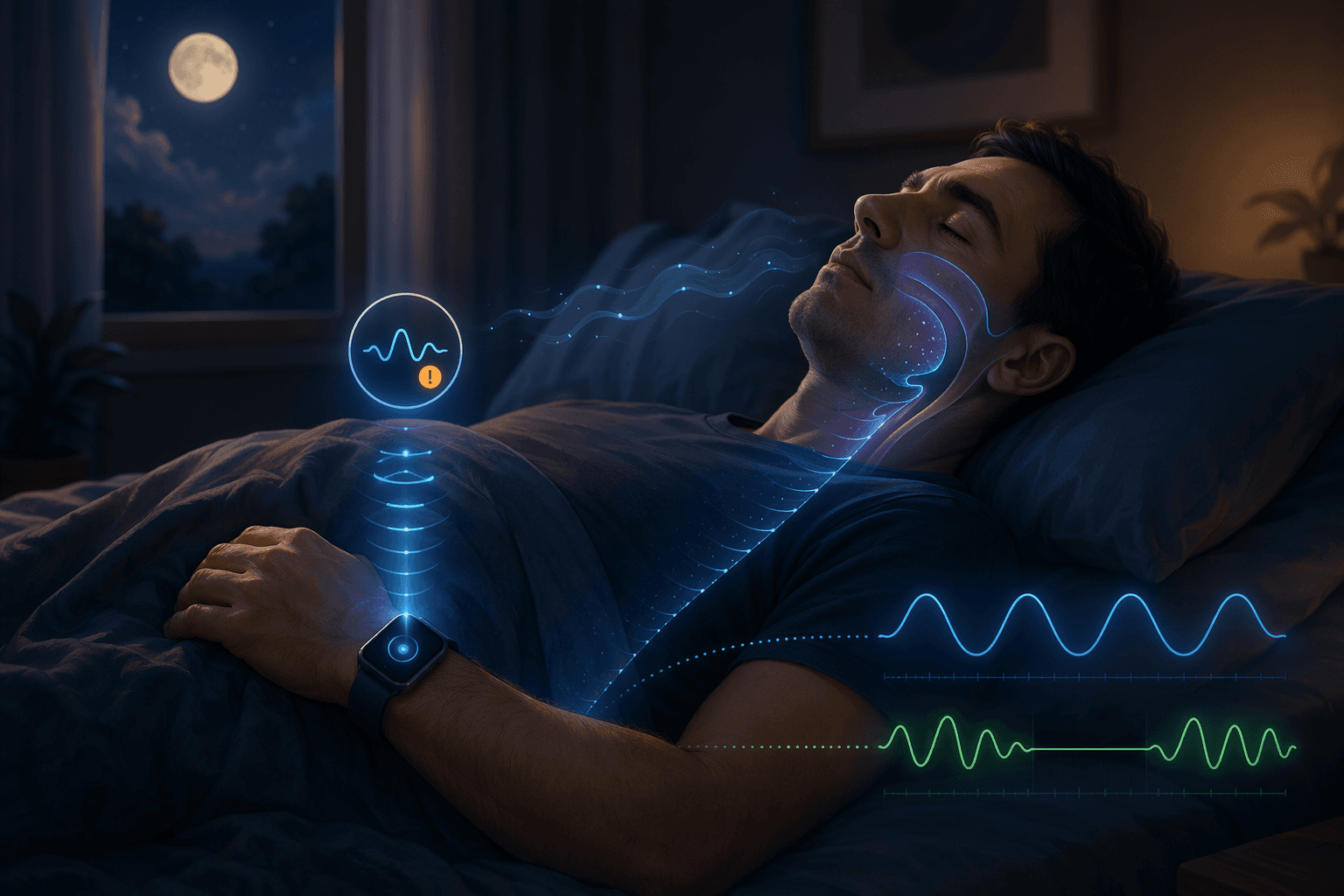
Apple’s feature uses accelerometer data over a 30-day analysis window and is listed for adults 18 and older.[1] Samsung’s feature received De Novo authorization in February 2024 and uses a two-night protocol with at least four hours of sleep per night for adults 22 and older.[1] These are screening-style notifications, not diagnoses. A watch cannot tell you whether you need CPAP, rule out sleep apnea, or replace a sleep lab or home sleep apnea test ordered by a clinician.
The reason this still matters is simple: untreated sleep apnea is common enough that a nudge can be consequential. AASM has cited a context figure of about 22 million Americans with undiagnosed sleep apnea.[1] A person who has normalized snoring, morning headaches, daytime fatigue, or a partner’s concern may ignore those signals for years. A watch notification is not clinical proof, but it can lower the friction between suspicion and making an appointment.
Between Apple and Samsung, the first practical split is not medical; it is ecosystem. Apple’s apnea notifications live inside the Apple Watch and iPhone world. Samsung’s full sleep apnea feature requires a Galaxy phone, which is a sharper restriction than simply saying the Galaxy Watch works best with Android. If you are not willing to use a Galaxy phone, Samsung should not be treated as an equivalent apnea-screening option.
For a deeper look at Apple’s implementation, see the site’s guide to Apple Watch sleep score and apnea notifications. The short version for this comparison: Apple has the cleaner path for iPhone users; Samsung has a credible feature for Galaxy users; neither should be bought as a substitute for diagnosis.
Apple has the strongest sleep-wake evidence, but deep sleep is the trap
If the question is, “Which smartwatch is most likely to identify my main sleep period correctly?” Apple has the best case from the published data in this brief. In Robbins et al., Apple Watch Series 8 reached 93% agreement with PSG for sleep-wake classification and κ=0.60. It also showed REM sensitivity of 82.6% and light sleep sensitivity of 86.1%, the strongest figures among the watches tested in that study.[2]
The same study is also the reason not to worship the Apple sleep-stage chart. Apple underestimated deep sleep by about 43 minutes compared with PSG, with a poor ICC of 0.13.[2] That is not a rounding error for someone who wakes up, sees a low deep-sleep number, and decides the night was a failure.
Fitbit Sense 2, in the same study, underestimated deep sleep by about 15 minutes, less severely than Apple.[2] That does not automatically make Fitbit or Pixel the better sleep watch overall, because Apple’s broader sleep-wake agreement and apnea authorization change the decision. It does mean Apple’s polished sleep presentation should not be mistaken for a lab-grade breakdown of REM, light, and deep sleep.
A second body of evidence points in the same cautionary direction. A 2026 aggregator review summarized Schyvens et al.’s 2025 Antwerp PSG comparison of six consumer sleep trackers in 62 healthy adults and reported Apple Watch as the best overall wearable in that set, with κ=0.53, while also noting a shared conservative bias across devices: wake, deep sleep, and REM were often misclassified as light sleep.[3][4] The exact rankings are less important than the pattern. Light sleep becomes the dumping ground when wrist sensors are uncertain.
Garmin’s battery advantage is not a minor feature
Garmin is the counterargument to making Apple the default sleep pick. A watch that lasts roughly 10 to 14 days on a charge is simply easier to wear through real life than one that needs daily charging. For sleep tracking, battery life is not a spec-sheet vanity number. It determines whether the watch is actually on your wrist at 2:30 a.m.
That is especially true for people who train, travel, work shifts, or nap unpredictably. Garmin’s current sleep ecosystem, including models such as Venu 3 and many Forerunner watches, is better positioned for continuous wear and nap detection than Apple or Samsung. If your watch is often on a charger during the very hours you want measured, a more accurate algorithm on paper will not rescue your missing data.
The tradeoff is that Garmin’s published staging evidence is weaker. The Kygo.app evidence synthesis reports that in the Antwerp PSG comparison, Garmin Vivosmart 4 scored lowest among six wearables, with κ=0.21, categorized as poor.[3] The same source reports wake detection specificity of 27.6% for Garmin versus 52.2% for Apple in an independent comparison.[3] Those figures are not necessarily a verdict on every Garmin watch sold in 2026, but they are enough to keep Garmin out of the “most accurate sleep stages” chair.
Pulse Ox is another place to stay sober. The Kygo.app compilation cites studies finding Apple Watch SpO2 mean absolute error of 2.2%, with 58.3% of readings within a clinically acceptable range, while Garmin Venu 2s had 5.8% mean absolute error and 18.5% within range.[3] That does not mean Apple turns into a clinical oximeter. It means wrist SpO2 should be treated as a rough overnight signal, not a number to micromanage without context.
If Garmin’s strengths sound like the right tradeoff, the site’s Garmin sleep tracking accuracy update goes deeper into the staging limitations. The practical buying rule is narrower: choose Garmin when battery continuity and recovery trends matter more to you than lab-like stage labels.
Pixel Watch is acceptable for Fitbit-style sleep estimates, not a category leader
Google’s Pixel Watch 3 sits in the middle of this decision. Fitbit’s sleep system is mature, familiar, and generally useful for seeing broad patterns: bedtime consistency, total sleep time, restlessness, and changes over time. In the Robbins study, Fitbit Sense 2’s deep-sleep underestimation was less severe than Apple’s, at about 15 minutes versus Apple’s roughly 43 minutes.[2]
That is not enough to make Pixel the best sleep tracking watch for most buyers. Pixel/Fitbit does not have FDA-authorized sleep apnea notification in the AASM comparison used here.[1] Its algorithm remains proprietary, even if Fitbit has historically been more transparent than many consumer sleep brands about how it thinks about sleep stages. If you already want a Pixel Watch for Android use and like Fitbit’s interpretation style, sleep tracking is a reasonable part of the package. It is not the strongest reason to switch ecosystems.
Samsung is compelling for Galaxy users, less so outside that lane
Samsung deserves to be treated as more than “the Android Apple Watch” because its FDA-authorized sleep apnea feature puts it in the small group that can surface a medically meaningful prompt.[1] Galaxy Watch models also add sleep features such as snore detection, which may be useful when paired with the right phone setup.
The catch is that Samsung’s strongest sleep-tracking argument depends on being inside Samsung’s ecosystem. If you already carry a Galaxy phone, the Watch 7, Watch 8, or Ultra can make sense as a sleep-focused pick. If you use an iPhone, it is not a practical option. If you use a non-Samsung Android phone, check the exact feature requirements before buying, because the apnea feature’s Galaxy-phone requirement is not a footnote for sleep shoppers.
On accuracy, the independent evidence cited here does not crown Samsung above Apple. The available Antwerp comparison reports Apple as the top overall performer among the tested wearables, while the broader finding was that all devices struggled with conservative misclassification into light sleep.[3][4] Samsung’s best case is therefore not “more accurate sleep stages than Apple.” It is “FDA-authorized apnea notification for Galaxy users.”
Withings is the side path for people who do not really want a smartwatch
Withings ScanWatch 2 should not be forced into the same fight as Apple Watch, Galaxy Watch, Pixel Watch, and Garmin Venu. It is a hybrid watch for people who want an analog look, long battery life, and basic overnight metrics such as heart rate, SpO2, and breathing-disturbance-style scoring. It does not offer REM tracking, and it does not appear in the AASM comparison as having FDA-authorized sleep apnea notification.[1]
That makes it a niche but legitimate choice. Some people sleep better with a quieter device and fewer prompts. If you are buying a sleep watch because you want detailed stage charts, app coaching, or apnea notifications, Withings is not the main answer. If you want a watch that looks like a watch and gives you a basic overnight trend line, it belongs on the edge of the shortlist.
The sleep-stage chart is where buyers most often overpay emotionally
The most misleading part of a sleep watch is often the part that looks most scientific. A neat stack of REM, light, and deep sleep can make the night feel settled and quantified. The PSG studies cited here do not support that level of confidence. Robbins et al. found no device reached a good ICC for any sleep stage, even though sleep-wake detection was much stronger.[2] Schyvens et al., as summarized in the available evidence, found a recurring tendency to misclassify uncertain epochs as light sleep.[3][4]
This is where sleep tracking can turn from useful feedback into pressure. If a watch helps you notice that late alcohol, irregular bedtimes, or short nights consistently hurt how you feel, it is doing something helpful. If it makes you anxious before you get out of bed because your deep sleep score looks bad, the device has become part of the sleep problem. For readers prone to that spiral, the site’s guide to insomnia and orthosomnia risk is worth reading before buying another sensor.
The healthiest use of these watches is usually trend-based: Did your sleep window shrink? Did awakenings increase? Are you keeping a consistent wake time? Did a breathing notification suggest you should talk to a clinician? Those questions are more durable than whether Wednesday contained exactly the amount of deep sleep the app says it did.
Decision guide: which sleep watch should you buy?
- Buy an Apple Watch Series 9–11 or Ultra 2 if you use an iPhone, want FDA-authorized sleep apnea notifications, and care most about the strongest published sleep-wake evidence among the mainstream watches in this comparison. Accept the daily-charging routine and do not overread deep sleep.
- Buy a Samsung Galaxy Watch 7, 8, or Ultra if you use a Galaxy phone and want FDA-authorized sleep apnea notification in Samsung’s ecosystem. Treat it as a strong Galaxy-user choice, not a universal Android sleep champion.
- Buy a Garmin Venu 3 or comparable Garmin if you want multi-day battery life, nap detection, and continuous wear more than the best available sleep-stage validation. It is the practical pick for people who will not reliably charge a watch every day.
- Buy a Pixel Watch 3 if you already want Google’s smartwatch and Fitbit-style sleep interpretation. It is a decent sleep-pattern watch, but the lack of FDA-authorized apnea notification keeps it from leading this category.
- Buy a Withings ScanWatch 2 if you want hybrid styling, long battery life, and basic overnight health trends rather than a full smartwatch sleep dashboard.
If this comparison makes you wonder whether a watch is the wrong form factor, compare watches against rings, bands, and non-wearables in the broader sleep tracker form-factor guide or the 2026 PSG-based fitness tracker comparison. For a smartwatch-only accuracy comparison, the related sleep tracking watch accuracy guide goes deeper into device-level validation, while this article keeps the decision centered on 2026 smartwatch buying tradeoffs: apnea notification, accuracy evidence, battery life, and ecosystem.
References
- Comparing Sleep Features of Popular Smartwatches — AASM, 2025.
- Accuracy of Three Commercial Wearable Devices for Sleep Tracking in Healthy Adults — Sensors, 2024.
- Wearable Accuracy Ranked: 17 Studies, 6 Devices (2026) — Kygo.app, 2026.
- Performance of Six Consumer Sleep Trackers in Comparison with Polysomnography — Sleep Advances, 2025.
Comments
Join the discussion with an anonymous comment.