
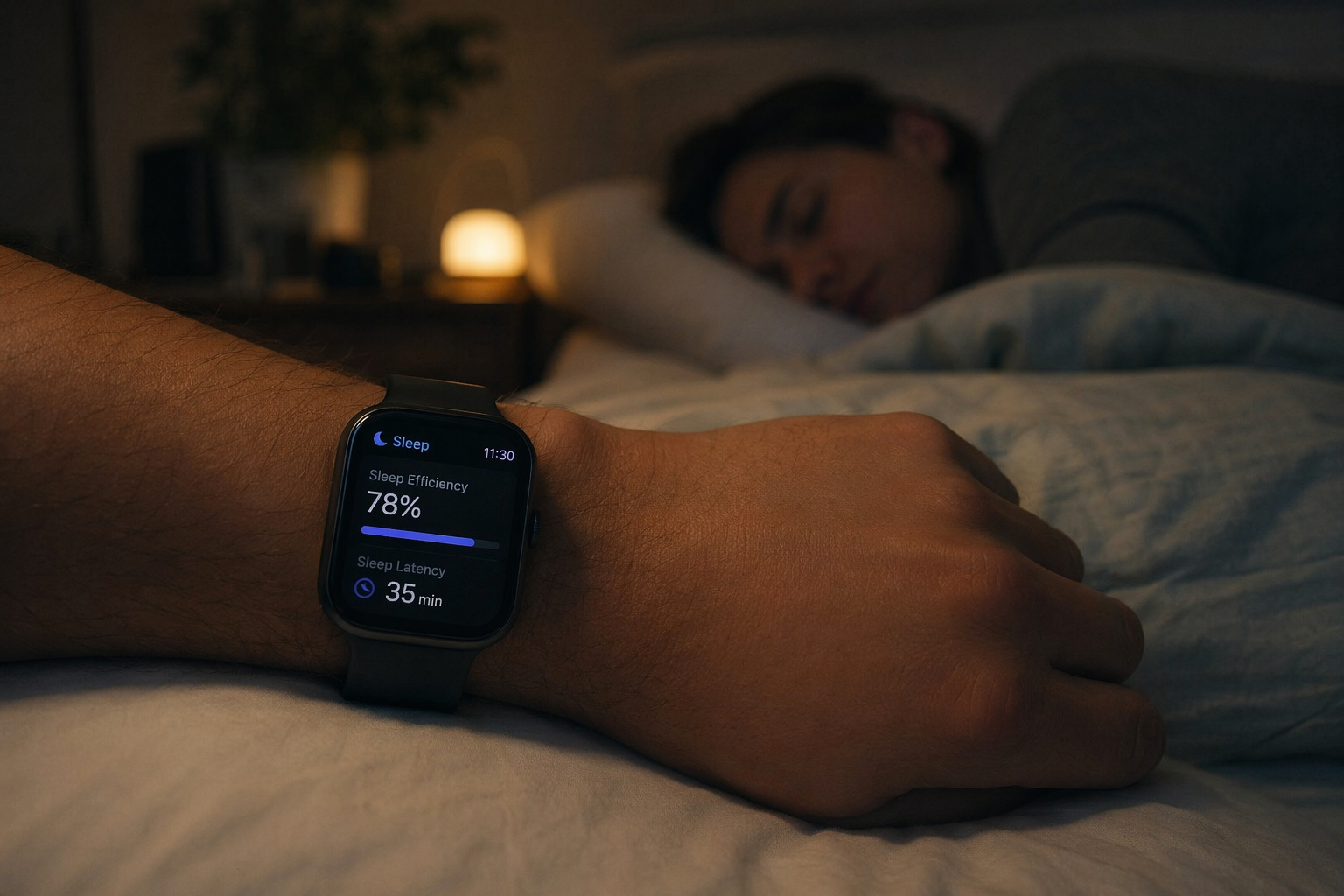
If your sleep tracking watch says your sleep efficiency was 78% and your sleep latency was 35 minutes, the calm answer is: do not treat that single screen as a diagnosis. Treat it as a reason to check how the watch got there.
Those two numbers deserve different levels of trust. Sleep efficiency is a real clinical idea, but watches tend to overestimate it, especially when you are awake but lying still. Sleep latency is also clinically meaningful, but a watch cannot measure it well unless it knows when you actually started trying to fall asleep. Without that “lights out” anchor, the latency number can look precise while resting on a missing input.
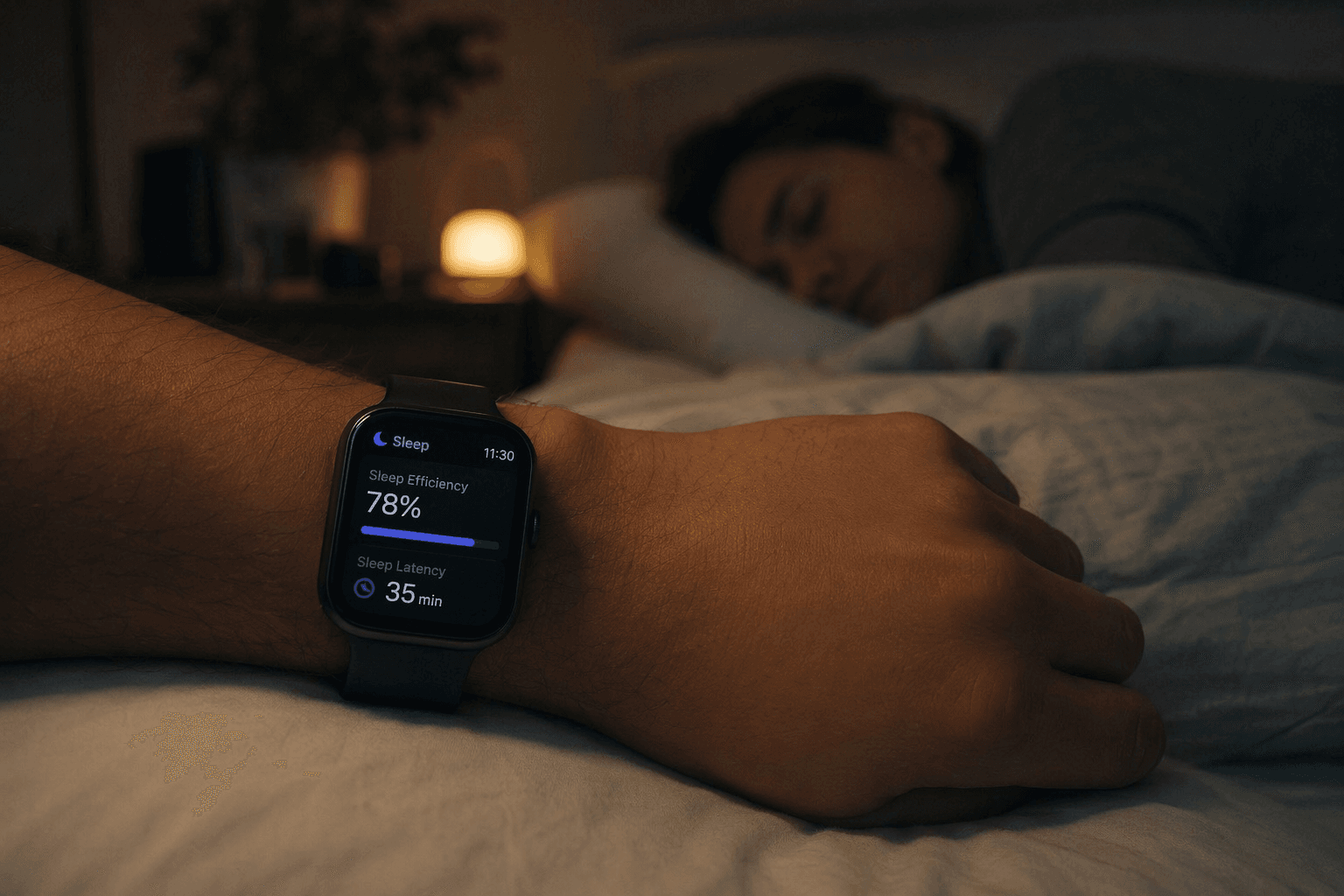
A useful operating rule is simple enough to use tomorrow morning: do not react to one bad night; manually log lights-out time if your app allows it; watch the pattern for about two weeks; and treat persistently low watch-reported efficiency—roughly below 80–85%, especially when you also feel unrefreshed, sleepy, or impaired during the day—as a reason to look more closely or seek clinical guidance. An isolated 78% after a stressful evening is not the same thing as a repeated pattern.
What the two numbers are supposed to mean
Sleep efficiency is the percentage of your time in bed that was actually spent asleep. If someone is in bed for 8 hours and sleeps for 6.8 hours, the sleep efficiency would be 85%. In clinical sleep work, 85% is often treated as an important reference point, not because one night at 84% is dangerous, but because sustained low efficiency can reflect long periods awake in bed.
Sleep latency is the time between trying to fall asleep and actually falling asleep. A commonly cited healthy reference range is about 10–20 minutes, while much longer latency can matter when it happens repeatedly and matches the person’s experience of struggling to fall asleep.[1]
The important phrase is “trying to fall asleep.” A watch can estimate when your body looked asleep. It does not automatically know whether you were reading, scrolling, meditating, worrying, listening to a podcast, or earnestly trying to sleep. That missing distinction is where many dramatic latency numbers begin.
| Metric | Clinical meaning | Where a sleep tracking watch can go wrong | Best user response |
|---|---|---|---|
| Sleep efficiency | Time asleep divided by time in bed | Still wakefulness may be counted as sleep, inflating efficiency | Watch the two-week pattern and compare it with how you feel |
| Sleep latency | Time from trying to sleep to sleep onset | The watch may lack a reliable lights-out or “trying to sleep” time | Manually log lights-out time before judging the number |
Why watches often make sleep efficiency look better than it was
Consumer watches and rings infer sleep from signals such as movement and physiology. That is useful over time. It is also the reason they can confuse quiet wakefulness with light sleep. If you are lying still with your eyes open, the device may not have enough information to know that your mind is awake.
Cleveland Clinic states the practical problem plainly: smart watches tend to overestimate sleep efficiency.[2] That does not make the data worthless. It means the number is not the same kind of number you would get from polysomnography, the clinical sleep test that uses brain-wave and other physiological measurements to identify sleep and wake more directly.
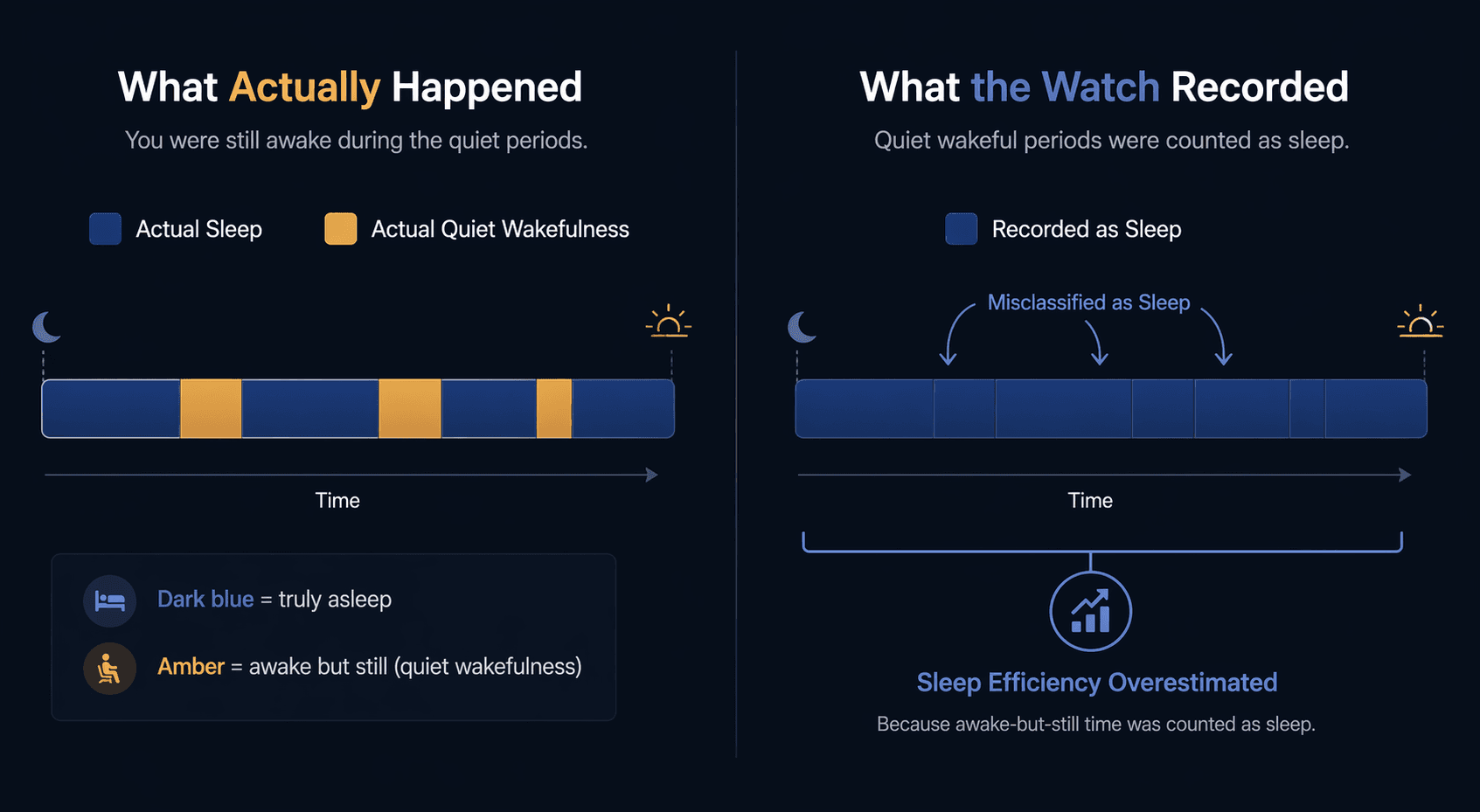
A 2024 study by Robbins and colleagues compared three consumer sleep devices against polysomnography in 35 healthy adults. The devices were generally good at detecting sleep, with sleep sensitivity around 95%, but weaker at detecting wake, with wake specificity ranging from about 48% to 61% depending on the device.[3] That pattern is the heart of the issue. A watch can be very good at saying “asleep” when you are asleep and still be much less reliable at saying “awake” when you are quietly awake.
Sensitivity and specificity sound like technical clutter until they explain a morning like this. High sleep sensitivity means the watch catches most of your real sleep. Low wake specificity means some of your real wakefulness gets absorbed into the sleep total. When wake minutes are counted as sleep minutes, total sleep time rises and sleep efficiency rises with it.
This is especially relevant for people who spend long stretches awake but motionless in bed. The Better Sleep Clinic describes the same tradeoff: many trackers are better at detecting sleep than wake and may overestimate sleep time, particularly in insomnia populations.[1] The person most likely to notice the error is not someone thrashing around. It is often the person lying very still, trying hard not to make the night worse.
So a watch-reported efficiency of 82% is not a clean clinical 82%. It might reflect a genuinely fragmented night. It might also be concealing more wake time than the watch recognized. The direction of the common error matters: if your watch repeatedly reports efficiency below 80–85%, and watches tend to overestimate efficiency, that pattern deserves more attention than a single borderline reading.
One caveat belongs next to the Robbins study rather than hidden in the fine print: the study was partially funded by Oura Ring Inc.[3] That does not erase the finding, and the sensitivity-specificity pattern is consistent with the broader clinical concern. It does mean brand-specific claims should be read carefully. The useful lesson here is category-level: wrist and ring trackers infer sleep, and inferred wake is the harder task.
Sleep latency has a different problem: the watch may not know when the clock started
A sleep latency number needs two points: when you began trying to sleep, and when sleep began. Your watch is much better positioned to estimate the second point than the first. If you do not manually tell it when lights went out, or if your bedtime routine includes a long quiet period in bed before you intend to sleep, the latency calculation can become structurally shaky.
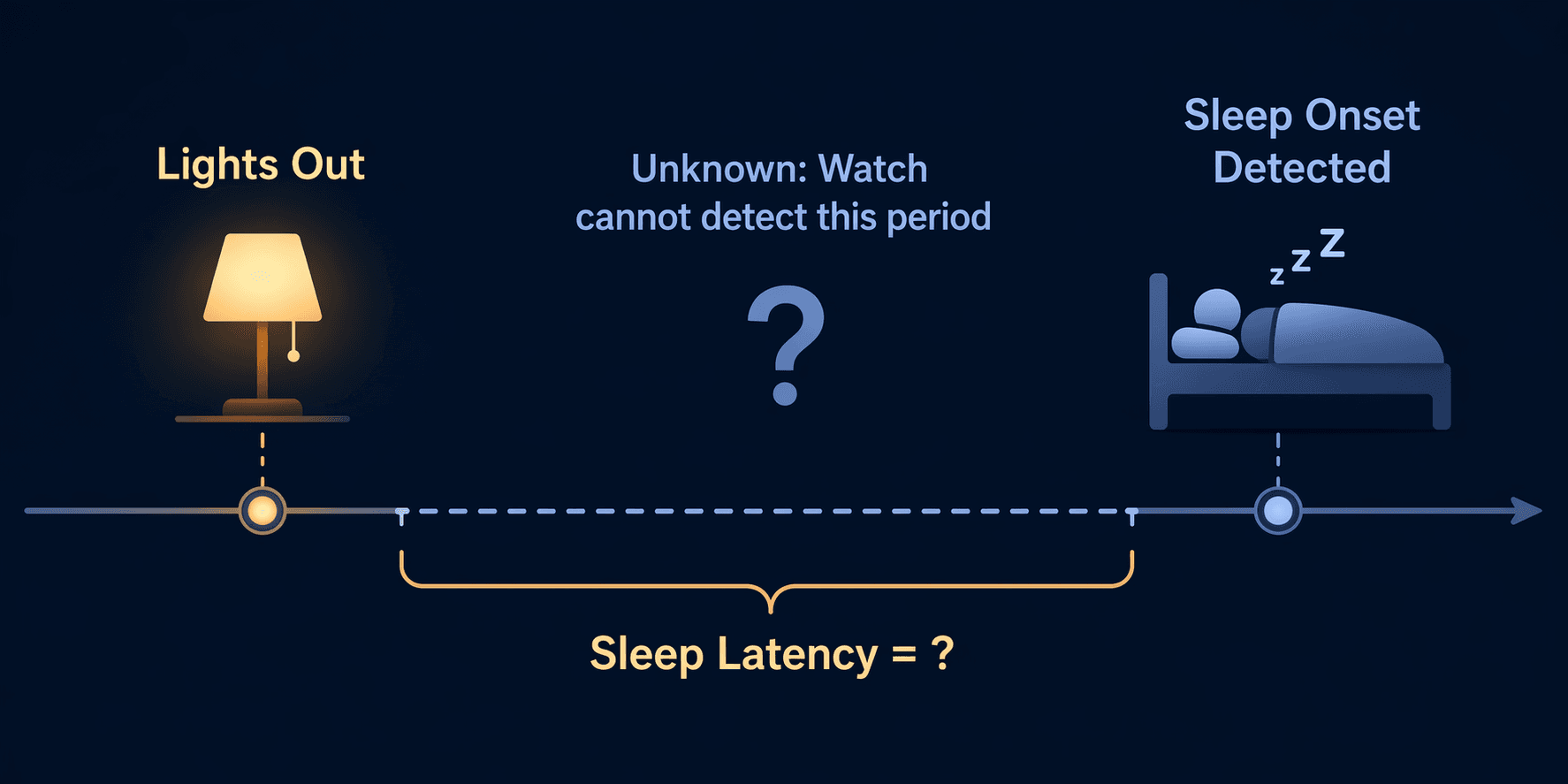
Oxford Neuroscience summarized research showing that tracker accuracy for sleep latency dropped to about 38% when compared with polysomnography.[4] That figure should not be stretched into a universal claim that every device is wrong 62% of the time in every bedroom. Its value is that it exposes the structural weakness: latency depends on knowing when the attempt to sleep began, and that is not always observable from the wrist.
This is why manually logging lights-out time can improve the usefulness of your data. It gives the app a better anchor. It still does not turn the watch into a clinical sleep study, and it still may misread quiet wakefulness, but it removes one avoidable source of nonsense.
The distinction matters when you are deciding what to do. A 35-minute latency after you intentionally spent 25 minutes reading in bed is not the same as 35 minutes of trying and failing to fall asleep. The watch may display both as if they mean the same thing. They do not.
How to handle one bad morning
When the app gives you a poor score, first separate the device’s judgment from the measurement underneath it. “Poor” is a label. Sleep efficiency and latency are estimates. Your next step is not to fix the label; it is to decide whether the estimate is credible enough to guide action.
- If the bad number happened once, do not reorganize your day around it. Look at how you feel, caffeine and alcohol timing, illness, stress, travel, and whether the watch had a normal night of data.
- If latency looks high, ask whether you logged the time you actually tried to sleep. If not, treat the latency estimate as weak.
- If efficiency looks low, remember that the common watch error is usually overestimating sleep, not underestimating it. Repeated low efficiency deserves more attention than a single low score.
- If the numbers and your lived experience disagree, do not automatically give the watch the tie-breaker. A person who feels alert after one “fair” night does not need to become a patient by breakfast.
There is also a psychological reason not to overreact. Oxford’s summary discusses research in which false sleep feedback affected mood and cognitive performance.[4] That is the small cruelty of a dramatic sleep notification: it can change the day it is supposedly only describing.
This does not mean you should ignore your watch. It means you should make the watch earn your attention by showing a pattern.
Use the next two weeks better
For the next 14 nights, keep the job boring. Do not chase a perfect sleep score. Try to make the inputs cleaner and the interpretation steadier.
- Log lights-out time when you actually intend to sleep, not when you first get into bed.
- Keep a short note on how you felt the next day: refreshed, sleepy, irritable, foggy, or normal.
- Look at median or typical sleep efficiency rather than the worst night.
- Mark unusual nights—travel, alcohol, illness, late caffeine, caregiving interruptions—so they do not become mysterious “proof” that your sleep is broken.
- If latency remains long even after accurate lights-out logging, and you also experience daytime impairment, treat that as more meaningful than the app’s label alone.
If your main issue appears to be habits around bedtime, an evidence-based routine is a better first response than buying a new device. This sleep hygiene and bedtime routine guide is the more useful next stop for that problem.
If your numbers are persistently concerning and your days are affected, use an insomnia triage framework rather than letting the watch supply the diagnosis. This sleeping problem versus insomnia guide can help separate a rough patch from a pattern that needs care.
When the watch number is worth escalating
A persistent watch-reported sleep efficiency below about 80–85% is worth taking seriously, especially if it matches repeated daytime sleepiness, impaired concentration, mood changes, or the feeling that you are spending long periods awake in bed. The reason for the buffer is the measurement mismatch: because watches often overestimate efficiency, a repeatedly low watch value may be pointing to an even lower true efficiency.
High sleep latency deserves a similar pattern-based reading. If you accurately log lights-out time and still see long latency most nights, and you remember lying awake trying to sleep, that is different from a watch inventing latency from an unclear bedtime window.
At that point, the most useful data to bring to a clinician is not a sleep score screenshot. It is a two-week pattern: approximate lights-out time, estimated wake time, watch-reported efficiency, watch-reported latency, and daytime symptoms. That gives the number context. It also prevents one unusually bad night from carrying more authority than it deserves.
If you are comparing Apple Watch, Fitbit, Oura, Garmin, Samsung, Pixel, or another device, the model differences can matter for comfort, battery life, app design, and which sleep features are easiest to use. They do not remove the basic limitation that consumer sleep trackers infer sleep and wake. For device-level tradeoffs, use a dedicated smartwatch sleep tracking comparison rather than trying to solve a clinical interpretation problem through a shopping decision.
The balanced rule
A sleep tracking watch is useful as a trend detector, weak as a single-night judge, and not a diagnostic tool. Sleep efficiency can point to a real problem when it stays low, but watches often make it look better than it was. Sleep latency can matter, but only if the watch has a credible lights-out anchor and the number matches your experience.
So if this morning’s screen says 78% efficiency and 35 minutes latency, do not let the alert decide your mood. Log lights-out tonight. Track the next two weeks. Compare the pattern with your daytime life. If low efficiency or long latency persists, use that pattern to seek better guidance—not to punish yourself for one imperfect night.
References
- How Accurate Are Sleep Trackers, Smart Watches & Smart Rings? — The Better Sleep Clinic
- Do Sleep Trackers Help You Achieve Better Sleep? — Cleveland Clinic
- Performance of Consumer Sleep Trackers in Measuring Sleep in Healthy Adults — Sensors
- Are sleep trackers accurate? Here’s what researchers currently know — Oxford Neuroscience — 2021

Comments
Join the discussion with an anonymous comment.