
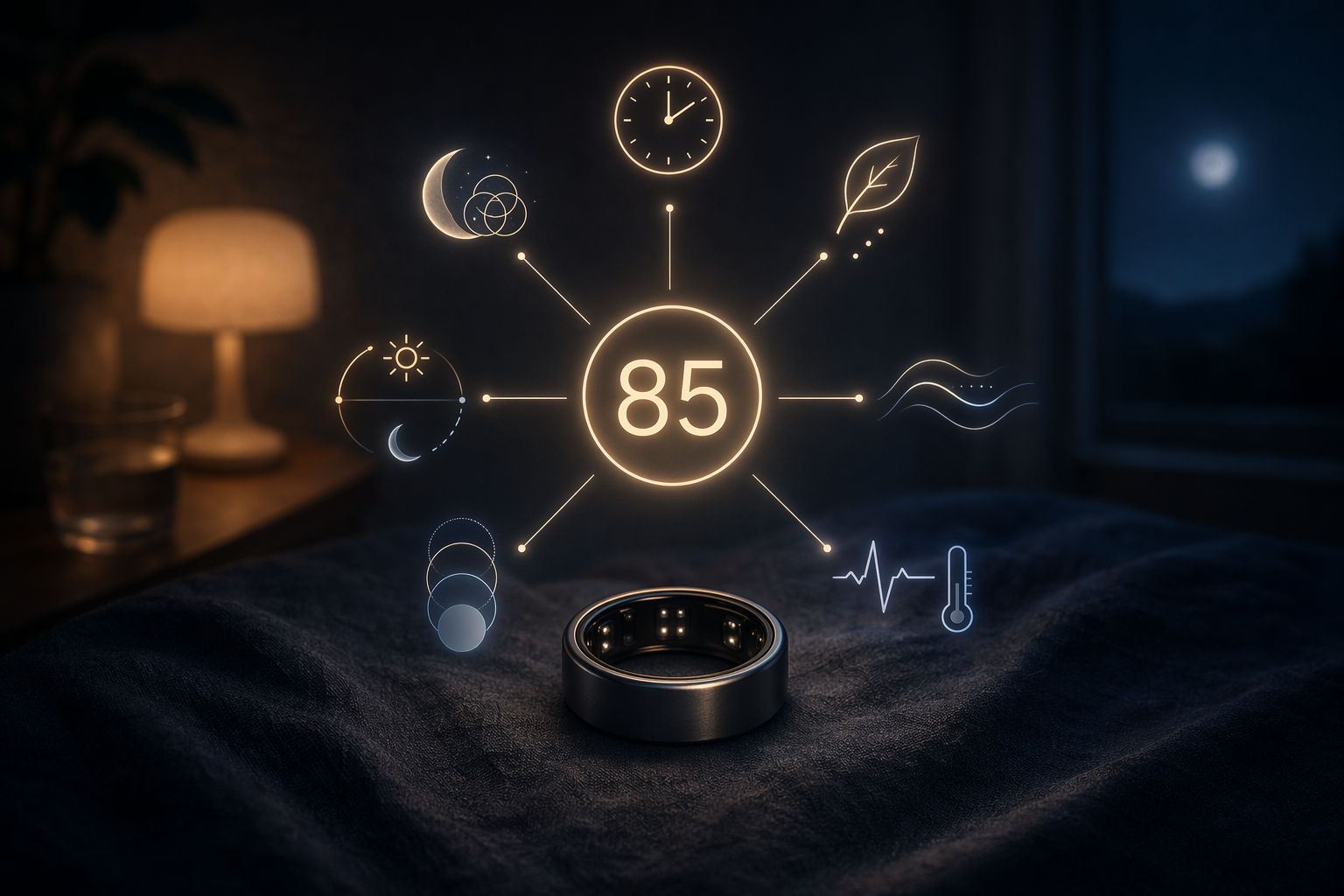
The most useful way to read an Oura Sleep Score is also the least dramatic one: it is not a verdict on whether you “slept well.” It is a 0–100 composite score built from several signals the ring can estimate overnight. Oura labels 85 and above as optimal and shows a crown icon, 70–84 as good, and under 70 as needing attention.[1] That framing can be helpful, but it can also turn a normal groggy morning into a small performance review before coffee.
For anyone using an oura ring health tracker, the real question is not “How do I get a crown every day?” It is “Which part of last night is the score pointing toward, and is there a calm, repeatable adjustment I can make?” The answer depends on the seven contributors underneath the number: total sleep time, efficiency, latency, restfulness, timing, sleep stages, and recovery context.[1]
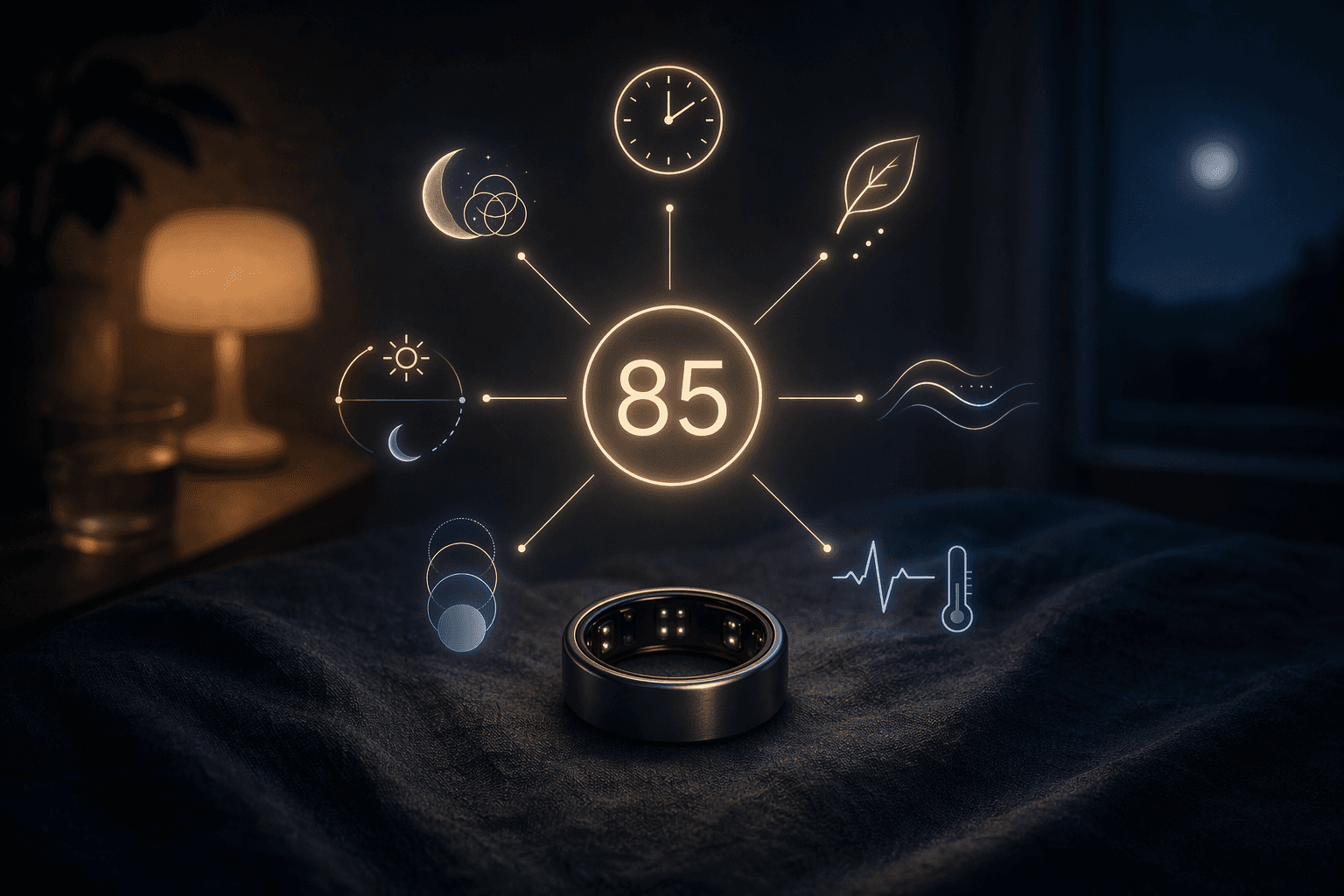
The Sleep Score is seven signals, not one mysterious grade
A single score is convenient because mornings are short. It is also where people get into trouble. Two nights with the same Sleep Score can have very different stories: one may be short but consolidated, another long but fragmented, another well-timed but physiologically restless. The app’s top-line number compresses those differences.
The contributor view is where the score becomes usable. It separates “I need a longer sleep window” from “I am spending too much time awake in bed,” and both from “my schedule is drifting later than my body seems to prefer.” Those are different problems. They deserve different responses.
| Contributor | What Oura is trying to capture | Most reasonable first response |
|---|---|---|
| Total sleep time | Estimated time asleep across the night | Protect a large enough sleep window before changing smaller habits |
| Efficiency | Time asleep divided by time in bed | Reduce long awake periods in bed and keep the bed strongly associated with sleep |
| Latency | Estimated time it takes to fall asleep | Adjust wind-down timing, light exposure, and arousal before bed |
| Restfulness | Movement-based fragmentation and restlessness | Look for noise, alcohol, late meals, temperature, pets, pain, or stress |
| Timing | How well sleep lines up with the body’s expected circadian window | Stabilize bedtime and wake time before trying to fine-tune stages |
| Sleep stages | Estimated light, deep, and REM sleep | Use as trend context, not as a precise clinical readout |
| Recovery context | Overnight HRV trends and temperature deviation | Notice strain, illness, alcohol, heat, and recovery patterns without treating HRV as a command |
Total sleep time: the boring lever that often matters first
Total sleep time is the estimated amount of time you were actually asleep, not merely the time between getting into bed and getting out of it.[1] It is easy to underestimate how much this matters because it is not a clever metric. Still, if the ring shows that you regularly sleep less than your body needs, most stage-level analysis becomes a distraction.
The practical distinction is between sleep duration and sleep opportunity. If someone wants 7–9 hours of actual sleep, they usually need more than a 7–9 hour calendar gap, because normal nights include some time falling asleep and brief awakenings. A person with a 7-hour bed window may be asking the body to do something too efficient to repeat comfortably.
When total sleep time is the weak contributor, the first experiment is not a supplement, a new alarm sound, or a deep-sleep hack. It is a protected sleep window. Move the non-negotiable part of the night earlier by a modest amount, keep the wake time steady, and watch the trend for at least a couple of weeks. If the score improves but the person feels no better, that mismatch is also information; subjective rest and tracker estimates do not always move together in a neat line, which is why the subjective-versus-objective sleep gap is worth taking seriously.
Efficiency: how much of your bed window is actually sleep
Sleep efficiency is one of the cleanest contributors to act on because it has a simple denominator: time asleep divided by time in bed.[1] Low efficiency usually means the bed window is padded with wakefulness. That may be trouble falling asleep, long awakenings, early morning wakefulness, or a habit of lying in bed while reading, worrying, scrolling, or waiting for sleep to happen.
This is where the advice has to be careful. A low-efficiency night does not mean you failed. It means the nervous system spent too much of the bed period awake. The most reasonable response is to strengthen the relationship between bed and sleep: keep wakeful activities out of bed when possible, avoid getting into bed long before sleepiness arrives, and if you are awake long enough to feel alert or frustrated, leave the bed for something quiet and dim until sleepiness returns.
Efficiency is also where more time in bed can backfire. If someone responds to poor sleep by spending an extra hour in bed every night, the score may not improve because the added time becomes more awake time. A tighter, more predictable sleep window often teaches the body better than a bigger one. Once efficiency rises, the window can expand gradually.
Latency: falling asleep fast is not always the goal
Latency estimates how long it takes to fall asleep.[1] A long latency often points to timing, arousal, light exposure, caffeine timing, or a bed window that starts before the body is ready. But a very short latency can also mean a person is chronically under-slept. The goal is not to pass out instantly; it is to approach bed with enough sleep pressure and enough calm for sleep to arrive without a fight.
When latency is the recurring weak point, look at the two hours before bed rather than the minute you close your eyes. Bright light, work conflict, intense exercise for some people, heavy meals, alcohol, and emotionally loaded media can all keep the system activated. The ring cannot know the full story from your finger. It can only show that the transition into sleep is taking longer than usual.
A useful latency experiment is deliberately plain: dim the lights earlier, move problem-solving off the pillow, keep the phone out of the final stretch if it tends to pull you back into alertness, and set a consistent “last call” for stimulating tasks. The point is not to create a precious bedtime ceremony. It is to stop asking a stimulated brain to behave like a sedated one.
Restfulness: the score’s clue that the night was broken up
Oura’s restfulness contributor reflects movement-based fragmentation during the night.[1] It is not a full explanation for why the night was restless, but it can tell you that the body did not stay settled. This is one of the places where a tracker can catch a pattern a person might miss, especially when awakenings are brief and not remembered in the morning.
Low restfulness deserves a practical inventory before a dramatic interpretation. Was the room too warm? Did the dog change position all night? Was there alcohol, a late dinner, congestion, pain, stress, a new medication, noise, a partner’s movement, or a child waking nearby? The ring cannot separate those causes by itself, but Tags can help over time.
The strongest first changes are environmental because they are repeatable: a cooler room, less light, fewer notification sounds, more stable bedding, and fewer sources of physical interruption. A broader sleep environment guide can be more useful here than another night spent staring at the movement graph.
Timing: regularity is usually more useful than stage chasing
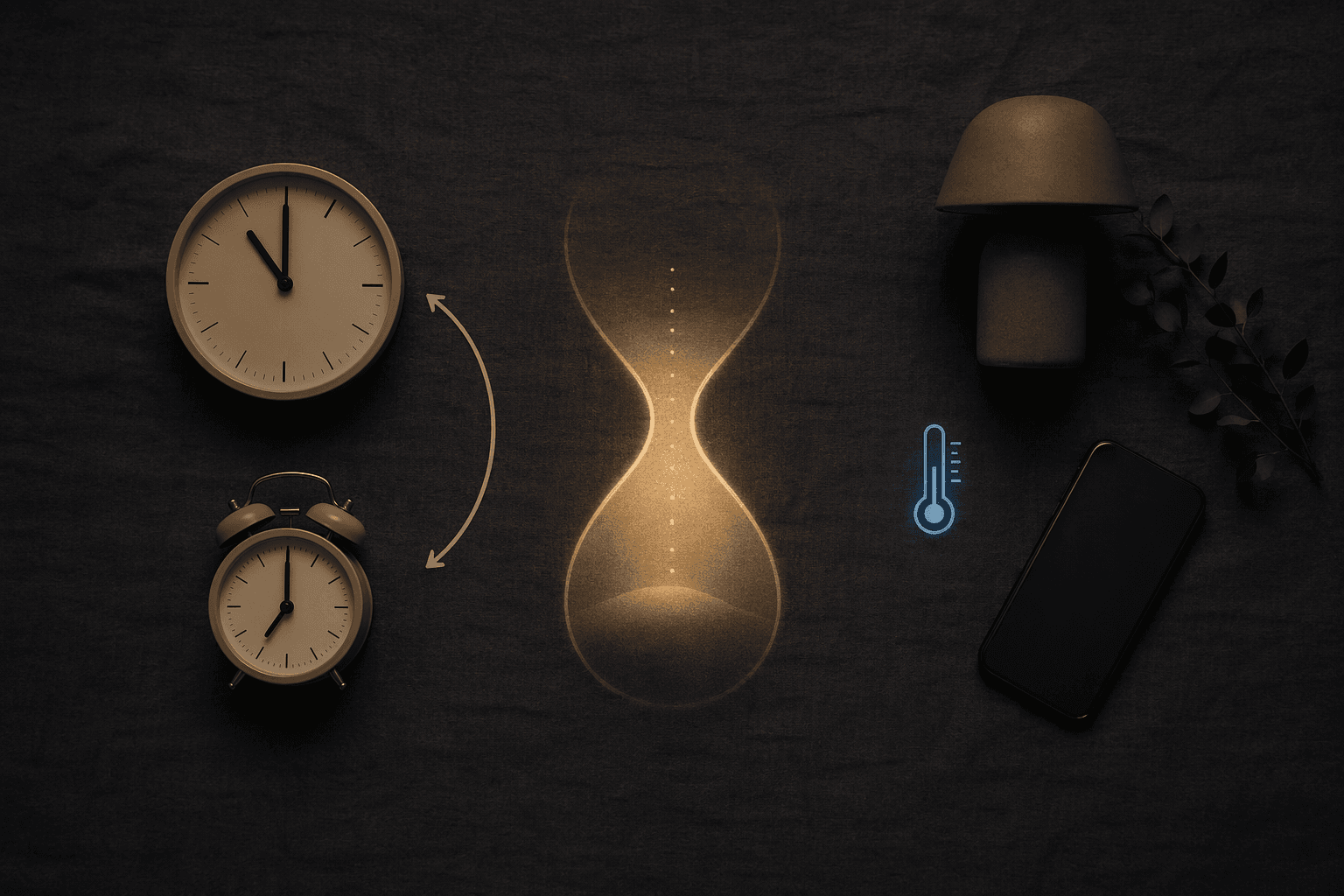
The timing contributor looks at whether your sleep lines up with your expected circadian window.[1] This is where Oura can be genuinely helpful, because many people are less irregular than they think on weekdays and more irregular than they think across the whole week. A sleep schedule that looks “close enough” by memory may show a clear drift when plotted over time.
Regularity is not just neatness. Consistent sleep and wake timing helps the body predict when to raise and lower alertness, temperature, and hormone signals. The National Sleep Foundation’s 2023 consensus position emphasized sleep regularity as an important dimension of sleep health, which is why this lever belongs near the top of the list, not as a personality preference for organized people. For a deeper look at why regularity can matter beyond duration, see this guide to sleep regularity.
Oura’s Bedtime Guidance is built for this part of the problem. The feature uses rolling sleep data and chronotype detection to suggest a personalized bedtime window.[2] That is manufacturer documentation, so it should not be mistaken for proof that following the recommendation will fix sleep. Still, it can be a useful nudge if the recommendation is treated as a starting hypothesis rather than an order.
For most people, timing experiments work best when they begin with wake time. Pick a wake time that is realistic on most days, get morning light soon after waking, and let bedtime move earlier only when sleepiness appears. If your schedule shifts for work, caregiving, or health reasons, the goal is not perfect regularity. It is reducing avoidable swings.
Sleep stages: useful context, weak ground for precision
Oura estimates time in light, deep, and REM sleep as part of the Sleep Score.[1] These stages are real physiological states, and trends can be interesting. Deep sleep tends to cluster more in the earlier part of the night, REM more toward morning, and fragmented or shortened sleep can alter the balance. The mistake is treating a consumer stage estimate as if it came from a clinical sleep lab.
A 2025 clinical sleep-lab study comparing Oura Ring generation 3 with polysomnography found 53% accuracy for four-stage sleep classification.[3] That number should not be used as a cheap “gotcha.” It simply marks the boundary. The ring can be useful for seeing broad patterns, but it is not a diagnostic staging tool, and it should not be used to decide whether a person has a sleep disorder.
If deep sleep looks low for one night, the best response is usually no response. If REM or deep sleep looks consistently unusual alongside symptoms such as severe daytime sleepiness, loud snoring, witnessed breathing pauses, unusual movements, or persistent insomnia, that is a clinical conversation, not a self-optimization project.
Recovery context: HRV and temperature can be meaningful without becoming an oracle
The recovery side of Oura’s sleep picture includes overnight heart rate variability trends and nocturnal temperature deviation.[1] These are not sleep stages. They are context: signs that the body may be under more or less strain than usual. Alcohol, illness, late intense exercise, heat, travel, menstrual cycle phase, and emotional stress can all show up in these overnight patterns.
The ring form factor matters here. Oura has argued that finger-based photoplethysmography can capture a pulse signal up to 100 times stronger than wrist-based PPG, a claim that comes from the company’s engineering language rather than an independent trial of that exact number.[2] The broader physiological idea is plausible: the finger can be a favorable site for overnight pulse and temperature sensing, especially because a ring tends to stay in place while a wrist device may shift.
The healthy use of HRV is comparative, not moral. A lower-than-usual HRV trend after alcohol or a hard training day may help you choose an easier morning. A temperature deviation may make you more attentive to illness or cycle-related changes. But HRV should not decide whether you are allowed to have a difficult day, exercise, travel, or feel fine. It is one input from one device on one finger.
What to change first when your score is low
A low Sleep Score is most useful when it narrows the next experiment. It becomes less useful when it triggers a full lifestyle audit every morning. Start with the contributor that is repeatedly weak, not the one that bothers you most emotionally.
- If total sleep time is low, protect a longer sleep opportunity before changing supplements, alarms, or stage targets.
- If efficiency is low, reduce long awake periods in bed and make the bed less available for scrolling, worrying, and waiting.
- If latency is high, move attention earlier: evening light, caffeine timing, workload, emotional activation, and whether bedtime is arriving before sleepiness.
- If restfulness is low, inspect the room and the body: temperature, light, noise, alcohol, late meals, pain, congestion, pets, and partner disturbance.
- If timing is weak, stabilize wake time and morning light before trying to engineer more REM or deep sleep.
- If sleep stages look disappointing, look for multi-week patterns and symptoms rather than reacting to one graph.
That order is intentionally unglamorous. Regular timing, enough sleep opportunity, and a room that supports sleep usually give more return than micromanaging stage percentages. For a broader evidence ranking of common sleep advice, use an evidence-ranked sleep tips guide rather than treating every habit change as equally important.
Use Tags and Discoveries over weeks, not as a nightly courtroom
Oura’s Tags and Discoveries are where the app can become more personal than generic sleep hygiene advice. The company describes using Tags for habits such as alcohol, late caffeine, evening exercise, and other behaviors, then using Discoveries to notice recurring relationships with sleep quality over time.[2] Because this is Oura’s own product material, it should be read as a feature description, not proof that every suggested relationship is causal.
The cleanest way to use Tags is to track one question at a time. For example, a person might tag alcohol for several weeks and compare nights with and without it, while keeping bedtime relatively stable. Another person might tag late workouts, warm bedrooms, or work travel. The pattern is more credible when it repeats across many nights and fits the body’s plausible response.
Avoid turning Tags into a confession booth. If every dessert, argument, deadline, workout, and social event becomes a mark against tomorrow’s score, the tracking itself starts to add strain. Habit work needs enough time to show a pattern; this guide to how long it takes to build sleep habits is a better frame than judging a change after one night.
How much should you trust the ring?
Trust the Oura Ring most as a trend tool. Be more cautious when interpreting exact stage minutes, clinical meanings, or single-night deviations. Independent reviews generally support the Oura Ring as a strong sleep-focused wearable, especially for comfort and passive overnight tracking, but those strengths are different from medical-grade diagnosis.[4][5]
A 2025 meta-analysis on Oura sleep tracking found evidence supporting useful sleep-wake and trend-level performance while still pointing to limitations in more granular sleep-stage classification.[6] That is the middle ground most users need: the data are not useless, and they are not a sleep lab.
Oura also reports that 86% of surveyed members said their sleep improved after 30 days of using the ring.[2] It is a promising user-reported figure, but it comes from an internal survey of 699 members, not a randomized controlled trial.[2] People who buy and keep using a sleep tracker may also be more motivated to change sleep habits than the general population.
One more boundary matters in 2026: Oura Ring 5 launched on June 4, 2026, but independent accuracy studies for that specific generation are not yet available in the materials reviewed here. The Sleep Score mechanics discussed here carry over from documented Oura scoring materials, but claims about accuracy should be understood mainly through prior-generation evidence until new independent studies appear.
When the score starts harming sleep
There is a name for the trap where sleep tracking creates anxiety that worsens sleep: orthosomnia. The risk is not that a ring shows data. The risk is that a person begins going to bed already bracing for tomorrow’s number, then interprets normal variation as failure. If that pattern sounds familiar, read more about sleep tracker accuracy and orthosomnia risk before adding another layer of tracking.
A practical rule: if the Sleep Score helps you choose one reasonable experiment, keep using it. If it makes you scan the app before noticing your own body, change the order. Ask first: Do I feel rested enough? Am I sleepy during the day? Did something obvious happen last night? Then look at the score as supporting context.
Taking the ring off for a night can be a sleep intervention, not a rejection of technology. So can hiding the score for a few mornings, reviewing trends weekly instead of daily, or choosing one contributor to work on while ignoring the rest. The goal is not to win the app. It is to make sleep less fragile.
The useful boundary
Use the Oura Sleep Score to identify patterns. Prioritize regular timing, enough sleep opportunity, and a bedroom that supports darkness, quiet, and a comfortable temperature. Treat sleep stages as context, not a nightly assignment. Treat HRV and temperature as recovery clues, not commands. If the number starts making bedtime tense, step back from the number before you change another habit.
References
- Sleep Score. Oura Member Care.
- Ultimate Guide to Better Sleep With Oura. Oura.
- Herberger et al.. Nature Scientific Reports. 2025.
- Oura Ring Review. Sleep Foundation.
- Oura Ring Review. Wirecutter.
- Khan et al.. PMC. 2025.

Comments
Join the discussion with an anonymous comment.