
The short answer: the Samsung Galaxy Ring is most trustworthy for broad sleep timing patterns, less trustworthy for wakefulness in bed, and weakest when it assigns your night into light, deep, and REM sleep. If you mainly want to know whether your bedtime drifted later this week, whether your sleep window is consistent, or whether a short night was obviously short, the ring can be useful. If you want to know that you got exactly a certain amount of deep sleep, or that a quiet 3 a.m. wake-up “counted” correctly, the evidence does not support that level of confidence.
The most important thing to know about Samsung Galaxy Ring sleep tracking accuracy is also the least satisfying: there is no published polysomnography validation study for the Galaxy Ring itself. Polysomnography, or PSG, is the clinical sleep-lab standard that combines brain activity, eye movement, muscle activity, breathing, and other signals. Without a ring-specific PSG study, buyers are left with proxy evidence from Samsung’s watch algorithm and real-world comparisons against other consumer wearables.
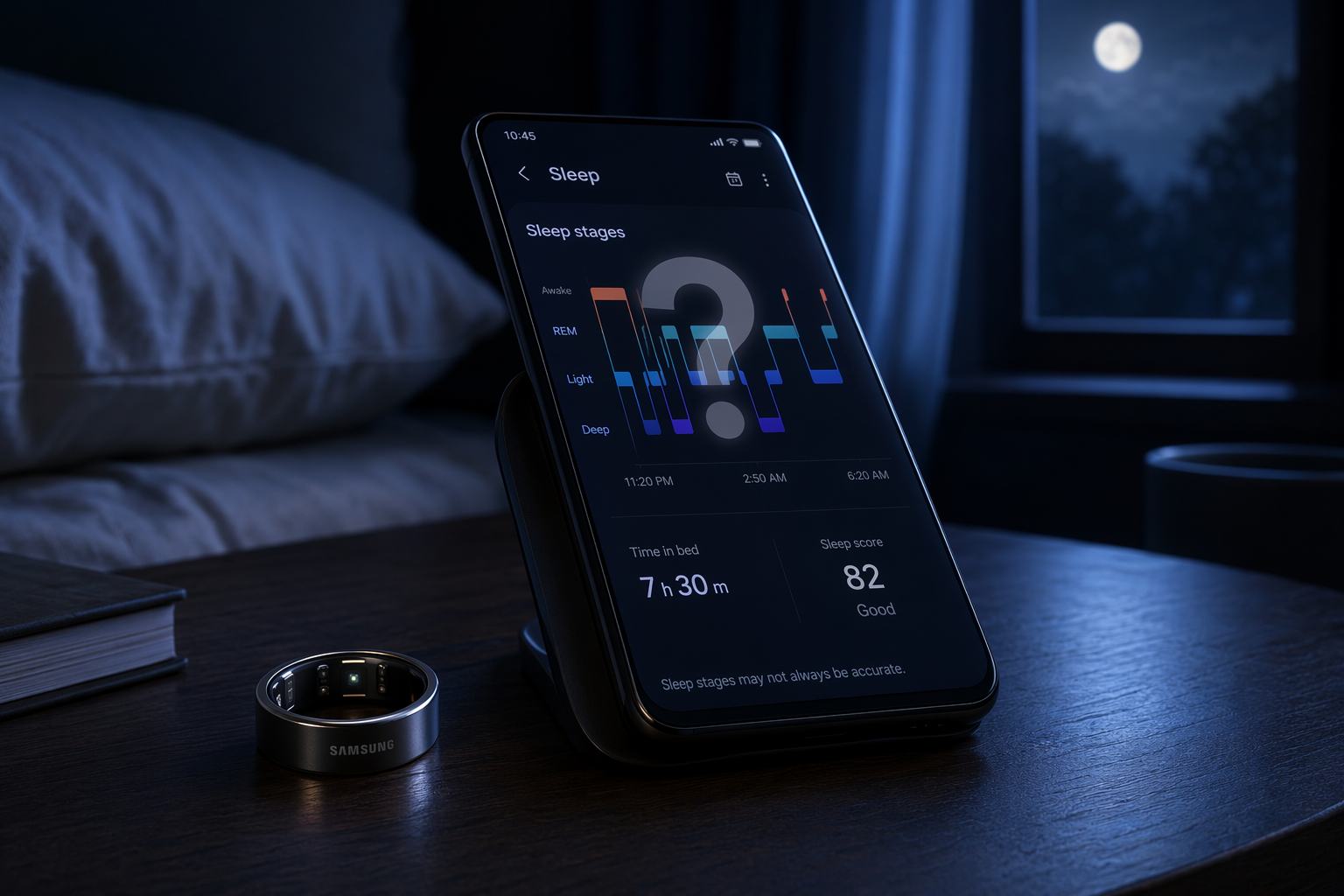
That distinction matters because a polished sleep graph can feel more settled than the science behind it. Samsung’s sleep presentation is clean and confident, but the strongest published Samsung evidence comes from a Galaxy Watch 3 validation study, not from the Galaxy Ring. In that study, the watch reached 65.1% accuracy for four-stage sleep classification against PSG, with sleep sensitivity of 0.954 and wake specificity of 0.524.[1]
Those two smaller-looking numbers explain a lot. High sleep sensitivity means that when a person is truly asleep, the device is usually good at labeling that time as sleep. Low wake specificity means that when a person is awake, especially awake but still, the device is much less reliable at recognizing wakefulness. That is the pattern many users notice: the tracker is not wildly wrong about the existence of a night’s sleep, but it can quietly absorb awake time into the sleep total.
What The Closest Validation Evidence Actually Says
The Kim et al. study is not a Galaxy Ring study, and it should not be treated as one. It tested the Galaxy Watch 3 against PSG in a predominantly male, healthy Korean sample; 87.5% of participants were male, which limits how comfortably the results can be generalized to women, older adults, or people with sleep disorders.[1] Still, it is the closest published Samsung validation evidence because the Galaxy Ring’s sleep experience sits inside Samsung Health and depends on Samsung’s sleep-analysis approach rather than a separately validated ring-specific body of research.
| Measure from the Samsung proxy study | Reported result | What it means for Galaxy Ring users |
|---|---|---|
| Four-stage sleep accuracy | 65.1% | Stage labels are only moderately aligned with PSG, so deep, light, and REM estimates should be treated as rough signals. |
| Sleep sensitivity | 0.954 | The algorithm is strong at detecting sleep when sleep is actually present. |
| Wake specificity | 0.524 | The algorithm is much weaker at identifying wakefulness, especially still wakefulness in bed. |
| Total sleep time | Overestimated by about 9.5 minutes | Nightly totals may look reasonable on average, but some individual nights can still be misleading. |
| Deep sleep | Overestimated by about 11.6 minutes | Deep sleep minutes should not be read as a literal physiological measurement. |
| REM sleep | Overestimated by about 26.3 minutes | REM estimates are especially worth treating cautiously. |
The wake-specificity result is the one to keep in mind when looking at your own morning report. A ring can measure movement, heart rate, skin temperature trends, and related signals, but it cannot read brain waves. If you wake up at 3 a.m., lie still, and try not to look at your phone, your body may look “sleep-like” to a wearable even though you know perfectly well you were awake. The result can be a hypnogram that looks tidy while the lived night felt fragmented.
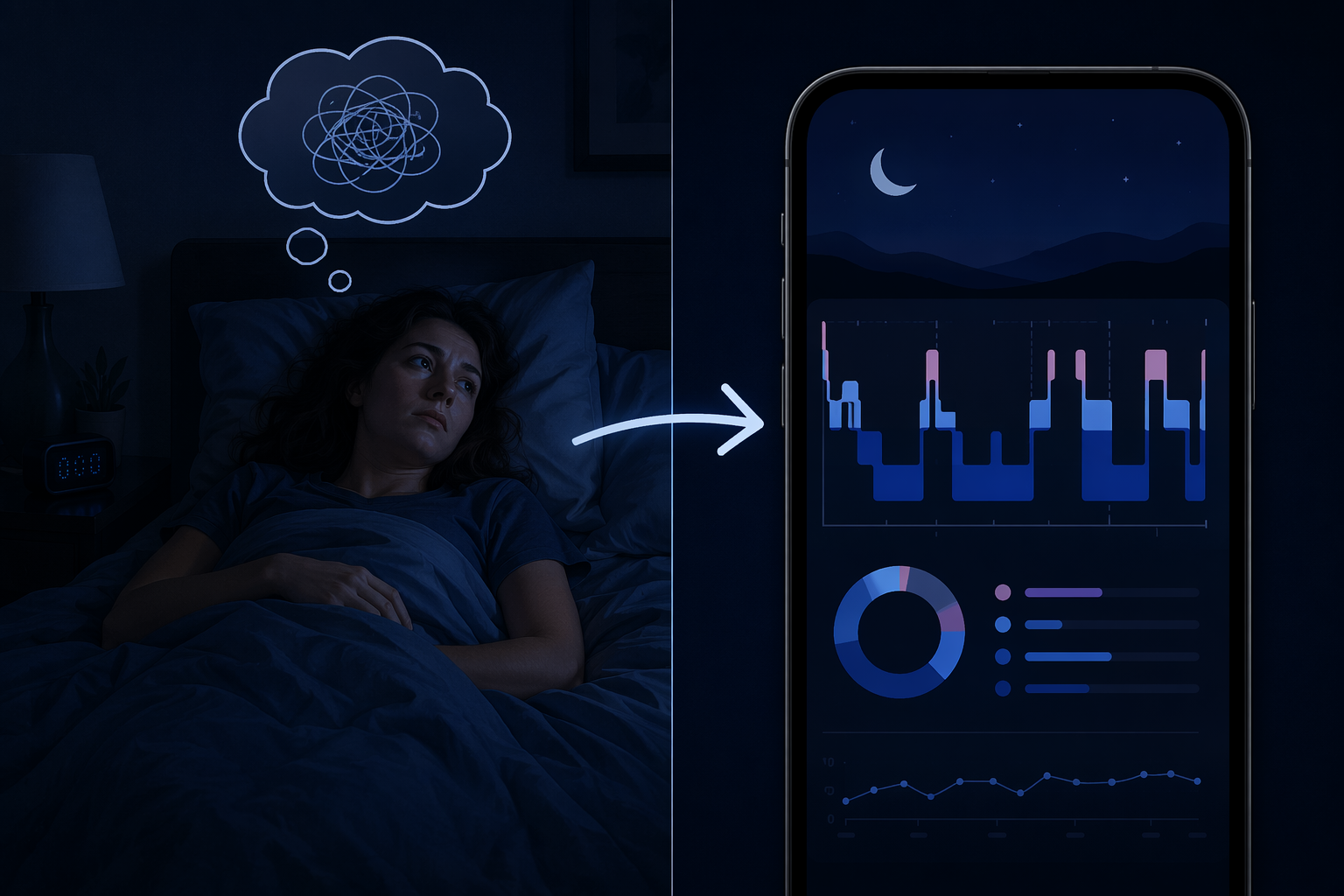
That does not make the Galaxy Ring useless. It means the most defensible use is trend tracking rather than stage interpretation. If your sleep schedule moves from 11 p.m. to 1 a.m. for a week, or your total sleep window drops sharply during travel, the ring may help you notice the pattern. But if it says you got a precise block of deep sleep during a period when you remember being awake, the memory should not automatically lose to the chart.
Why Total Sleep Time Can Look Better Than Sleep Stages
Total sleep time is a lower-resolution problem than sleep staging. A device does not have to know your exact brain state minute by minute to approximate whether your overnight rest window was long or short. Over several weeks, even an imperfect tracker can be useful if its errors are reasonably consistent and your question is broad: Am I sleeping earlier? Am I getting fewer hours during workweeks? Do late workouts or alcohol-heavy evenings tend to coincide with shorter sleep windows?
Sleep staging asks for much more. Deep sleep, REM sleep, and light sleep are clinical categories normally scored from PSG signals. A consumer ring infers those stages indirectly. That is why a moderate four-stage accuracy result from the Samsung watch study should lower expectations for the Galaxy Ring’s stage chart, even if the ring feels comfortable and collects data passively.[1]
The most tempting mistake is to treat stage minutes as if they were lab results: “I only got 42 minutes of deep sleep,” or “My REM improved by 18 minutes.” The Galaxy Ring may be detecting a meaningful change in your physiology, or it may be moving still wakefulness and ambiguous sleep into the wrong bucket. Without ring-specific PSG validation, those numbers should stay in the category of estimates.
This is also where sleep scores can become too persuasive. A single score compresses sleep duration, timing, movement, heart-rate patterns, and staging estimates into something that looks like a grade. That can be helpful when it nudges you to protect bedtime consistency. It becomes less helpful when it makes a messy night feel scientifically resolved. For a broader explanation of this trap, see what a sleep tracker watch can and cannot tell you about your sleep.
The Real-World Reviews Mostly Fit The Same Pattern
Independent reviews are not validation studies. They usually compare one consumer device against another, not against PSG, and they are affected by firmware versions, ring fit, individual physiology, and what the reviewer remembers about the night. Still, they are useful when they echo the same failure mode suggested by the Samsung watch validation data: missed wakefulness.
Android Authority reported large sleep-score gaps between the Galaxy Ring and Oura, including differences of 30 to 40 points, and said the Galaxy Ring over-recorded time in bed by more than an hour in side-by-side testing. The same review described frequent missed middle-of-the-night wake windows.[2] That is not proof that every Galaxy Ring will be off by that amount, but it is exactly the kind of error low wake specificity would lead you to expect.
Runner’s World described a similar issue from a user-facing angle: the ring did not consistently recognize when the reviewer was awake in bed before falling asleep or after waking.[3] Android Central also reported overestimated sleep and missed wakefulness.[4] The point is not that these reviews establish a precise error rate. They make the abstract validation issue visible: a quiet awake person can be too easy for the system to mistake for a sleeping person.
Wareable’s experience was more favorable. Its review found Galaxy Ring sleep data within about 10 minutes of Oura on most nights and described the energy score as broadly matching subjective feeling over longer-term use.[5] That should not be brushed aside. It is a reminder that individual experience can be better than the worst reviews suggest, and that a tracker can be useful even when it is not clinically precise.
The disagreement does not need a dramatic winner. Different firmware versions, comparison devices, sleep patterns, and expectations can all change the experience. A person who sleeps continuously may see more plausible reports than someone who spends long stretches awake but still. A reviewer checking bedtime and wake time may be happier than one scrutinizing wake after sleep onset or REM minutes.
How It Compares With Oura And Other Sleep Trackers
Oura is the obvious comparison because it is the best-known smart ring for sleep. But Oura’s own validation record is not a reason to treat any ring’s stage chart as clinical truth. A 2025 Scientific Reports study of Oura Ring performance in clinical populations reported about 85% sleep/wake accuracy and 53% four-stage accuracy.[6] That contrast is useful: even a more studied ring can struggle with detailed staging.
Samsung’s disadvantage is not that the Galaxy Ring is uniquely incapable. It is that the ring has less direct public evidence behind it. A broader multi-device study using the Galaxy Watch 5, another proxy rather than a ring study, reported a macro F1 score of 0.5761 and Cohen’s kappa of 0.4177 for four-stage sleep classification.[7] That supports the same broad reading: Samsung’s wearable sleep staging is useful as an estimate, not as a literal map of sleep architecture.
For readers comparing devices, the more honest question is not “Which ring is perfectly accurate?” None of the available consumer rings deserves that framing. The better question is whether a device has been directly tested against PSG for the thing you care about. For the Galaxy Ring, the answer is still no. For a wider evidence-based comparison, see which sleep tracker is best and the broader guide to smart ring sleep accuracy.
What You Can Trust, What You Should Treat Carefully
The Galaxy Ring is at its best when it is allowed to be a passive trend tool. That is a real advantage. A ring is less intrusive than a watch for many sleepers, has no bright screen on the wrist, and can collect overnight data without asking you to do much. Comfort matters because the tracker you actually wear consistently will usually tell you more about your habits than the more annoying tracker left on a charger.
| Galaxy Ring sleep metric | How much confidence to place in it | Why |
|---|---|---|
| Sleep and wake schedule | Moderate | Useful for seeing bedtime, wake-time, and consistency trends, especially across weeks. |
| Total sleep time | Moderate with caveats | Likely useful directionally, but can be inflated when quiet wakefulness is counted as sleep. |
| Wake after sleep onset | Low to moderate | The closest Samsung validation evidence shows weak wake specificity. |
| Deep sleep minutes | Low | Stage estimates are indirect and were overestimated in the Samsung watch proxy study. |
| REM sleep minutes | Low | REM was notably overestimated in the Samsung watch proxy study. |
| Sleep score | Directional only | Helpful as a behavioral prompt, not as a clinical grade for the night. |
There is also a moving-target problem. Samsung Health and Galaxy Ring firmware can change, and reviews published across different years may reflect different software states. Updates could improve accuracy, worsen a specific behavior, or change how the app labels sleep stages. That uncertainty is a reason to revisit the evidence, not a reason to assume the current output has already been validated.
Long-term reliability is worth a smaller note. Any sleep tracker becomes less useful if battery life declines enough that charging interrupts overnight use. The available material here is too limited to turn battery degradation into a broad Galaxy Ring accuracy claim, but it is a practical maintenance issue: missing nights and inconsistent wear can distort trends even when the underlying algorithm is unchanged.
A Sensible Trust Boundary
Use the Galaxy Ring to notice broad patterns: whether your sleep window is regular, whether your nights are getting shorter, whether weekends shift your schedule, and whether lifestyle changes seem to coincide with better or worse sleep timing. Be more cautious with any claim that depends on detecting quiet wakefulness, especially wake after sleep onset.
Do not use the Galaxy Ring to rule out insomnia, sleep apnea, periodic limb movement disorder, or any other sleep disorder. A consumer ring can miss wakefulness and cannot replace clinical testing. If your sleep feels poor, your breathing is disturbed, you are excessively sleepy, or a bed partner notices concerning symptoms, the ring’s reassuring score should not close the case.
The fairest reading is that the Galaxy Ring is promising for passive overnight trend tracking and overconfident for sleep-stage certainty. If Samsung publishes a direct Galaxy Ring PSG validation study, that should change the conversation. Until then, the ring’s sleep report is best read as a well-designed estimate, not a decoded record of what your brain did all night.
References
- Accuracy of Sleep Tracking by Samsung Galaxy Watch 3 Compared with Polysomnography, Journal of Sleep Medicine, 2023.
- Samsung Galaxy Ring sleep tracking, Android Authority.
- Samsung Galaxy Ring review, Runner’s World.
- Samsung Galaxy Ring review, Android Central.
- Samsung Galaxy Ring review, Wareable.
- Oura Ring validation, Scientific Reports, 2025.
- Multi-device sleep tracking study, PMC, 2023.

Comments
Join the discussion with an anonymous comment.