
Under-mattress sleep trackers can help flag possible moderate-to-severe obstructive sleep apnea, but they should not be treated as a diagnosis. The most important detail is not the sensor shape; it is which product, in which market, under which regulatory pathway, is making the apnea claim.
That distinction matters because three similar-looking Withings products carry different meanings. In Europe, the Withings Sleep Analyzer has CE medical certification for detecting moderate-to-severe sleep apnea. In the United States, the consumer Withings Sleep Tracking Mat has not been cleared by the FDA to diagnose sleep apnea. Separately, Sleep Rx, a prescription version, received FDA 510(k) clearance in September 2024 for home sleep apnea screening under clinician direction.[1]
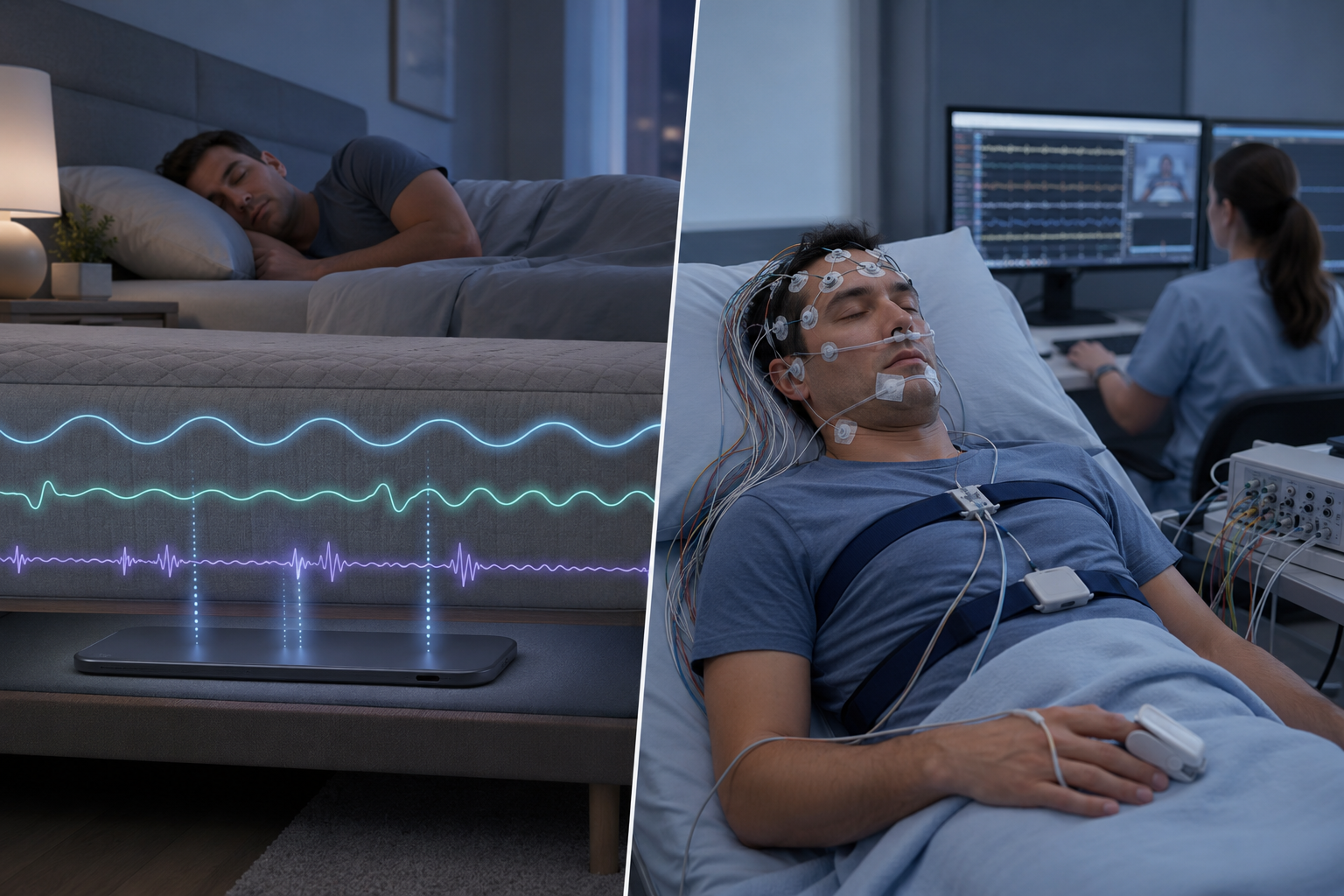
So the practical answer to under-mattress sleep tracker apnea detection is narrow but useful: these devices can be a screening bridge, especially when snoring, witnessed breathing pauses, daytime sleepiness, high blood pressure, or other risk factors are already present. They are not a replacement for a formal home sleep apnea test or in-lab polysomnography when clinical suspicion is meaningful.
What the mat is actually sensing
An under-mattress tracker does not watch you sleep and does not measure airflow at the nose. It sits beneath the mattress and reads small pressure changes that travel through the bed. In the Withings system studied for apnea detection, a pneumatic sensor captures movement, breathing effort, and heart-related mechanical signals through ballistocardiography. A sound sensor contributes snoring and snorting information. Software then combines those signals to estimate sleep time, respiratory disturbance, and an apnea-hypopnea index, or AHI.[2]
The idea is elegant because apnea often leaves a mechanical trace. Breathing effort changes. The body shifts. Heart-rate patterns can vary with respiration through respiratory sinus arrhythmia. Snoring or snorting may cluster around obstructive events. A convolutional neural network can be trained to recognize combinations of these patterns and estimate whether the night looks compatible with clinically relevant sleep apnea.[2]
But this is still inference. The mat is not measuring airflow directly. It is not measuring blood oxygen saturation. It is not reading EEG brain waves to stage sleep the way polysomnography does. It is not placing effort belts around the chest and abdomen. That is why its best role is to notice risk and support referral, not to close the diagnostic loop by itself.
| Signal | What it can contribute | What it cannot prove alone |
|---|---|---|
| Pressure changes through the mattress | Breathing effort, movement, restlessness | Exact airflow reduction at the nose or mouth |
| Ballistocardiography | Heart-rate and cardiac mechanical patterns | A clinical ECG diagnosis |
| Snoring or snorting sounds | Possible obstructive breathing events | Whether an event is obstructive rather than central |
| Machine-learning AHI estimate | Screening-level apnea risk trend | A definitive medical diagnosis without clinical testing |
For readers comparing form factors, an under-bed sensor belongs to the same broad family as other contactless sleep systems, but its evidence should be judged on the specific outcome being claimed. A broader discussion of contactless sleep tracker accuracy is useful only after separating apnea screening from general sleep-stage scoring.
The strongest validation is for moderate-to-severe OSA
The most useful clinical evidence comes from Edouard and colleagues’ 2021 multicenter validation of the Withings Sleep Analyzer in the Journal of Clinical Sleep Medicine. The study enrolled 118 adults and compared the under-mattress device with polysomnography, the clinical reference standard. The question was not whether the mat could produce a pleasant sleep score. It was whether it could classify sleep apnea severity at standard AHI thresholds.[2]
At an AHI threshold of 15 events per hour, the device showed sensitivity of 88.0% and specificity of 88.6% for detecting moderate-to-severe sleep apnea. At an AHI threshold of 30 events per hour, it showed sensitivity of 86.0%, specificity of 91.2%, and an AUROC of 0.954 for severe sleep apnea. In the study’s main classification analysis, no patient with severe OSA was misclassified as normal or mild.[2]
Those numbers support a clinically meaningful screening use. If a person’s mat repeatedly estimates values in the severe range, that is not something to file under ordinary sleep curiosity. It is a reason to contact a clinician and ask whether a formal home sleep apnea test or in-lab study is appropriate.
The same numbers do not support using the consumer mat as a stand-alone diagnostic device. The validation population had a high pretest probability of OSA, about 60%, which is not the same as testing a low-risk general population. The study was also funded by Withings and included Withings employees as co-authors. That does not invalidate the engineering or the clinical comparison, but it does mean readers should absorb the performance claims with the sponsorship plainly in view.[2]
The threshold matters too. A device can perform well at identifying moderate-to-severe disease and still be less reliable at sorting mild disease, distinguishing event types, or telling a physician why the events are happening. In practice, a mat result is most actionable when it points toward a level of risk that already warrants clinical evaluation.
Why more than one night can change the picture
One of the better arguments for passive under-mattress tracking is not that one night is perfect. It is that the device can collect many nights with almost no effort from the sleeper. That matters because AHI can vary substantially from night to night, and single-night studies can misclassify 30–50% of patients.[2]
Several ordinary things can move AHI around. A person may spend more time on their back one night and more time on their side the next. REM sleep may be longer or shorter. Alcohol, nasal congestion, sleep deprivation, medication, travel, and the unfamiliar setting of a lab can all affect what gets captured. A single normal-looking night does not always erase a partner’s repeated observation that breathing stops.
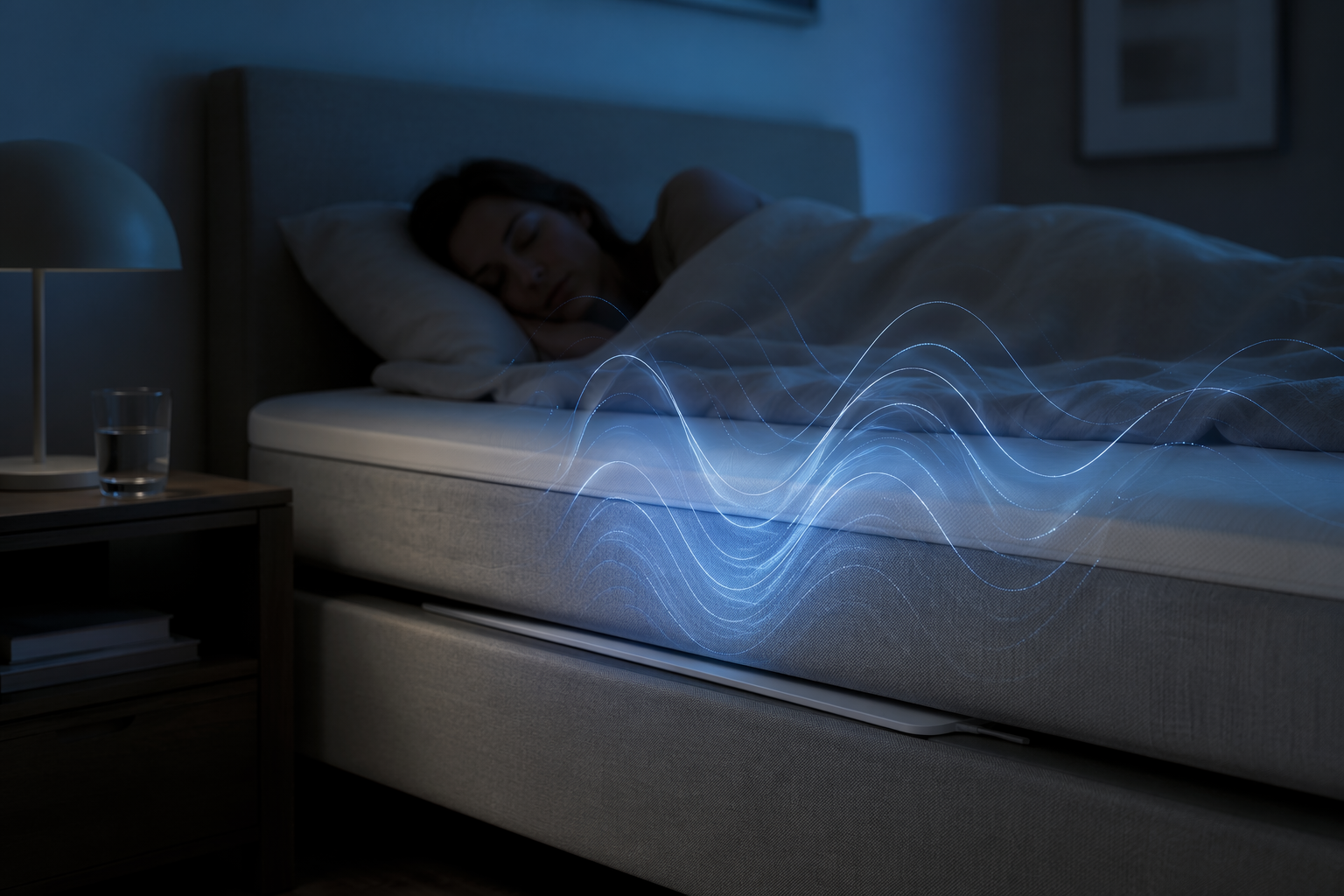
A passive mat can turn those scattered observations into a sleep diary: nights with heavier snoring, clusters of breathing interruptions, estimated AHI trends, awakenings, and sleep duration. That diary is not a diagnosis, but it can make a clinical conversation more concrete. Instead of saying “I think I snore sometimes,” a patient can say, “My partner hears pauses, and the tracker has repeatedly flagged high respiratory disturbance.”
That is also where convenience becomes clinically relevant. A tired adult with suspected OSA may not wear a watch tightly, charge another device, or remember a finger sensor every night. A sensor that stays under the mattress can collect longitudinal data precisely because it asks less of the person using it.
Regulation changes what the same-looking mat means
The regulatory split is the easiest place for consumers to get misled. A web search can surface Withings devices, European apnea claims, U.S. product pages, and FDA-cleared prescription news in the same sitting. Those are not interchangeable.
| Product identity | Market or use | Apnea meaning |
|---|---|---|
| Withings Sleep Analyzer | Europe | CE medical certification for detecting moderate-to-severe sleep apnea |
| Withings Sleep Tracking Mat | U.S. consumer product | No FDA clearance for apnea diagnosis |
| Sleep Rx | Prescription pathway | FDA 510(k) clearance in September 2024 for home sleep apnea screening |
This is not a pedantic distinction. A consumer wellness report may be useful for noticing risk, but it does not carry the same medical status as a prescription-cleared screening pathway. The same underlying sensing concept can sit in different regulatory categories depending on the product version, claims, intended use, and jurisdiction.[1]
For someone deciding what to buy, the question should be more specific than “Can this mat detect apnea?” Ask: Is this the European CE-certified Sleep Analyzer, the U.S. consumer Sleep Tracking Mat, or the prescription Sleep Rx? Is the claim screening, diagnosis, or sleep wellness? Who is expected to review the result? Those answers determine whether the data are a reason to seek care, part of a clinician-directed pathway, or simply a personal tracking signal.
Do not confuse sleep staging scores with apnea detection
Under-mattress devices are often reviewed alongside wearables for sleep-stage accuracy, but that is a different test. A 2023 JMIR multicenter validation of 11 consumer sleep technologies reported a macro F1 score of 0.4496 for the Withings Sleep Mat on four-stage sleep classification. That result speaks to sleep staging, not to apnea detection or AHI estimation.[3]
Likewise, sleep-wake accuracy is not apnea accuracy. A mat can be reasonably good at telling whether someone is in bed asleep versus awake and still be limited in identifying respiratory event type, oxygen desaturation burden, or sleep-stage-specific breathing risk. The clinically important question for suspected OSA is not whether the device drew a polished hypnogram. It is whether the respiratory signal is strong enough to justify evaluation and whether the product is cleared for the claim being made.
If you are comparing device categories, a form-factor comparison of sleep monitoring devices can help explain why a mat is comfortable for long-term tracking while still missing sensors that clinical studies use.
Where under-mattress apnea detection fails
The largest missing signal is blood oxygen saturation. Oximetry helps clinicians understand whether respiratory events are causing oxygen drops and how severe those drops are. An under-mattress pressure sensor cannot provide that information. It can estimate breathing disturbance; it cannot show the oxygen consequence of each event.
Other missing signals create practical limits:
- No direct airflow signal, so respiratory events are inferred rather than observed at the airway.
- No EEG, so sleep stages are estimated rather than clinically scored from brain activity.
- No clinical body-position signal, so back-sleeping patterns may not be clear.
- No reliable apnea-versus-hypopnea or central-versus-obstructive distinction, which matters for treatment decisions.
- No established performance for every comorbidity group, including people with atrial fibrillation, severe COPD, or neuromuscular disease.
Real bedrooms add another layer. A bed partner can move. Mattress thickness and construction can dampen signals. Slatted frames may affect how pressure changes travel to the sensor. Pets, restless children, or unusual bed setups can create signals that were not the center of a controlled validation study. None of this makes the technology useless; it just means a clean-looking app number should not outrank symptoms.
Low-risk users are another uncertainty. A device validated in a population with substantial suspected OSA may not perform the same way when used casually by people with little clinical risk. Screening tools often look strongest when the condition is common in the tested group. That is one reason a physician still has to interpret the result in context.
How to use the data without overusing it
A useful under-mattress report is a warning sign, not a verdict. Bring it to a clinician when it lines up with symptoms: loud habitual snoring, witnessed pauses, choking or gasping, morning headaches, daytime sleepiness, resistant hypertension, atrial fibrillation, or high-risk anatomy. The report is especially worth mentioning when multiple nights show the same pattern rather than one isolated spike.
The most productive use is documentation. Note the dates with high estimated AHI or breathing interruptions. Add what was different that night: alcohol, sleeping position, congestion, sedating medication, unusual sleep deprivation, or a partner’s observation. If the app records snoring patterns, bring those too. A clinician can decide whether the pattern warrants a home sleep apnea test, in-lab polysomnography, or another evaluation.
For readers looking at mattress-based systems more broadly, smart beds and mats raise similar questions: what signal is being measured, what outcome is being claimed, and whether the result changes care. A related discussion of smart-bed sleep apnea screening is helpful as long as the same boundary is kept: screening signals are not the same as diagnosis.
Seek formal testing rather than relying on the mat when symptoms are strong, when a partner witnesses breathing pauses, when estimated AHI repeatedly lands in a moderate or severe range, when heart or lung disease is present, or when sleepiness creates driving or work safety risk. The under-mattress device can help get the concern onto the clinical agenda sooner. The diagnosis and treatment plan still belong in a medical pathway.
References
- Under-Mattress Mat Gets FDA Clearance for Home Sleep Apnea Screening, Respiratory Therapy
- Validation of the Withings Sleep Analyzer, an under-the-mattress device for the detection of moderate-severe sleep apnea syndrome, Journal of Clinical Sleep Medicine, 2021
- A Multicenter Validation of Sleep-Tracking Technology Compared With Polysomnography in Healthy Adults, JMIR, 2023


Comments
Join the discussion with an anonymous comment.