
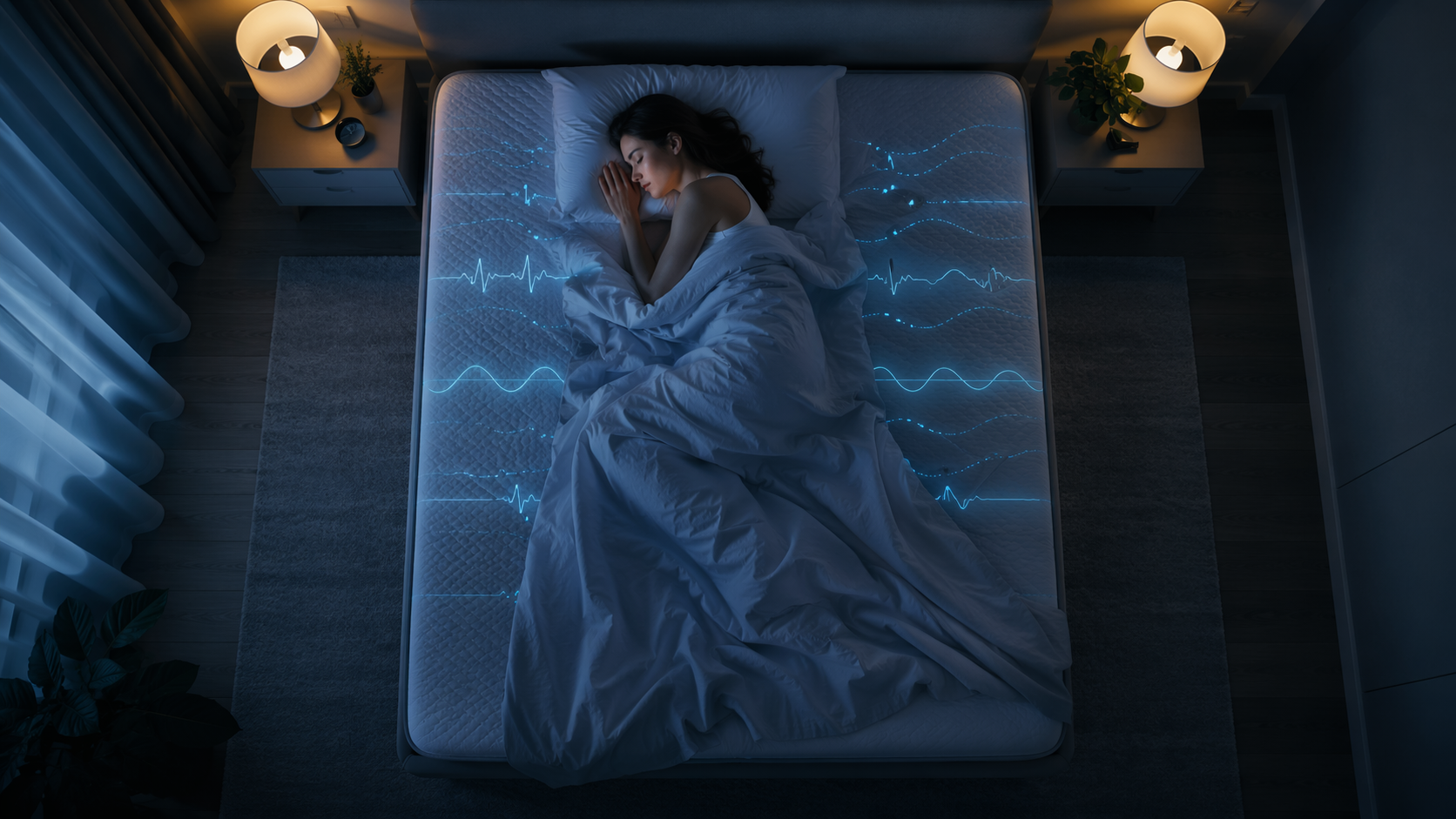
If a Sleep Number smart bed suggests your breathing may be abnormal, the safest answer is: treat it as a reason to follow up, not as a diagnosis. The strongest published apnea-specific evidence so far is a 2025 Nature Scientific Reports validation study of 104 adults comparing Sleep Number smart bed signals with overnight polysomnography, the in-lab sleep study standard. For detecting moderate-to-severe sleep apnea, defined in the study as an apnea-hypopnea index, or AHI, of 15 or higher, the smart bed reached 83.3% accuracy, 76% sensitivity, 85% specificity, and an AUC of 0.81.[1]
Those numbers are meaningful. They are also not a permission slip to skip medical care. A Sleep Number smart bed may be able to flag a pattern worth investigating, especially for someone who has been postponing a sleep study for months or years. But it is not FDA-cleared to diagnose sleep apnea, and the published evidence does not show that a normal-looking bed signal can safely rule it out.
The number that matters most is not the headline accuracy
Accuracy sounds tidy because it tells you how often the model was right overall. In the 2025 study, that was 83.3% for moderate-to-severe sleep apnea at AHI ≥ 15.[1] But accuracy can hide the two errors a worried sleeper cares about most: false reassurance and false alarm.
Sensitivity answers a harsher question: among people who really had moderate-to-severe sleep apnea by polysomnography, how many did the bed correctly flag? The answer was 76%.[1] Put plainly, the bed caught many cases, but not all of them. For a consumer screening tool, that missed-case side of the equation matters because the person who gets a reassuring signal may be the very person who stops asking why they snore, wake up choking, feel unrefreshed, or need naps to get through the day.
Specificity asks the opposite question: among people who did not have moderate-to-severe sleep apnea by polysomnography, how many did the bed correctly identify as not having it? The study reported 85% specificity.[1] That is a reasonably strong result for reducing false alarms, though it still means some people may be told they look concerning when the lab study would not classify them that way.
AUC, or area under the curve, is a broader measure of how well a model separates people with and without the target condition across possible thresholds. The reported AUC was 0.81, which supports the idea that the bed signal contains real diagnostic information.[1] It does not turn the bed into a stand-alone diagnostic device.
| Metric from the 2025 study | Reported result | What it means for a sleeper |
|---|---|---|
| Accuracy | 83.3% | The model was correct overall about five out of six times for AHI ≥ 15 in this study population. |
| Sensitivity | 76% | Some moderate-to-severe cases were missed, so a reassuring result cannot rule out sleep apnea. |
| Specificity | 85% | The model avoided many false positives, but a concerning signal still needs confirmation. |
| AUC | 0.81 | The model showed meaningful separation between the study’s apnea and non-apnea groups. |
What the bed is actually measuring
The appeal of this approach is its quietness. Sleep Number’s smart bed uses built-in ballistocardiography, or BCG, sensors to capture tiny body movements produced by heartbeat, breathing, and shifts in posture through the mattress. The sleeper does not have to wear a watch, charge a ring, tape on a sensor, or remember to start a recording.
That matters because sleep apnea is widely missed. The 2025 paper cites an estimated 936 million adults aged 30 to 69 with obstructive sleep apnea globally, with underdiagnosis rates reaching 92% in women and 82% in men with moderate-to-severe disease.[1] A passive bed-based signal will not solve that problem by itself, but it does address one stubborn barrier: many people do not complete formal testing until symptoms have been present for a long time.
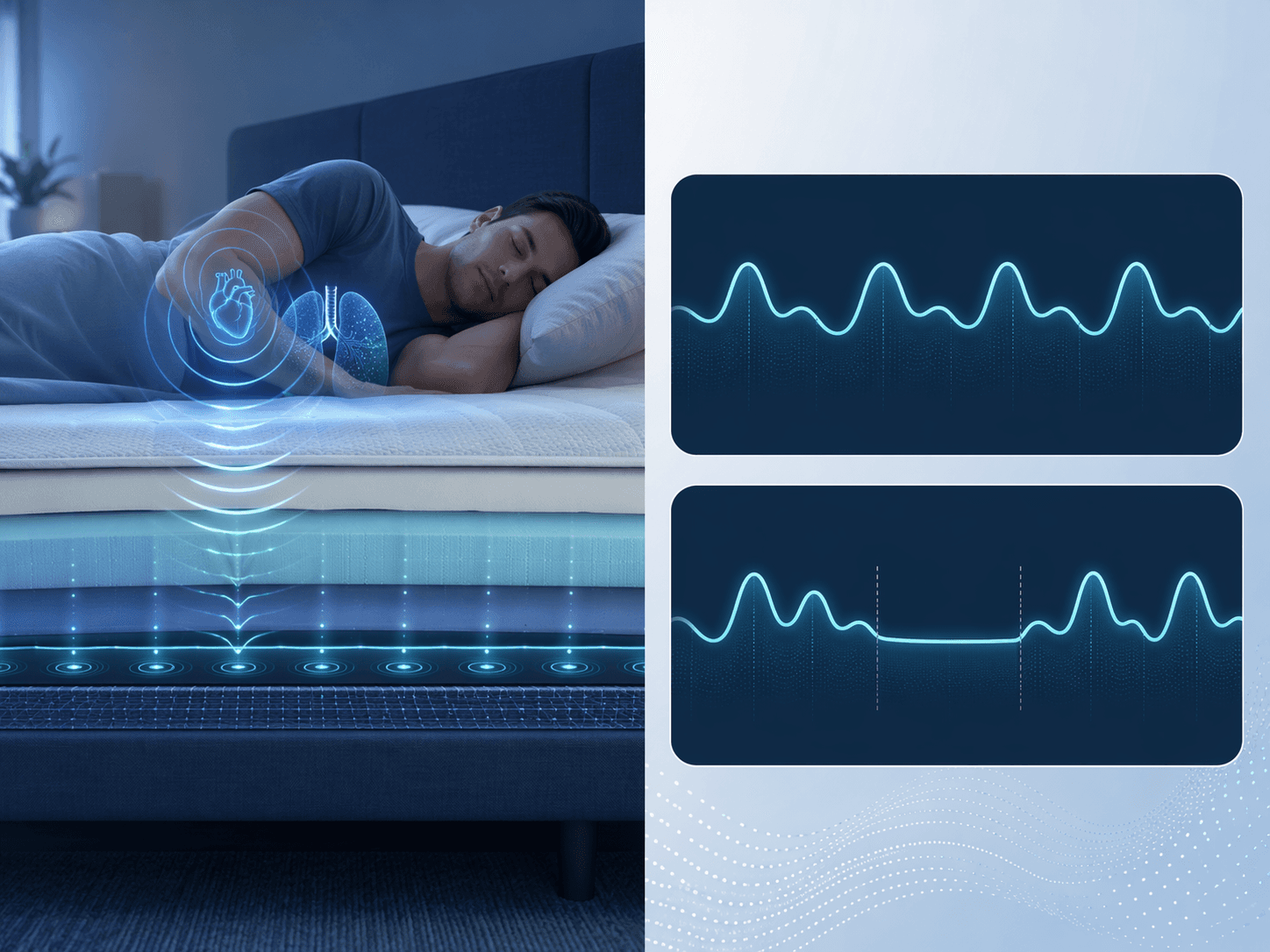
In the 2025 study, the apnea model was trained on data from 54 subjects, representing 320 hours of recording and more than one million ten-second segments. The algorithm used a deep neural network combining convolutional and recurrent layers, which is a technical way of saying it was built to recognize local signal patterns and how those patterns change over time.[1] The important point for consumers is not that the model uses AI; it is that the bed signal was compared against polysomnography rather than judged only by user impressions.
This apnea work also sits on top of earlier Sleep Number validation research. A 2022 study comparing smart bed measures with polysomnography reported sleep/wake accuracy of 86%, heart-rate correlations of 0.81 and 0.94, and breathing-rate correlations of 0.71 and 0.96, depending on the analysis method used.[2] That does not validate apnea detection by itself, but it helps explain why researchers would look to the mattress signal for breathing-related events in the first place.
Readers who want the broader SleepIQ validation context can go deeper in our full Sleep Number smart bed accuracy review. For the apnea question, the 2025 comparison with polysomnography is the more relevant evidence.
What the study can and cannot prove
The cleanest reading is this: the Sleep Number smart bed showed promising screening performance for moderate-to-severe sleep apnea in a controlled validation study. It did not prove that the bed can diagnose sleep apnea in ordinary bedroom use, across many nights, for every body type, symptom pattern, or apnea subtype.
The single-night design is a real limitation. The 2025 validation used in-lab polysomnography data from one night, and the authors called for multi-night real-world validation.[1] That matters because sleep apnea severity can vary from night to night with sleep position, alcohol, nasal congestion, medication, sleep stage distribution, and how much time someone spends on their back. A bed meant to monitor passively over time has a theoretical advantage here, but the published apnea paper does not yet show how the model performs across repeated nights at home.
The funding disclosure also belongs close to the result, not buried at the end. The 2025 apnea study was funded by Sleep Number and conducted by Sleep Number Labs employees.[1] The 2022 smart bed validation study was also funded by Sleep Number and authored by Sleep Number-affiliated researchers.[2] That does not make the data useless. It does mean independent replication would carry more weight, especially before consumers start treating a bed output as a medical answer.
There is also an equity wrinkle that should not be ignored. The earlier 2022 validation paper reported that higher BMI and female sex were associated with lower cross-correlation for heart-rate measurements.[2] That finding is not the same as showing worse apnea detection in women or people with higher BMI. Still, it is worth remembering because women with moderate-to-severe sleep apnea are already reported to be underdiagnosed at very high rates.[1] If a woman in midlife is being told her sleep disruption is probably hormones, stress, or insomnia, a quiet bed signal should not be the only thing deciding whether apnea stays on the table. For that overlap, see our guide to perimenopause insomnia versus sleep apnea.
Central events were easier for the bed to see, but that is not a home diagnosis
One clinically interesting finding in the 2025 paper is that the bed detected central sleep apnea events more readily than obstructive sleep apnea events. The authors explain this by the distinct absence of movement during central apnea, while obstructive events can involve continued respiratory effort and more complex movement patterns.[1]
That is useful scientifically because it suggests the mattress signal may contain information about different breathing-event patterns. It is not a consumer-facing promise that the bed can tell you which kind of sleep apnea you have. Central sleep apnea and obstructive sleep apnea have different clinical implications, and sorting them out belongs in a medical evaluation, not in a self-interpretation of a consumer dashboard.
How to use a concerning Sleep Number signal
A concerning pattern from a Sleep Number smart bed should be treated like a smoke alarm, not like a lab report. It tells you there may be something worth checking. It does not tell you the diagnosis, severity, treatment choice, or whether oxygen levels are dropping.
The next step is to bring the pattern to a clinician, especially if it appears alongside loud snoring, witnessed pauses in breathing, gasping or choking awakenings, morning headaches, high blood pressure, nighttime urination, unrefreshing sleep, or daytime sleepiness. A clinician may recommend a home sleep apnea test or in-lab polysomnography, depending on symptoms, medical history, and whether another sleep disorder or breathing disorder may be involved.
Johns Hopkins Medicine’s consumer sleep-tracker guidance makes the same practical distinction: sleep trackers can provide information about habits and patterns, but they do not directly measure sleep the way a clinical sleep study does and should not be used as a medical diagnosis.[3] That caution fits the Sleep Number apnea evidence well. The signal can be useful without being definitive.
If you are comparing this with wearable alerts, the same logic applies. An Apple Watch apnea notification, a ring trend, or a mattress signal may be enough to justify a conversation, but not enough to choose treatment on your own. For that comparison, see our breakdown of Apple Watch sleep apnea notifications. If you are deciding between bed sensors, watches, rings, and under-mattress devices, our sleep monitoring form-factor guide may be more useful than comparing raw marketing claims.
What not to do with a reassuring result
The most dangerous use of this technology is not overreacting to a concerning signal. It is using a normal-looking signal to dismiss symptoms that still point toward sleep apnea.
That is where the 76% sensitivity figure matters again.[1] In the study, the bed did not catch every moderate-to-severe case. A person with persistent symptoms, a partner who observes breathing pauses, or a clinician who is concerned should not let a consumer bed result close the question.
It is reasonable to use the bed’s passive monitoring as a nudge. It is reasonable to bring trend screenshots or notes to an appointment. It is not reasonable to decide that snoring and choking awakenings are harmless because the app did not make the problem look urgent.
After a clinician is involved, behavior changes such as avoiding alcohol near bedtime, treating nasal obstruction, weight management when appropriate, and positional strategies may enter the conversation. If position seems relevant to your symptoms, start with what the evidence says about sleeping position and sleep apnea— but do that as part of follow-up, not as a substitute for testing when symptoms are significant.
The practical verdict
The Sleep Number smart bed has better apnea evidence than most consumer sleep-tech claims. The 2025 validation study shows that its built-in BCG sensors and algorithm can identify moderate-to-severe sleep apnea reasonably well against polysomnography, with performance that is promising for a zero-burden screening signal.[1]
The same evidence also sets the boundary. The study was single-night and in-lab, the apnea work has not yet been validated across many real-world nights at home, the research was company-funded and company-conducted, and the product is not a diagnostic replacement. A Sleep Number smart bed may be useful as an early warning sign, especially for someone who would otherwise do nothing. A concerning pattern should lead to a clinician, a home sleep apnea test, or polysomnography rather than self-diagnosis or self-reassurance.
References
- Validating a smart bed against polysomnography for sleep apnea detection — Nature Scientific Reports, 2025.
- Performance Evaluation of a Smart Bed Technology against Polysomnography — PMC9002520, 2022.
- Do Sleep Trackers Really Work? — Johns Hopkins Medicine.

Comments
Join the discussion with an anonymous comment.