
Cannabis sits in an awkward place in insomnia care: common enough that clinicians cannot pretend it is fringe, but not supported well enough to treat as a routine sleep medicine. Up to half of medical cannabis users cite insomnia as a reason for use, while the American Academy of Sleep Medicine says current evidence is insufficient to support routine clinical use of cannabinoids for any sleep disorder.[1]
That gap matters because the lived experience can be convincing. Someone who has spent weeks lying awake may not care, at 2:40 a.m., whether a product has cleared the evidentiary bar for chronic insomnia. If it shortens the night, quiets the anxiety around bedtime, or makes sleep feel less punishing, the effect is not imaginary to that person. The harder question is whether cannabis remains helpful once use becomes regular, expectations build, tolerance develops, and stopping makes sleep worse.
The Short-Term Trial Results Are Real, But Narrow
The strongest fair case for cannabis as an insomnia aid comes from small randomized trials using defined cannabinoid formulations over short treatment windows. These studies do not prove that cannabis should be recommended for chronic insomnia, but they also do not support a dismissive “there is nothing here” response.
In Walsh et al. 2021, adults with chronic insomnia used a sublingual medicinal cannabis oil containing THC, CBN, and CBD in a randomized crossover trial. Compared with placebo, the active treatment reduced Insomnia Severity Index scores by 5.07 points and increased total sleep time by 64.6 minutes over the treatment period.[2] For a person measuring the night by how long it drags, an hour is not a trivial change.
Ried et al. 2023 tested a THC:CBD formulation in adults with insomnia in another randomized, double-blind, placebo-controlled crossover study. After two weeks, 60% of participants were no longer classified as clinical insomniacs, and objective sleep measures showed an increase of 21 minutes in light sleep.[3] Again, these are not sweeping long-term outcomes. They are measurable short-term improvements in a small, selected group using a specific product.
| Study | Formulation and duration | Main sleep findings | What limits confidence |
|---|---|---|---|
| Walsh et al. 2021 | THC:CBN:CBD sublingual oil; 2-week treatment periods | Insomnia Severity Index improved by 5.07 points; total sleep time increased by 64.6 minutes | Small completer count, short duration, and complete participant unblinding |
| Ried et al. 2023 | THC:CBD formulation; 2-week treatment periods | 60% no longer classified as clinical insomniacs; light sleep increased by 21 minutes | Small sample, short duration, and limited long-term safety information |
The important restraint is that both trials were brief. Two weeks can capture sleep onset, perceived sleep quality, and early tolerability. It cannot tell us much about what happens after months of nightly use, whether the same dose keeps working, whether next-day functioning improves, or how difficult sleep becomes when the product is stopped.
Blinding Is Not a Minor Technicality
The Walsh trial has one detail that should slow down anyone tempted to turn its result into a product claim: 100% of participants correctly guessed when they had received the active cannabis treatment rather than placebo.[2] That does not erase the findings. It does mean the study could not cleanly separate pharmacologic benefit from expectancy, recognition of intoxication or sedation, and relief at receiving the active product.
This problem is especially difficult in cannabis research because the “active” feeling can be part of the experience. If a participant notices familiar psychoactive effects, the trial may still be randomized on paper while becoming partly unblinded in practice. For insomnia, where anxiety about sleep and confidence in a treatment can influence the night, that matters.
Expectation effects are not hypothetical in this field. Research on cannabis use and sleep has found that expectations about cannabis can shape reported sleep outcomes, and that age may moderate these relationships.[4] That does not mean users are inventing their sleep changes. It means subjective improvement and drug-specific effect are hard to untangle unless trials are large, durable, and convincingly blinded.
The Broader Evidence Looks Less Reassuring
When the lens widens beyond the two short insomnia trials, the picture turns more cautious. In an AASM-cited scoping review of cannabis and sleep, 48% of studies reported worsened sleep, 21% reported improved sleep, 14% reported mixed results, and 17% reported no effect.[1] That distribution is a useful corrective to the casual claim that cannabis simply “helps sleep.”
Some of the mismatch comes from what different studies measure. A short trial may ask whether a defined product helps a small group sleep better over two weeks. A survey may capture perceived benefit among people who already choose cannabis for sleep. Epidemiologic work may detect associations between frequent cannabis use and poorer sleep in the real world. These are not interchangeable forms of evidence.
Real-world clinical data and surveys are still useful, but mainly for understanding behavior. A retrospective chart review of patients using cannabis for insomnia and sleep disorders describes clinical patterns among people who sought or received cannabis-related care.[5] A large survey by Stueber and Cuttler reports preferred products and perceived effects among cannabis users who used it for sleep.[6] Neither design can establish that cannabis caused better sleep, because people who respond well are more likely to keep using and reporting on it, while people who felt worse may have already stopped.
The same caution applies in the other direction. Observational findings linking cannabis use with worse sleep do not prove that cannabis caused every sleep problem measured. People with more severe insomnia may be more likely to try cannabis in the first place. Pain, anxiety, alcohol use, medications, work schedules, and underlying sleep disorders can all complicate the signal. The best reading is not “cannabis always worsens sleep,” but “the broad evidence does not support confidence in chronic benefit.”
Why Nightly Use Changes the Risk Equation
Occasional use and nightly use are different clinical situations. A product that seems useful on scattered bad nights may become more complicated when it is used every evening, especially if the person begins to feel unable to sleep without it.
Cannabinoids can affect sleep architecture, including REM sleep, and chronic exposure is associated with changes in the endocannabinoid system, including CB1 receptor desensitization.[7] In plain terms, the brain may adapt to repeated cannabinoid exposure. When that happens, the same dose may feel less reliable, and stopping may reveal a rebound state that feels worse than the original insomnia.
This is where cannabis differs from a harmless bedtime ritual. If tolerance develops, the user may increase dose, use more potent products, or become more rigid about timing. If REM sleep has been suppressed, discontinuation can bring vivid dreams, fragmented sleep, and the feeling that the nervous system has become louder at night. Those experiences can be distressing enough to drive a quick return to use.
The Withdrawal-Insomnia Loop
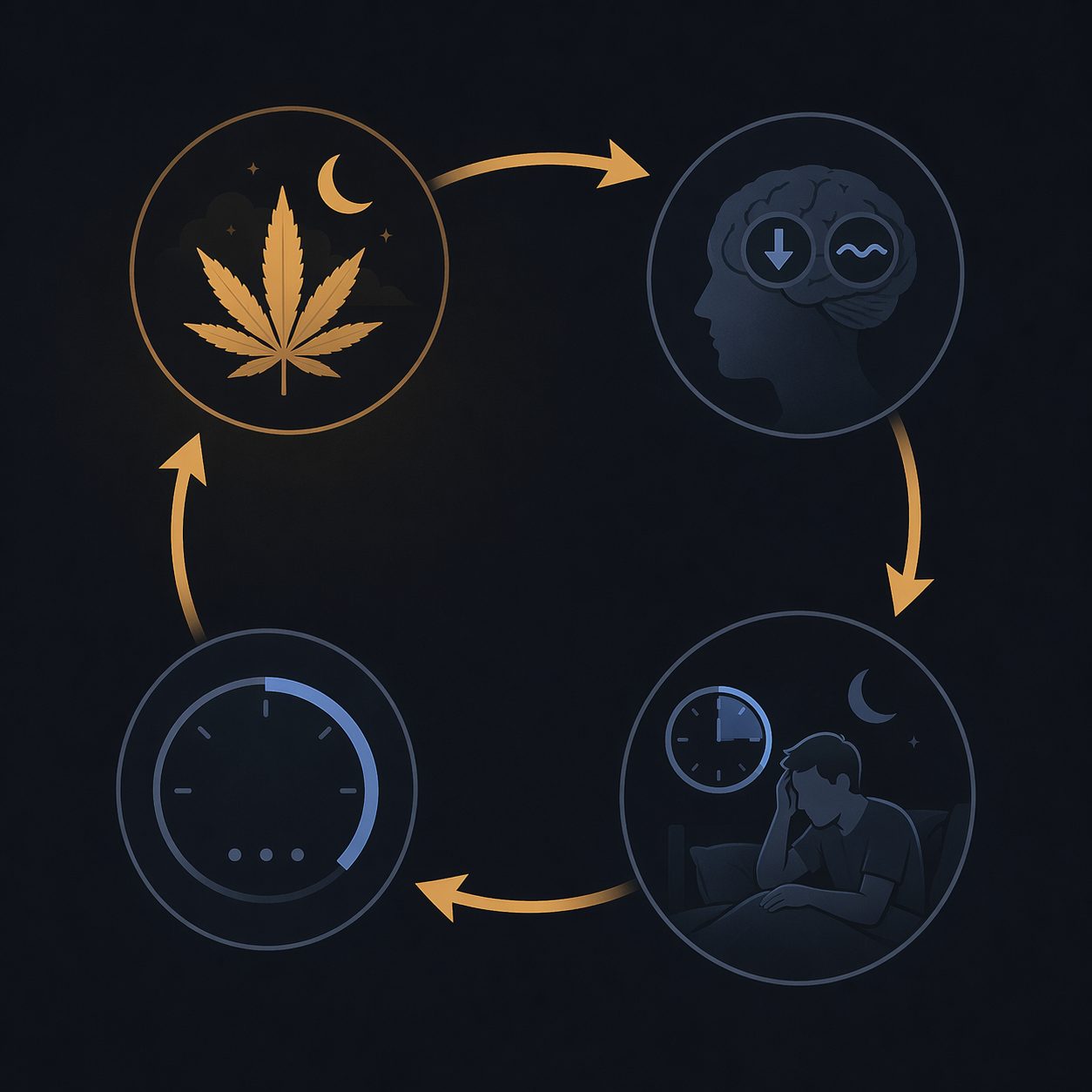
Sleep disturbance is a hallmark of cannabis withdrawal. It can appear within 24 to 72 hours after stopping and may persist for 6 to 7 weeks.[7] That time course is crucial because it explains why someone can sincerely conclude that cannabis is the only thing keeping them asleep.
The loop can look like this: cannabis helps at first, nightly use becomes routine, tolerance or dependence develops, the person stops or runs out, sleep worsens within a few days, and restarting cannabis brings relief. From inside that cycle, restarting feels like proof of treatment. Clinically, it may also be relief from withdrawal.
That distinction is not moral. It is practical. If the current insomnia is partly withdrawal-driven, adding more cannabis may quiet the immediate problem while preserving the cycle that keeps returning.
Genetics May Make Some Sleepers More Vulnerable
A University of Colorado Boulder twin and genomic study adds another layer: genetic factors may help explain why cannabis use and sleep deficits cluster together in some people. The researchers described direct evidence linking genetic risk for cannabis use disorder with short sleep and insomnia symptoms.[8]
That finding should not be inflated into a simple claim that cannabis causes all sleep deficits. It suggests vulnerability is uneven. Some people may be more likely to use cannabis heavily, more likely to have insomnia, or more susceptible to a cycle in which cannabis and poor sleep reinforce each other. For chronic insomnia care, uneven vulnerability is exactly why broad consumer claims are risky.
CBD, THC, and Product Labels Do Not Solve the Evidence Problem
It is tempting to make the question smaller by asking whether THC, CBD, CBN, flower, oil, gummies, or a particular ratio is “best” for insomnia. The trials above used specific THC-containing formulations, and their findings cannot be generalized to every dispensary product, hemp-derived gummy, or homemade dosing routine.
Product consistency is also a real-world problem. Cannabis regulations, testing requirements, potency, labeling, and access vary by jurisdiction. A study product used under trial conditions is not the same thing as a changing retail product chosen by sleep-deprived consumers at bedtime. For readers comparing cannabis with other over-the-counter options, it belongs in the same evidence-checking frame as other natural sleep remedies, where popularity and proof often move at different speeds.
CBD-only products deserve separate caution. The evidence summarized here is not a clean endorsement of CBD for chronic insomnia, and THC-containing products raise different concerns than non-intoxicating products. Readers using gummies for sleep may need a more specific comparison of cannabinoid content, dose uncertainty, and the sleep problem they are trying to treat, rather than assuming all cannabis-derived products share the same evidence.
How It Compares With First-Line Insomnia Care
For chronic insomnia, cognitive behavioral therapy for insomnia remains the first-line treatment in major sleep-medicine guidance.[1] That recommendation is not meant as a scold. CBT-I can be hard to find, expensive, time-consuming, and difficult to complete when someone is already exhausted. Those access barriers are real enough that telling people to “just do CBT-I” can sound detached from the problem.
But the hierarchy exists for a reason. CBT-I targets the learned behaviors, conditioned arousal, sleep scheduling problems, and fear of sleeplessness that maintain chronic insomnia. Its appeal is durability: the goal is not to sedate one night at a time, but to change the pattern that keeps the insomnia going. For readers who have been told to try it without being told how hard access can be, our guide to why CBT-I is so hard to get covers the practical bottlenecks.
Prescription hypnotics have their own tradeoffs, and no head-to-head randomized trials establish how cannabis compares with FDA-approved sleep medications or CBT-I for chronic insomnia. That absence matters. Without direct comparison, cannabis cannot claim a better safety or effectiveness profile simply because some people prefer it or because it feels more “natural.” Readers weighing medication options may find it more useful to compare known benefits and risks in prescription sleep medications rather than treating cannabis as outside the same standard.
A Practical Reading of the Evidence
The best-supported conclusion is narrow: certain THC-containing medicinal cannabis formulations have shown modest short-term improvements in small insomnia trials, but the evidence is not strong or durable enough to recommend cannabis as a routine treatment for chronic insomnia.
- If use is occasional, the main issue is uncertainty: short-term relief may be real, but product variability, next-day effects, and limited trial evidence make confidence low.
- If use is nightly, the main issue is the cycle: tolerance, REM effects, CB1 receptor adaptation, and withdrawal insomnia can make cannabis feel necessary even when it is helping maintain the problem.
- If insomnia has lasted for months, the main clinical task is to treat chronic insomnia itself, not only to find a stronger sedating agent.
- If stopping cannabis causes severe rebound insomnia, that pattern is worth discussing with a clinician rather than interpreting it as simple proof that the original treatment was working.
People using cannabis for sleep are not foolish for noticing short-term relief. The trials give some support to that experience. The concern is what happens after the first few nights, when the question shifts from “did I sleep better?” to “can I still sleep without it?” For chronic insomnia, that second question carries more clinical weight.
For a broader treatment map, it may help to step back from cannabis and look at whether chronic insomnia can be cured and which home remedies for insomnia carry safety risks. Cannabis may help some adults sleep in the short term, but current evidence does not support making it a first-line treatment for chronic insomnia, especially when use becomes nightly.
References
- Cannabis and sleep disorders: What clinicians need to know — AASM Viewpoints
- Treating insomnia symptoms with medicinal cannabis: a randomized, crossover trial — Walsh et al., 2021
- Medicinal cannabis improves sleep in adults with insomnia: a randomised double-blind placebo-controlled crossover study — Ried et al., 2023
- Cannabis Use and Sleep: Expectations, Outcomes, and the Role of Age — Winiger et al., 2020
- Cannabis use in patients with insomnia and sleep disorders: Retrospective chart review — Vaillancourt et al., 2022
- A large-scale survey of cannabis use for sleep: preferred products and perceived effects — Stueber & Cuttler, 2023
- Effects of Cannabinoids on Sleep and their Therapeutic Potential for Sleep Disorders — Kaul, Zee & Sahni, 2021
- Sleep deficits linked to chronic cannabis use — CU Boulder


Comments
Join the discussion with an anonymous comment.