


Introduction: The Scope of Pregnancy Insomnia and Why Treatment Matters
Sleep disruption during pregnancy is not a minor inconvenience — it is a near-universal experience with significant clinical implications. By the third trimester, up to 80% of pregnant individuals report insomnia symptoms, according to the Cleveland Clinic. A 2021 meta-analysis by Salari and colleagues corroborates this figure, placing late-pregnancy insomnia prevalence in that range. Even in the first trimester, about 1 in 4 pregnant people (25%) meet criteria for insomnia. The stakes are high: untreated insomnia during pregnancy is associated with an elevated risk of preeclampsia, gestational diabetes, preterm birth, longer labor, higher rates of cesarean section, and postpartum depression.
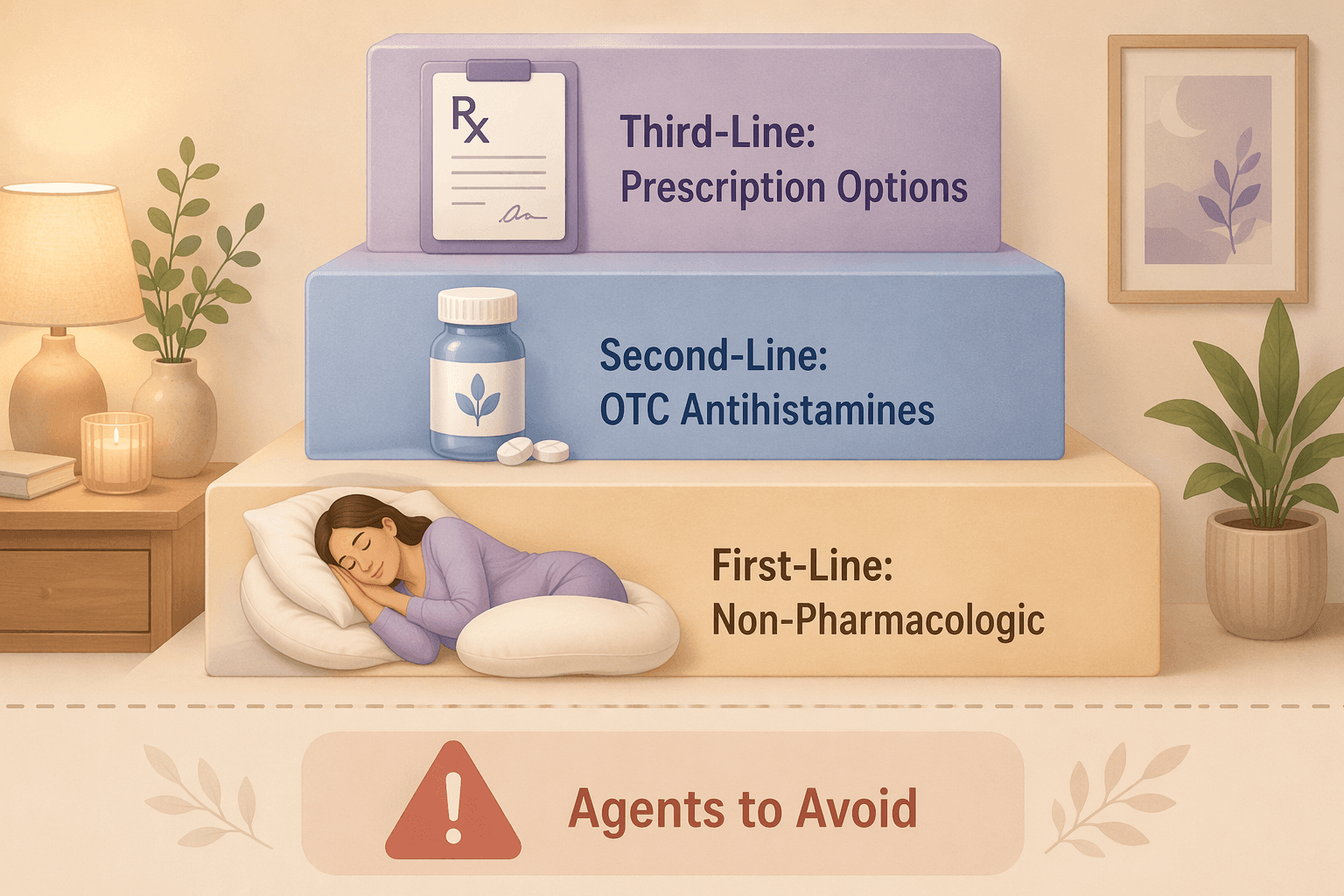
This article presents a structured, clinically grounded treatment ladder for managing moderate-to-severe insomnia during pregnancy. Rather than offering a flat list of options, it ranks interventions by safety and efficacy evidence: first-line non-pharmacologic approaches (CBT-I, sleep hygiene), second-line OTC antihistamines (doxylamine, diphenhydramine), and third-line prescription options (trazodone, amitriptyline) for refractory cases. It also clearly identifies agents to avoid entirely. This framework is designed to help you and your healthcare provider make informed, shared decisions about sleep during pregnancy.
Why Traditional Sleep Aids Are Tricky in Pregnancy
The challenge of treating insomnia during pregnancy stems from a fundamental evidence gap: pregnant individuals are systematically excluded from most clinical trials of sleep medications. This means that for the vast majority of sleep aids — both OTC and prescription — we lack the high-quality, randomized controlled trial data that would definitively establish safety during pregnancy.
In 2015, the FDA replaced the older ABCDX pregnancy risk letter categories with the Pregnancy and Lactation Labeling Rule (PLLR), which requires narrative summaries of available data rather than a single letter grade. However, many consumer-facing sources still reference the old categories (e.g., "FDA Category A"), creating confusion. Under the PLLR framework, clinicians must weigh the available — often limited — human and animal data for each agent against the known risks of untreated insomnia.
Despite this evidence gap, the use of sleep aids during pregnancy is widespread. The Sleep Foundation reports that more than 90% of pregnant people occasionally use over-the-counter sleep aids. This reality underscores the need for a clear, evidence-informed framework — not a blanket prohibition, but a tiered approach that prioritizes the safest options first.
- The FDA's PLLR system replaced the old ABCDX categories in 2015. Always look for narrative safety summaries rather than a single letter grade.
- Most sleep medications lack robust pregnancy-specific safety trials. Decisions are based on observational studies, registry data, and animal studies.
- The risk of untreated insomnia (preeclampsia, gestational diabetes, preterm birth, postpartum depression) must be weighed against the unknown or known risks of each intervention.
- More than 90% of pregnant people use OTC sleep aids despite limited evidence — making a structured, tiered approach essential for safety.
First-Line: Non-Pharmacologic Approaches (CBT-I and Sleep Hygiene)
Cognitive Behavioral Therapy for Insomnia (CBT-I) is the first-line treatment for insomnia during pregnancy, endorsed by the American College of Obstetricians and Gynecologists (ACOG) and the American Academy of Sleep Medicine (AASM). It is a structured, multi-component therapy that addresses the behavioral and cognitive factors perpetuating insomnia — without medication.
The Evidence for CBT-I in Pregnancy
The strongest evidence comes from a 2019 randomized controlled trial by Manber and colleagues, published in Obstetrics & Gynecology. In this study, 194 pregnant women (18–32 weeks gestation) were randomized to either CBT-I or a control condition involving imagery exercises. The results were striking:
- 64% of the CBT-I group achieved insomnia remission (Insomnia Severity Index score < 8), compared to 52% in the control group.
- Remission occurred faster: a median of 31 days versus 48 days in the control group (P < .001).
- The CBT-I group also showed a significantly greater reduction in depressive symptoms, as measured by the Edinburgh Postnatal Depression Scale.
A 2020 study by Felder and colleagues, published in JAMA Psychiatry, demonstrated that a digital CBT-I program (six weekly sessions of approximately 20 minutes each) also produced meaningful results: 44% of participants achieved insomnia remission, compared to 22.3% with standard care. These benefits were maintained at approximately two months of follow-up. Digital CBT-I also reduced anxiety symptoms alongside insomnia.
Supportive non-pharmacologic measures — such as sleep hygiene (consistent bedtime, cool dark room, avoiding screens before bed) and positional therapy (sleeping on the left side with pillows for support) — can complement CBT-I but should not replace it as a primary treatment. The core components of CBT-I — stimulus control, sleep restriction, cognitive restructuring — are what drive the clinical effect.
Second-Line: OTC Antihistamines (Doxylamine and Diphenhydramine)
When non-pharmacologic measures are insufficient — or when insomnia is causing significant daytime impairment — OTC antihistamines are the next step in the treatment ladder. Two agents are commonly used: doxylamine succinate (the active ingredient in Unisom SleepTabs) and diphenhydramine (the active ingredient in Benadryl and many generic sleep aids).
Doxylamine (Unisom SleepTabs 25 mg)
Doxylamine has the strongest safety profile among OTC sleep aids during pregnancy. ACOG states that doxylamine, when combined with vitamin B6, has "no harmful effects on the fetus" and is safe for treating nausea and vomiting during pregnancy — the same dose used for sleep. A 2022 study by Panchaud and colleagues in the Journal of Clinical Epidemiology reaffirmed doxylamine's safety and criticized earlier, flawed studies that had suggested a possible link to birth defects. Doxylamine is not teratogenic and can be used throughout pregnancy.
Diphenhydramine is generally considered safe for occasional use during pregnancy. The Cleveland Clinic and Johns Hopkins Medicine both note that it is "fairly safe" for occasional use. However, some older studies have suggested a possible association between first-trimester use and certain congenital anomalies, though these findings have not been consistently replicated. For this reason, diphenhydramine is generally considered safe but is slightly less preferred than doxylamine as a first-choice OTC option.
| Agent | Brand Names | Typical Dose | Pregnancy Safety Profile | Notes |
|---|---|---|---|---|
| Doxylamine succinate | Unisom SleepTabs | 25 mg | ACOG-endorsed; not teratogenic; FDA Category A (per older framework); Panchaud 2022 reaffirms safety | Preferred first-choice OTC option; also used for nausea |
| Diphenhydramine | Benadryl, Tylenol PM, ZzzQuil | 25–50 mg | Generally safe for occasional use; some conflicting older data on first-trimester use | Second-choice OTC option; use with provider knowledge |
Third-Line: Prescription Options for Refractory Cases
For a smaller subset of pregnant individuals — those with severe, refractory insomnia that does not respond to CBT-I or OTC antihistamines — prescription options may be considered. These are third-line interventions, reserved for cases where the risks of untreated insomnia (preeclampsia, gestational diabetes, preterm birth, postpartum depression) clearly outweigh the potential risks of medication. All prescription use during pregnancy requires shared decision-making with a healthcare provider.
Trazodone
Trazodone is a sedating antidepressant often used off-label for insomnia. According to a 2019 review in CHEST, trazodone is "not likely to result in major congenital malformations" based on small human studies. It is distributed in breast milk but in small amounts. A small trial by Khazaie and colleagues (2013) found that trazodone treatment in the third trimester improved sleep and reduced postpartum depression severity. However, the evidence base remains limited, and trazodone should only be used under close medical supervision.
Sedating Tricyclic Antidepressants (Amitriptyline)
Sedating tricyclic antidepressants (TCAs) such as amitriptyline and nortriptyline are another third-line option. The CHEST review notes that large-scale human studies and case-control data show no association between amitriptyline use during pregnancy and congenital malformations. The MGH Center for Women's Mental Health also notes that sedating TCAs "may be a better choice for women with sleep disturbance" and have not been associated with increased risk of congenital malformations. These medications are generally reserved for cases where insomnia is accompanied by depression or anxiety.
| Agent | Class | Key Safety Data | Considerations |
|---|---|---|---|
| Trazodone | Sedating antidepressant | Not likely to cause major malformations (small human studies); Khazaie 2013 trial showed improved sleep and reduced postpartum depression | Limited evidence base; use under specialist supervision |
| Amitriptyline | Sedating tricyclic antidepressant (TCA) | Large-scale studies show no association with congenital malformations | Preferred when insomnia co-occurs with depression or anxiety |
Agents to Avoid During Pregnancy
Several commonly used sleep aids carry well-documented risks during pregnancy and should be avoided. The evidence against these agents is stronger than the evidence supporting their use, making them inappropriate for the treatment of pregnancy insomnia.
- Benzodiazepines (Valium, Xanax, Ativan, temazepam): Pooled data suggests a possible 0.7% increased risk of cleft lip/palate with first-trimester exposure, though more recent research has not confirmed this association. Later in pregnancy, benzodiazepines can cause neonatal withdrawal (irritability, feeding difficulties) and "floppy baby syndrome" (hypotonia, respiratory depression). The MGH Center for Women's Mental Health advises against their use during pregnancy.
- Zolpidem (Ambien) and other Z-drugs (eszopiclone/Lunesta, zaleplon/Sonata): The FDA warns that third-trimester use is particularly risky, as these drugs can cause neonatal respiratory depression and increased sedation. A population-based study of 2,497 women found an increased risk of low birth weight and preterm deliveries with zolpidem use, though no increased risk of congenital anomalies was observed. The MGH Center for Women's Mental Health states that data on reproductive safety is limited and use is generally avoided.
- Melatonin: Melatonin crosses the placenta and raises fetal melatonin levels. The Sleep Foundation notes that some experts worry this may interfere with the development of the baby's own sleep-wake cycles (circadian rhythms). The CHEST review also raises concerns about interference with fetal circadian rhythm development. Melatonin is not recommended during pregnancy.
- Herbal supplements (chamomile, kava, passionflower, L-tryptophan): These products lack rigorous safety data. The Sleep Foundation reports that chamomile use in late pregnancy was associated with an increased risk of preterm birth in one study. Kava is linked to liver damage, and L-tryptophan has been linked to a rare white blood cell disorder. The American Pregnancy Association advises against herbal sleep supplements due to lack of research.
- Alcohol and cannabis: Both are clearly harmful during pregnancy. Alcohol is a known teratogen and can cause fetal alcohol spectrum disorders. Cannabis use during pregnancy is associated with preterm birth and small-for-gestational-age births, according to registry studies cited in the CHEST review. Neither should be used as a sleep aid during pregnancy.
Decision Framework: A Shared Decision-Making Grid
The following grid summarizes the treatment ladder, providing a quick reference tool to discuss with your healthcare provider. Each tier is ranked by priority, with the safest, most evidence-based options at the top.
| Tier | Intervention | Key Evidence / Safety Data | Benefit vs. Risk |
|---|---|---|---|
| First-Line | CBT-I (in-person or digital) | Manber 2019: 64% remission, median 31 days; Felder 2020 digital: 44% vs 22.3% remission | High benefit, no risk — preferred first step |
| First-Line (supportive) | Sleep hygiene, positional therapy | Supportive but not sufficient alone for moderate-severe insomnia | Low risk, low-to-moderate benefit as standalone |
| Second-Line | Doxylamine (Unisom SleepTabs 25 mg) | ACOG-endorsed; not teratogenic; Panchaud 2022 reaffirms safety | Moderate benefit, very low risk — use with provider knowledge |
| Second-Line | Diphenhydramine (Benadryl 25–50 mg) | Generally safe for occasional use; some conflicting older data | Moderate benefit, low risk — second-choice OTC |
| Third-Line | Trazodone | Small human studies; not likely major malformations; Khazaie 2013 trial | Moderate-to-high benefit, low-to-moderate risk — specialist supervision required |
| Third-Line | Amitriptyline (or other sedating TCA) | Large-scale studies: no association with congenital malformations | Moderate-to-high benefit, low risk — consider if insomnia co-occurs with depression |
| Avoid | Benzodiazepines, zolpidem/Ambien, melatonin, herbal supplements, alcohol, cannabis | Well-documented risks: cleft palate (0.7% if exists), neonatal withdrawal, preterm birth, fetal harm | Risk outweighs benefit — do not use |
When to Consult a Provider
While mild, occasional sleep difficulties during pregnancy are common and often manageable with sleep hygiene alone, certain situations warrant professional evaluation. You should consult your OB/GYN, a sleep specialist, or a perinatal mental health provider if:
- Insomnia persists for more than two to three weeks despite consistent use of non-pharmacologic measures (CBT-I, sleep hygiene).
- Sleep deprivation is causing significant daytime impairment — difficulty concentrating, excessive fatigue, mood changes, or reduced ability to function at work or home.
- You are experiencing symptoms of depression or anxiety, such as persistent sadness, loss of interest, excessive worry, or panic attacks.
- You are considering taking any medication — OTC or prescription — for sleep and want to discuss the risks and benefits with a provider.
- You have a history of preterm birth, preeclampsia, or gestational diabetes, as untreated insomnia may further elevate these risks.




Comments
Join the discussion with an anonymous comment.