
Adults are unlikely to have a life-threatening toxicity emergency from melatonin alone. That is the reassuring part. The less reassuring part is that you can still take too much, and gummies make “too much” harder to judge than the label suggests. The practical answer is this: there is no established lethal human dose, but side effects become more likely as the dose rises, 10 mg is a sensible upper limit for most adults, and 30 mg or more belongs in unsafe territory rather than casual sleep-aid use.[1]
That distinction matters because “overdose” is doing too much work here. A lethal overdose, a miserable next-day reaction, and a child eating gummies from an accessible bottle are three different safety problems. Melatonin gummies sit at the center of all three conversations because they look simple, taste like candy, and may not contain the amount printed on the front of the bottle.

What Counts as Too Much for an Adult?
For adults, melatonin is usually discussed in low milligrams, not handfuls. Many people use it short term for sleep timing problems, jet lag, or occasional sleeplessness. If you need a broader starting point on when melatonin makes sense at all, see Melatonin for Adults: How to Use It Safely as a Sleep Aid. This article is narrower: what happens when the form is a gummy and the dose creeps up.
| Amount taken | How to think about it for most adults |
|---|---|
| Low-dose use | Often the more reasonable starting point for occasional use; more is not automatically better. |
| Above 5 mg | Side effects become more likely, especially next-day drowsiness and vivid dreams. |
| Around 10 mg | A practical ceiling for most adults unless a clinician has advised otherwise. |
| 30 mg or more | Unsafe territory for self-directed use, even if it is not the same thing as a known lethal dose. |
The important move is not from “safe” to “deadly.” It is from a dose you can reasonably monitor to a dose that makes side effects, interactions, and impaired next-day functioning more likely. StatPearls notes that no LD50 has been established for melatonin in humans or animals, including animal doses up to 800 mg/kg, but that does not mean excess dosing is harmless.[1]
In adults, taking too much melatonin usually feels less dramatic than internet overdose language implies. The common problems are daytime drowsiness, headache, dizziness, nausea, vivid dreams, irritability, and sometimes anxiety rather than calm. If anxiety is part of why you are reaching for melatonin, that last point is worth pausing over; melatonin is not primarily an anxiety treatment, and some people do not feel emotionally steadier on it. For that narrower issue, see Can Melatonin Treat Anxiety?.
The Gummy Problem Is Dose Uncertainty
A tablet labeled 5 mg and a gummy labeled 5 mg invite the same mental shortcut: one unit equals one known dose. With melatonin gummies, that shortcut is not reliable enough. In a 2023 JAMA analysis of melatonin gummy products sold in the U.S., 88% were inaccurately labeled, and actual melatonin content ranged from 74% to 347% of the labeled amount.[2]
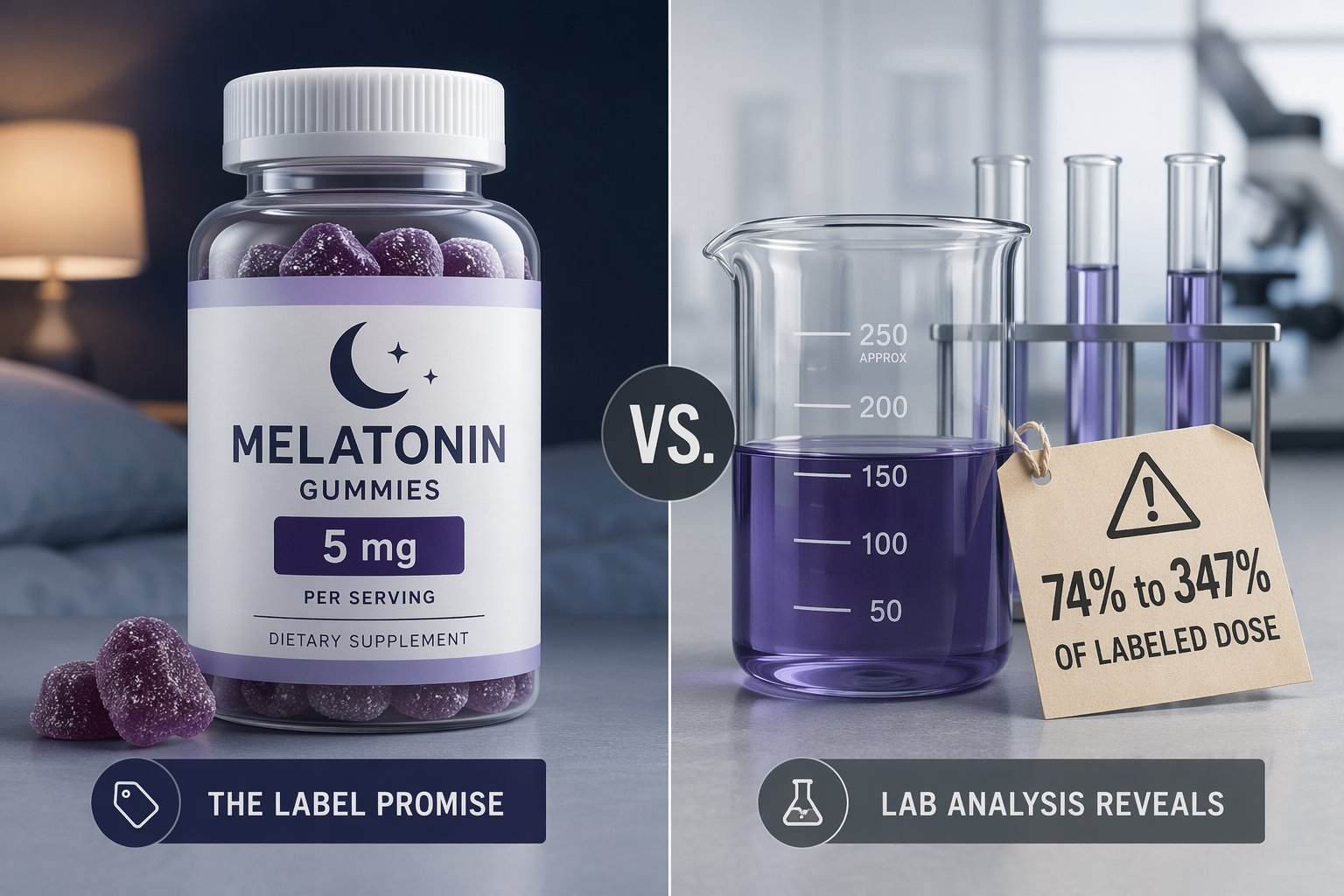
That is the part that should change behavior. If a bottle says 5 mg, you may think one gummy keeps you under a conservative limit and two gummies put you at 10 mg. But if the actual content is far above the label, “I took two gummies” is not the same as “I took 10 mg.” It may be more. The person making that choice is often tired, impatient, and trying to salvage the night; this is exactly when false precision on a supplement label becomes a real safety issue.
The JAMA finding also explains why gummies deserve their own safety conversation rather than being folded into generic melatonin advice. The dose is not only a personal decision; it is also a manufacturing and labeling problem. For a deeper look at the label-accuracy issue, see How Accurate Is Your Melatonin Gummy?.
Why “Just One More” Is Different With Gummies
Gummies lower the friction around taking another dose. They do not require water, they taste pleasant, and they resemble candy more than medication. That does not make every adult use careless. It does mean the format encourages a kind of casual escalation that capsules and tablets may not.
The practical risk is cumulative. A tired adult may take one gummy, wait, feel nothing, and take another. If the label is accurate, that may already be more than needed. If the label is inaccurate, the person has lost the ability to count milligrams at all. The front of the bottle still looks precise; the swallowed dose may not be.
What the CDC Data Shows—and What It Does Not
The strongest public-health signal around melatonin is pediatric, not adult. That matters in a household where adult gummies are stored within reach of children, but it should not be misread as proof that adults commonly have severe melatonin poisoning.
CDC surveillance reported approximately 11,000 emergency department visits for unsupervised melatonin ingestion among children aged 5 years or younger from 2019 through 2022. Among visits where the formulation was documented, gummies were the most common form, at 47.3%. Five children required mechanical ventilation, and two deaths were reported in children younger than 2 years; the CDC noted that causality attribution was uncertain.[3]
A separate CDC report on poison control data found 260,435 pediatric melatonin ingestions from 2012 through 2021, a 530% increase over that decade.[4] That is not an adult overdose rate. It is a storage, packaging, access, and supervision warning. Adult sleep aids live in real homes, and gummies are an especially easy product for a child to mistake for candy.
The adult takeaway is not panic; it is housekeeping with consequences. If melatonin gummies are in the home, they should be stored like medication, not like snacks. A child-resistant cap is not a storage plan. A bedside table, purse, kitchen counter, or open bathroom shelf is not a controlled location.
Why Supplement Rules Leave More Work to the Buyer
In the U.S., melatonin is sold as a dietary supplement, not as a prescription drug. That regulatory category helps explain why dose accuracy and purity can vary. It also explains why the label can look medically exact while the product has not gone through the same pre-market review expected of drugs. For the broader supplement-safety context around sleep remedies, see Are Home Remedies for Insomnia Safe? What the Evidence Shows.
The label problem is not new. A 2017 analysis of melatonin supplements found wide variability in melatonin content, and chewable formulations—closest in use pattern to gummies—showed 465% variability between lots of the same product. The same study detected serotonin in 26% of tested products.[5] That study examined Canadian-market products before later regulatory changes there, so it should not be treated as a perfect snapshot of every current U.S. gummy. It still supports the larger point: chewable, candy-like melatonin products have had documented quality-control problems.
When an Adult Can Monitor at Home
If an otherwise healthy adult takes more melatonin than intended and has mild symptoms—sleepiness, headache, dizziness, nausea, vivid dreams, or a groggy morning—the situation is often self-limited. The sensible response is to stop taking more that night, avoid alcohol or other sedating substances, do not drive if drowsy, and give the body time to clear the effect.
It is also worth writing down what happened: product name, labeled dose, number of gummies, time taken, other medications or alcohol, and symptoms. That turns a vague “melatonin doesn’t agree with me” into information you can use. If the product is a gummy, assume the labeled milligrams are an estimate, not a guarantee.
- Do not take extra gummies because the first dose “didn’t work” quickly enough.
- Do not combine melatonin with alcohol, sleep medications, or sedating drugs unless a clinician has cleared it.
- Do not drive or use equipment if you feel groggy, slowed, dizzy, or unusually sedated.
- Do not keep using the same dose if it leaves you impaired the next day.
When to Get Help
Call poison control or seek medical advice if symptoms are severe, confusing, or not improving; if melatonin was mixed with alcohol, opioids, benzodiazepines, prescription sleep medication, or other sedatives; or if the person who took it is pregnant, medically fragile, or older with multiple medications. Older adults deserve extra caution because sedation, dizziness, and falls can carry higher stakes; for that broader question, see Which Sleep Supplements Are Safe for Older Adults?.
For a child who may have eaten melatonin gummies, do not use adult-dose logic. Call poison control, the child’s clinician, or emergency services depending on symptoms and local guidance. The CDC data is pediatric because this is where real-world severe events are most visible: young children, unsupervised access, and products that can look and taste like candy.[3][4]
A Safer Rule for Melatonin Gummies
For most adults, melatonin gummies are not usually a poisoning emergency when used alone. They are, however, a poor format for casual dose escalation. The problem is not only that a person might choose too much; it is that the product may make the chosen dose unknowable.
Keep adult use conservative, treat 10 mg as a ceiling rather than a target, avoid 30 mg-plus self-experimentation, and store gummies where children cannot reach or recognize them as treats. A bottle that says 5 mg is useful information, not a lab certificate. With melatonin gummies, safety starts by admitting that the printed dose may not be the dose swallowed.
References
- Melatonin, StatPearls, National Library of Medicine.
- Quantity of Melatonin and CBD in Melatonin Gummies Sold in the US, JAMA, 2023.
- Emergency Department Visits for Unsupervised Pediatric Melatonin Ingestion — United States, 2019–2022, CDC MMWR, 2024.
- Pediatric Melatonin Ingestions — United States, 2012–2021, CDC MMWR, 2022.
- Melatonin Natural Health Products and Supplements: Presence of Serotonin and Significant Variability of Melatonin Content, Journal of Clinical Sleep Medicine, 2017.


Comments
Join the discussion with an anonymous comment.