

Insomnia in pregnancy is often treated as if it belongs in the same bucket as backaches, bladder pressure, and awkward sleep positions: unpleasant, expected, and not especially worth discussing unless it becomes extreme. That framing is too small for what the research now shows. Pregnancy insomnia is common, but common does not mean harmless, and it certainly does not mean a person should have to wait until they are barely functioning before anyone takes it seriously.
The best evidence does not say that every bad pregnancy outcome is caused by poor sleep, or that a pregnant person can prevent complications by sleeping better. It says something more measured and still clinically important: insomnia symptoms during pregnancy are repeatedly associated with higher risks of hypertensive disorders of pregnancy, preterm birth, gestational diabetes, cesarean delivery, depression, and suicidal ideation. That is enough to move insomnia out of the “just deal with it” category.

Common, But Not Clinically Empty
A 2024 meta-analysis of 44 studies including more than 47 million participants estimated a pooled global insomnia prevalence of 44% during pregnancy, with regional variation: 53.6% in Europe and 40.7% in Asia.[1] Those numbers should be read with some caution. Prevalence depends on how insomnia is measured, how questions are asked, and how willing people are to report sleep problems as health concerns rather than private discomforts.
That measurement issue matters because many pregnancy studies assess insomnia symptoms, not a formal insomnia disorder diagnosed under DSM-5 criteria. For example, a large 2024 nuMoM2b cohort analysis used a Women’s Health Initiative Insomnia Rating Scale threshold of 9 or higher to identify clinically significant insomnia symptoms.[2] That captures meaningful symptom burden, but it is not the same as saying every person above that threshold has a formal insomnia disorder.
Still, symptom burden is not a trivial endpoint. If someone is awake for long stretches, dreading the night, unable to recover, and functioning worse during the day, that is clinically relevant even before a diagnostic label is attached. Pregnancy care already takes many symptom patterns seriously because they may signal risk; sleep should not be an exception.
What Large Studies Find About Pregnancy Outcomes
The strongest reason to take insomnia in pregnancy seriously is not a dramatic one-off story. It is the pattern that appears across large observational datasets.
In the nuMoM2b prospective cohort, researchers followed more than 7,676 nulliparous pregnant individuals and examined insomnia symptoms in relation to adverse pregnancy outcomes. Insomnia symptoms in early pregnancy were associated with hypertensive disorders of pregnancy, with an adjusted odds ratio of 1.10, and with preterm birth, with an adjusted odds ratio of 1.17 in early pregnancy and 1.28 in mid-pregnancy.[2] The size of those associations is modest, not sensational. But the study is important because the analysis adjusted for factors that can also shape pregnancy risk, including sleep-disordered breathing, body mass index, and smoking.[2]
That adjustment does not prove insomnia caused those outcomes. It does make the finding harder to dismiss as merely a reflection of snoring, higher BMI, or smoking status. For the person sitting in an exam room trying to explain that sleep has become unmanageable, this matters: persistent insomnia symptoms are not just a comfort issue in the available evidence.
A 2021 meta-analysis in Sleep Medicine Reviews looked across 120 studies and more than 58 million participants. Sleep disturbances during pregnancy were significantly associated with several outcomes: preeclampsia with an odds ratio of 2.80, gestational diabetes with an odds ratio of 1.59, cesarean section with an odds ratio of 1.47, and preterm birth with an odds ratio of 1.38.[3]
| Outcome | Association Reported | How to Read It |
|---|---|---|
| Hypertensive disorders of pregnancy | Insomnia symptoms in early pregnancy: aOR 1.10 in the nuMoM2b cohort | A modest association that remained after adjustment for sleep-disordered breathing, BMI, and smoking. |
| Preterm birth | aOR 1.17 in early pregnancy and 1.28 in mid-pregnancy in nuMoM2b; OR 1.38 in the 2021 meta-analysis | A recurring association across cohort and meta-analytic evidence. |
| Preeclampsia | OR 2.80 in the 2021 meta-analysis | A stronger pooled association, though still observational. |
| Gestational diabetes | OR 1.59 in the 2021 meta-analysis | Suggests sleep disturbance is part of the broader metabolic-risk picture in pregnancy. |
| Cesarean delivery | OR 1.47 in the 2021 meta-analysis | An association, not proof that insomnia directly leads to cesarean birth. |
The table compresses a large body of evidence, so it should not be read as a risk calculator for an individual pregnancy. Odds ratios describe group-level associations. They do not predict what will happen to one person, and they do not account for every clinical detail a prenatal provider would consider.
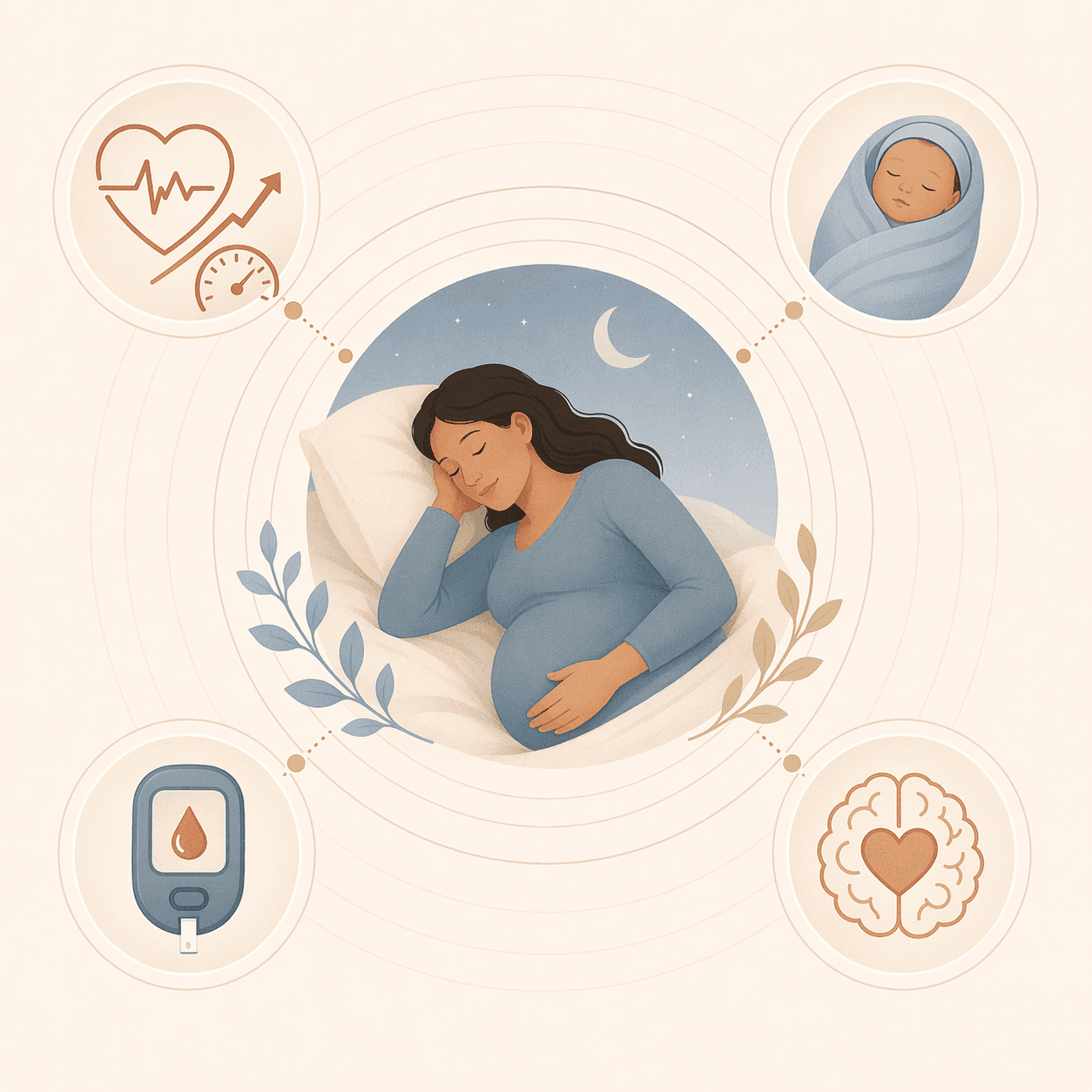
The Most Honest Interpretation Is Association, Not Blame
There is a careful line to hold here. Observational studies can show that insomnia symptoms and adverse outcomes travel together more often than expected. They cannot, by themselves, show that insomnia directly causes preeclampsia, gestational diabetes, or preterm birth.
Several explanations may overlap. Insomnia could contribute to physiologic stress through pathways involving cortisol, inflammation, glucose regulation, or blood pressure. The same underlying vulnerabilities that increase pregnancy complications might also make sleep worse. Mood symptoms, pain, reflux, nighttime urination, shift work, social stress, and untreated sleep-disordered breathing can all complicate the picture.
That uncertainty should narrow the claim, not erase the concern. The right conclusion is not “insomnia causes these outcomes.” It is that insomnia symptoms identify a group of pregnant people with measurably higher risk across several important outcomes, and that prenatal care should treat that information as clinically useful.
Mental Health Is Not a Side Issue
Sleep and mood are tightly linked in both directions, and pregnancy does not suspend that relationship. The 2024 meta-analysis found that pregnant people with insomnia had a three- to four-fold higher prevalence of depression, while about 70% of depressed pregnant individuals reported insomnia.[1] That does not tell us which came first for any one person. It does tell us that insomnia and depression often share the same clinical room.
This is where the familiar advice to “rest when you can” becomes especially thin. A person with insomnia is not simply choosing not to rest. They may be exhausted and unable to sleep, sleeping in fragments, waking too early, or becoming anxious as bedtime approaches. If mood symptoms are present too, the sleep problem can become part of a larger perinatal mental-health pattern.
A 2024 Journal of Sleep Research study reported that insomnia during pregnancy was associated with a 4.76-fold increased risk of perinatal suicidal ideation.[4] That finding should be handled with steadiness. It does not mean that insomnia usually leads to suicidal thoughts, and it should not make every sleepless night feel dangerous. It does mean that when insomnia is persistent, severe, or paired with hopelessness, panic, depression, or thoughts of self-harm, it deserves urgent clinical attention rather than reassurance alone.
For readers in the United States, suicidal thoughts, thoughts of self-harm, or fear of acting on those thoughts are reasons to seek immediate help through emergency services or the 988 Suicide & Crisis Lifeline. That threshold is not about being dramatic. It is about not leaving a high-risk symptom to be managed alone in the middle of the night.
Treatment Evidence Supports Taking Sleep Seriously
The pregnancy-outcome evidence does not yet prove that treating insomnia will prevent hypertensive disorders, preterm birth, gestational diabetes, or cesarean delivery. That distinction matters. But treatment studies do show that insomnia during pregnancy is modifiable, and that improving it can also improve depressive symptoms.
A randomized controlled trial of cognitive behavioral therapy for insomnia during pregnancy found that CBT-I improved insomnia outcomes and reduced depressive symptoms.[5] A separate randomized clinical trial of digital CBT-I for pregnant women also found improvements in insomnia symptoms and depressive symptoms.[6] Those trials are not proof that insomnia treatment prevents obstetric complications. They are evidence against the idea that pregnancy insomnia is simply something to endure.
For many people, the next question is what to do safely. That requires more individualized guidance than a risk explainer can provide, because treatment choices depend on trimester, medical history, mental-health symptoms, medications, sleep-disordered breathing risk, and the severity of impairment. Readers who want a practical next-step framework can use Restful Ground’s pregnancy sleep aid safety treatment ladder as a companion piece, then bring the specifics to a prenatal clinician.
When to Bring Insomnia Up in Prenatal Care
Insomnia is worth naming at a prenatal visit when it is persistent, impairing, worsening, or connected with mood symptoms. It is also worth bringing up when sleep loss is making it harder to work, drive, care for other children, eat regularly, monitor blood pressure or glucose, or follow medical advice. A symptom does not have to be rare to deserve care.
- Tell the provider what is happening: trouble falling asleep, long awakenings, early waking, nonrestorative sleep, or fear around bedtime.
- Describe duration and frequency: how many nights per week, how long it has been going on, and whether it started before or during pregnancy.
- Name daytime effects: exhaustion, irritability, concentration problems, anxiety, low mood, safety concerns, or missed responsibilities.
- Mention related symptoms: snoring, gasping, restless legs, reflux, pain, panic, depression, or thoughts of self-harm.
- Ask what evaluation or treatment options are appropriate in pregnancy, rather than assuming the only answer is to tolerate it.
The evidence supports a practical middle ground: insomnia in pregnancy is not a reason to panic, and it is not a personal failure. It is a symptom pattern associated with real maternal and infant health risks, with especially important overlap with perinatal mental health. That makes it worth documenting, discussing, and treating as a modifiable risk factor rather than a trivial complaint.
References
- Global prevalence and associated factors of insomnia among pregnant women: a systematic review and meta-analysis. PMC, 2024.
- Associations between insomnia symptoms and adverse pregnancy outcomes in the nuMoM2b cohort. Sleep, 2024.
- Sleep disturbances during pregnancy and adverse maternal and fetal outcomes: a systematic review and meta-analysis. Sleep Medicine Reviews, 2021.
- Insomnia during pregnancy and perinatal suicidal ideation. Journal of Sleep Research, 2024.
- Cognitive Behavioral Therapy for Prenatal Insomnia: A Randomized Controlled Trial. 2019.
- Efficacy of Digital Cognitive Behavioral Therapy for the Treatment of Insomnia Symptoms Among Pregnant Women: A Randomized Clinical Trial. JAMA Psychiatry, 2020.



Comments
Join the discussion with an anonymous comment.