
The best adult sleep aid is not the strongest one on the shelf. It is the one that matches the sleep problem you actually have, while staying inside your safety limits. That distinction matters because “adult” covers a 28-year-old with jet lag, a 44-year-old waking at 3 a.m. during a stressful month, and a 72-year-old taking several medications. In national survey data from 2024, sleep aid use was 10.5% among adults ages 18 to 34 and 15.8% among adults 65 and older, which means use rises in the same age range where some common OTC ingredients become more concerning.[1]
A better first question is: what kind of sleep problem are you trying to solve tonight? Trouble falling asleep, trouble staying asleep, anxiety-linked arousal, and circadian timing problems do not point to the same ingredient.
| If your main problem is... | Ingredients people often consider | What to keep in mind |
|---|---|---|
| Trouble falling asleep for a few nights | Diphenhydramine or doxylamine | Sedating, but best treated as short-term tools; avoid if you have certain medical risks or are an older adult. |
| Jet lag, delayed sleep timing, or schedule shift | Melatonin | More of a timing signal than a broad sleeping pill; label accuracy matters. |
| Waking during the night | L-theanine or magnesium glycinate | Lower-grogginess options, but evidence is smaller and results are less predictable. |
| Feeling wired or stress-activated at bedtime | Magnesium glycinate or L-theanine | Reasonable lower-risk experiments for some adults, not replacements for treating persistent insomnia or anxiety. |
| Age 65+, pregnancy, multiple medications, glaucoma, urinary retention, or chronic insomnia | Do not choose by shelf strength | Check with a clinician or pharmacist before using OTC sleep aids. |

Start With the Sleep Pattern, Not the Product Claim
Most OTC sleep aid labels are written as if sleep were one problem. It is not. If you fall asleep easily but wake at 3 a.m., a product designed mainly to knock you out at bedtime may leave you groggy without fixing the timing of your wake-up. If you are traveling across time zones, a sedating antihistamine may make you drowsy, but it does not directly teach your body clock what time it is. If stress is keeping your nervous system on alert, a heavy sedative effect may feel appealing, yet the better long-term question is why bedtime has become the place your brain starts working.
For readers who want a shorter ranking-style view, which over-the-counter sleep aid is most effective can be useful. But for choosing safely, a ranked list is only the beginning. The same ingredient can be reasonable for one adult and a poor fit for another.
Diphenhydramine and Doxylamine: Sedating, Familiar, and Easy to Overuse
Diphenhydramine and doxylamine are first-generation antihistamines. They can make people sleepy because they cross into the brain and block histamine signaling, which is one of the systems involved in wakefulness. This is why they show up in many nighttime products, including some products marketed for sleep and some combination cold or pain formulas.
Their best-matched use is narrow: an otherwise healthy adult who needs short-term help falling asleep for a few nights. Mayo Clinic notes that tolerance to the sedating effects of these antihistamines can develop quickly, so the same dose may stop working as well with repeated use.[2] That is the point where people often start escalating dose, stacking products, or using a sleep aid as a nightly habit. None of those moves makes the ingredient safer.
The other issue is anticholinergic burden. Diphenhydramine and doxylamine can cause next-day drowsiness, dry mouth, constipation, blurred vision, and urinary problems. Johns Hopkins lists closed-angle glaucoma, peptic ulcer, and urinary retention among conditions where these sleep aids are not appropriate.[3] That warning is easy to miss when the product is sold without a prescription.
Doxylamine and diphenhydramine are often compared as if one is automatically the safer adult sleep aid. The more honest answer is that both share the same broad problem: they are sedating antihistamines with anticholinergic effects. GoodRx describes both as intended for short-term use, not ongoing nightly insomnia treatment.[4] If you are choosing between them because one has already stopped working, that is a sign to pause rather than switch labels and continue the pattern.
For a deeper comparison of these two ingredients, see which OTC sleep aid is safer: doxylamine or diphenhydramine.
Melatonin Fits Timing Problems Better Than General Sleeplessness
Melatonin is often treated like the gentle default sleep aid. That reputation is only partly useful. Melatonin is a hormone involved in circadian timing, so it makes the most sense when the problem is timing: jet lag, delayed sleep schedule, or a body clock that is not aligned with the bedtime you are trying to keep.
It is less impressive as a broad hypnotic. Sleep Foundation reports that 49% of adults have tried melatonin, yet the average objective effects in one analysis were modest: sleep latency shortened by a mean of 4 minutes and total sleep duration increased by 12.8 minutes.[5] Those averages do not mean no one benefits. They do mean melatonin should not be sold to adults as if it reliably works like a sedative.
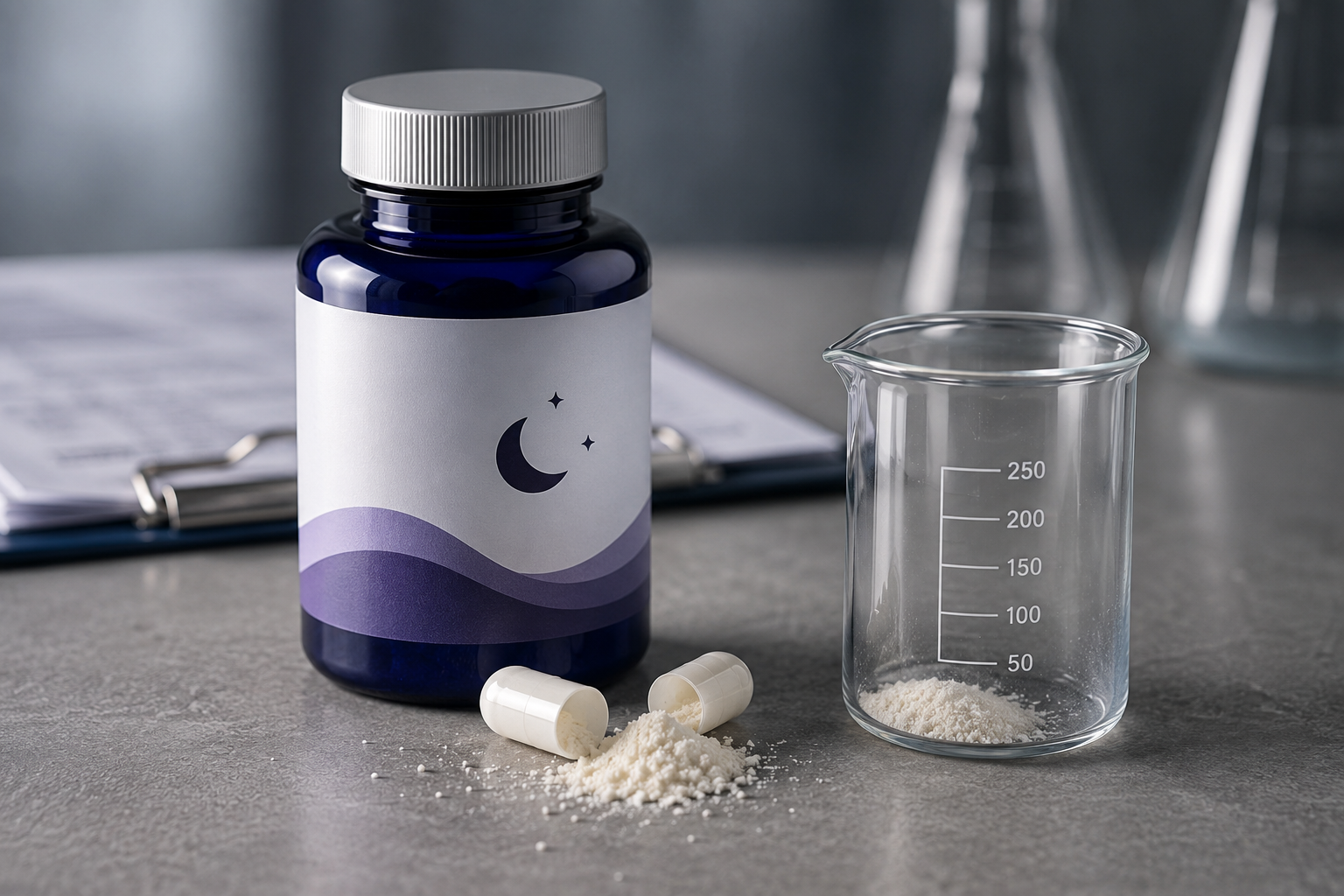
Product quality is the second melatonin problem. In a 2017 analysis of melatonin supplements, 88% were inaccurately labeled, measured content ranged from far below to far above the labeled dose, and more than a quarter of products contained serotonin.[6] That study was not a perfect snapshot of every U.S. bottle in 2026, but it is a serious warning about assuming supplement labels are exact dosing instructions.
If melatonin matches your problem, the practical choice is not “highest dose.” It is a product with better quality signals, a dose that does not overshoot your need, and timing that fits the body-clock problem. For more detail on that narrower decision, see the best melatonin for adults depends on label accuracy.
Magnesium Glycinate and L-Theanine: Lower Grogginess, Smaller Evidence Base
Magnesium glycinate and L-theanine occupy a different part of the sleep aid aisle. They are not usually chosen because they are the most sedating. They are chosen because some adults want a lower-grogginess option when the problem feels like tension, stress, or an inability to settle.
Magnesium is involved in normal nervous system function, and glycinate is often marketed as a gentler form. The evidence base for magnesium as a sleep aid is smaller than many labels imply, but it may be a reasonable experiment for adults whose sleep disruption seems tied to stress or muscle tension and who do not have medical reasons to avoid supplementation. The more cautious framing is important: magnesium glycinate is not a proven fix for chronic insomnia.
L-theanine, an amino acid found in tea, is usually discussed for relaxation rather than direct sedation. Sleep Foundation describes L-theanine as a natural sleep aid that may help with sleep quality, though the evidence is limited compared with better-studied treatments.[7] In practical terms, it may be more relevant to nighttime awakenings or stress-linked restlessness than to someone who needs a strong push into sleep at 10 p.m.
These ingredients are tempting because they feel less serious than antihistamines. That does not make them consequence-free. Magnesium can interact with some medications and may not be appropriate for people with certain kidney problems. L-theanine products still vary in dose and formulation. The right expectation is modest: a lower-risk trial for some adults, not a guaranteed solution.
Readers comparing supplement options may find natural sleep aids ranked by clinical evidence or match your sleep problem to the right natural remedy helpful if they are trying to separate plausible options from overconfident marketing.
Valerian Deserves More Caution Than Hype
Valerian is one of the older “natural sleep” ingredients, and it is often placed near melatonin, magnesium, and calming tea blends. The problem is not that valerian can never help anyone. The problem is that the evidence is mixed, products vary, and the promised effect is often more certain than the research allows.
For an adult deciding what to buy tonight, valerian is rarely the cleanest first choice. If the problem is circadian timing, melatonin is more directly matched. If the problem is occasional sleep onset and there are no safety exclusions, an antihistamine may be more predictably sedating, though only for short-term use. If the problem is stress-linked restlessness, magnesium glycinate or L-theanine may be simpler lower-grogginess experiments. Valerian sits in a less certain middle.
The Safety Boundary Is Not Fine Print
The adults most likely to need caution are often the adults most motivated to find relief: people over 65, people taking several medications, people with glaucoma or urinary symptoms, pregnant people, and people whose insomnia has become routine. These are not edge cases. They are exactly the people who should be protected from the idea that OTC automatically means low risk.
Anticholinergic exposure is the clearest example. Harvard Health, discussing research published in JAMA Internal Medicine, reported a 54% higher dementia risk among people with three or more years of anticholinergic use compared with those taking the same dose for three months or less.[8] That finding does not prove that one occasional dose causes dementia. It does make long-term casual use of diphenhydramine or doxylamine a poor bargain, especially for older adults.
A good safety screen before using an OTC adult sleep aid is short and blunt:
- Are you 65 or older?
- Are you pregnant, trying to become pregnant, or breastfeeding?
- Do you have closed-angle glaucoma, urinary retention, prostate-related urinary trouble, or a history of peptic ulcer?
- Do you take medications that already cause sedation, dizziness, confusion, or anticholinergic side effects?
- Have you needed a sleep aid repeatedly for more than a short spell?
A “yes” does not always mean no sleep aid is ever allowed. It does mean the choice should involve a clinician or pharmacist rather than a quick scan of the strongest-looking box. Older adults can start with which sleep aids are safe for people over 65 for a more focused safety discussion.
When the Problem Is Waking at 3 A.M.
Middle-of-the-night waking is where many OTC choices disappoint. A bedtime sedative may help you fall asleep, then leave you foggy if you wake anyway. Taking another dose in the middle of the night can be unsafe because it may impair alertness the next morning, especially if you need to drive, care for someone, or work early.
If waking is rare and tied to an obvious disruption, a short-term approach may be enough. If it is becoming a pattern, the question shifts. Some cases of sleep maintenance insomnia involve stress, alcohol timing, medications, pain, hot flashes, breathing problems, or a sleep schedule that no longer builds enough sleep drive. An OTC sleep aid may cover the night without identifying the reason the wake-up keeps happening.
For readers whose main complaint is staying asleep rather than falling asleep, sleep maintenance insomnia is a sleep drive problem and trouble falling asleep vs. staying asleep are better next reads than another product comparison.
Occasional Sleeplessness and Chronic Insomnia Are Different Decisions
OTC sleep aids make the most sense for occasional, short-term sleep disruption: travel, a stressful week, a temporary schedule change, or a brief patch of difficulty falling asleep. Chronic insomnia is different. The American Academy of Sleep Medicine’s 2017 pharmacologic guideline does not recommend OTC antihistamines or melatonin for chronic insomnia treatment.[9]
That guideline should not be stretched into a claim that OTC products never make anyone sleepy. They can. The boundary is the pattern of use. If you need a sleep aid night after night, if you are increasing the dose, if you are mixing products, or if sleep anxiety is starting earlier and earlier in the evening, the problem has moved beyond the shelf.
Cognitive behavioral therapy for insomnia is the better-established first-line direction for chronic insomnia, including cases where worry about sleep has become part of the cycle. Readers in that situation should look at CBT-I for sleep anxiety or talk with a sleep clinician rather than rotating through stronger OTC products.
How to Choose Tonight Without Turning It Into a Habit
A practical choice can be made in four moves. First, name the sleep pattern: falling asleep, staying asleep, body-clock timing, or stress-linked arousal. Second, remove unsafe options based on age, pregnancy status, medical history, and medications. Third, choose the ingredient that fits the pattern rather than the loudest promise on the box. Fourth, set a stop point before you start.
For occasional sleep onset trouble, diphenhydramine or doxylamine may work, but they are short-term tools with real anticholinergic limits. For circadian timing problems, melatonin may fit better, but dose, timing, and label reliability matter. For stress-linked or maintenance complaints, magnesium glycinate or L-theanine may be reasonable lower-grogginess experiments, with weaker evidence than their marketing often suggests. For older adults, contraindications, pregnancy, complex medication use, or chronic insomnia, the best adult sleep aid is not an OTC product chosen from a shelf.
If the pattern persists, the responsible next step is not a stronger sleep aid. It is a better explanation for why sleep is failing in the same way again.
References
- Use of Sleep Aids Among Adults Age 18 and Older: United States, 2024 — CDC NCHS
- Sleep aids: Understand options sold without a prescription — Mayo Clinic
- Sleep Aids — Johns Hopkins Medicine
- Doxylamine vs. Diphenhydramine: Here Are the Differences — GoodRx
- Compare Sleep Aids: Understanding the Differences — Sleep Foundation
- Poor Quality Control of Over-the-Counter Melatonin — Journal of Clinical Sleep Medicine, 2017
- Natural Sleep Aids: Which Are the Most Effective? — Sleep Foundation
- Common anticholinergic drugs like Benadryl linked to increased dementia risk — Harvard Health
- Pharmacologic Treatment of Chronic Insomnia in Adults — American Academy of Sleep Medicine, 2017


Comments
Join the discussion with an anonymous comment.