
If you have sleep apnea, or you think you might, mouth taping is not a safe at-home shortcut unless a clinician has already confirmed three things: your nasal airway is open, your obstructive sleep apnea is mild, and you do not have relevant conditions such as reflux, asthma, or panic disorder. Without that screening, the main mouth taping sleep apnea risks are not cosmetic or theoretical. They include blocked breathing when the nose cannot carry airflow, possible worsening of apnea-related airflow in some people, and lost time before proper diagnosis or treatment.
That boundary matters because mouth taping removes the backup route your body may try to use when nasal breathing fails. The most complete review available, published in 2025, found that all 10 included studies on mouth taping were rated poor quality on the Newcastle-Ottawa Scale, and four of those studies explicitly discussed serious asphyxiation risk when the mouth is occluded in the setting of nasal obstruction or regurgitation risk. [1]
Why Sleep Apnea Changes the Risk
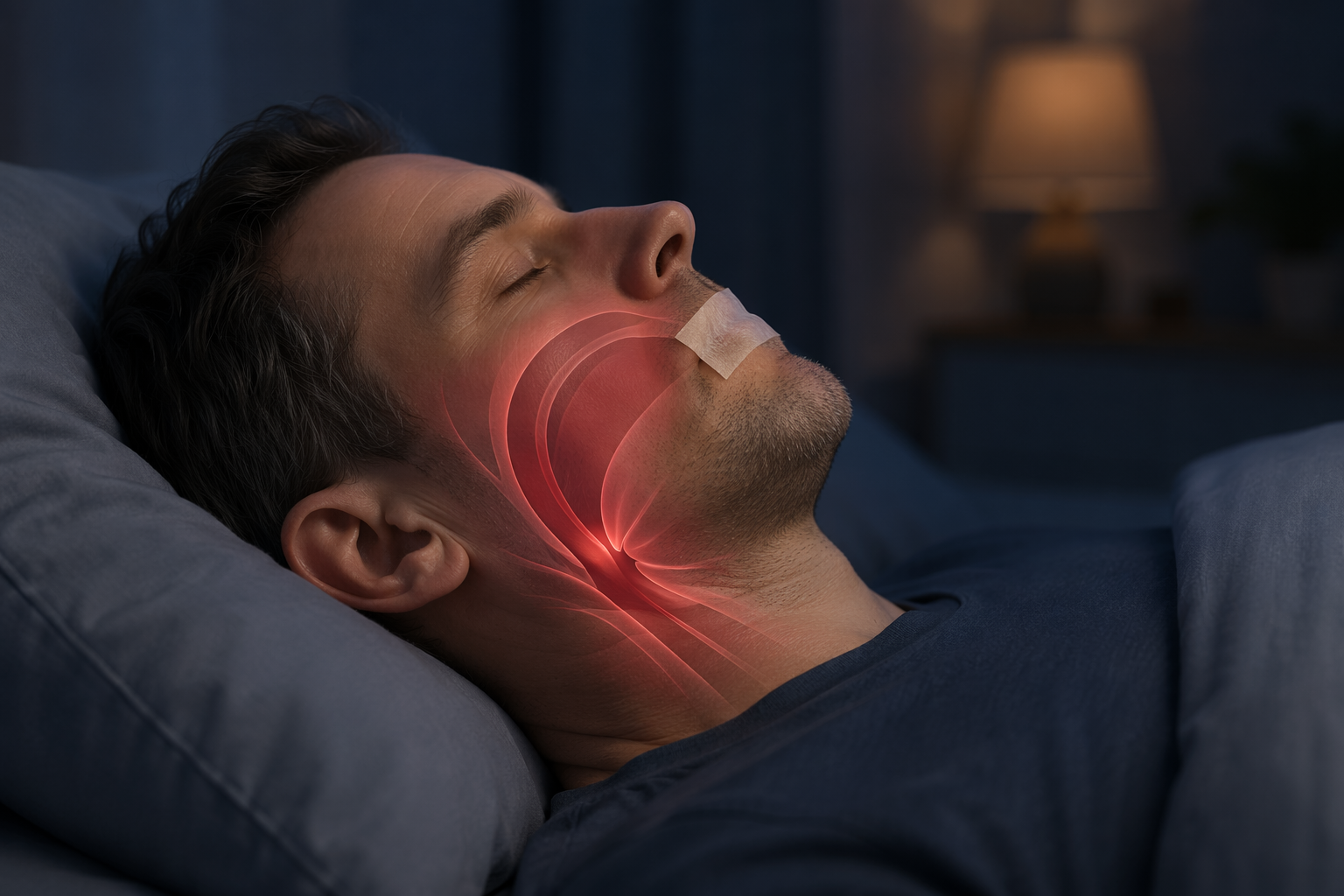
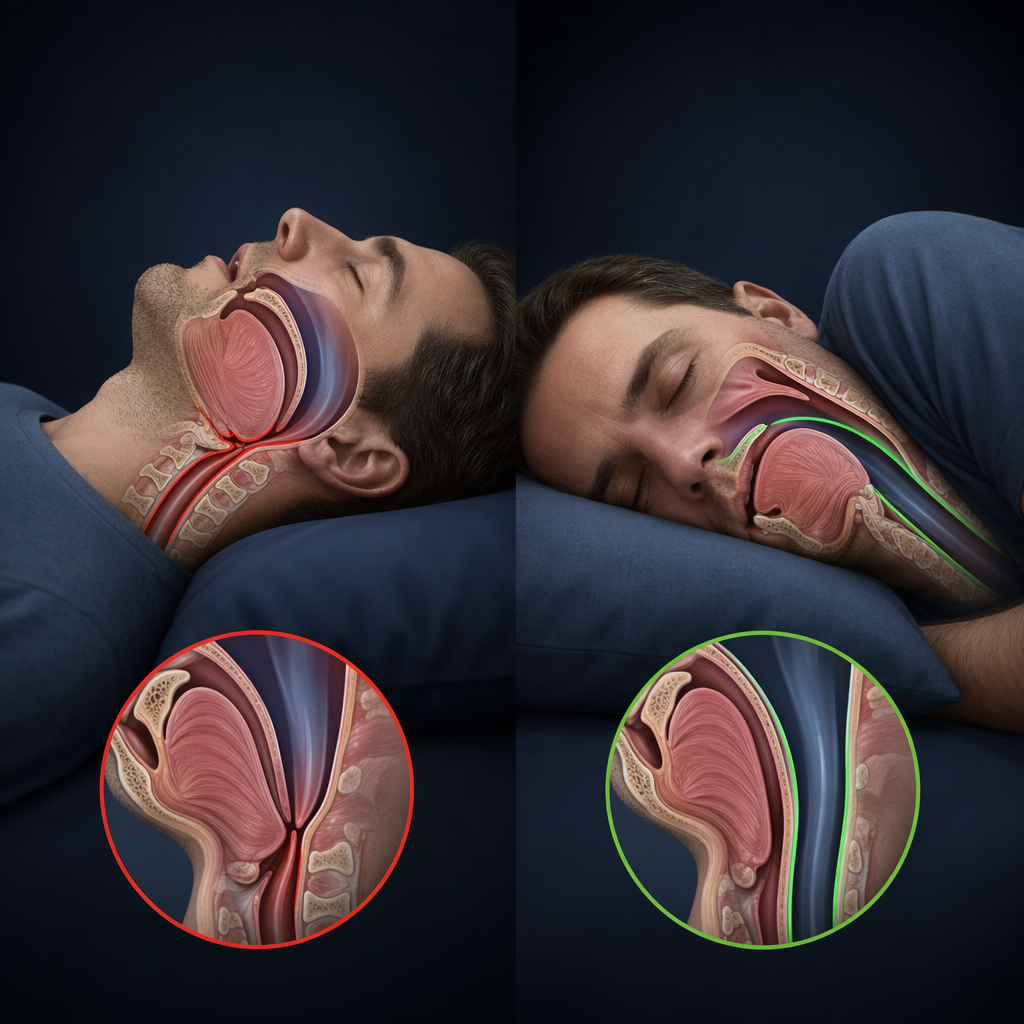
Obstructive sleep apnea is not just mouth breathing. It is repeated narrowing or collapse of the upper airway during sleep. When that happens, oxygen can drop, sleep can fragment, and the body may partially wake itself to restore breathing. Some people also open their mouth because nasal airflow is limited, because airway resistance is rising, or because the body is trying to compensate during an event.
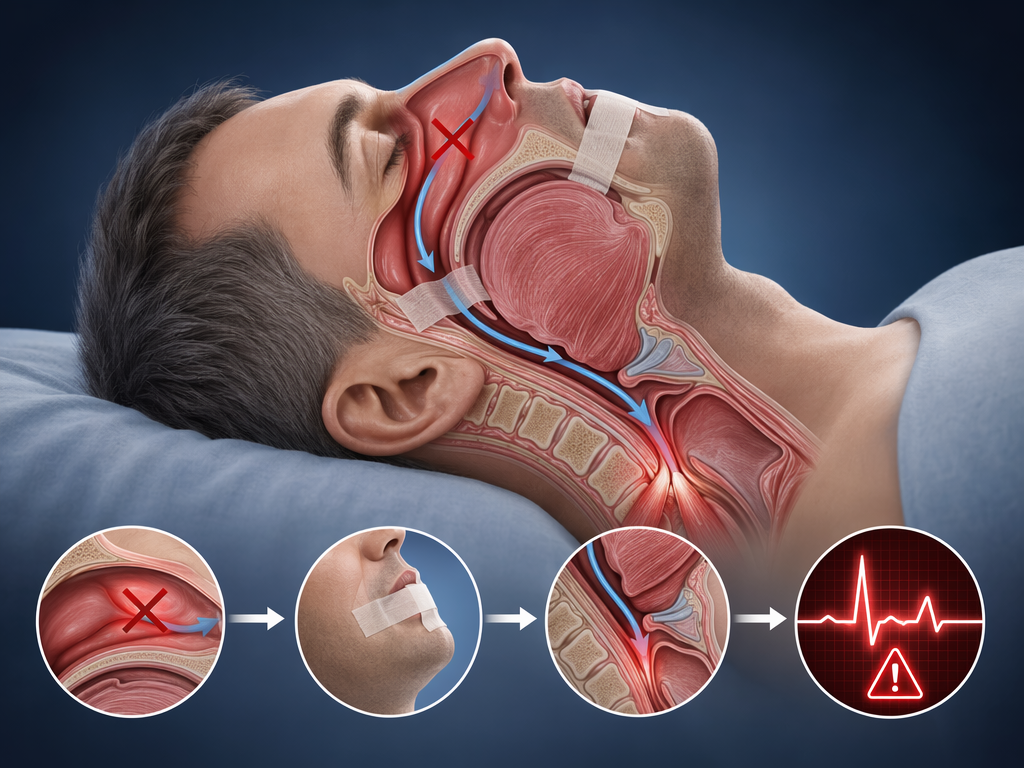
Taping the lips does not fix the throat collapse that defines obstructive sleep apnea. It also does not prove the nose can move enough air. If the nose is blocked by congestion, a deviated septum, enlarged turbinates, allergies, or another obstruction, sealing the mouth can turn an already strained breathing pattern into a more dangerous one.
The risk is not limited to total nasal blockage. A 2024 nonrandomized trial of 54 patients with obstructive sleep apnea found that mouth closure did not affect everyone the same way: airflow improved by 2.0 L/min in moderate mouth breathers but decreased by 1.86 L/min in high mouth breathers, as summarized in the 2025 systematic review. [1][2]
That finding is the part that should slow the trend down. The popular claim is that tape “forces nasal breathing.” The clinical problem is that some bodies do not respond that cleanly. In severe obstructive sleep apnea, researchers have described “mouth puffing,” where patients continued trying to move air through taped lips; intermittent puffers had significantly higher AHI in the study discussed by the systematic review. [1]
The Three Main Ways Mouth Taping Can Go Wrong
1. The Nose Cannot Carry the Load
A person can look like a simple “mouth breather” and still have a nasal airway problem that needs evaluation. If the nose is partially blocked, taping the mouth may increase the work of breathing during sleep. If it is severely blocked, the danger is more obvious: the mouth has been closed while the nose cannot provide adequate airflow.
Houston Methodist has warned that mouth taping can cause asphyxiation in people with nasal obstruction, sleep apnea, or GERD, and that warning is consistent with the safety concerns raised in the systematic review. [1][3]
2. Apnea Events May Not Improve — and Airflow May Worsen
For someone with sleep apnea, the question is not whether the mouth stays shut. The question is whether breathing actually becomes safer during sleep. The JAMA Otolaryngology study is useful because it measured a response that varied by mouth-breathing pattern rather than assuming one universal effect. Moderate mouth breathers improved; high mouth breathers had reduced airflow. [1][2]
That does not prove mouth taping injures every high mouth breather. It does show why the “just try it and see” approach is a poor fit for suspected sleep apnea. You are asleep during the test. You may not know whether oxygen dropped, whether events lengthened, or whether your body repeatedly fought against the tape.
3. It Can Delay the Diagnosis You Actually Need
Snoring, dry mouth, morning headaches, unrefreshing sleep, and waking up gasping are not problems to mechanically cover over. They can be clues. If you are trying mouth tape because a partner says you snore or because you keep waking with a dry mouth, the safer next question is whether this is ordinary snoring or sleep apnea. A symptom guide such as how to tell the difference between snoring and sleep apnea is more useful than another roll of tape.
Delay matters because sleep apnea treatment is not one thing. CPAP is common, but clinicians may also consider oral appliances, positional strategies, weight-related care, surgery, or implantable options depending on the person and the severity. If symptoms are being muted or reinterpreted as a “mouth breathing habit,” the workup gets postponed.
Who Should Not Use Mouth Tape Without Medical Clearance
The unsafe group is larger than people with a formal sleep apnea diagnosis. It includes people who may have sleep apnea but have not been tested, people whose severity is unknown, and people whose nasal breathing changes from night to night.
- Known moderate or severe obstructive sleep apnea: the positive mouth-taping studies do not apply to this group, and one mild-OSA study explicitly states that mouth taping is not recommended for moderate or severe OSA patients. [4]
- Suspected sleep apnea: loud snoring, witnessed pauses, gasping, daytime sleepiness, morning headaches, or high-risk anatomy should prompt evaluation before any attempt to seal the mouth.
- Nasal obstruction or unreliable nasal breathing: congestion, allergies, sinus disease, structural blockage, or frequent nighttime stuffiness can make oral occlusion risky.
- GERD or regurgitation risk: reflux changes the safety calculation because the mouth may be needed for clearing or responding to regurgitated material; asphyxiation risk in this context is specifically raised in the evidence review and Houston Methodist guidance. [1][3]
- Asthma or other breathing disorders: nighttime breathing already has less margin for error when the lower airways can narrow or symptoms can flare.
- Panic disorder or strong anxiety around breathing restriction: waking with the mouth sealed can trigger distress, and distress can make it harder to respond calmly to a breathing problem.
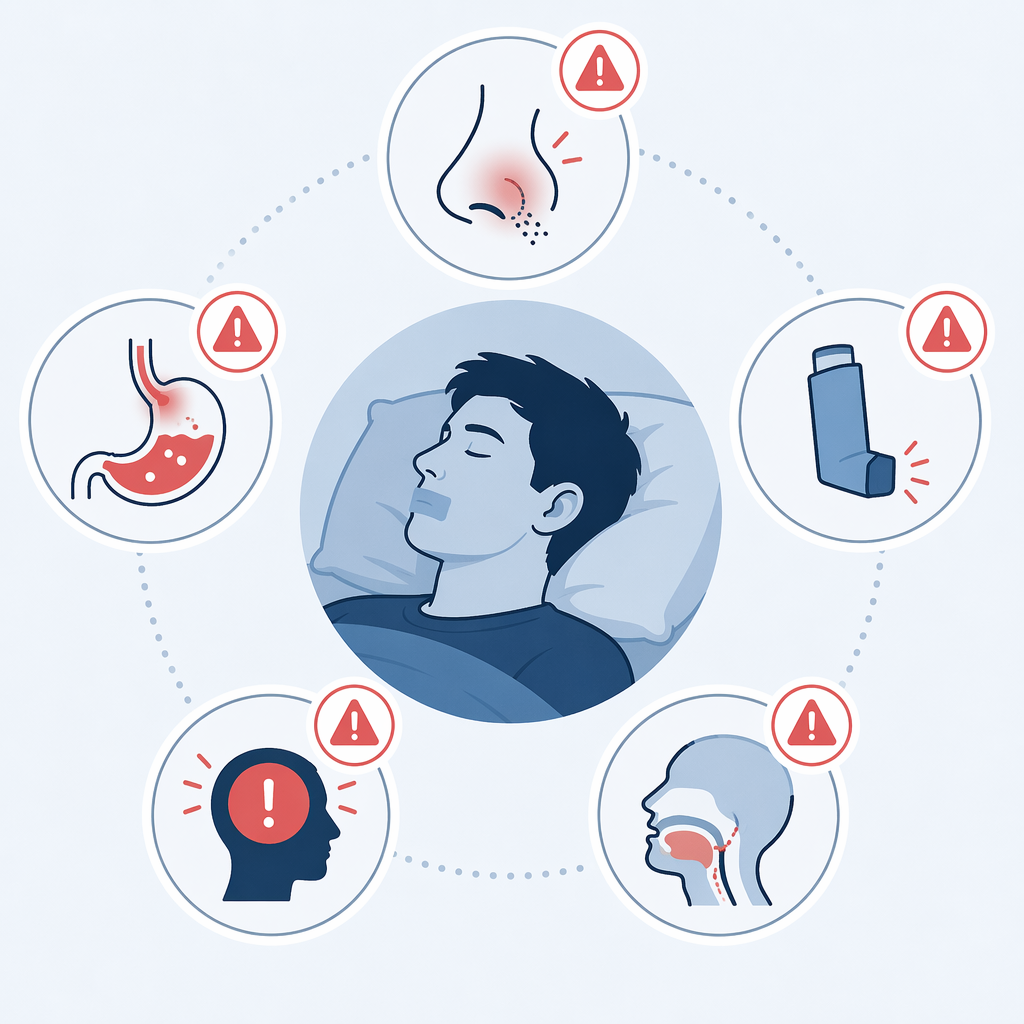
Cleveland Clinic’s patient guidance also treats mouth taping as something to discuss with a healthcare professional first, especially when breathing problems, nasal obstruction, or sleep apnea are part of the picture. [5]
What About the Mild Sleep Apnea Studies?
There are small studies that look more encouraging at first glance. Lee et al. studied 20 mouth breathers with mild obstructive sleep apnea and reported an AHI reduction of about 47% with mouth taping; Huang et al. studied 30 people with mild obstructive sleep apnea and reported a similar scale of AHI reduction. [4]
The exclusions are the point. These studies were not testing unscreened people with possible sleep apnea, people with moderate or severe OSA, or people whose nasal airway was obstructed. Lee et al. excluded nasal obstruction and moderate or severe OSA, and the authors stated that mouth taping is not recommended for moderate or severe OSA patients. [4]
So the narrow reading is fair: in selected mild OSA patients without nasal obstruction, mouth taping has shown AHI reductions in small preliminary studies. The broader internet reading is not fair: those findings do not make mouth taping safe for people with undiagnosed sleep apnea, more severe disease, reflux risk, asthma, panic disorder, or unreliable nasal breathing.
Why Clinicians Are Wary of the Trend
The concern is not that every person who tapes their mouth will be harmed. It is that the trend is being sold to exactly the sort of people who should be screened first: people who snore, wake dry-mouthed, feel tired, or struggle with existing sleep apnea treatment.
In a Sermo poll, 62% of surveyed physicians said social media drives the mouth-taping trend, and 48% said they would never recommend it. [6] CU Anschutz also quoted sleep specialist Jessica Camacho, MD, saying that the American Academy of Sleep Medicine “strictly recommends against” mouth taping. [7]
Those warnings should not be read as contempt for low-tech sleep habits. Side sleeping, nasal congestion treatment, alcohol reduction, and weight-related care can all matter in the right clinical context. The difference is that those approaches do not usually remove an emergency breathing route. If your apnea worsens when you are supine, for example, learning how sleeping on your back affects airway collapse is a safer starting point than sealing your lips and hoping your nose compensates.
What to Do Instead
If you already have a sleep apnea diagnosis, the first step is to know your severity and current treatment status. AHI under 15 is considered mild in the studies discussed here; that does not automatically make mouth taping appropriate, but it is the minimum category where the limited positive evidence exists. Moderate or severe OSA belongs in a treatment conversation, not a tape experiment. [4]
If you suspect sleep apnea but have not been tested, get evaluated before trying to control nighttime breathing mechanically. A home sleep apnea test or in-lab sleep study can establish whether apnea is present and how severe it is. That information changes the menu of options.
If CPAP is the problem, do not assume tape is the fix. Mask leaks, pressure intolerance, nasal congestion, mouth dryness, and claustrophobia each have different solutions. A clinician or sleep technologist can adjust mask style, humidification, pressure settings, nasal treatment, or other supports without asking you to seal your only backup airway on your own.
If your apnea is confirmed mild, ask about evidence-based alternatives rather than starting with tape. Options may include oral appliance therapy, positional therapy, nasal obstruction treatment, and other individualized approaches. For a broader comparison, see what works for mild sleep apnea besides CPAP. For people considering implantable therapy, cost and eligibility are separate issues; this Inspire sleep apnea therapy cost breakdown can help frame that conversation.
For readers who want the general evidence on mouth taping outside the sleep-apnea question, this companion overview of mouth taping for sleep covers the broader trend. The safety rule here is narrower and firmer: do not tape your mouth if you have, or may have, sleep apnea until a clinician has evaluated your airway, apnea severity, and relevant medical conditions.
References
- The risks of mouth taping in patients with obstructive sleep apnea: A systematic review, PLOS One, May 21, 2025
- Mouth Closure and Breathing Route in Patients With Obstructive Sleep Apnea, JAMA Otolaryngology-Head & Neck Surgery, 2024
- Can Mouth Tape During Sleep Be Dangerous?, Houston Methodist, 2025
- The Impact of Mouth-Taping in Mouth-Breathers with Mild Obstructive Sleep Apnea: A Preliminary Study, Healthcare, 2022
- Mouth Taping: Is It Safe?, Cleveland Clinic
- Mouth Taping Risks, Sermo
- Mouth Tape for Better Sleep: Myth or Miracle?, CU Anschutz



Comments
Join the discussion with an anonymous comment.