
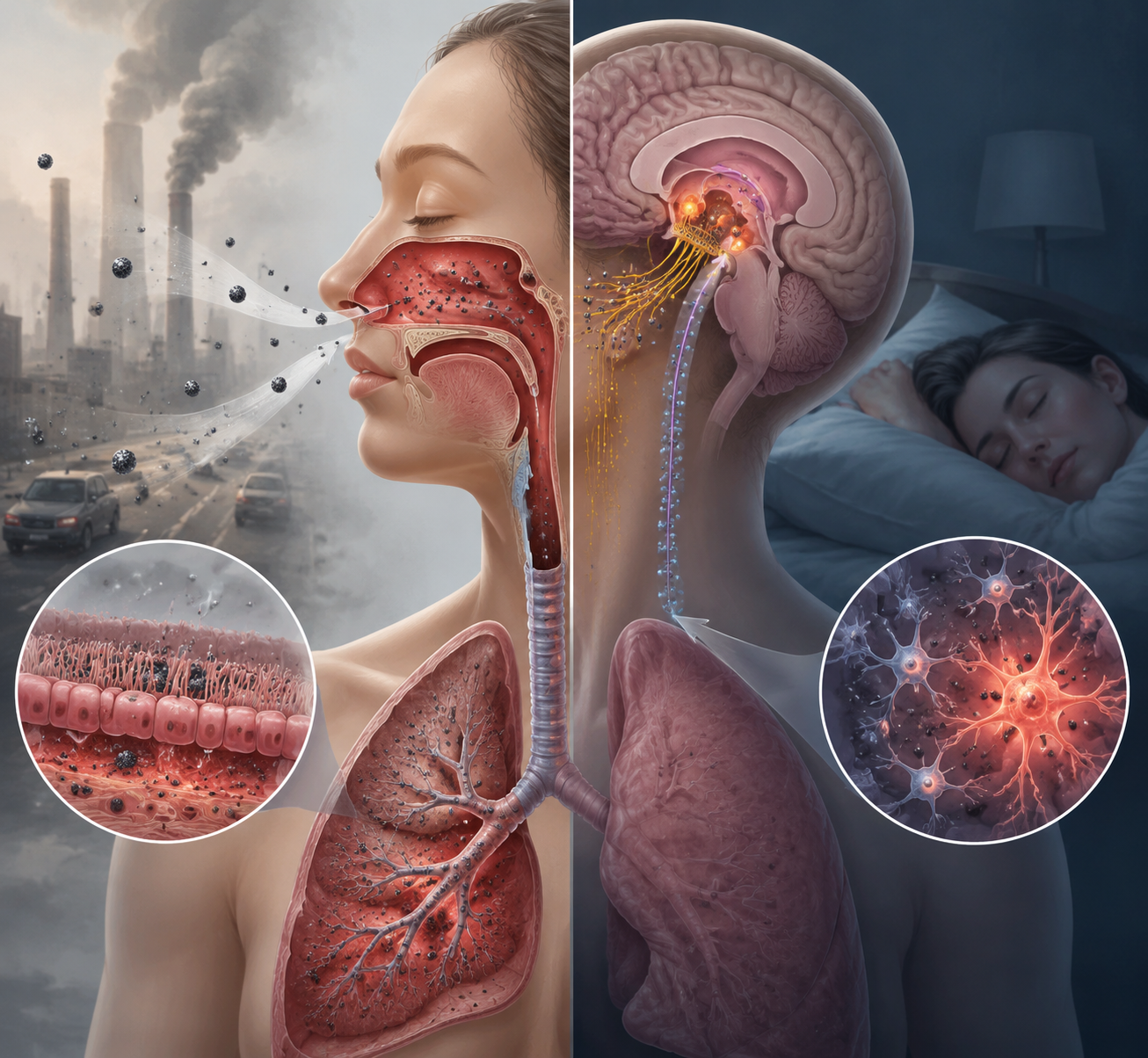
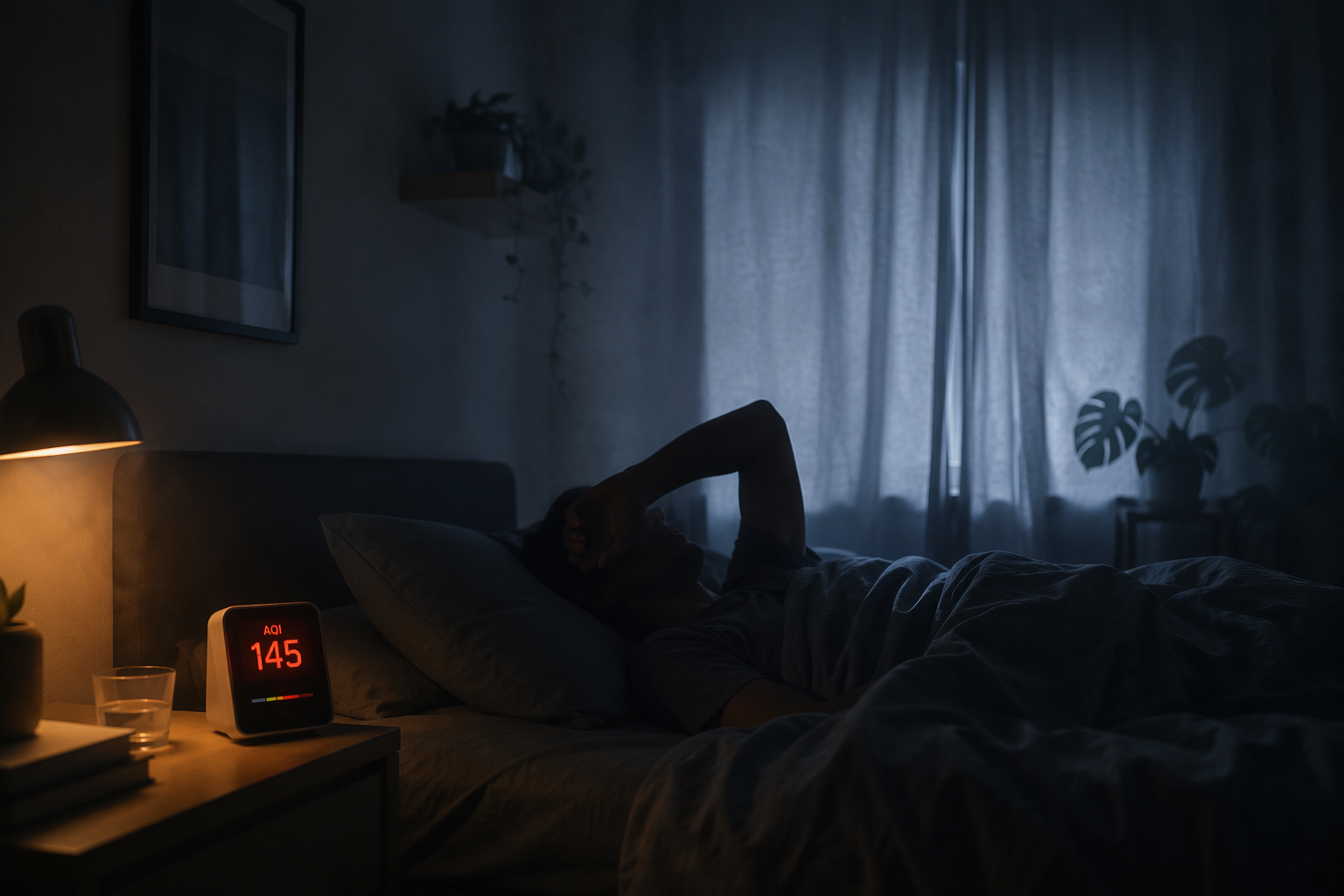
Air quality and sleep can seem to live in different places. Air is outside the body. Sleep is coordinated inside the brain. The bridge is not a vague sense that pollution is “stressful.” It is anatomy: polluted air first contacts the nose, throat, and lungs, and some particles may also reach nervous tissue through the olfactory route. From there, the signals that matter for sleep become more concrete: airway inflammation, airway narrowing, oxygen drops, arousals from sleep, and inflammatory changes in brain regions that help regulate sleep-wake state.
A useful way to sort the evidence is to separate two pathways. The respiratory route is the more clinically familiar one: inhaled pollutants irritate nasal and airway tissue, which can worsen sleep-disordered breathing. The central nervous system route is less familiar but biologically plausible: ultrafine particles and pollution-related inflammatory signals may affect sleep-regulating brain regions, including areas involved in serotonin signaling.
This is not a niche exposure question. The World Health Organization estimated in 2018 that 91% of the world’s population was breathing air that exceeded WHO guideline limits for pollutants at the time.[1] That figure should not be used to make every bad night of sleep sound pollution-caused. It does justify taking the mechanism seriously, because the exposure is common enough that even modest sleep effects could matter across a population.
The First Route: Polluted Air Meets the Sleeping Airway
The respiratory pathway starts before the lungs. Air pollutants enter through the nose and mouth, contact the nasal passages, pass the pharynx, and move through airway surfaces already doing a difficult job during sleep. At night, upper-airway muscle tone falls. In people with vulnerable anatomy or existing sleep-disordered breathing, the airway is already closer to collapse. Add irritation, swelling, or inflammatory narrowing, and the margin gets smaller.
This matters because obstructive sleep apnea is not simply “snoring loudly.” In sleep studies, one common measurement is the apnea-hypopnea index, or AHI. It counts how many times per hour breathing stops completely or becomes shallow enough to matter. A higher AHI means sleep is being interrupted more often by breathing instability, oxygen changes, or arousals that may be too brief to remember in the morning.
The Northern Taiwan population-based study by Shen and colleagues gives this pathway a concrete human measurement. In that study, each 3.4 μg/m³ increase in 1-year mean PM2.5 exposure was associated with a 4.7% increase in AHI.[2] That is an association, not proof that PM2.5 caused the breathing events in each participant. Still, the outcome is close to the mechanism: the study did not merely ask whether people felt tired; it linked longer-term particulate exposure with a sleep-breathing index.
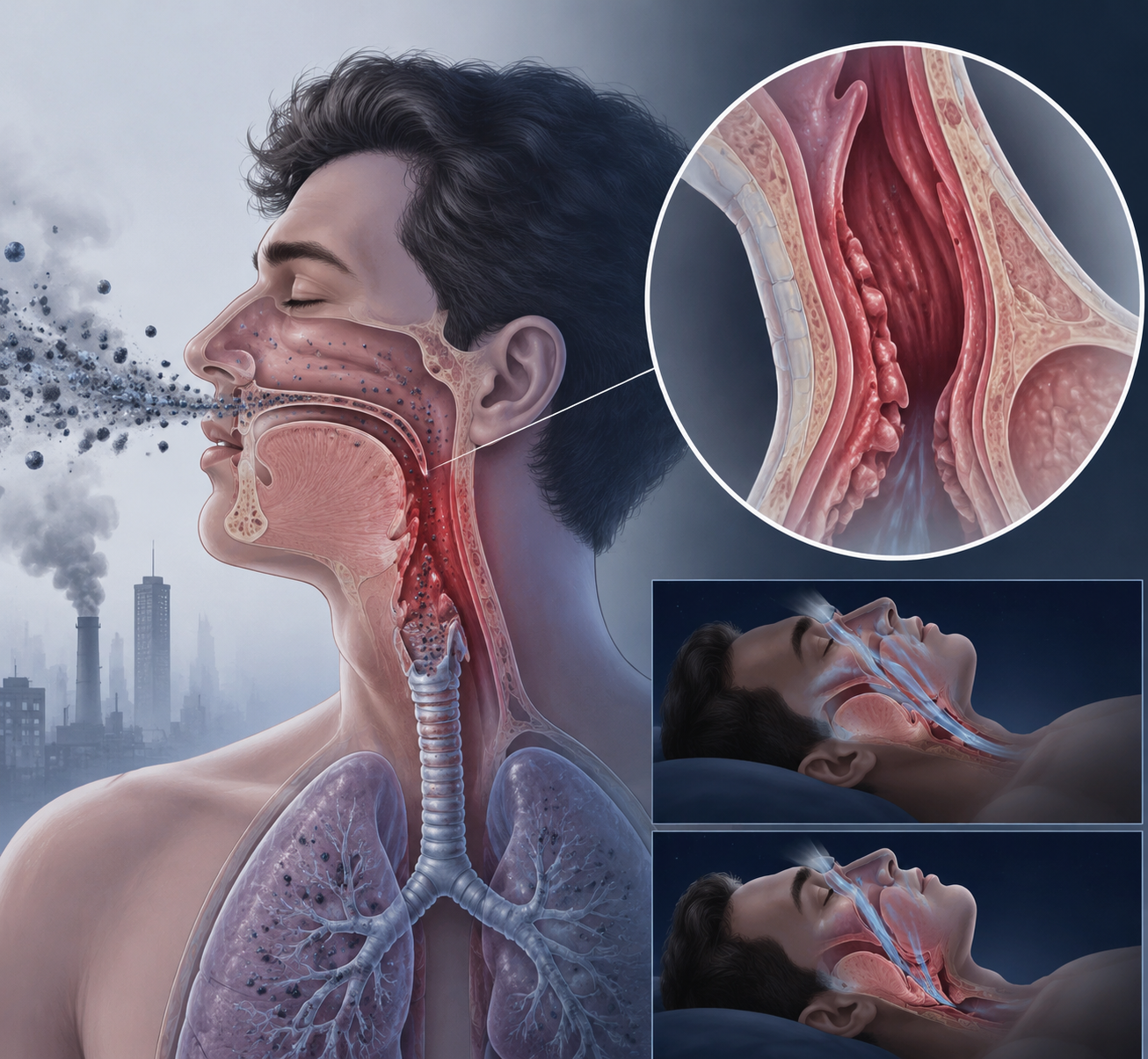
The MESA Sleep Study adds another piece. In a sample of 1,974 adults, higher annual exposure to NO₂ and PM2.5 was associated with increased odds of developing sleep apnea.[3] NO₂ is often treated as a traffic-related pollution marker, while PM2.5 refers to fine particles small enough to be inhaled deeply. For sleep, the point is not the label itself; it is that these exposures can reach or irritate the same airway structures that determine whether breathing stays stable during sleep.
The respiratory route is also where indoor and outdoor air begin to overlap. Outdoor particles and gases can enter homes. Indoor sources can add their own burden. The sleeping airway does not care whether an irritant began at a roadway, a stove, a building material, or a poorly ventilated room. It responds through tissue-level processes: irritation, inflammation, mucus changes, vascular responses, and altered airway caliber.
Why Sleep-Disordered Breathing Is the Clearest Human Signal
Airway evidence is easier to interpret than many pollution-and-sleep claims because the proposed chain is short. Pollutants contact airway tissue. Airway tissue becomes more reactive or inflamed. A narrower or more collapsible upper airway increases breathing instability during sleep. Breathing instability fragments sleep.
That does not make the evidence simple. People with higher pollution exposure may also live with more traffic noise, different housing quality, different access to medical care, different neighborhood stressors, or other co-exposures. A cross-sectional study can show that exposure and outcome appear together, but it cannot fully establish which came first or whether a third factor helped produce both.
Even so, sleep apnea is the outcome where air pollution evidence has a plausible route and measurable nighttime physiology. If someone already has obstructive sleep apnea, chronic nasal congestion, asthma, allergic airway disease, or a bedroom exposure that irritates the airway, the question becomes less abstract. The relevant issue is not whether pollution “causes insomnia” in a broad wellness sense. It is whether breathing during sleep is being made more unstable by tissue-level irritation and inflammation.
The Second Route: From the Nose Toward Sleep-Regulating Brain Regions
The central nervous system pathway is more vivid and less settled. It begins high in the nasal cavity, near the olfactory system. The cribriform plate is a thin bone at the roof of the nasal cavity with small openings for olfactory nerve fibers. In animal models, ultrafine particles and pollution-related exposures have been studied as a route through this olfactory interface into the brain.
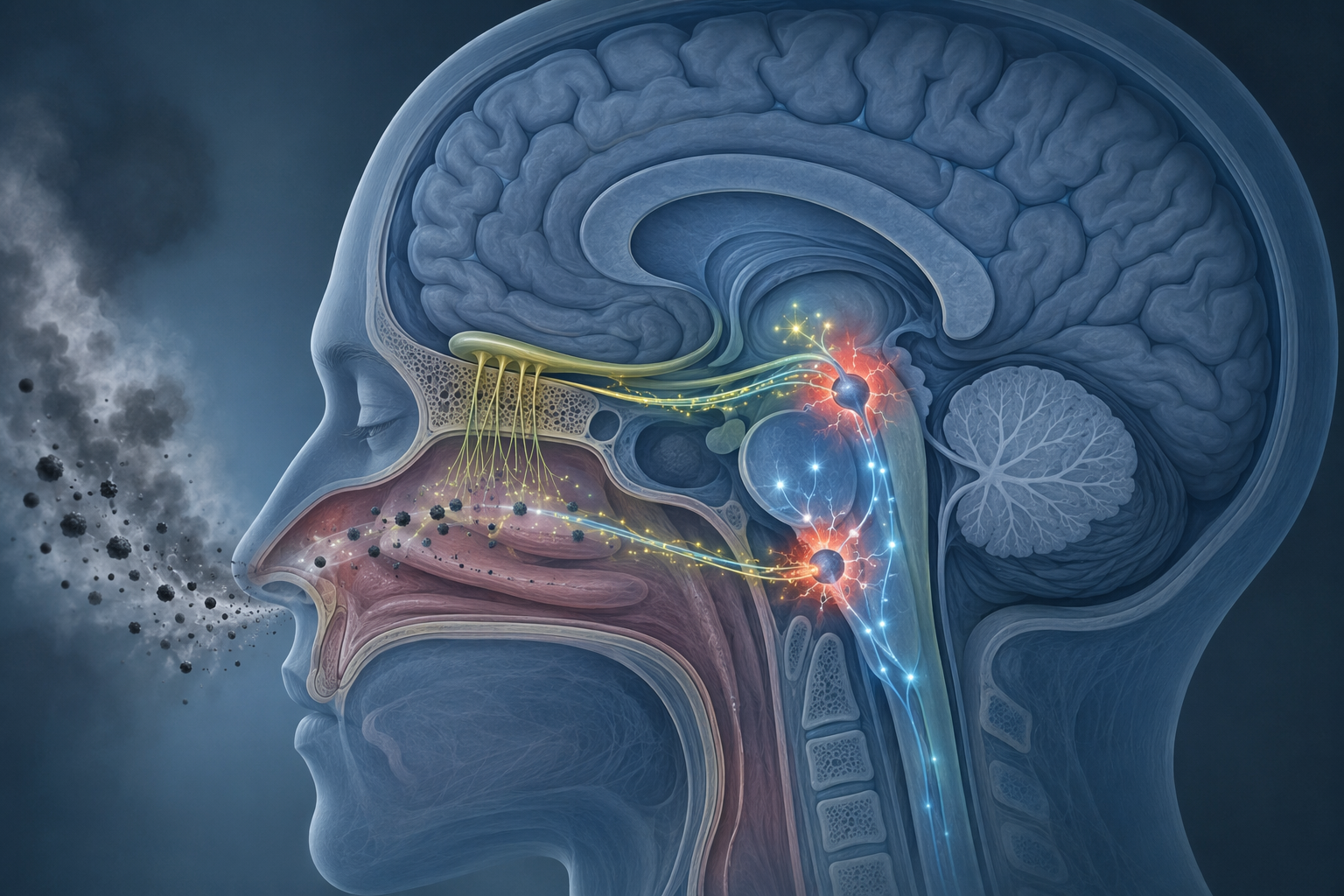
The sleep relevance comes from where the inflammatory signal appears. González-Piña and colleagues reported in rat models that ultrafine particulate matter and NO₂ exposure were associated with neuroinflammation in the dorsal raphe and hypothalamic preoptic area, along with altered serotonin and 5-HIAA levels.[4] Those names matter. The dorsal raphe is a major serotonin-producing region. The hypothalamic preoptic area participates in sleep regulation. 5-HIAA is a serotonin metabolite, so changes in serotonin and 5-HIAA suggest that exposure is not merely leaving particles in tissue; it is touching a neurotransmitter system that helps organize sleep-wake physiology.
This pathway helps explain why some researchers look beyond the lungs when studying air quality and sleep. If inflammatory changes reach regions that participate in sleep regulation, sleep could be altered without the main event being an apnea episode. The possible expression might be lower sleep efficiency, more fragmented sleep, or altered sleep timing. But this is where the confidence level should drop a notch. Animal models can show tissue access and neurochemical changes with a precision that human residential studies usually cannot. They do not automatically prove the same magnitude of effect in a typical bedroom or city neighborhood.
Human evidence keeps the pathway from being purely speculative, but much of it comes from exposed populations rather than clean experiments. Calderón-Garcidueñas and colleagues reported neuroinflammatory changes in exposed human populations, a finding that fits the brain-inflammation side of the model.[4] What remains harder to prove directly is the full chain in ordinary settings: pollutant enters through the olfactory route, reaches a named sleep-regulating region, changes a neurotransmitter signal, and then measurably disrupts that person’s sleep that night or over that year.
Timing May Matter: Prenatal Exposure and Child Sleep
The same exposure may not mean the same thing at every stage of life. Prenatal development is a different biological setting from adult sleep apnea, and the outcome is not simply whether a child sleeps well on a polluted night. The question is whether exposure during sensitive developmental windows is associated with later sleep organization.
In the PROGRESS cohort in Mexico City, Bose and colleagues found that prenatal PM2.5 exposure during weeks 1–8 of gestation was associated with reduced sleep efficiency in preschoolers, measured by actigraphy. Exposure during weeks 31–35 was linked to shorter sleep duration.[5] Sleep efficiency is the proportion of time in bed actually spent asleep, so this is a more specific outcome than a parent simply reporting that sleep was “bad.”
That study is useful because it brings timing into the air-quality discussion. It should not be stretched into a universal rule for all pregnancies or all pollution settings. The cohort was in Mexico City, and the finding may not generalize cleanly to lower-pollution environments or to populations with different co-exposures. Its value is narrower and still important: sleep effects may depend not only on dose and pollutant type, but also on when exposure occurs.
Indoor Air Is Not a Separate Biology
Outdoor air pollution often dominates the public-health discussion because individuals cannot fully opt out of regional smoke, traffic pollution, or industrial emissions. Indoor air deserves attention for a different reason: it is where people sleep, and some sources are more controllable. The biology, however, does not split neatly into “outdoor effects” and “indoor effects.” The nose, airway, and brain respond to exposure characteristics, not to where the pollutant was generated.
A 2025 KNHANES cross-sectional study reported that indoor formaldehyde levels were associated with increased risk of obstructive sleep apnea.[6] Formaldehyde is not PM2.5 or NO₂, and this finding should not be blended carelessly with traffic-pollution studies. It is a signal that indoor chemical exposures may also matter for sleep-disordered breathing, especially when the outcome is obstructive sleep apnea rather than a vague sleep complaint.
The limitation is the same one that follows many cross-sectional exposure studies: association is not causation. Housing quality, ventilation, income, occupation, smoking exposure, building materials, and neighborhood factors can cluster together. A formaldehyde measurement may be part of a larger indoor exposure pattern. Still, indoor sources are important because they are where future practical guidance can become more specific: ventilation, source reduction, and filtration are decisions made at the room and household level, not only at the city level.
What the Evidence Can and Cannot Say Yet
The pattern across studies is stronger than a one-off correlation. A 2020 systematic review by Liu and colleagues found that 21 of 22 reviewed studies reported positive associations between air pollution and sleep-related outcomes.[7] That sounds decisive until the methods are inspected. The same review noted that study quality was generally low-to-moderate and that a meta-analysis was not possible because the studies were too heterogeneous.[7]
Heterogeneous is not a technicality here. One study may measure PM2.5 over a year; another may estimate short-term exposure; another may use NO₂ as a traffic marker; another may examine indoor formaldehyde. Sleep outcomes also vary: apnea-hypopnea index, sleep duration, sleep efficiency, self-reported sleep quality, or odds of a clinical sleep apnea classification. These are related, but they are not interchangeable.
| Evidence type | What it helps show | Main caution |
|---|---|---|
| Human sleep-breathing studies | Pollution exposure is associated with AHI or sleep apnea odds | Confounding and cross-sectional design can limit causal claims |
| Animal and cellular pathway studies | Particles and inflammatory signals can affect airway or brain tissue | Exposure conditions may not match typical residential life |
| Prenatal cohort evidence | Sensitive exposure windows may relate to later child sleep | Single-cohort findings may not generalize broadly |
| Indoor-air studies | Bedroom-relevant sources may be associated with sleep-disordered breathing | Indoor pollutants often cluster with housing and socioeconomic factors |
The most defensible conclusion is therefore not that a given pollutant exposure guarantees a specific sleep outcome. It is that the pathways are biologically credible and the human associations are consistent enough to take seriously. The respiratory pathway has the clearest connection to measured sleep-disordered breathing. The central nervous system pathway adds a plausible route for effects on sleep regulation itself, but direct causal evidence in typical residential settings is still developing.
A Calibrated Way to Read Air Quality and Sleep Claims
When an air-quality claim about sleep appears, the first question should be which pathway it is invoking. If the claim is about snoring, obstructive sleep apnea, morning headaches, or oxygen drops, the respiratory route should be examined first. Is the exposure known to irritate the nose or airway? Was sleep-disordered breathing measured, or was sleep only self-reported? Were noise, socioeconomic conditions, smoking, and other co-exposures handled carefully?
If the claim is about sleep efficiency, sleep duration, or brain-based sleep regulation, the evidence needs a different filter. It should name the nervous-system route clearly rather than treating “inflammation” as a magic word. The more convincing version identifies the olfactory pathway, the cribriform plate, sleep-regulating regions such as the hypothalamic preoptic area, and neurotransmitter signals such as serotonin or 5-HIAA. Even then, animal evidence and high-exposure human evidence should not be sold as direct proof for every ordinary home.
Ambient pollution matters because people cannot fully choose the air outside their homes. Indoor pollution matters because sleeping rooms are exposure environments, and some sources can be reduced more directly. The practical conversation about ventilation, source control, and filtration belongs after the physiology, not before it. Without the pathway, “cleaner air helps sleep” stays too broad to verify.
Air pollution is not just a background sleep stressor. The better reading is more specific: common pollutants can plausibly disrupt sleep through airway inflammation and worsened sleep-disordered breathing, and may also influence sleep-regulating brain systems through olfactory and neuroinflammatory routes. The evidence is convergent enough to take seriously, but not precise enough to turn every exposure into a guaranteed sleep outcome.
References
- Ambient air pollution: A global assessment of exposure and burden of disease, World Health Organization, 2018.
- Association of ambient air pollution with sleep apnea in a population-based study in Northern Taiwan.
- The Association of Ambient Air Pollution with Sleep Apnea: The Multi-Ethnic Study of Atherosclerosis.
- Air pollution and sleep disorders: A systematic review.
- Prenatal particulate air pollution exposure and sleep disruption in preschoolers: Windows of susceptibility, 2019.
- Association between indoor air pollutants and obstructive sleep apnea in Korean adults: a cross-sectional study using KNHANES, 2025.
- The association between air pollution and sleep: A systematic review, 2020.

Comments
Join the discussion with an anonymous comment.