
On a July 2026 schedule snapshot, Alaska Airlines’ Seattle-to-Honolulu flight leaves around 10:55 a.m. Pacific time and lands around 2:04 p.m. Hawaii time, a roughly six-hour westbound flight that puts passengers on the ground with a usable afternoon still ahead of them.[1] That timing is why jet lag advice for Alaska Airlines Honolulu flights should start at the arrival curb, not at a generic warning about crossing time zones.
If you boarded from Seattle, Portland, San Diego, or San Francisco, your body is not trying to solve the same problem as someone who began in Boston or Washington, DC. A West Coast traveler landing at 2 p.m. in Honolulu is only about two to three hours ahead of local time. The next several hours decide whether that small mismatch smooths out or turns into the familiar Hawaii pattern: sleepy before dinner, wide awake before sunrise.

The First Five Hours in Honolulu Matter Most
The useful part of Alaska’s morning West Coast schedule is not that it magically prevents jet lag. It gives you a clean timetable. You land early enough to use daylight, but late enough that you do not need to survive an entire local day. For West Coast passengers, the job is to avoid pushing the body clock farther west than necessary, then help it settle into Hawaii time before bed.
That means the most tempting move after landing is also the easiest one to mishandle. A hotel nap at 3 p.m. Hawaii time may feel harmless. To a body still partly on Pacific time, that is early evening sleep. If the nap runs long, dinner becomes foggy, bedtime moves too early or too late, and the next morning can start at 3 or 4 a.m. with no realistic way to fall back asleep.
Westbound travel is usually the more forgiving direction. The CDC Yellow Book describes an adaptation rate of about 1.5 hours per day traveling west, compared with about 1 hour per day traveling east, partly because the human circadian system tends to tolerate a delay better than an advance.[2] Roach and Sargent describe the same basic asymmetry through circadian phase-response physiology: light at different biological times can push the clock earlier or later, and late-day light is not interchangeable with morning light.[3]
For the traveler, the mechanism matters only because it changes the instructions. “Get sunlight” is incomplete. “Get the right sunlight at the right part of the arrival day” is the plan.
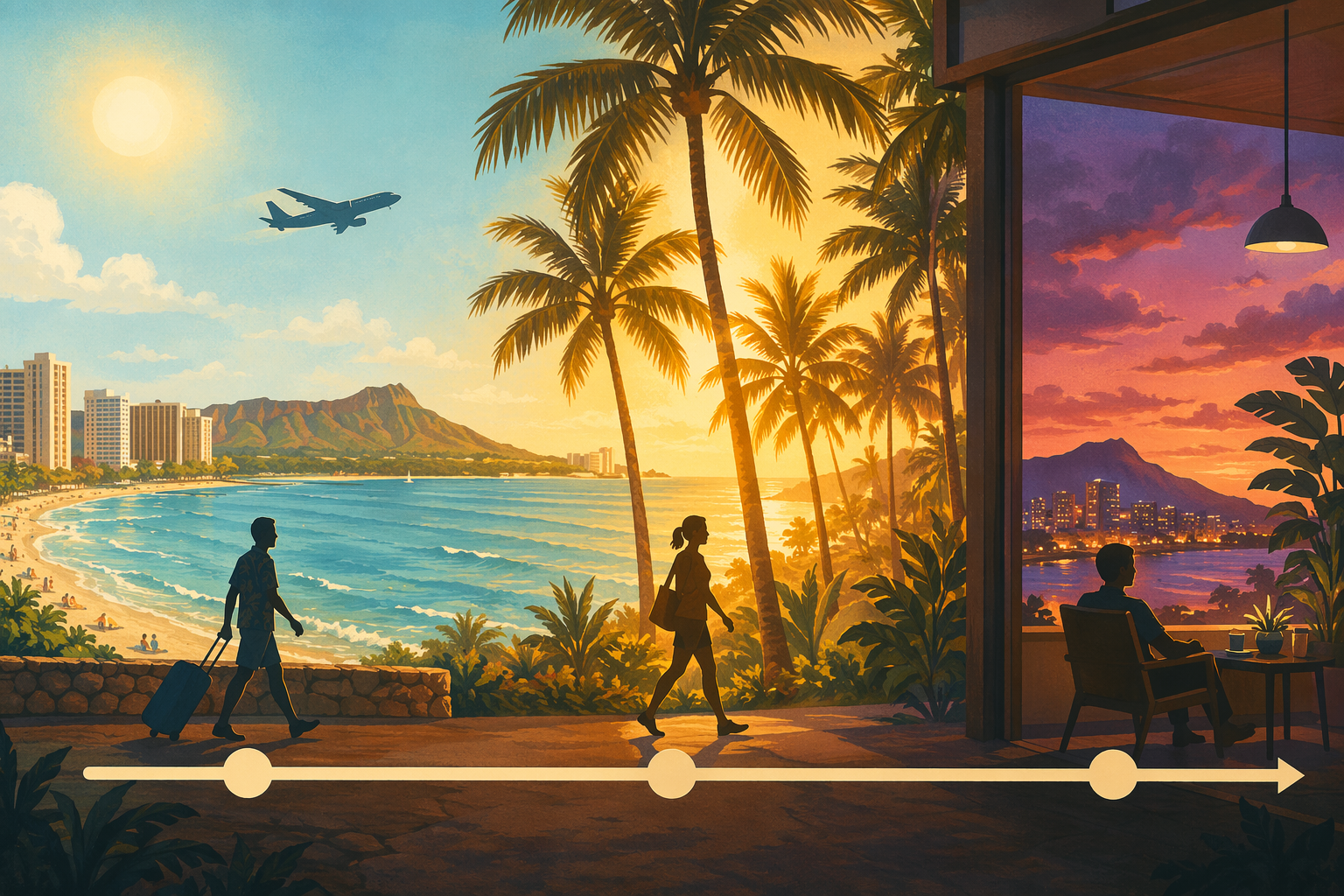
A West Coast Arrival-Day Protocol
Use your actual landing time, not the published timetable alone. The Seattle example is a July 2026 snapshot, and Alaska schedules can vary by season, operating day, and route. If your flight lands in the early afternoon, this protocol applies well. If it lands much later, keep the bedtime rule but shorten the daylight plan.
| Honolulu time | What to do | Why it matters |
|---|---|---|
| Landing to about 3:30 p.m. | Keep light moderate if you feel very sleepy: sunglasses outside, check-in tasks, food, shade, indoor errands. | Bright early-afternoon light can keep delaying the clock when a West Coast traveler may not need much more delay. |
| About 3:30 p.m. to sunset | Get outside for an easy walk, beach time, or dinner in natural light. | Late-afternoon daylight helps anchor the day without forcing a nap. |
| Evening | Eat on local time, dim the hotel room gradually, and avoid turning the first night into a second travel shift. | The goal is a normal Honolulu bedtime, not heroic wakefulness. |
| Bedtime | Aim for a reasonable local bedtime, often around your usual bedtime adjusted to Hawaii time. | Going to bed too early increases the chance of waking far before dawn. |
The counterintuitive part is the first row. A traveler from Seattle landing at 2 p.m. HST has a body that may still read early evening. Flooding it with intense afternoon light immediately after arrival is not always the best move. If you are alert, you do not need to hide in a conference room. But if you are struggling to stay awake, use shade and sunglasses while you get through baggage, transportation, and check-in. Save the brighter outdoor time for the later afternoon.
The nap rule is stricter than most people want. If you truly cannot function, take a short, controlled nap as early as practical, set an alarm, and use an eye mask. Do not let it drift into late afternoon. The CDC’s worked example for Washington, DC to Honolulu includes strategic early napping with an eye mask and staying awake until destination bedtime, but that example is built around a larger East Coast-to-Hawaii shift than a nonstop West Coast departure.[2]
After 3:30 or 4 p.m., the plan becomes pleasantly ordinary: walk outside, keep dinner on Honolulu time, and let the evening get dimmer. This is where Alaska’s schedule helps. You are not landing at midnight and pretending a sleep strategy can rescue the day. You are using the remaining daylight as a timed cue.
Adjust the Plan by Departure City
The flight number matters less than the clock your body brought onto the airplane. Sort yourself by where your day actually began.
| Starting point | Approximate shift to Honolulu | Arrival-day emphasis | Realistic adjustment window |
|---|---|---|---|
| Seattle, Portland, San Diego, San Francisco | About 2–3 hours | Avoid the hotel nap, keep early-afternoon light moderate if sleepy, use late-afternoon daylight, sleep at local bedtime. | Often mostly adjusted by day 2. |
| Mountain time connections such as Denver | About 3–4 hours | Use the West Coast plan, but be more protective of bedtime and morning light on day 2. | Often closer to day 3. |
| Central time connections such as Dallas-Fort Worth or Chicago | About 4–5 hours | Treat the first afternoon as partial alignment, not completion; avoid late naps and expect early waking. | Often closer to day 4. |
| East Coast connections such as New York, Washington, DC, or Boston | About 5–6 hours | Use a structured light and sleep plan for several days; do not expect the first night to solve it. | Often day 5 or 6 for fuller adjustment. |
For Seattle, Portland, San Diego, and San Francisco passengers, the small shift is good news, but it also makes overcorrection easy. You do not need an elaborate clinical schedule for a two- or three-hour delay. You need to avoid the two behaviors that make the first night worse: sleeping through the late afternoon and going to bed as soon as the room is available.
For Mountain time travelers, keep the same arrival-day structure and add discipline the next morning. If you wake early, do not turn on every hotel light at 4:30 a.m. Keep the room dim, rest quietly if you can, then get outdoor light closer to a normal local morning. This does not need to be perfect; it needs to stop one early waking from becoming your new vacation schedule.
Central and East Coast connectors are solving a larger timing problem. The CDC’s Washington, DC to Honolulu example is useful here because it treats Hawaii as a major westward shift and recommends avoiding bright light in the early morning HST, using carefully timed early naps when necessary, and staying awake until destination bedtime.[2] That advice should not be casually pasted onto a Seattle nonstop, but it is relevant if your travel day began near the Atlantic.
What to Do Before the Flight
Pre-shifting helps most when your starting clock is far from Hawaii time. A practical version is to delay bedtime by 30 to 60 minutes per night for three or four nights before departure, paired with evening light exposure when possible.[3][4] For a West Coast traveler, even one or two later nights may be enough to make the first Honolulu evening feel less abrupt. For an East Coast traveler, the same adjustment is more valuable but still incomplete.
- If you start on the West Coast, shift modestly: a slightly later bedtime for several nights, but do not create sleep debt before travel.
- If you start in Central or Eastern time, begin earlier and protect the last pre-trip night; arriving exhausted makes the arrival-day nap harder to resist.
- If your connection requires a very early wake-up, prioritize total sleep over a perfect pre-shift; travel fatigue and circadian timing are separate problems that can stack.
Plane sleep is useful only if it serves the timetable. On a morning West Coast departure to Honolulu, a long flight nap can make the arrival afternoon harder: you may land groggy enough to collapse later, but not aligned enough to sleep cleanly at night. Rest your eyes, keep the flight calm, and use a short nap if you need it, but do not treat the airplane as the main sleep event.
Melatonin: Useful, Bounded, and Easy to Mis-time
Melatonin can help some travelers, but it should be tied to Honolulu bedtime, not taken casually in the afternoon because you feel tired. A Cochrane review found melatonin effective for preventing or reducing jet lag, with a number needed to treat of 2, and reported that low fast-release doses such as 0.5 to 1 mg can be as effective as 5 mg.[5] The CDC advises against doses above 5 mg for jet lag.[2]
The evidence is not equally strong for every direction of travel, and the Cochrane review’s most recent search was in 2008.[5] That does not make melatonin irrelevant; it means the best recommendation is conservative. If you use it, use a low dose near local bedtime for a short period, and avoid taking it earlier in the day.
Melatonin is also not FDA-regulated like a prescription drug. Travelers taking warfarin, people with epilepsy, and people with autoimmune conditions should get medical advice before using it. Parents should not treat an adult jet lag dose as automatically appropriate for children.
Keep Comfort Tips in Their Lane
Hydration, alcohol, caffeine, meal timing, and seat comfort matter because travel fatigue can feel like jet lag. They do not reset the clock by themselves. Keep them simple: drink enough water, go easy on alcohol, avoid late-day caffeine after arrival, and make the hotel room dark and cool at bedtime. If you want a broader directional framework, use a general guide to choosing jet lag prevention tips based on flight direction; this Honolulu plan is narrower because the route timing is doing part of the work.
Hotel sleep matters most on the first night. Close blackout curtains before dinner if the room gets bright, but do not sit in a dark room all afternoon. Set the room up for bedtime, then leave it. The arrival-day danger is not a poorly folded pillow; it is accidentally teaching your body that 4 p.m. is night.
The Two-Day Expectation
For most passengers starting from Alaska’s West Coast hubs, a morning departure and early-afternoon Honolulu arrival create a manageable two-day problem. Verify your actual schedule, keep the first few arrival hours controlled, get late-afternoon daylight, avoid the hotel nap trap, and hold bedtime close to Honolulu time. If you wake early the next morning, keep light low until a reasonable local morning and repeat the daylight pattern.
For Central and East Coast connectors, success is slower. A good first night is welcome, but it is not the test. The better measure is whether wake time, meals, daylight, and bedtime move steadily toward Hawaii time over the next several days.
References
- Alaska Airlines ASA887 Flight Tracker, FlightAware, July 2026.
- Jet Lag Disorder, CDC Yellow Book 2026.
- Jet Lag and Shift Work Sleep Disorders: How to Help Reset the Internal Clock, Frontiers in Physiology, 2019.
- How to avoid jet lag, Harvard Health Publishing.
- Melatonin for the prevention and treatment of jet lag, Cochrane Database of Systematic Reviews, 2009.




Comments
Join the discussion with an anonymous comment.