
The safest sleep tips during a tornado watch start with an uncomfortable truth: the goal is not to knock yourself out. The goal is calm alertness. A tornado watch means conditions are favorable for tornadoes; a tornado warning means a tornado has been spotted or indicated by radar, and you should take shelter immediately rather than keep trying to relax in bed.[1]
So before you ask your body to settle down, give it proof that you have not ignored the risk. Put shoes near the bed. Charge the phone. Turn on reliable emergency alerts. Know where you will go if a warning is issued: a basement, storm shelter, or small interior room on the lowest level, away from windows. If you live in a mobile home, your nighttime plan needs to include a safer structure you can reach before storms arrive, because that anxiety may be pointing to a real vulnerability rather than an overreaction.
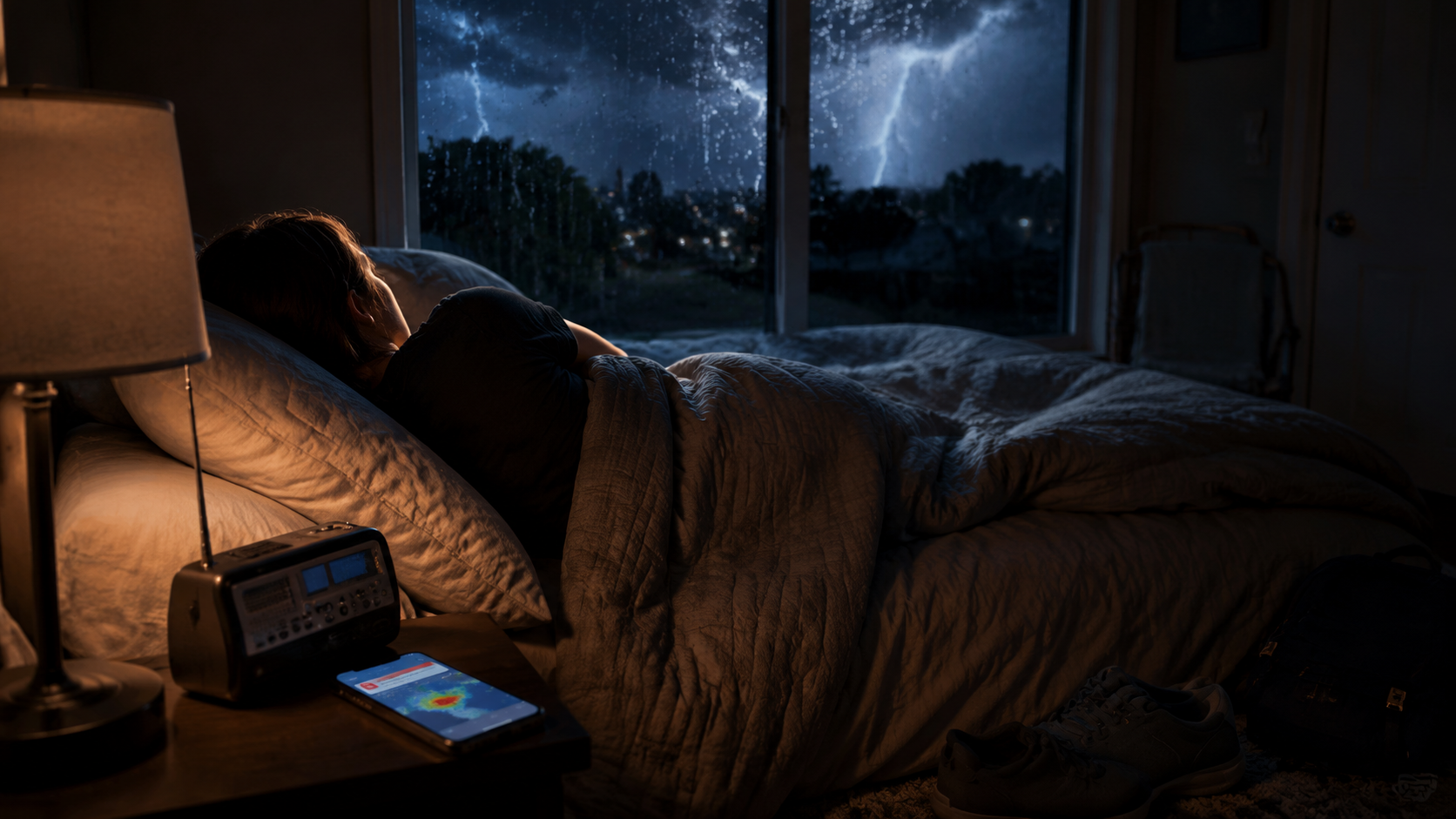
Once that safety layer is in place, the work changes. You are no longer trying to decide whether you care. You are trying to reduce the extra arousal that keeps you refreshing radar long after you already know what you will do.
Why a watch can feel like an alarm
The National Weather Service explains storm anxiety through the brain’s threat-detection system: the amygdala can trigger an alarm response before the thinking brain has fully sorted out whether danger is immediate, nearby, or only possible.[2] That is useful when you need to move. It is miserable when the watch box covers half the evening and your bedroom is quiet except for rain and notifications.
This reaction is not rare enough to be embarrassing. CoxHealth reports that about 1 in 8 people experience weather-related anxiety intense enough to disrupt sleep or daily life, though the article does not name the original study behind that figure, so it is best read as a clinical normalization point rather than a final prevalence estimate.[3]
The important part tonight is practical: your body may be doing a protective job too loudly. You can lower the volume without turning the system off.
Build the safety layer before the calming layer
A bedtime routine during a tornado watch should begin with decisions, not reassurance. Anxiety often keeps returning because something remains undecided: where to go, who wakes the kids, whether the phone volume is high enough, whether the weather radio has fresh batteries, whether the dog leash is by the door.
- Choose the shelter location now, not after the warning tone sounds.
- Set alerts from more than one reliable channel if possible, such as Wireless Emergency Alerts and a weather radio.
- Put shoes, glasses, keys, medications, charger, and any child or pet essentials where you can grab them fast.
- Tell the household the plan in one calm sentence: “If the alarm goes off, we go to the hallway bathroom.”
- If your home is not safe in a tornado, leave for the safer place before bedtime while the event is still a watch.
This is still sleep hygiene, but it is sleep hygiene with the weather in the room. A dark bedroom and a cool pillow do not help much if your brain is still trying to solve shelter logistics.
For a broader storm setup—noise, lightning, room temperature, and what to do when thunder keeps jolting you awake—use a separate storm sleep routine rather than trying to solve every environmental problem during the watch itself: How to Sleep During a Thunderstorm When Nothing Else Works.
Stop letting live coverage run the bedroom
Information helps until it starts behaving like a stimulant. Baylor College of Medicine psychiatrist Dr. Asim Shah specifically advises that watching storm coverage on video can escalate anxiety more than reading updates, and recommends limiting monitoring to one or two trusted text-based sources.[4]
That distinction matters at bedtime. A live stream gives you urgent voices, flashing maps, repeated damage footage, and constant “we’re watching this cell” language even when the cell is not near you. Text updates are less theatrical. They let you check the fact that matters—watch, warning, expiration, county, direction—without absorbing the emotional pacing of a broadcast.
| Instead of | Use this during a watch | Why it helps |
|---|---|---|
| Leaving live TV or video radar running beside the bed | Keep alerts on and check one or two trusted text sources at planned intervals | Reduces urgency cues while preserving warning information |
| Refreshing multiple apps with different radar colors and timing | Choose one primary weather app or local NWS feed plus one backup | Prevents conflicting interpretations from becoming the night’s main activity |
| Reading social media comments about damage elsewhere | Read only official warnings, local emergency updates, or your chosen meteorologist’s text posts | Keeps distant fear from being mistaken for local threat |
| Checking again every time your body spikes | Check on a schedule unless an alert sounds | Teaches your nervous system that fear is not the same as new data |
A reasonable watch-night boundary might be: check the forecast before bed, check once more near the expected arrival window, then let alerts do the waking. If storms are close or conditions are changing quickly, the interval may need to be shorter. If the watch is broad and the local line is hours away, constant monitoring usually buys little except adrenaline.
Parents can use the same boundary out loud. Children do not need a full radar briefing. They need to see that the adult knows the plan, has the alerts on, and is not using panic as the monitoring system.
Use a calming sequence that keeps you responsive
During a tornado watch, calming is different from sedating. Breathing, grounding, reframing, and attention exercises are good tools because they reduce arousal while leaving you able to hear an alert, wake a child, or move to shelter. Alcohol, extra sedating medication, or anything that makes you harder to wake belongs in a separate safety discussion, not in a list of quick storm-night tips.
If you are considering an over-the-counter or prescription sleep aid during severe weather, treat arousability as the main question. The same safety logic used for tropical storms applies here: half-life, grogginess, alert volume, and whether another responsible adult is awake enough to respond all matter. For that question, see Which sleep aids are safe during a tropical storm?.
When fear spikes: 5-4-3-2-1 grounding
Grounding helps when your attention has left the bedroom and moved into imagined sirens, roof sounds, or worst-case radar loops. The Anxiety and Depression Association of America includes grounding among practical strategies for reducing weather-related anxiety during severe weather seasons.[5]
- Name 5 things you can see: the lamp, the door, the charger, the shoes, the weather radio.
- Name 4 things you can feel: the sheet, your pillow, your feet, the mattress under your shoulder.
- Name 3 things you can hear, without interpreting them as danger unless an alert sounds.
- Name 2 things you can smell.
- Name 1 thing you can taste, or one steady fact: “I have alerts on.”
The point is not to pretend nothing is happening outside. The point is to bring the alarm system back into the actual room, where the phone is charged and the plan is ready.
When your body is revved: box breathing or 4-7-8 breathing
If your chest is tight or your breathing has moved high and fast, use a pattern simple enough to remember in the dark.
- Box breathing: inhale for 4, hold for 4, exhale for 4, hold for 4. Repeat for several rounds.
- 4-7-8 breathing: inhale for 4, hold for 7, exhale for 8. If holding your breath feels uncomfortable, shorten the counts and keep the exhale slower than the inhale.
Use the breathing pattern after the safety check, not instead of it. “I have done the responsible things” gives the body more permission to downshift than “calm down” ever will.
When thoughts keep arguing: reframe the exact status
Reframing does not mean telling yourself the storm is harmless. It means naming the category accurately.
- “This is a watch. Conditions are possible, not a confirmed tornado over me.”
- “If it becomes a warning, I stop resting and go to shelter.”
- “I do not need to solve the whole radar. I need to hear the alert and follow the plan.”
- “My body is loud because it is trying to protect me. The plan is already protecting me too.”
This wording matters because vague reassurance often fails during real risk. A precise sentence gives the anxious brain a job boundary.
When the mind keeps rehearsing danger: cognitive shuffling
Cognitive shuffling is useful after you have checked alerts and decided not to keep monitoring. Pick a neutral word, then think of unrelated images for each letter. If the word is “lamp,” you might picture a leaf, an apple, a mitten, and a pencil. The images should be boring, brief, and disconnected.
This gives the mind something to do besides build a private documentary about the storm. If an alert sounds, you stop. If no alert sounds, you return to the next neutral image.
A watch-night routine you can actually follow
Do not make the routine elaborate. Storm anxiety loves complicated systems because they create more things to verify. Use a short sequence and repeat it the same way each time.
- Confirm the status: watch, not warning. If it is a warning, go to shelter.
- Confirm alerts: phone volume, emergency alerts, weather radio, and charger.
- Confirm the shelter path: shoes, glasses, keys, children, pets, and the exact room or safer building.
- Close video coverage and keep only one or two trusted text sources.
- Set the next check time, unless an alert sounds first.
- Get in bed and do grounding, then breathing, then cognitive shuffling.
- Rest lightly. Let the alert system, not your adrenaline, be the night watch.
If your main fear is not the storm itself but sleeping through the warning, solve that directly. Alarm volume, alert redundancy, weather radio placement, hearing needs, and household roles are practical problems. The companion guide Why You Sleep Through Tornado Warnings and How to Fix It is a better fit for that specific fear.
For parents, keep the plan smaller than the fear
A child who asks, “Are we going to have a tornado?” usually does not need a probability lecture. A steadier answer is: “There is a watch, so we are paying attention. If the alert says warning, we go to our safe place. You can sleep, and I will listen for the alert.”
Then show the concrete pieces: the shoes, the flashlight, the hallway, the weather radio. Children borrow more from adult behavior than from adult vocabulary. If the grown-up keeps reopening live coverage, pacing, and whispering over radar, the child learns that the plan is not enough. If the grown-up checks the source, names the plan, and returns to bed, the child sees what managed concern looks like.
For some families, a non-drug comfort tool can help as long as it does not interfere with movement. A familiar blanket, stuffed animal, or appropriately used weighted blanket may support settling for some people. If you are considering weight, heat, age, breathing comfort, or mobility issues, read more before making it part of a storm-night setup: Weighted blankets for anxiety and sleep.
When storm anxiety is no longer just a storm-night problem
A hard night during a tornado watch does not automatically mean you have a sleep disorder or a phobia. It may mean you live in a place where the sky sometimes deserves respect. But if severe-weather forecasts repeatedly trigger panic symptoms, avoidance, hours of monitoring after the threat has passed, or insomnia that spreads into normal nights, it is worth treating that as more than a quirky habit.
Cognitive behavioral treatment can help when sleep anxiety becomes a learned bedtime pattern; start with Sleep Anxiety Before Bed? CBT-I Is the Proven Treatment. If storm nights bring sudden surges of terror, racing heart, choking sensations, or fear that you are dying, compare the pattern with Nocturnal Panic Attacks vs. Sleep Anxiety.
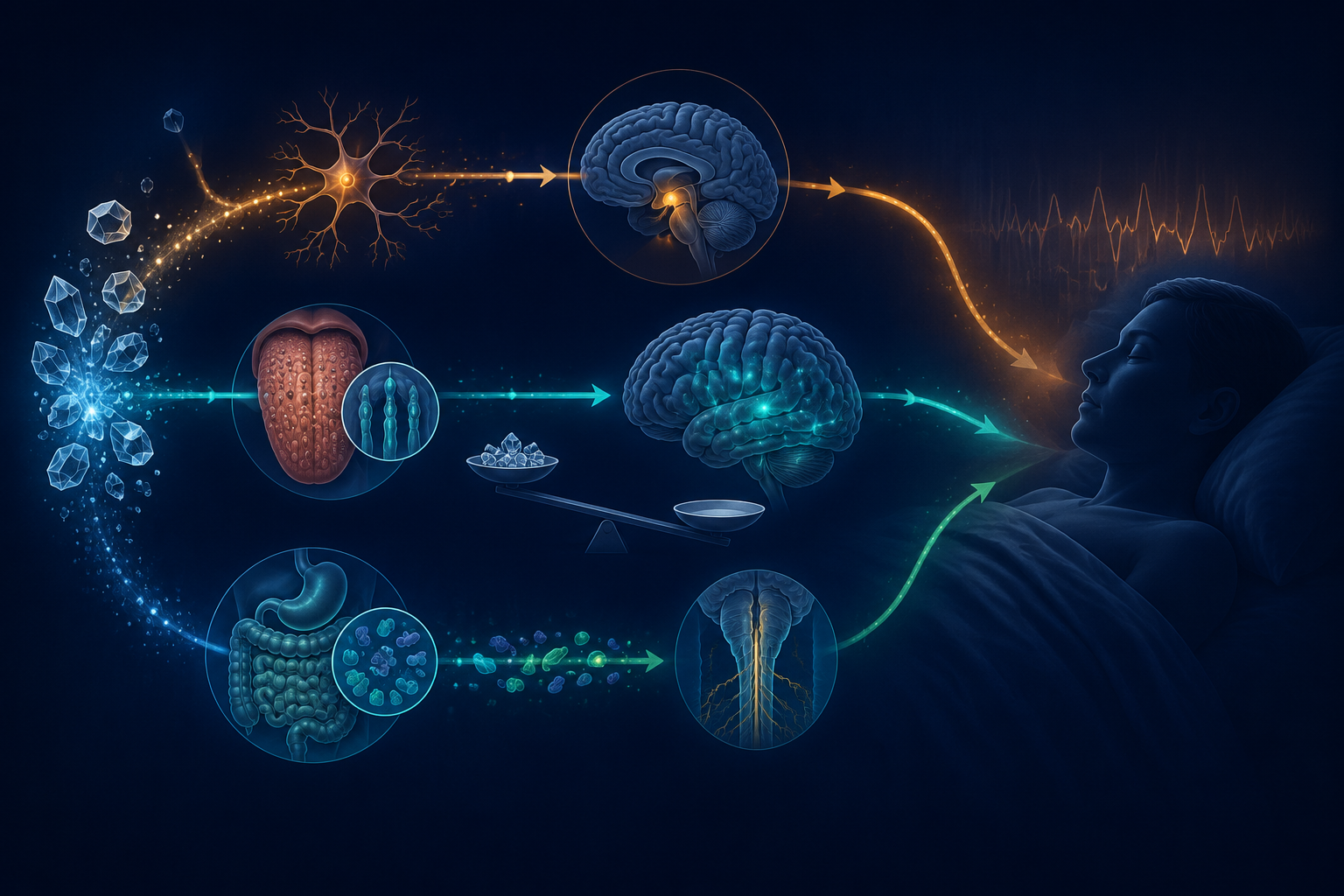
There is also a broader physiology behind why severe weather disrupts sleep: sound, barometric shifts, light, anticipatory stress, and conditioned fear can all contribute. For a deeper explanation, see Severe weather disrupts sleep through four physiological pathways. Tonight, though, the job is narrower.
If the watch becomes a warning
The plan changes the moment a tornado warning is issued for your area. Do not finish a breathing round. Do not wait to see if the storm “really looks close.” Do not keep watching video from bed. Go to the shelter location you chose earlier and follow local emergency instructions.[1]
If it remains a watch, your body may still be loud. Give it structure: alerts on, video off, shelter plan ready, one or two text sources, a check time, grounding when fear spikes, breathing when the body revs, and a neutral mental task when the mind keeps rehearsing danger. That is enough. You are not asking yourself to sleep through danger. You are giving your nervous system permission to stand down without going offline.
References
- Can I Sleep During a Tornado Watch? - Amerisleep - https://amerisleep.com/blog/can-i-sleep-during-a-tornado-watch/
- Storm Anxiety - National Weather Service - https://www.weather.gov/oun/stormanxiety
- Storm Anxiety: How to Manage Tornado Season Stress - CoxHealth - https://www.coxhealth.com/content-hub/storm-anxiety-how-to-manage-tornado-season-stress-coxhealth/
- Navigating pre-storm anxiety - Baylor College of Medicine - https://www.bcm.edu/news/navigating-pre-storm-anxiety
- Hurricane Season is Here: How to Reduce Your Anxiety - Anxiety and Depression Association of America - https://adaa.org/living-with-anxiety/managing-anxiety/hurricane-season-here-how-reduce-your-anxiety

Comments
Join the discussion with an anonymous comment.