
If earthquake anxiety is keeping you from sleep tonight, start with the next 30 minutes rather than the whole night. The goal is not to prove that nothing else can happen. The goal is to give your body fewer reasons to stay in fight-or-flight and give your bedroom enough visible safety cues that closing your eyes feels possible.
| Time | What to do | Why it matters tonight |
|---|---|---|
| 0-8 minutes | Breathe in for 5 counts, out for 7 counts, repeating slowly. | The longer exhale gives your nervous system a clear downshift signal. |
| 8-20 minutes | Do progressive muscle relaxation from feet to face. | Tension becomes something you can locate, tighten, release, and finish. |
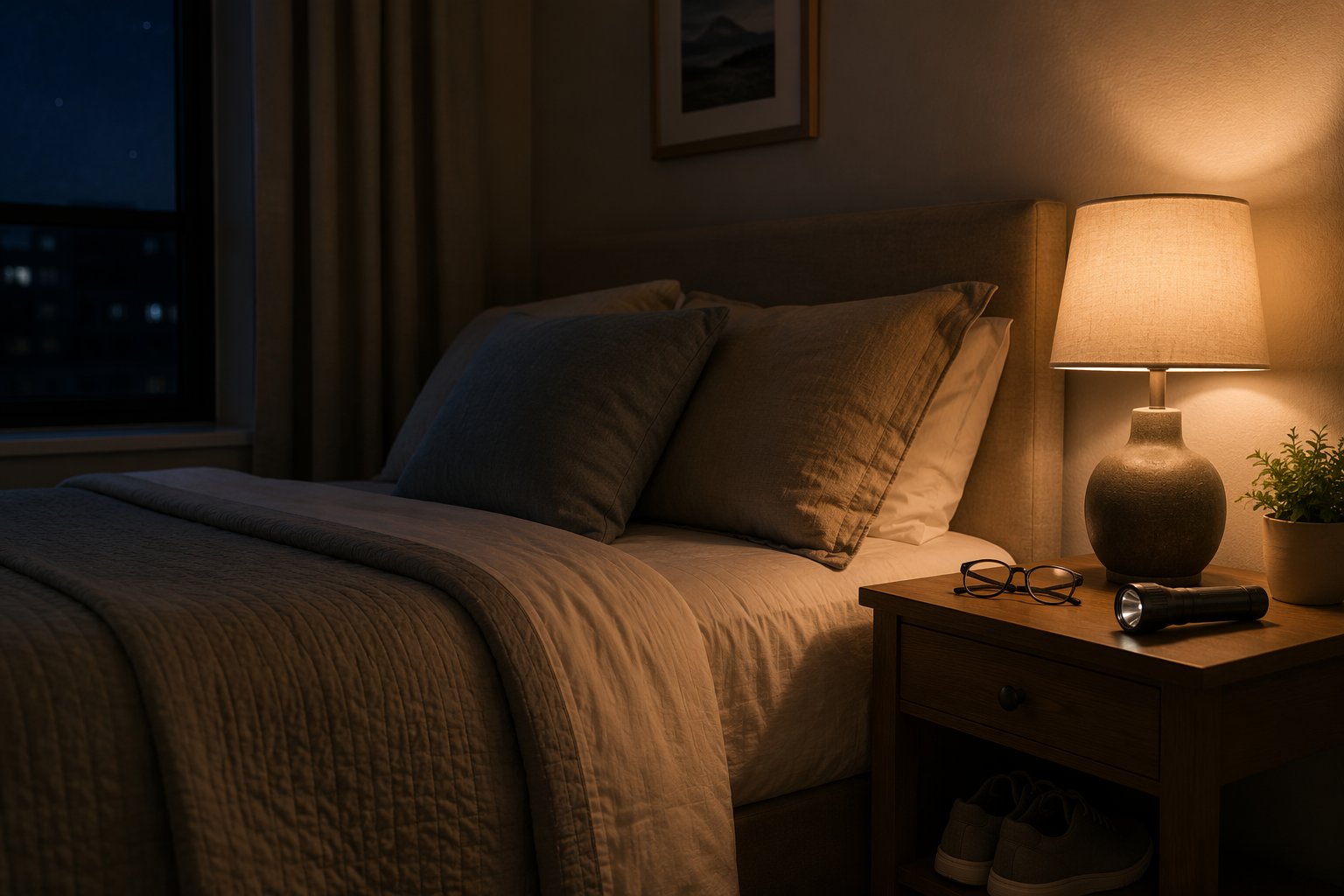
| 20-28 minutes | Do one bedside safety audit: hazards, path, shoes, flashlight, essentials. | Your room stops feeling like an unknown problem you need to keep scanning. |
| 28-30 minutes | Get back in bed and use one quiet rule: safe enough for tonight. | Sleep needs permission, not perfect certainty. |
First 8 Minutes: Use the 5-7 Breath
Sit up in bed or stand with your feet on the floor. Keep the lights low if you can. Inhale through your nose for 5 counts. Exhale through your mouth for 7 counts. Repeat for several minutes, without trying to make the breath dramatic.
- Inhale: 1, 2, 3, 4, 5.
- Exhale: 1, 2, 3, 4, 5, 6, 7.
- Let the shoulders drop during the exhale.
- If counting makes you feel trapped, count more softly or trace the rhythm with your fingers.
Dr. Gail Saltz recommended this 5-count inhale and 7-count exhale after earthquake anxiety, explaining that the longer exhale can activate the vagus nerve, lower heart rate, and counter the fight-or-flight response.[1] That is the useful part tonight: your body gets a repeated signal that the emergency response can ease down.
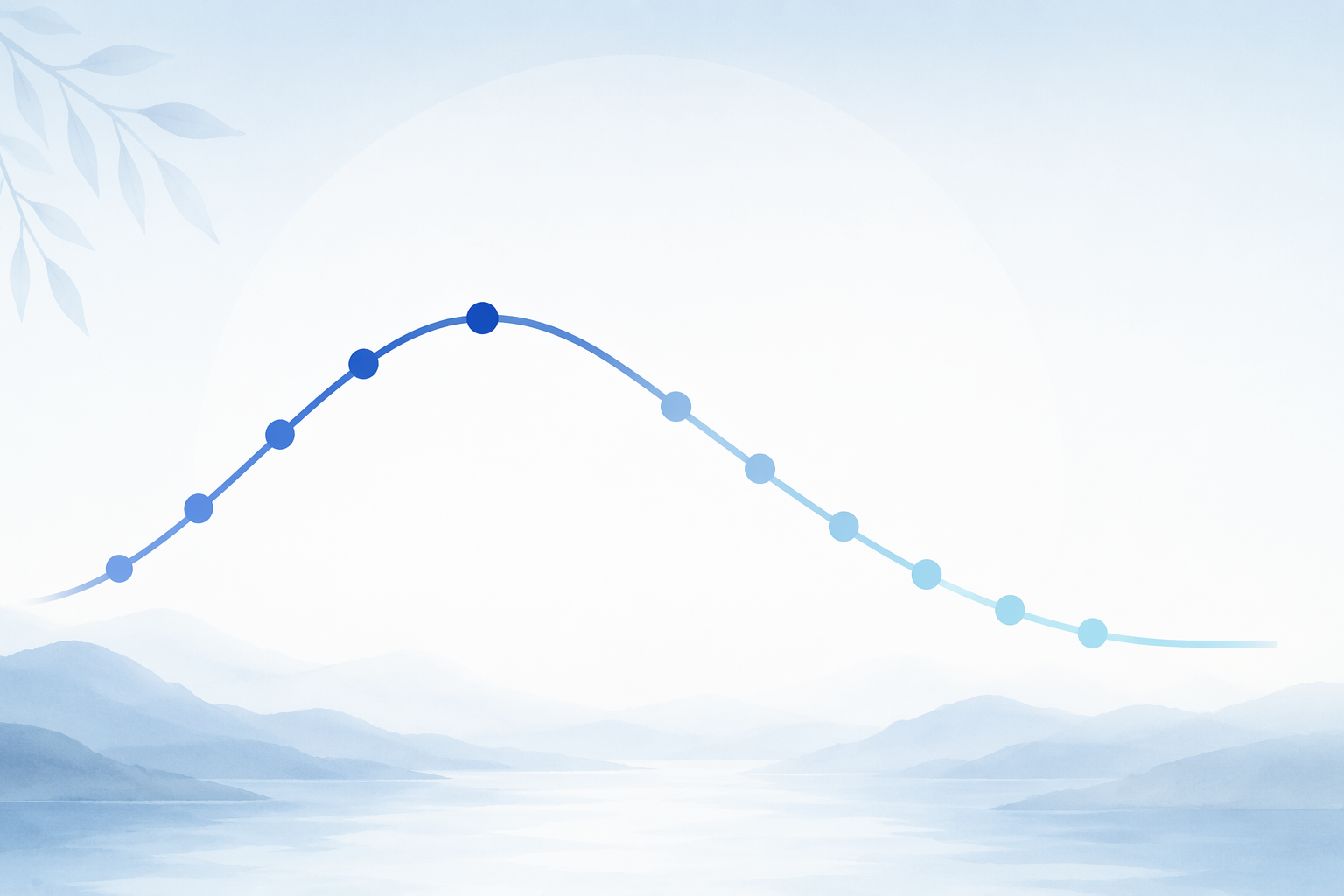
Do not worry about making yourself calm in the first minute. After a tremor, your body may still be acting as if it has a job to do. Give it a simpler job: count, exhale longer than you inhale, repeat.
Next 12 Minutes: Release the Body From Feet to Face
Progressive muscle relaxation works well here because earthquake anxiety often hides in the body as bracing: calves ready to jump, jaw clenched, shoulders lifted, hands tight. Crisis Text Line and UCI Health both recommend a feet-to-head progressive muscle relaxation sequence after earthquakes, using a 5-count squeeze followed by release.[2][3]
Move through the sequence once. If one area hurts, skip the squeeze and only soften it. This should feel controlled, not punishing.
- Feet: curl your toes or press your feet gently into the floor for 5 counts, then release.
- Calves: tighten the lower legs for 5 counts, then let them go heavy.
- Thighs: squeeze the upper legs, hold for 5 counts, then release into the mattress or chair.
- Abdomen: draw the belly in slightly or brace gently for 5 counts, then let the breath move normally again.
- Hands: make fists for 5 counts, then open the fingers.
- Arms: tense the forearms and upper arms, hold for 5 counts, then drop the effort.
- Shoulders: lift them toward your ears for 5 counts, then let them fall.
- Face: tighten the forehead, eyes, jaw, and mouth lightly for 5 counts, then unclench everything.
At the end, do two more rounds of the 5-7 breath. You are not checking whether the anxiety is gone. You are checking whether the body has dropped one level: less jaw pressure, less chest grip, less readiness to spring upright.
Then Make One Brief Bedside Safety Audit
Now give the room one pass. Not ten. One. This is the hinge between “I am trying to relax” and “I have answered the obvious safety problems my brain keeps replaying.”
Start with what could fall or block you. Amerisleep’s earthquake-ready bedroom guidance recommends moving the bed away from windows, ceiling fans, heavy light fixtures, and unsecured shelves; clearing heavy objects such as picture frames, books, and decor from above the bed; keeping the path from bed to door unobstructed; and making sure shoes, glasses, and a flashlight are reachable from the bedside.[4]
- Move a framed picture, mirror, plant, stack of books, or heavy decor away from the wall above your head.
- Shift glass, ceramics, or sharp objects off the bedside edge where they could fall.
- Clear the route from bed to door enough that you would not trip in the dark.
- Put sturdy shoes within reach, not across the room.
- Place glasses, medications you need overnight, and a flashlight where your hand can find them.
If you have them nearby, add a whistle, work gloves, and a bike helmet or hard hat to the bedside area. Utah Division of Emergency Management lists sturdy shoes, a flashlight with extra batteries, a whistle, work gloves, and a hard hat or bike helmet as useful bedside items for earthquake readiness.[5] If you do not have every item tonight, do not turn the audit into a shopping list at midnight. Put the best available version near the bed and continue.
There is a reason this can feel calming. In a Utah Division of Emergency Management Twitter poll, 65% of respondents said taking earthquake preparedness actions reduced their anxiety.[5] That is a poll, not peer-reviewed clinical evidence. Still, it matches what many bodies understand quickly: a visible plan can quiet some of the helplessness that keeps the room feeling unsafe.
Know the In-Bed Rule Before You Lie Down
If shaking starts again while you are already in bed, the recommended response is to stay in bed, cover your head with a pillow, and hold on until the shaking stops.[4] That instruction is one reason the bedside audit matters. You are making the place where you may need to stay put less exposed.
Once you have checked the room, say the action out loud if it helps: “The picture is down. The path is clear. Shoes and flashlight are here. If shaking starts, I cover my head and hold on.” Then stop auditing. Rechecking can become another way of staying awake.
Why This Kind of Fear Hits Harder at Bedtime
Earthquake anxiety at bedtime has a specific cruelty: sleep asks you to be unconscious, horizontal, and slow to react, exactly when your threat system wants you alert. Hypervigilance keeps the brain scanning for danger, and sympathetic arousal can involve elevated heart rate and cortisol, both of which work against the parasympathetic shift needed for sleep onset.[6]
The broader sleep-anxiety relationship is also bidirectional: anxiety can disturb sleep, and disturbed sleep can worsen anxiety.[7] Tonight, that does not mean you need a full therapy plan before you can rest. It means the first useful move is to interrupt the loop at two practical points: the body’s arousal and the room’s perceived danger.
If you want more background on how earthquake fear hijacks sleep, read this companion explanation of earthquake and bridge-collapse fears. If this becomes a more general anxiety-at-night pattern, this anxiety insomnia guide may fit better than an earthquake-specific protocol.
When to Stop Trying to Solve the Night
After the breathing, muscle release, and safety audit, get into bed. Keep the light low. Let the standard be “safe enough,” not “certain.” If your body asks for one more breath cycle, give it one. If your mind asks for one more inspection, do not restart the room check unless something actually changed.
Some people are not dealing with a brief post-tremor adrenaline surge. If sleep problems, intrusive memories, panic, avoidance, or severe distress persist beyond the acute period, interfere with functioning, or resemble PTSD-level distress, professional support is appropriate. Crisis Text Line and UCI Health both note that post-earthquake anxiety can be treatable and that people should seek support when symptoms are persistent or overwhelming.[2][3]
For tonight, the work is smaller: lengthen the exhale, release the bracing, remove the obvious hazards, put the essentials within reach, and let the room be safe enough for sleep.
References
- What to do if you have earthquake anxiety, according to an expert, CNN, 2024.
- Post-Earthquake Anxiety: It’s Normal and Treatable, Crisis Text Line, 2019.
- Earthquake Anxiety, UCI Health, 2024.
- Earthquake Ready Bedroom, Amerisleep, 2024.
- Can We Have a Talk About Earthquake Anxiety?, Utah Division of Emergency Management / Earthquakes.utah.gov, 2020.
- Hypervigilance and Sleep: Breaking the Cycle of Restlessness, ANCSleep.
- A systematic review assessing bidirectionality between sleep disturbances, anxiety, and depression, Sleep, 2013.
Comments
Join the discussion with an anonymous comment.