
After a car accident, “I can’t sleep” can mean several different things. One person lies down and immediately hears the sound of impact again. Another falls asleep but wakes at 3 a.m. with their heart racing, as if the headlights are still coming toward them. Someone else is not frightened at bedtime at all; they simply cannot keep their neck, back, or head comfortable long enough to stay asleep. A fourth person is sleeping at odd hours because pain medication, muscle relaxants, or daytime exhaustion has shifted the whole rhythm of the day.
Those are not the same sleep problem. Car accident trauma and sleep problems often travel together, but the sleep disruption may be driven mainly by threat memory, physical injury, medication effects, or a combination of all three. That distinction matters because nightmares, hypervigilance, whiplash pain, mild traumatic brain injury symptoms, and sedating medications point toward different kinds of help.
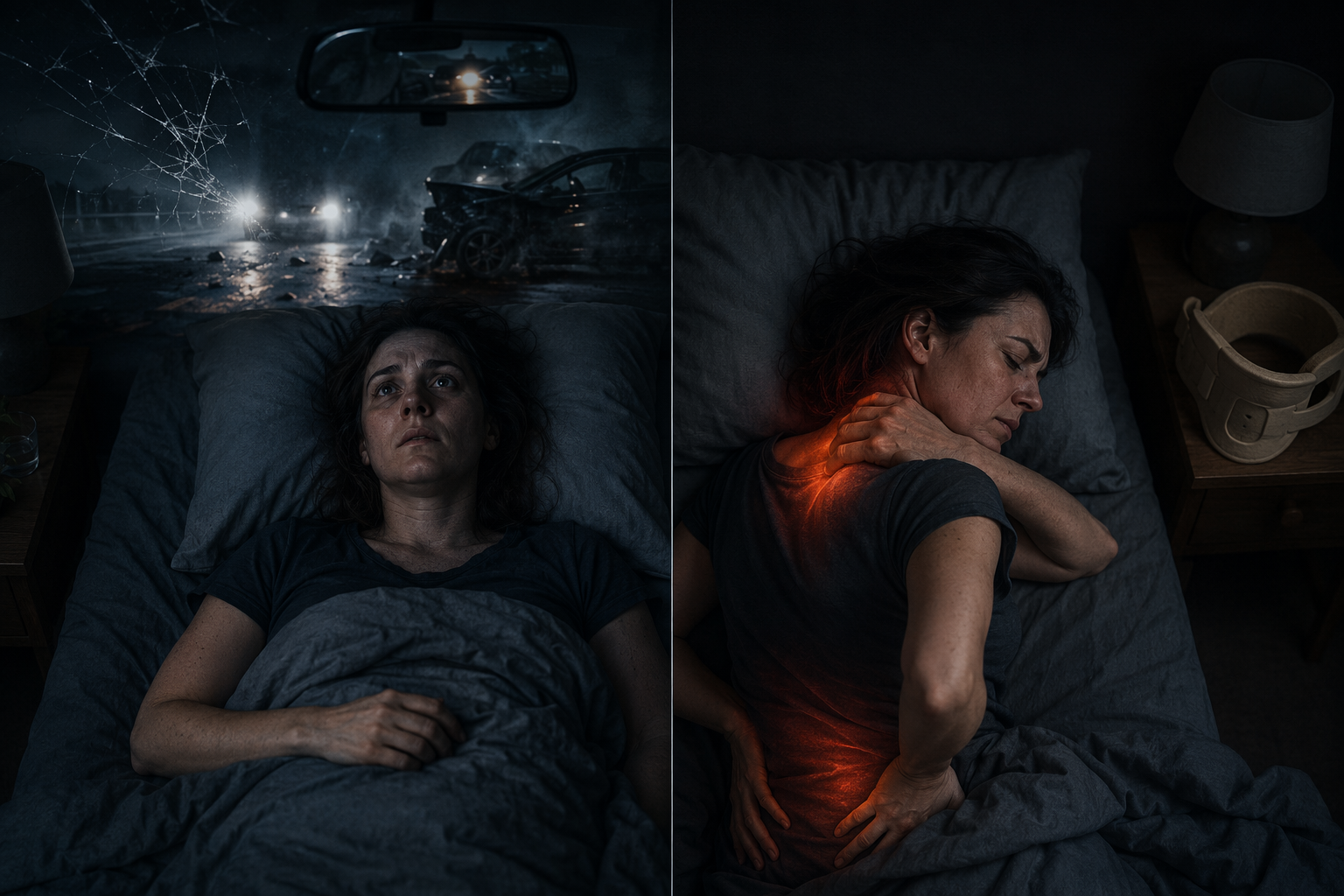
The Two Main Pathways After a Crash
The first pathway is trauma-driven hyperarousal. In this pattern, the nervous system keeps scanning for danger after the danger has passed. Bedtime becomes difficult because quiet, darkness, being alone, or closing the eyes removes distractions and leaves room for crash memories, body sensations, or sudden images. Sleep may feel unsafe, not because the person is choosing to worry, but because the body is still acting as if rapid response is necessary.
This pathway often shows up as trouble falling asleep, jolting awake, light sleep, nightmares, exaggerated startle, checking sounds outside, or feeling tense when riding in or driving a car. Some people avoid the crash location or delay going to bed because sleep itself has become associated with loss of control.
The second pathway is injury-driven sleep disruption. In this pattern, the bed is not frightening; it is physically unworkable. A sore neck tightens when the head turns. Back pain wakes the person every time they roll over. Headache, dizziness, light sensitivity, or concussion-type symptoms make the sleep-wake cycle feel unreliable. Medication may add another layer: some drugs make a person drowsy in the day, some fragment sleep at night, and some leave the person sleeping more hours without feeling restored.
Many post-crash patients have both pathways at once. A person may have whiplash pain that wakes them repeatedly, then find that every awakening gives the mind another chance to replay the accident. Another person may be afraid to sleep, but also taking medication that changes dreaming, alertness, or daytime napping. Sorting the dominant pathway is not about choosing whether the problem is “mental” or “physical.” It is about identifying what is actually keeping the night unstable.
How Common Is This?
The numbers are useful as orientation, not as a personal diagnosis. A 2025 meta-analysis of road traffic accident survivors estimated that 20.3% developed PTSD, but the rates across individual studies ranged from 2.9% to 77.8%.[1] That wide range matters. It reflects differences in settings, injury severity, measurement tools, timing, and populations. The pooled figure says the risk is real and common enough to take seriously. It does not mean one in five people can look at the calendar and predict their own outcome.
The injury side has its own benchmark. A 2023 study of hospitalized traffic injury patients in Vietnam reported that more than half of these patients slept fewer than 5 hours per night; the same paper cited earlier review work indicating that approximately 50% of injury patients report sleep disturbances and 25% to 29% are diagnosed with sleep disorders.[2] Because the 50% figure comes through a secondary citation rather than the original review, it is best treated as a strong signal rather than a final exact number.
Together, these figures explain why sleep can change after a crash even when no one has told you that you have PTSD, and even when you were discharged from the emergency department. A person can “walk away” from the accident and still have a nervous system, neck, head, or medication schedule that does not return to normal sleep immediately.
When the Night Is Driven by Threat Memory
Trauma-related sleep disruption usually has a recognizable emotional charge. The person may dread lying down, avoid silence, keep lights or a television on, or wake with a clear sense of danger before they can explain what they are afraid of. Dreams may replay the accident directly, or they may carry the same themes: being trapped, being hit, losing control, seeing lights, hearing brakes, or being unable to stop something from happening.
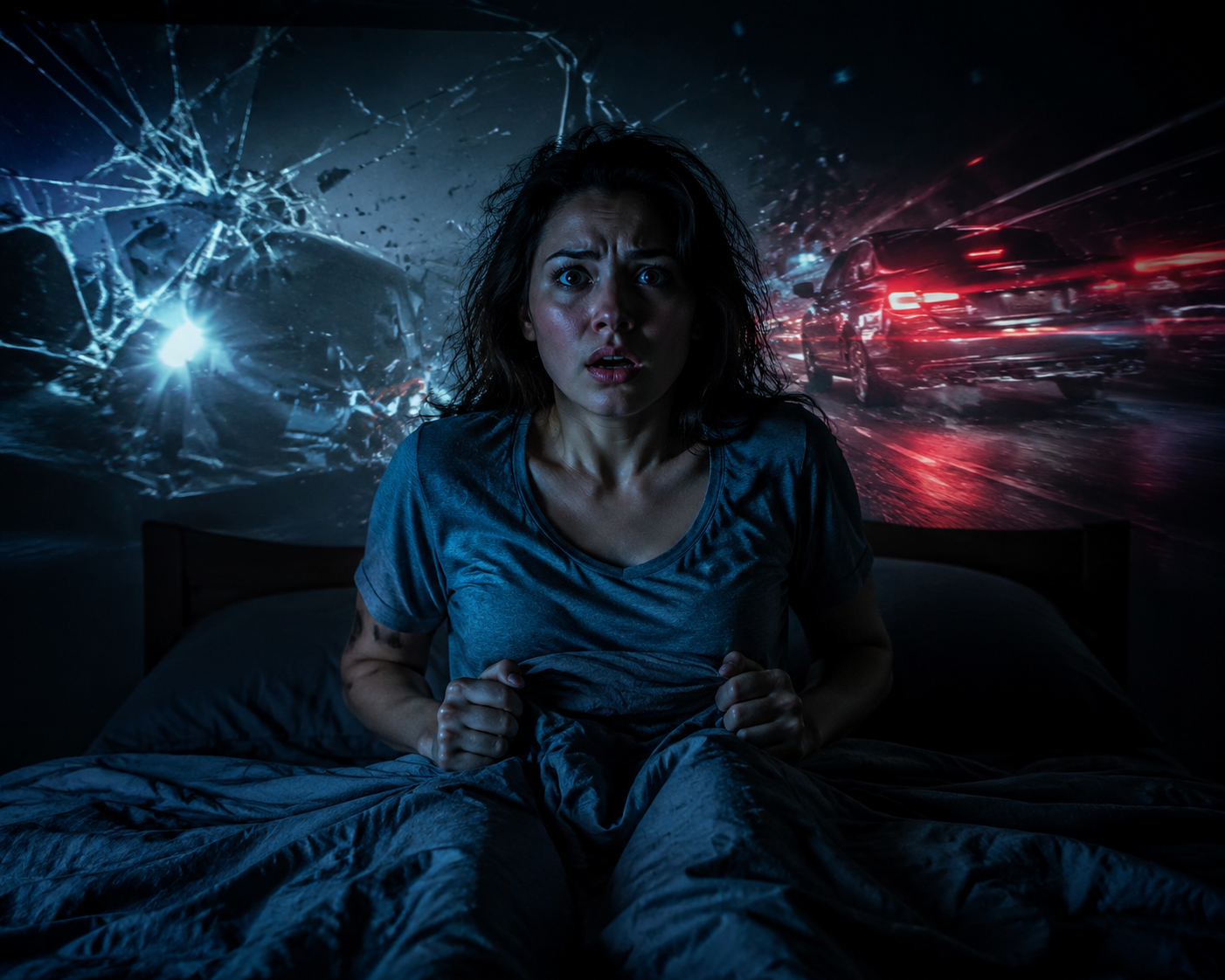
Nightmares are not just unpleasant dreams in this context. They can become a reason the person resists sleep, shortens sleep, or stays in shallow sleep. In PTSD samples, older cited work reported that up to 91% of individuals had difficulty maintaining sleep and up to 72% reported post-traumatic nightmares.[3] Those figures should not be converted into a claim that almost everyone after a crash has insomnia. They describe sleep symptoms among people with PTSD, not all accident survivors.
Early sleep complaints also appear to have prognostic value. The AURORA study, which followed people after motor vehicle collision, reported from its PubMed abstract that pre-existing sleep problems and sleep complaints soon after the crash predicted adverse neuropsychiatric outcomes at 6 and 12 months.[4] The abstract is not enough to support more detailed estimates here, but the direction is clinically important: sleep problems in the first month are not merely a nighttime inconvenience if they persist or intensify.
Other evidence supports the broader relationship between poor sleep and later PTSD, though not always in civilian car accident samples. A 7-year prospective cohort of U.S. veterans found that poor sleep quality was associated with a 60% increased risk of developing PTSD.[5] That finding should be generalized carefully because veterans are not the same population as recent motor vehicle accident survivors, but it still supports a practical point: sleep is part of the risk picture, not just an after-effect.
When the Night Is Driven by Pain, Brain Injury, or Medication
Physical injury can disturb sleep without any nightmare at all. Whiplash and musculoskeletal injuries are common examples because they make sleep position matter. A person who can function upright during the day may discover that the neck stiffens after 20 minutes on a pillow, or that shoulder and upper back pain becomes louder when there are no daytime tasks competing for attention.
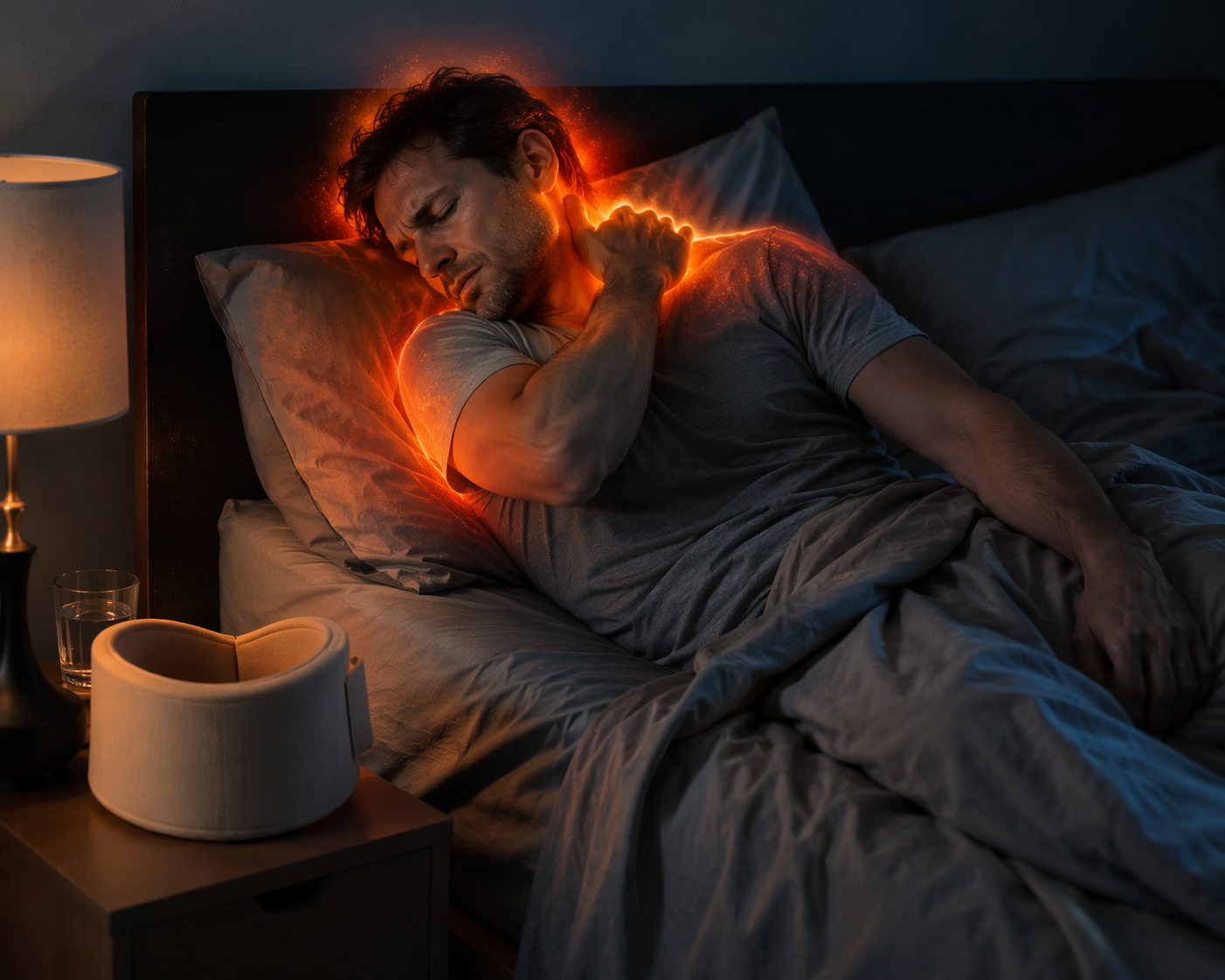
Pain fragments sleep in a very practical way. Each position change can wake the person. Each awakening can increase muscle guarding. Poor sleep can lower pain tolerance the next day, which then makes the following night harder. The cycle does not require panic to be serious. It only requires enough repeated interruption for the person to stop getting consolidated sleep.
Mild traumatic brain injury can complicate the picture further. After a head impact or rapid acceleration-deceleration movement, some people report insomnia, excessive sleepiness, irregular sleep timing, headaches, dizziness, light sensitivity, or difficulty concentrating. These symptoms deserve clinical attention on their own terms rather than being folded automatically into stress or PTSD.
Medication effects are also easy to miss. A person may reasonably take prescribed pain medication, anti-anxiety medication, muscle relaxants, anti-inflammatory medication, or sleep aids after the accident and then notice that sleep becomes longer but less refreshing, dreams become more vivid, daytime naps increase, or wake-up time shifts later. The question is not whether the medication is “bad.” The question is whether the current medication schedule is helping recovery or unintentionally keeping the sleep-wake cycle unstable.
A Practical Way to Sort Your Pattern
A sleep log for one week can be more useful than trying to decide, in the abstract, whether the problem is trauma or injury. The log does not need to be elaborate. It should capture what starts the night, what wakes you, and what happens the next day.
| What you notice | What it may point toward |
|---|---|
| You delay bedtime because quiet or darkness brings back the crash | Trauma-driven hyperarousal or fear of sleep |
| You wake from dreams about impact, headlights, being trapped, or losing control | Post-traumatic nightmares or re-experiencing |
| You wake mainly when turning your neck, shoulder, back, or head | Pain-related sleep fragmentation |
| You sleep at unusual times, feel sedated in the day, or feel unrested after long sleep | Medication effect, circadian disruption, concussion-related sleep-wake change, or a combination |
| You avoid driving, riding in cars, or passing the crash site | Trauma-related avoidance that deserves attention if persistent |
Patterns matter more than one bad night. A single nightmare after a frightening collision is not the same as repeated accident-specific dreams that make a person afraid to sleep. One painful night after a long day is not the same as a nightly neck-pain cycle that reduces sleep to short blocks. The body may need time after a crash, but repeated patterns show where the recovery system is getting stuck.
Red Flags That Mean It Is Time to Seek Help
A red flag is not proof that something is permanently wrong. It is a threshold for getting a more careful assessment. After a car accident, the following patterns are worth bringing to a clinician, especially if they are getting worse rather than slowly improving:
- Sleep disruption lasting longer than 1 month after the accident, especially when it affects work, caregiving, driving, or basic daytime functioning.
- Recurrent nightmares, particularly dreams that replay the crash or carry the same danger, helplessness, or impact theme.
- Fear of sleeping, delaying bedtime, needing to stay highly alert at night, or feeling unsafe when trying to rest.
- Avoidance of driving, riding in a car, the crash location, medical follow-up, or reminders of the accident.
- Persistent neck pain, back pain, headache, dizziness, light sensitivity, excessive sleepiness, or irregular sleep timing after a possible head or neck injury.
- Medication-related concerns, such as heavy daytime sedation, worsening nightmares, confusion, or sleep that becomes longer but less restorative.
The 1-month mark deserves special attention because early post-crash sleep complaints have been linked with later neuropsychiatric outcomes in the AURORA motor vehicle collision study.[4] That does not mean everyone with poor sleep in the first month will develop PTSD or a chronic sleep disorder. It means persistent sleep disruption is a signal worth evaluating rather than dismissing as ordinary stress.
Daytime impairment is another dividing line. If the person is missing work, making unsafe driving decisions, struggling to care for children, using alcohol or extra medication to force sleep, or feeling increasingly detached and irritable, the sleep problem has moved beyond a private nighttime nuisance. It is affecting recovery, safety, and judgment.
What Kind of Help Matches Which Pattern?
Treatment direction depends on what is driving the nights. When the dominant pattern is re-experiencing, avoidance, hypervigilance, or fear of sleep, trauma-focused mental health care is usually the more relevant doorway than generic sleep advice. Nightmare-specific approaches may also matter. A meta-analysis of imagery rehearsal therapy found support for reducing post-trauma nightmares and improving sleep, though the details of fit and timing belong in a clinical conversation.[3]
When insomnia has become persistent, cognitive behavioral therapy for insomnia may be considered, especially if the person is spending long periods awake in bed, sleeping irregularly, or developing fear around the bed itself. If nightmares and trauma symptoms are active, CBT-I may need to be coordinated with trauma-focused care rather than treated as a stand-alone sleep habit problem.
When the dominant pattern is pain, headache, dizziness, or positional waking, the next step is usually medical evaluation of injury drivers: whiplash, musculoskeletal strain, concussion or mild TBI symptoms, and medication effects. A sleep plan cannot compensate for an untreated pain generator that wakes the person every hour. A medication review can also clarify whether daytime sedation, nighttime restlessness, vivid dreams, or circadian drift began after a prescription change.
Basic sleep routines still have a place: consistent wake time, limiting late caffeine and alcohol, reducing long daytime naps, and making the bedroom easier on pain. But if the person is having accident-specific nightmares, avoiding driving, waking in panic, or sleeping in fragments because of neck and head pain, sleep hygiene is not the main treatment. It is supporting care, not the diagnosis.
The Useful Question Is Not Just “Is This Normal?”
It is common for sleep to change after a car accident. It is also common for people to minimize it, especially if they were not hospitalized or if the visible injuries seem mild. The more useful question is: what is keeping sleep from returning?
If the night is organized around threat, the clues are nightmares, hypervigilance, fear of sleep, and avoidance. If the night is organized around injury, the clues are pain, position changes, headache, dizziness, excessive sleepiness, or medication disruption. If both are present, both deserve attention. The next step is not to force one label onto the whole experience, but to name the active pathway clearly enough that the right kind of help can begin.
References
- Post-traumatic stress disorder in road traffic accident survivors: a meta-analysis, 2025.
- Sleep quality among hospitalized traffic injury patients in Vietnam, Nature, 2023.
- A Meta-Analysis of Imagery Rehearsal for Post-trauma Nightmares: Effects on Nightmare Frequency, Sleep Quality, and Posttraumatic Stress.
- Sleep complaints predict posttraumatic stress disorder and other neuropsychiatric outcomes after motor vehicle collision: the AURORA study, Neylan et al., 2021.
- Poor sleep quality and risk of posttraumatic stress disorder in a 7-year prospective veteran cohort, DeViva et al., 2021.

Comments
Join the discussion with an anonymous comment.