
If you are over 60 and finding yourself wide awake at 3 or 4 a.m., the first clue may have happened hours earlier. Maybe you were nodding off at 7:30 p.m., fighting sleep through the evening news, or waking on the couch with the room still lit. Then, when your eyes opened before dawn, it felt like insomnia, anxiety, or a new failure of discipline.
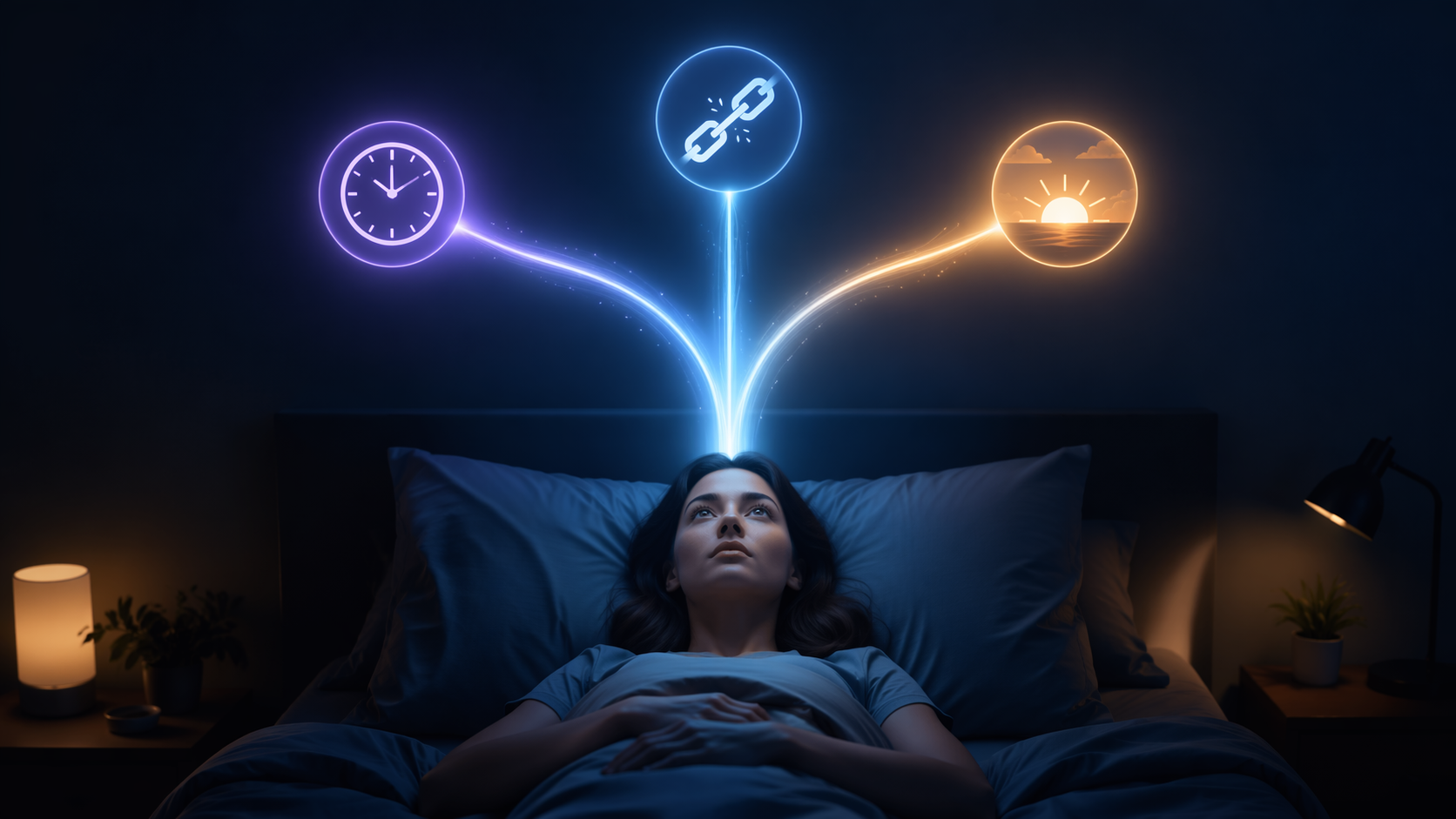
Often, the pattern is more mechanical than that. Starting around ages 60 to 65, circadian rhythms tend to shift earlier: sleepiness arrives earlier in the evening, and spontaneous waking moves earlier into the morning, sometimes around 3 or 4 a.m. [1] That shift is called a circadian phase advance. It is one of the most important aging and sleep health concerns because it can look like a sleep problem even when the body clock is simply running on an earlier schedule.
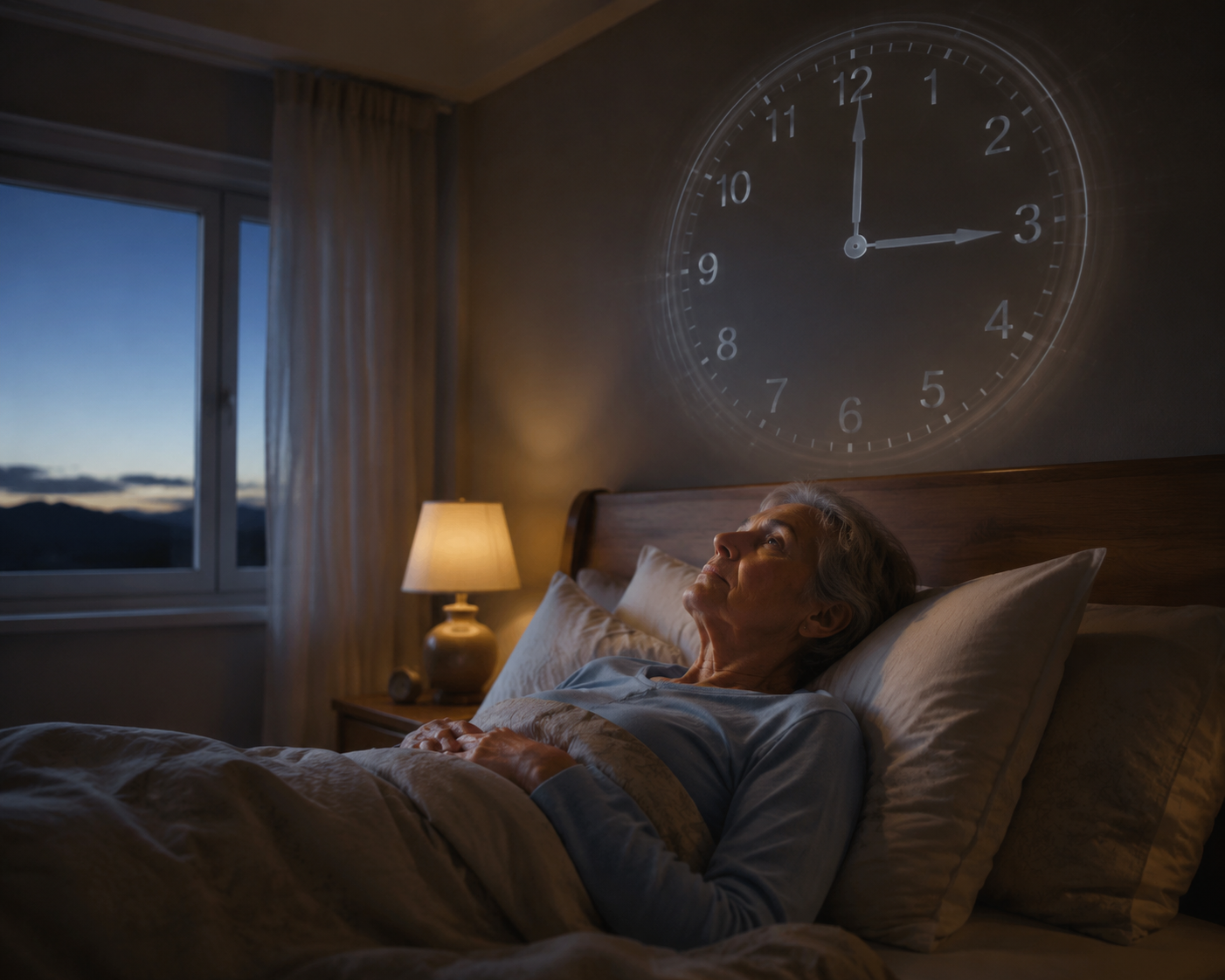
The distinction matters. A person who falls asleep at 8 p.m. and wakes after seven hours at 3 a.m. may be getting a full night of sleep on an inconvenient schedule. A person who goes to bed at 11 p.m., wakes repeatedly, struggles for hours, snores heavily, feels persistently low, or cannot function the next day may be dealing with something else entirely.
The 3 a.m. Pattern Is Often an Earlier Body Clock
The body’s sleep timing is coordinated by the circadian system, with the brain’s central clock responding strongly to light and darkness. In later adulthood, that system commonly becomes earlier and less forceful. The signal that says “stay awake now” may fade sooner in the evening, while the signal for morning alertness may arrive before the household, the street, or the person’s preferred schedule is ready for it.
That is why the bedtime matters as much as the wake time. If sleep starts at 8 p.m., a 3:30 a.m. waking may not mean the night was broken; it may mean the night began earlier than intended. Older adults are often reported to average about 6.5 to 7 hours of sleep, while many still need about 7 to 8 hours. [1] The person who delays bedtime to stay socially “normal” may end up shortchanging sleep. The person who gives in to the earlier clock may sleep enough, but wake at an hour that feels lonely and wrong.
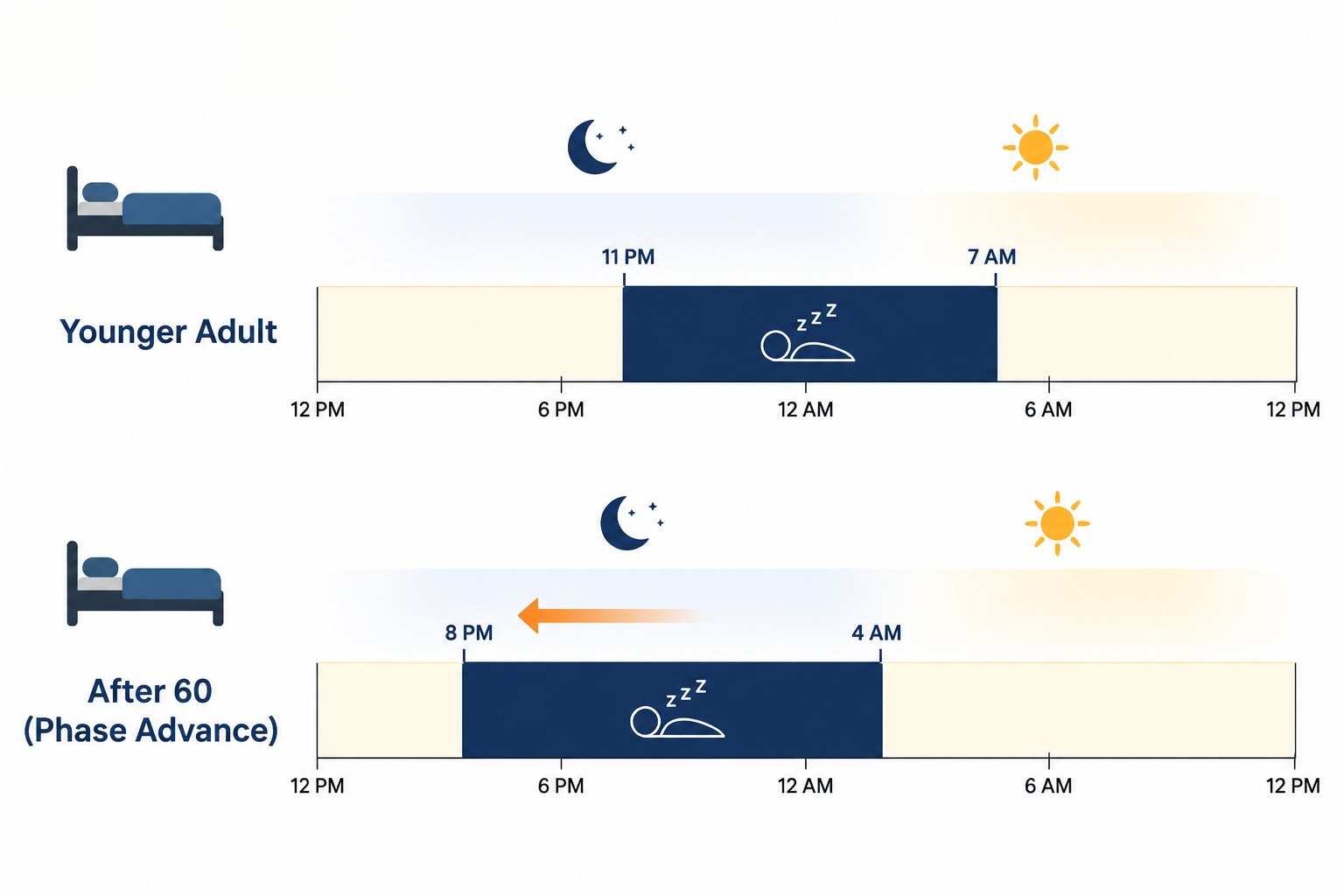
This is different from simply saying “older people need less sleep.” Some do sleep a little less, but the larger practical issue is timing. The sleep period can move forward. If bedtime does not move with it, total sleep can shrink. If bedtime does move with it, morning waking may arrive before sunrise.
Why Aging Pushes Sleep Earlier
The early shift is not caused by one lever. Research summaries point to several aging-related changes: the circadian clock’s signal can weaken, melatonin secretion may decline, and aging eyes transmit less short-wavelength light to the brain clock. [2][3] That last point is worth sitting with, because “get more light” can sound like soft lifestyle advice until you remember that the signal has to pass through an older eye before it can reach the timing system.
The cataract finding makes the light issue more physical. Sleep Foundation’s review notes that increased retinal light exposure after cataract surgery has been shown to improve sleep quality in older adults. [2] That does not mean cataract surgery is a sleep treatment for everyone. It does mean that the eye’s ability to deliver light to the clock is not a decorative detail; it can affect how strongly the body knows what time it is.
Melatonin is part of this discussion, but it should not swallow the discussion. Melatonin secretion changes with age are commonly described in sleep education materials, yet the clinical meaning is not simple enough to turn every early waking into a supplement problem. [2][3] For many people, the safer first question is not “What pill replaces the signal?” but “What timing signals is my body actually receiving?”
Lighter Sleep Can Make the Shift Feel Worse
The clock shift is not the only age-related change. Older adults tend to spend more time in lighter sleep stages, including N1 and N2, and less time in deep sleep and REM sleep. Sleep Foundation describes an average of 3 to 4 awakenings per night in older adults. [1] A brief awakening that a younger person might never remember can become noticeable, especially in the thin hours of early morning.
That lighter sleep can be normal, but it is not a reason to dismiss every complaint. A person may wake several times and still feel rested. Another may wake repeatedly because of pain, breathing disruption, reflux, urinary symptoms, medication effects, or anxiety. The same clock on the nightstand does not prove the same cause.
Older prevalence figures are often used to show that sleep complaints are common in later life. For example, Miner and Kryger reviewed data including older surveys and epidemiologic findings on sleep disruption in aging populations. [4] Those data remain useful background, but they should not be treated as if they precisely describe every 2026 household. The more helpful question for an individual is whether the pattern follows a stable earlier schedule or whether sleep is being fragmented by a condition that needs its own treatment.
How to Tell Phase Advance From Insomnia, Depression, or Sleep Apnea
A phase-advanced clock has a recognizable shape: sleepiness comes early, sleep starts easily if you allow the early bedtime, and waking comes early after a fairly solid block of sleep. UCLA Health describes this distinction plainly: older adults with an advanced sleep phase can maintain solid sleep if they go to bed early enough, while insomnia involves difficulty initiating or maintaining sleep regardless of timing. [3]
That is the hinge. If you are sleepy at 7 or 8 p.m., fall asleep quickly, and wake at 3 or 4 a.m. after roughly a full night, the internal clock deserves attention. If you are not sleepy early, lie awake for long stretches, wake with dread, or cannot sleep well even when you adjust bedtime, the problem may not be simple phase advance. A guide to identifying your insomnia pattern can help separate early-morning awakening from trouble falling asleep or repeated nighttime waking.
| Pattern | What it often looks like | Why it matters |
|---|---|---|
| Circadian phase advance | Sleepy early in the evening; wakes very early after a fairly consolidated sleep period | Timing interventions may help move or strengthen the clock |
| Insomnia disorder | Difficulty falling asleep or staying asleep even when timing changes | May need insomnia-focused evaluation and treatment |
| Depression-related early waking | Early waking with persistent low mood, loss of interest, or other mood symptoms | Needs mental health assessment rather than clock advice alone |
| Sleep apnea or breathing disruption | Loud snoring, witnessed pauses, gasping, morning headaches, or severe daytime sleepiness | Needs medical evaluation because sleep may be repeatedly interrupted |
The table is not a diagnosis. It is a sorting tool. Phase advance and insomnia can also coexist, which is one reason self-labeling can go wrong. Cleveland Clinic Journal of Medicine’s 2025 review of insomnia in older adults emphasizes careful assessment because insomnia in later life may overlap with medical, psychiatric, and medication-related contributors. [5]
What Helps When the Clock Has Shifted Earlier
The aim is not to bully the body into sleeping later by willpower. It is to give the circadian system clearer timing cues. Light, activity, meals, naps, and bedtime all tell the body something about time. For an older adult whose signals have weakened, those cues need to be less accidental.

Use morning light to anchor the day
Morning bright light is the main timing lever because light is the strongest environmental cue for the circadian clock. For someone waking too early, the exact timing can matter. Very early light before the intended wake time may reinforce an early schedule; light after the desired wake time can help anchor the day where you want it. This is where generic advice to “get sunlight first thing” needs a little judgment.
A practical approach is to choose a consistent target wake time, get bright outdoor light soon after that time, and avoid turning the pre-dawn awakening into a fully lit morning if the goal is to sleep later. Open curtains, sit near a bright window, or go outside once it is time to start the day. If vision problems, cataracts, or eye disease are present, it is worth discussing light exposure and eye health with a clinician rather than assuming the same light strategy works for every older eye.
Stop feeding the early evening collapse
Evening is the vulnerable stretch. If the body already wants sleep at 7:30 p.m., a dark room, a soft chair, and passive television can turn an early signal into an unplanned bedtime. The fix is not harsh stimulation. It is enough light and movement to keep the evening from becoming a nap by mistake.
- Keep the room comfortably lit in the early evening if you are trying to delay sleep.
- Stand up during long sedentary stretches instead of watching from a recliner for hours.
- Move absorbing activities earlier into the evening, before the strongest sleepiness arrives.
- Dim lights closer to the intended bedtime, not at dinner, if dinner is when you start nodding off.
This is a timing adjustment, not a command to flood the house with bright light until midnight. Someone trying to stay awake until 9:30 p.m. has a different problem from someone scrolling under bright light at 1 a.m. The cue has to match the pattern.
Place activity where it supports the clock
Timed physical activity can reinforce daytime alertness. A morning walk has two advantages: movement and light. Late-day activity can also help bridge the early evening dip, as long as it does not leave the person overstimulated or uncomfortable near bed. The useful question is not whether exercise is “good for sleep” in the abstract. It is whether the activity helps the day feel like day and the intended night feel like night.
Use naps carefully, not automatically never
The usual warning to avoid naps can be too blunt. A short, early nap may help a person function without stealing much from nighttime sleep. A long nap late in the afternoon can make an already shifted clock harder to read: Was bedtime delayed because the clock moved later, or because too much sleep pressure was spent at 4 p.m.?
If naps are needed, keep them brief and earlier in the day. If a nap reliably pushes bedtime later and improves total sleep, that is useful information. If it leads to a scattered night, it is probably costing more than it gives. This is one place where a simple sleep diary can do more good than another rule.
Track the sleep block, not just the bad hour
For one to two weeks, write down when sleepiness starts, when you actually fall asleep, when you wake, how long you are awake, nap timing, morning light exposure, evening light level, and daytime sleepiness. The goal is to see whether the whole sleep block has moved earlier or whether sleep is breaking apart.
This is also where broader evidence-based sleep tips for healthy aging fit best. Caffeine, bedroom comfort, alcohol, medications, and regular routines still matter. They simply should not be allowed to obscure the timing pattern if the body clock is the main problem.
What Not to Assume About Melatonin
Melatonin is often the first supplement people mention when sleep shifts with age. The caution is that timing, dose, medications, medical conditions, and next-day effects all matter, and age-related early waking is not automatically a melatonin deficiency that needs replacement. Melatonin decline may be one part of the physiology, but it is not a stand-alone explanation or a routine solution.
If you are considering melatonin, especially with other medications or chronic conditions, it belongs in a conversation with a clinician or pharmacist. It should not be used to postpone evaluation of loud snoring, breathing pauses, severe daytime sleepiness, persistent low mood, or worsening insomnia.
When Early Waking Needs Medical Attention
A shifted clock can be worked with. It should not become a blanket explanation for every early morning awakening after 60. Medical evaluation is especially important when early waking comes with low mood, loss of interest, anxiety that feels unmanageable, loud snoring, witnessed breathing pauses, gasping, morning headaches, pain, confusion, falls, medication changes, or sleepiness that makes driving or daily tasks unsafe.
It is also time to ask for help if timing changes do not improve the pattern, if total sleep remains consistently too short, or if the person is spending long stretches awake in bed night after night. In those cases, treating the problem as simple aging can delay care for insomnia disorder, sleep apnea, depression, or another condition that deserves a different plan.
Early waking after 60 is often a body clock that has moved forward, not a character flaw or proof that sleep is “over” with age. The reassuring part is that timing cues can be adjusted. The protective part is knowing when the pattern no longer looks like a clock shift and should not be self-treated indefinitely.
References
- Aging and Sleep, Sleep Foundation.
- How Circadian Rhythms Change as We Age, Sleep Foundation.
- 5 reasons you wake up earlier as you age — and how to get better sleep, UCLA Health.
- Sleep in the Aging Population, PMC/NIH.
- Insomnia in older adults, Cleveland Clinic Journal of Medicine, Jan. 2025.



Comments
Join the discussion with an anonymous comment.