
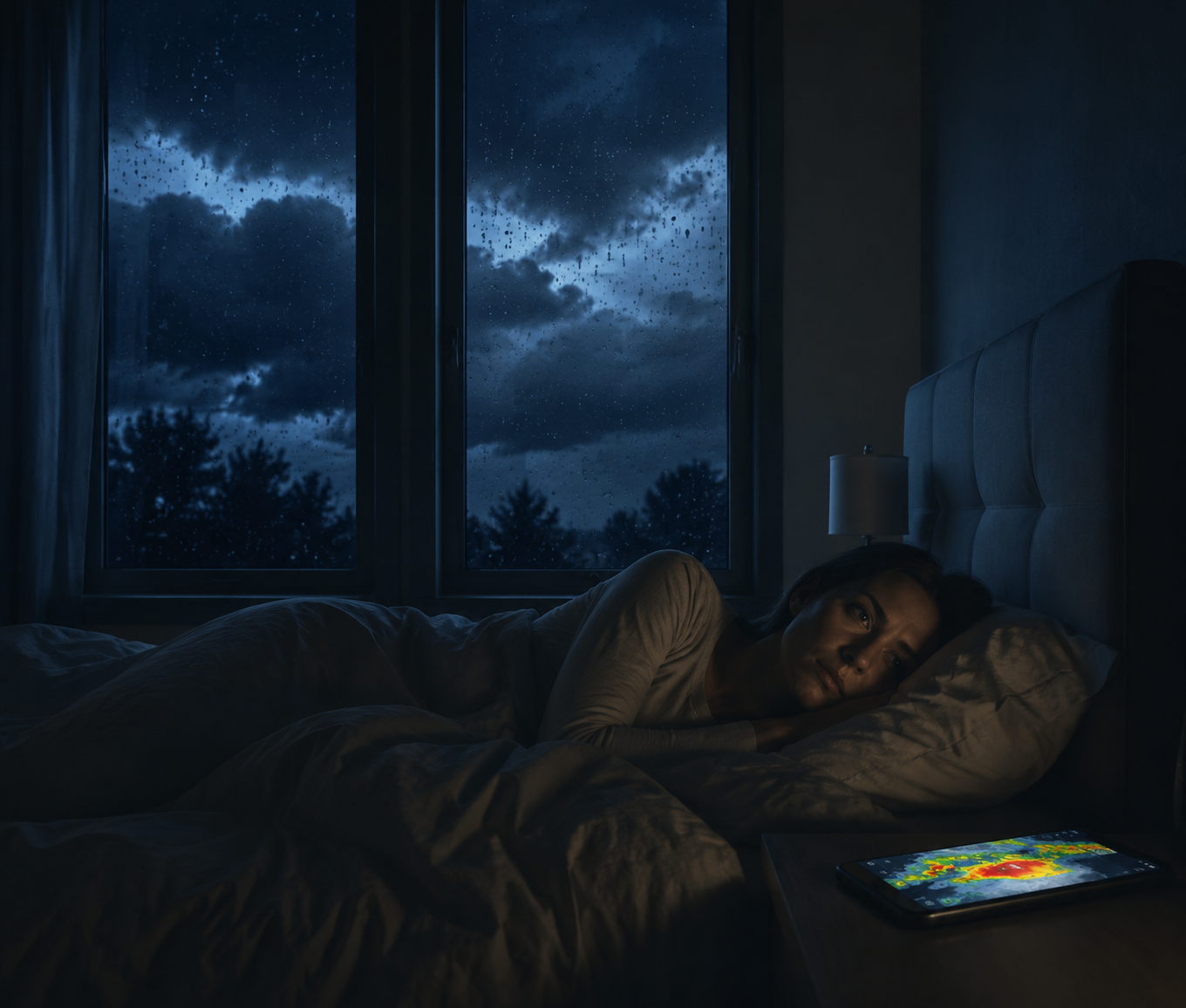
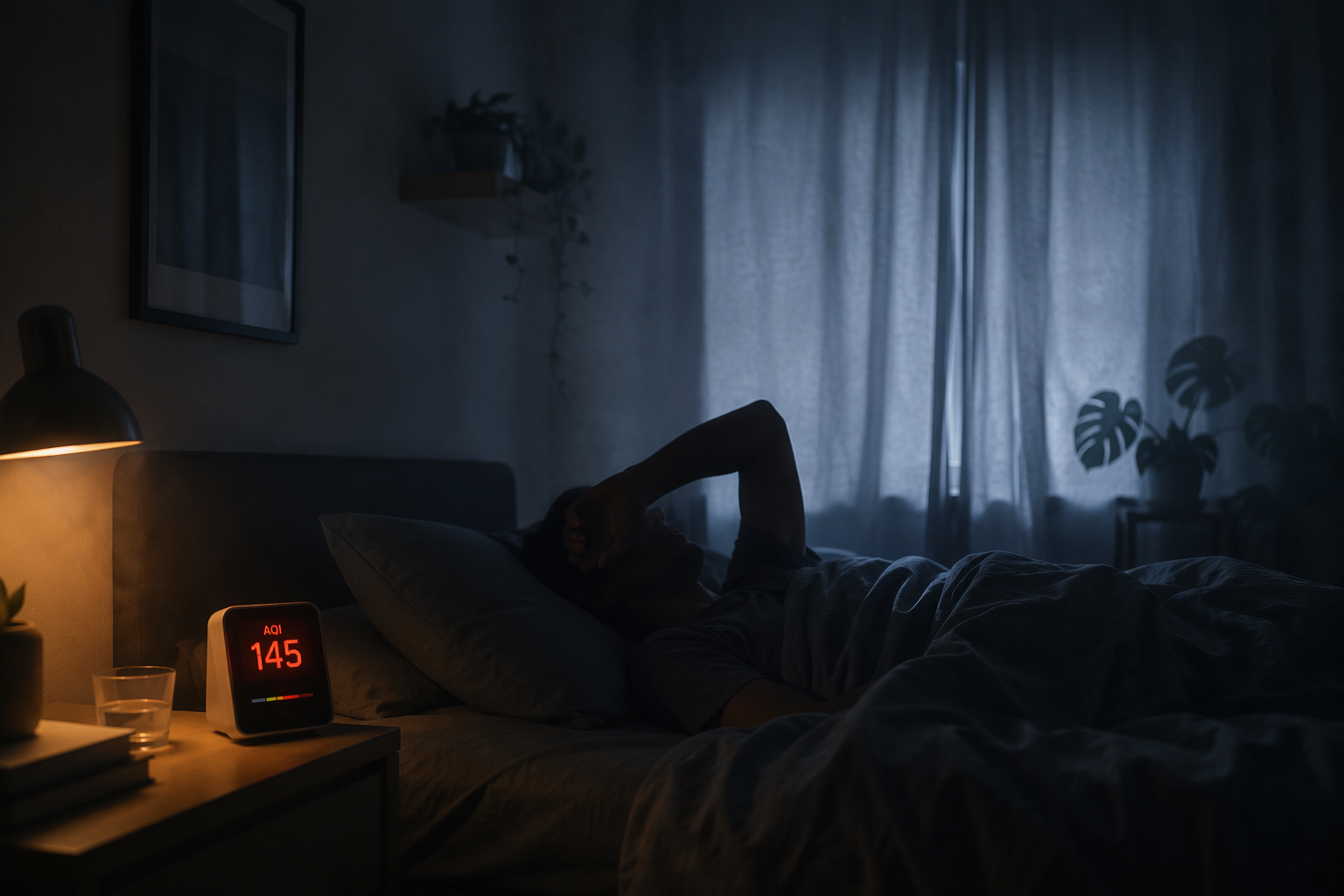
Rain starts against the window, and the bedroom changes function. The phone stays within reach. The window becomes something to read. A culvert, creek, storm drain, basement wall, road dip, or nearby river starts taking up space in the mind. For people with flash flood anxiety affecting sleep, the problem often feels humiliatingly physical: the forecast may be uncertain, the house may be safe for the moment, and still the body behaves as if someone has assigned it to night watch.
That reaction is not just “worry” in the casual sense. Flood survivors interviewed by The Guardian described nights when “we don’t sleep when it’s raining” and households taking shifts to watch conditions through the window.[1] That kind of vigilance makes sense during active danger. The harder problem begins when the same alarmed sleep pattern persists on nights when the immediate safety decision has already been made: alerts checked, evacuation threshold known, phone charged, shoes and documents ready, and yet the bed still does not feel like a place where the nervous system is allowed to stand down.
Why Rain Can Make the Body More Awake
Sleep onset depends on a biological shift toward reduced threat monitoring. The body has to permit lower muscle tone, slower responsiveness, and less scanning of the environment. That is a vulnerable state. If the brain believes a cue may signal danger, it does not treat sleepiness as the priority.
The amygdala is central to that sorting process. In weather-related anxiety, accessible clinical explanations often describe the amygdala as part of the brain’s threat-detection system, rapidly responding to cues such as thunder, wind, sirens, weather alerts, or the sound of heavy rain.[2] In a flood-prone home, those cues are not abstract. They may have been paired with evacuation, property loss, insurance calls, contaminated water, power outages, or the sight of water moving where it should not be.
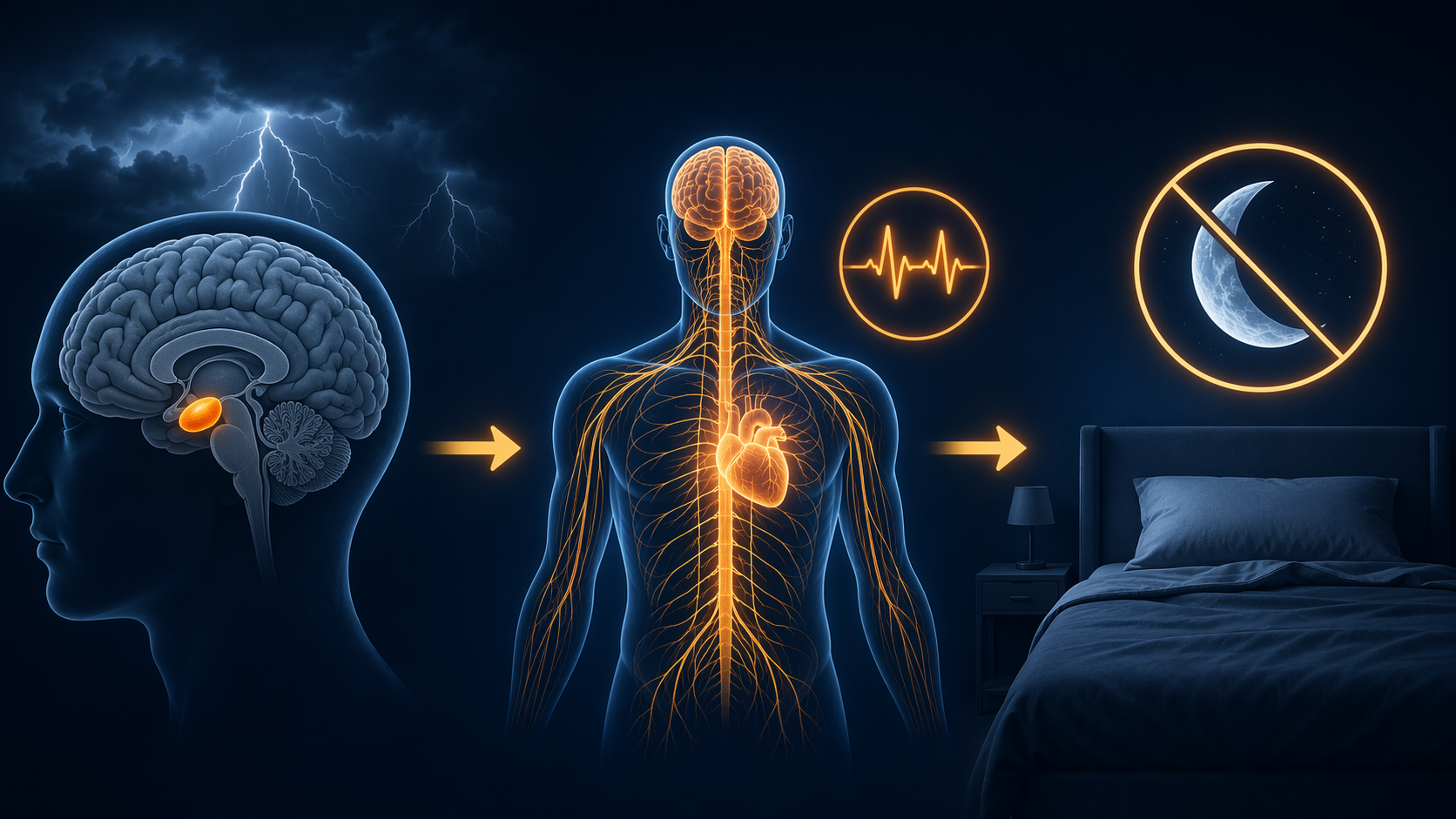
Once threat detection is active, the body can move into hyperarousal. Heart rate may feel louder. Muscles stay slightly braced. The mind checks, predicts, compares, and listens. A person may not be forming complete thoughts such as “I am in danger” every minute. The body can still be acting on a simpler command: keep monitoring.
That is why ordinary relaxation advice can land badly. If the nervous system is prioritizing threat surveillance, being told to “just calm down” misreads the state. The issue is not a lack of appreciation for sleep hygiene. It is a conflict between two biological jobs: sleep requires reduced vigilance, while flood-related cues recruit vigilance.
The Bedroom Can Become Part of the Alarm System
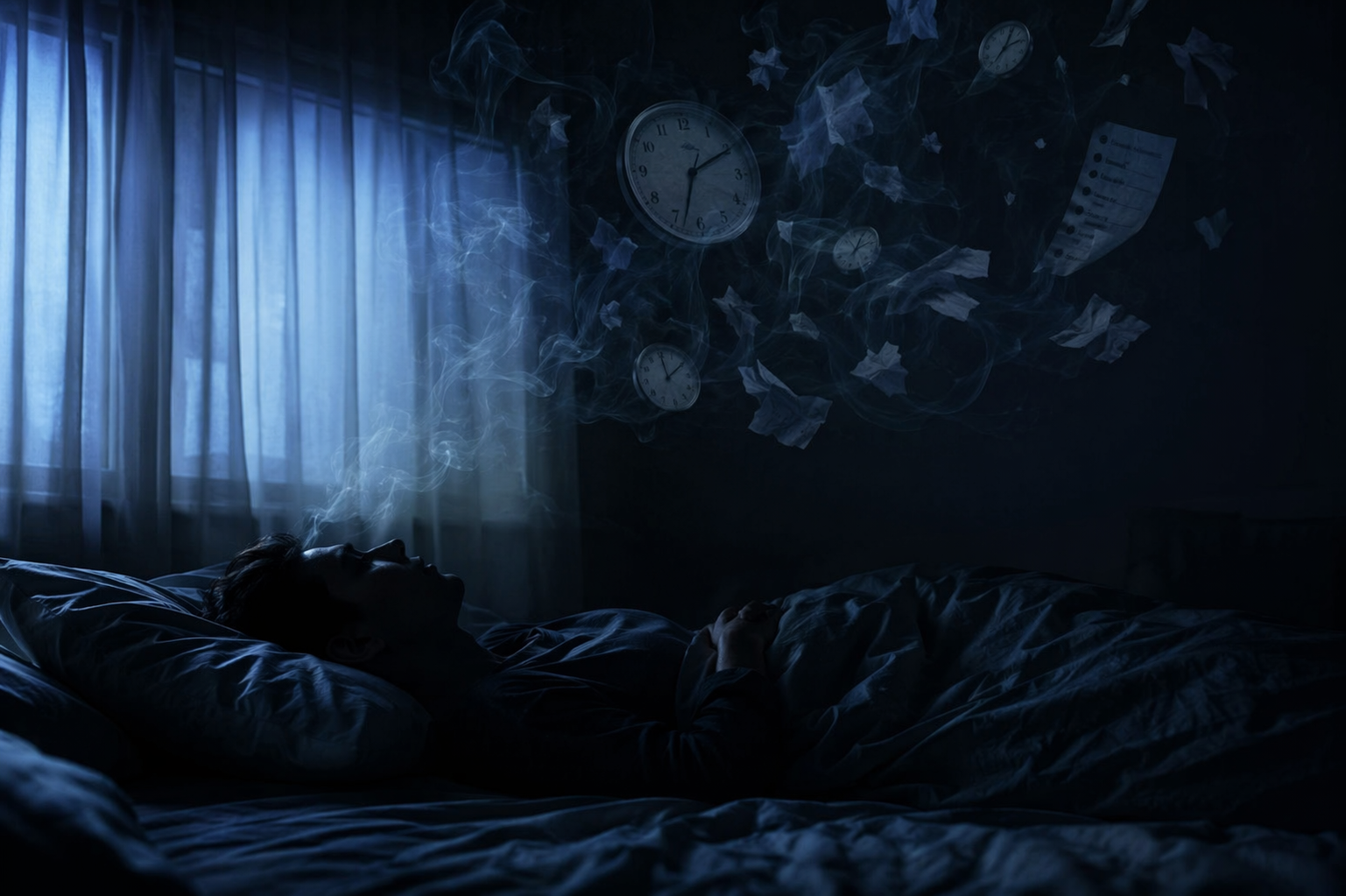
A single anxious night does not necessarily create chronic insomnia. Repetition is what gives the pattern its grip. If several rainy nights involve lying in bed with the phone lit, getting up to check the window, refreshing radar, listening for a change in rainfall, and waiting for the next alert, the brain starts learning a specific association: bed plus rain means stay awake and monitor.
This is conditioned arousal. The bed, which should predict sleep, starts predicting a task. That task may be rational during an active flood warning; no sleep article should ask someone to ignore a real hazard. But when the immediate safety plan is already set, repeated weather surveillance from bed can train the nervous system to treat the bedroom as a monitoring station.
| Cue | Learned meaning | Sleep consequence |
|---|---|---|
| Rain on the window | Possible water rise or travel danger | Listening replaces drowsing |
| Phone alert tone | Immediate decision may be needed | Arousal spikes and sleep pressure is interrupted |
| Lying in bed awake during storms | Bed is where monitoring happens | The bed becomes less strongly associated with sleep |
| Repeated radar checks | Certainty must be obtained before sleep | The brain keeps searching instead of disengaging |
The cruel part is that this learning can survive the original event. A person may know that tonight’s rain is ordinary and still feel the same wakeful jolt. The body is not making a legal argument about risk. It is recognizing a pattern that once mattered.
This Pattern Is Larger Than One Bad Night
The broader climate-emotion literature supports a modest but real connection between negative climate emotions and insomnia symptoms. Ogunbode and colleagues analyzed cross-sectional data from 25 countries, with 10,143 participants, and found that negative climate emotions were positively associated with insomnia symptoms, with a pooled correlation of r=0.16 and equivalent effect sizes across Western and non-Western populations.[3] That does not prove that climate anxiety causes insomnia. The study design cannot settle direction, and insomnia itself can intensify emotional reactivity. What it does show is that the link between environmental threat emotion and sleep difficulty is not an odd personal failure.
Flooding research adds the longer tail. A Health Protection Agency review of 48 flooding studies found that secondary stressors such as insurance problems, rebuilding, displacement, and disruption can prolong mental health and sleep impacts after the water recedes.[4] That detail matters because flood anxiety is rarely only about rain. It can also be about paperwork, money, mold, contractors, temporary housing, lost objects, damaged neighborhoods, and the knowledge that recovery is slower than the weather event itself.
Disaster-related insomnia can also become self-reinforcing. A prospective Sleep Medicine study of disaster-exposed adolescents examined bidirectionality between sleep problems and anxiety subtypes, supporting the clinical point that poor sleep and anxiety can feed each other over time.[5] The population in that study is not identical to every adult living with flash flood anxiety, so it should not be stretched into a universal rule. But the loop is recognizable: a storm night damages sleep, the next day’s fatigue lowers resilience, the next forecast feels harder to evaluate calmly, and the next bedtime begins with less confidence.
For severe storm survivors, post-event symptoms can include insomnia, nightmares, and hypervigilance for weeks.[6] Some people recover as the immediate danger and disruption pass. Others remain sensitized, especially when rain keeps returning as a cue. The difference is not strength of character. It is the difference between an alarm system that resets and one that keeps finding reasons to stay armed.
Safety Monitoring Is Not the Same as Insomnia Monitoring
There is a necessary distinction here. During an active flood warning, dangerous travel conditions, visible water rise, evacuation uncertainty, or official instructions, staying awake may be appropriate. The sleep problem should not be solved by pretending risk is absent. If the real question is whether it is safe to sleep during a flood warning, use a safety decision framework such as how to decide if you can sleep during a flood warning before treating the night as an insomnia problem.
The conditioned insomnia pattern is different. It appears when the practical safety steps have already been handled but the body continues behaving as if more checking will finally produce certainty. That checking often feels useful because it briefly reduces anxiety. The cost arrives later: the bed becomes paired with scanning, and the nervous system gets another repetition of “rain means stay awake here.”
- Active danger: monitoring serves a safety decision, such as whether to evacuate or avoid travel.
- Conditioned arousal: monitoring continues after the decision is made, mainly to reduce distress or search for certainty.
- Clinical priority: keep the safety plan outside the bed as much as possible, so the bed does not keep absorbing the monitoring role.
Why Generic Sleep Hygiene Often Feels Too Weak
A cooler room, dim lights, consistent wake time, less caffeine, earplugs, and a calmer evening routine may still help the sleep environment. They are not useless. Noise, light, and physical discomfort can add load to an already activated nervous system, and articles on severe weather sleep disruption or sleeping through a tropical storm can be useful when the problem is partly sensory.
But sleep hygiene alone does not directly retrain a bed that has become linked to threat monitoring. Earplugs can reduce rain noise, yet they may also make a flood-anxious person wonder what they are missing. A white-noise machine may cover small sounds, but it does not teach the brain that the bed is for sleep rather than radar review. Breathing exercises and grounding skills can reduce acute arousal; they are often worth learning. They still may not be sufficient if the central learned association remains untouched.
This is where the mechanism matters. If the main problem were only poor habits, a habit list would be enough. If the main problem is conditioned hyperarousal, the intervention has to change the conditioning.
Stimulus Control Matches the Mechanism
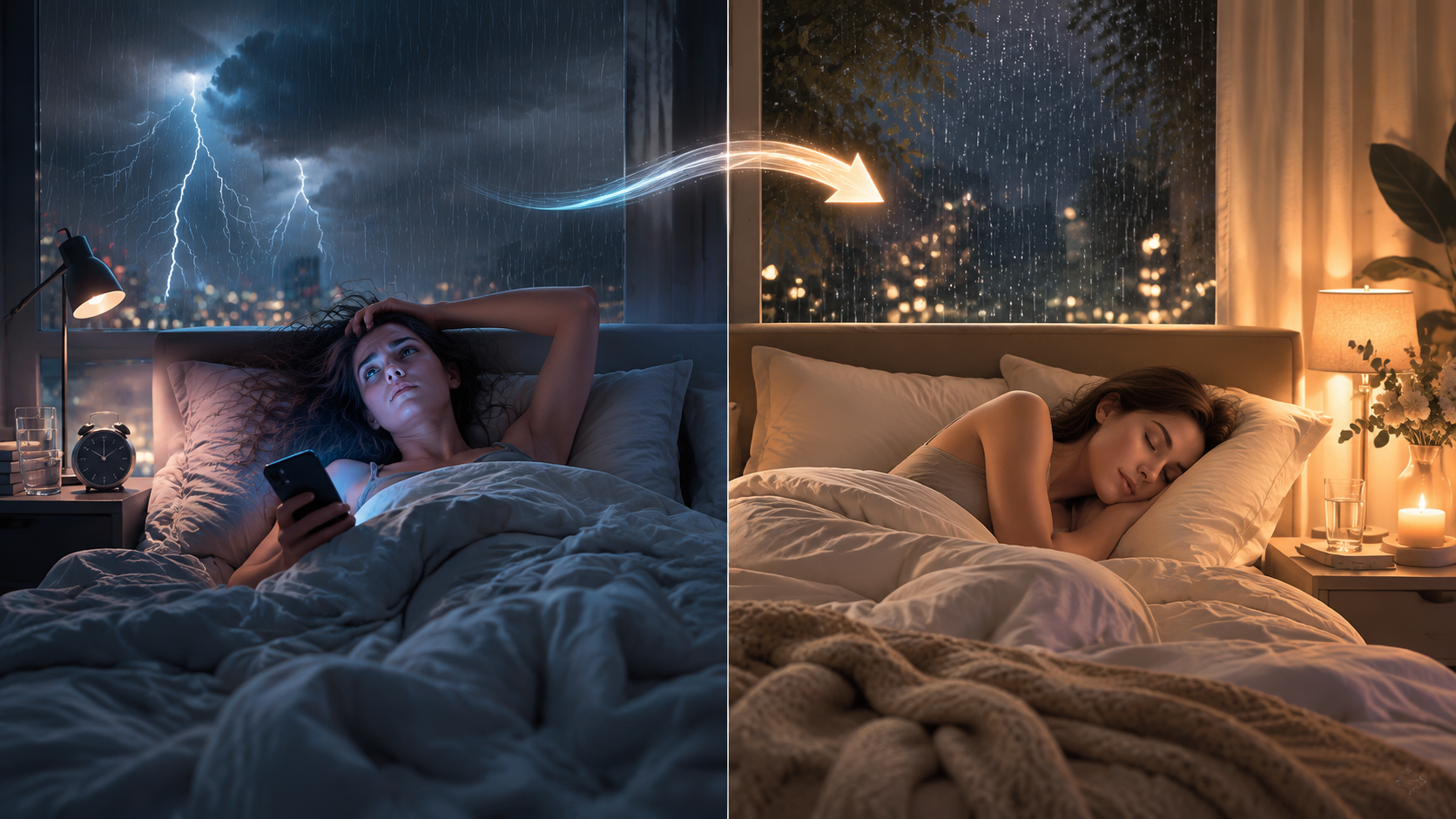
Stimulus control is a core behavioral component of cognitive behavioral therapy for insomnia, or CBT-I. Its logic is simple and demanding: if the bed has learned the wrong job, stop giving it more practice at that job. The goal is to rebuild a strong association between bed and sleep by reducing awake, alert, problem-solving time in bed.
For flash flood anxiety, that does not mean abandoning weather awareness. It means separating safety planning from the sleep space. A practical version might look like this: decide before bed which alerts matter, where the phone will be, what threshold would require action, who else is responsible for monitoring if anyone, and what steps are already complete. Then, once in bed, the bed is not used for radar checking, window watching, or repeatedly negotiating the same safety decision.
When sleep does not come, stimulus control typically asks the sleeper to get out of bed rather than continue rehearsing wakefulness there. The exact timing and method are best learned from a CBT-I clinician or a structured CBT-I program, especially when trauma symptoms are present. The behavioral principle is the important part: do not let the bed keep collecting hours of alertness.
| If the learned pattern is... | The stimulus-control response is... |
|---|---|
| Checking radar from bed | Move weather review to a planned place and time before bed |
| Watching the window while lying down | Use the bed only after the safety decision is complete |
| Staying in bed for long periods while fully alert | Leave the bed for a quiet, low-stimulation activity until sleepiness returns |
| Using the phone as both alarm and reassurance device | Set necessary alerts, then reduce optional checking |
This can feel counterintuitive during the first attempts. Getting out of bed may seem like losing more sleep. But the immediate night is not the only target. The treatment target is the learned prediction attached to the bed. Over time, the brain needs fewer repetitions of “bed equals vigilance” and more repetitions of “bed equals sleep.”
What to Do on a Rain Night Without Pretending Risk Is Zero
A mechanism-based plan should begin before the anxious part of the night. The point is not to convince yourself that nothing can happen. The point is to make the real safety decisions while the thinking brain is still available, so the bed does not become the place where every uncertainty is relitigated.
- Make the safety decision outside the bed: check official alerts, identify the action threshold, and decide what would require getting up.
- Prepare the practical items once: charge the phone, place essentials where they belong, and avoid repeating the same preparation loop.
- Set necessary alerts rather than running open-ended surveillance from bed.
- If you are awake and monitoring, leave the bed and keep the activity quiet, dim, and non-rewarding.
- Return to bed when sleepy, not when you have achieved perfect certainty.
Grounding and breathing skills can still have a place, especially during the first surge of adrenaline. If those are the tools you need in the moment, use them. The related guide on how to calm storm anxiety and sleep through a tornado watch covers that acute skill set from a neighboring severe-weather situation. For chronic flash flood anxiety, though, the larger question is whether those tools are being used to return the bed to sleep or to extend monitoring in a calmer form.
When the Problem Needs More Than Self-Help
Some storm-related sleeplessness should be treated as a clinical problem, not a personal project. Nightmares, panic symptoms, intrusive memories, avoidance of ordinary activities, persistent insomnia, or inability to function during the day are reasons to seek professional care. Flood trauma, generalized anxiety, panic disorder, post-traumatic stress symptoms, and chronic insomnia can overlap; a good treatment plan should not flatten them into one generic “weather anxiety” label.
The useful conclusion is narrower and more respectful than “relax.” Flash flood anxiety can keep you awake because the brain is treating rain and alerts as threat cues, the body is entering hyperarousal, and repeated nights of checking can condition the bed into a place of vigilance. That does not mean ignoring real flood risk. It does mean the sleeplessness is not weak willpower. It is a learned threat-and-sleep pattern, and learned patterns can be retrained with the right behavioral target.
References
- ‘We don’t sleep when it’s raining’: the Welsh flood victims fearing more storms — The Guardian, 2020, https://www.theguardian.com/environment/2020/dec/30
- Finding Calm in the Storm — Nashville Psych, https://www.nashvillepsych.com/finding-calm-in-the-storm
- Negative emotions about climate change are related to insomnia symptoms and mental health: Cross-sectional evidence from 25 countries — Springer, https://link.springer.com/article/10.1007/s12144-021-01385-4
- The effects of flooding on mental health: Outcomes and recommendations from a review of the literature — PMC, 2012, https://pmc.ncbi.nlm.nih.gov/articles/PMC3461973/
- Bidirectionality between sleep problems and anxiety subtypes among disaster-exposed adolescents — ScienceDirect, 2018, https://www.sciencedirect.com/science/article/abs/pii/S1389945718302065
- Hurricane Season Is Here: How to Reduce Your Anxiety — Anxiety and Depression Association of America, https://adaa.org/living-with-anxiety/managing-anxiety/hurricane-season-here-how-reduce-your-anxiety
Comments
Join the discussion with an anonymous comment.