
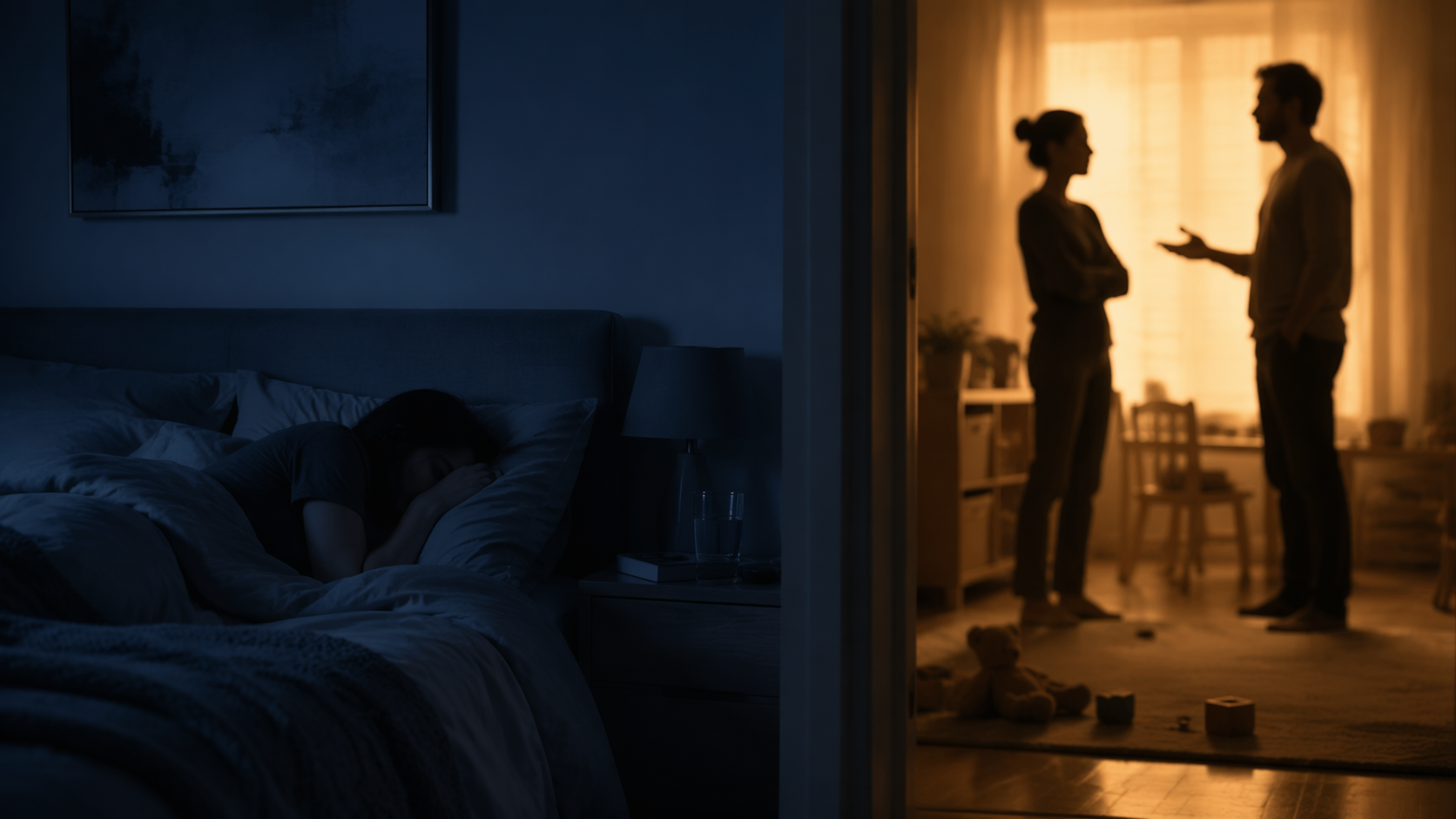
It usually starts the same way: a tense message about pickup time, bedtime rules, or who dropped the ball. Then the night goes badly. By morning, the reply is shorter, the tone is sharper, and the same small disagreement has more force than it should. That pattern is common enough to be recognizable, and the larger stress context around parenting helps explain why. In U.S. data cited by Sleep Education and the American Academy of Sleep Medicine, 33% of parents report high stress versus 20% of other adults, and 41% say they feel too stressed to function most days [1].
Why the loop keeps feeding itself
The cycle is not just emotional. Poor sleep makes it harder to regulate emotion, keep cortisol in check, pay attention without a threat bias, and stay steady under pressure; co-parenting stress can then push sleep later, shorter, more fragmented, or more variable. That is why this problem tends to feel so sticky: the body is already running with less buffering when the next disagreement lands. The strongest studies do not show a neat one-way cause, but they do support a reinforcing relationship rather than a coincidence [2][3].

That loop does not stay inside one adult. In a 2025 study of cohabiting mothers and fathers, one parent's sleep variability predicted the other parent's emotional availability at bedtime, which is a concrete way of showing that sleep problems spill across the family system instead of remaining private [4].
What the better studies show
| Study | Design | What it found | Why it matters |
|---|---|---|---|
| McQuillan et al. 2019 [2] | 314 mothers; actigraphy plus observed bedtime parenting | Shorter, later, and more variable sleep tracked with higher cumulative stress, and sleep deficits predicted less positive observed parenting at bedtime beyond other stressors. | Measured sleep and visible behavior lined up, not just self-report. |
| Bai et al. 2025 [3] | 152 mothers; longitudinal postpartum data | Poor sleep quality predicted lower parenting quality only when coparenting quality was poor; good coparenting neutralized the sleep effect. Earlier sleep onset helped only when coparenting quality was high. | This is the clearest dual-risk pattern in the evidence. |
| Saini et al. 2025 [4] | 225 mothers and fathers before kindergarten transition | One parent's sleep variability predicted the other parent's emotional availability at bedtime. | Sleep problems can change the tone of the relationship across the household. |
The most useful judgment in that evidence is not that sleep matters in isolation. It is that parenting looks most compromised when both systems are strained at once. In Bai et al., poor sleep quality mattered most when coparenting quality was also poor, while better coparenting buffered the sleep effect [3]. That does not mean good coparenting cancels sleep loss. It means the relationship context can either absorb some of the damage or intensify it.

Where the evidence is thinner
Most of the direct actigraphy studies here come from cohabiting, relatively advantaged samples, so it is safer to read them as strong evidence about a mechanism than as a universal map of every family. The term co-parenting also covers two different situations in everyday use: cooperative parenting inside a shared household, and shared parenting after separation or divorce. The evidence above speaks most directly to the first setting [2][3][4].
For post-separation families, the same cycle may show up differently: through handoffs, custody transitions, late-night texts, and a child whose sleep gets disrupted by shifting routines rather than by a shared bedtime. HealthyChildren notes that sleep problems can follow separation and divorce, which is enough to justify paying attention to sleep in those families without pretending the evidence base is identical [5].
What is worth changing first
- Treat sleep timing as part of the conflict plan, not a separate self-care project. A more stable lights-out and wake time reduces the odds that every disagreement lands on an exhausted nervous system.
- Stop using late-night messaging for high-stakes parenting disputes when possible. Fatigue makes tone harder to read and repair harder to do.
- If insomnia is persistent, use CBT-I rather than collecting more sleep rules. It is a more direct way to reduce the physiological load that keeps conflict feeling sharper than it is.
- When possible, pair sleep work with coparenting work. Better sleep gives emotion regulation a better chance; better coparenting gives that improved regulation somewhere to land.
That is the practical value of paying attention to co-parenting stress and sleep quality as one system instead of two separate complaints. Sleep is not the whole solution, and it does not erase the realities of a difficult relationship. But it is one of the few modifiable conditions that can make calmer repair, less reactive parenting, and a less punishing next conversation more reachable.
References
- Stressed parents, sleepless nights - Sleep Education / American Academy of Sleep Medicine
- Maternal Stress, Sleep, and Parenting - PMC / PubMed - 2019
- Maternal sleep, coparenting quality, and parenting across the first 2 years postpartum - Journal of Marriage and Family / Wiley - 2025
- Sleep, Coparenting, and Parenting among Mothers and Fathers Prior to Kindergarten Transition - PMC - 2025
- Sleep problems after separation/divorce - HealthyChildren.org / American Academy of Pediatrics




Comments
Join the discussion with an anonymous comment.