
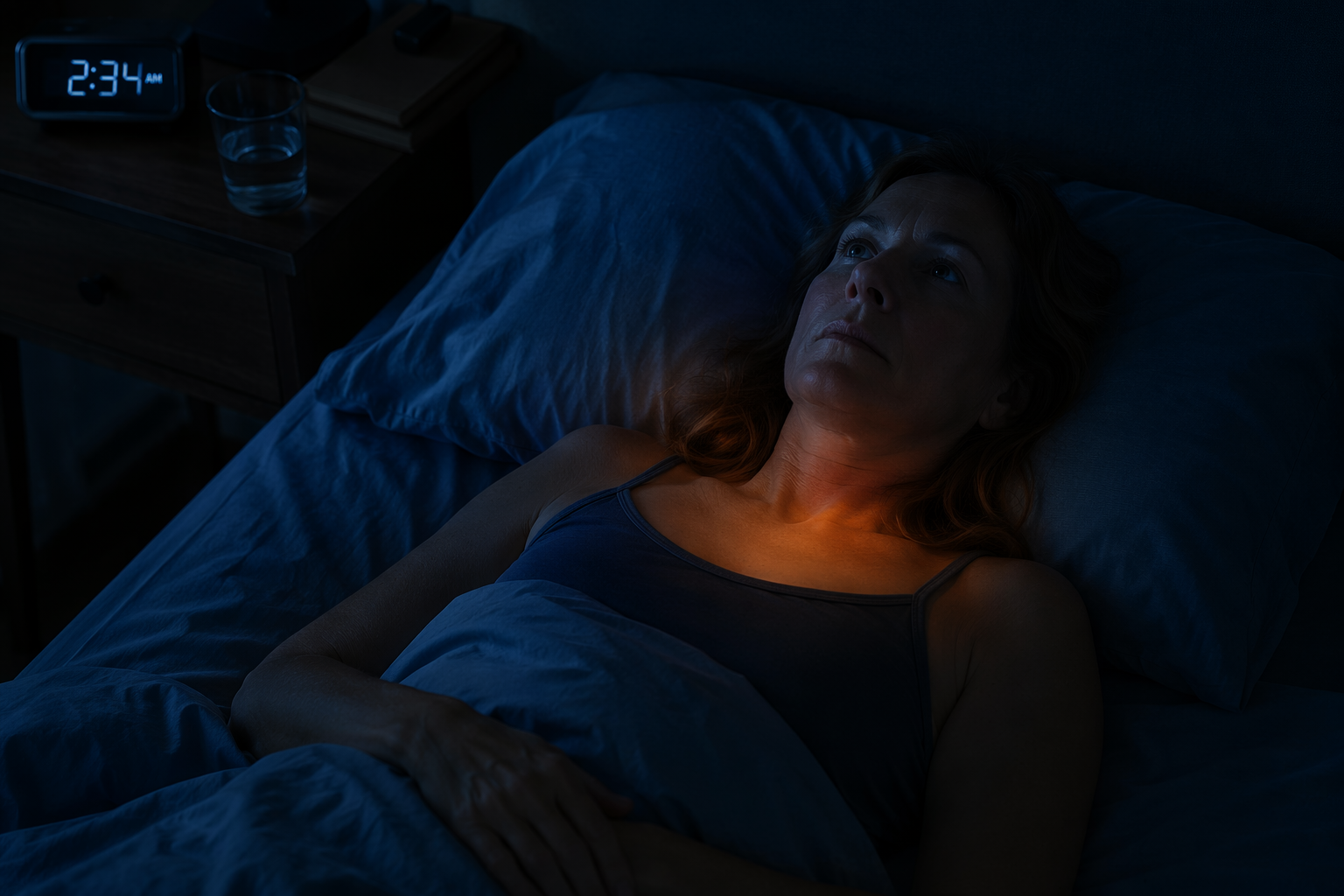
The perimenopause sleep complaint often has a very specific shape: you can fall asleep, sometimes easily, and then sleep starts breaking apart in the middle of the night. The waking may arrive around 2 or 3 a.m. with heat in the chest, neck, or face. Or it may arrive without obvious heat, just a sudden, irritating alertness that feels out of proportion to how exhausted you are. By morning, the problem may not sound dramatic on paper — “woke up a few times” — but the lived experience is sleep that has become thinner, lighter, and easier to lose.
That pattern matters because perimenopause sleep problems are often mislabeled as ordinary insomnia with a midlife timestamp. But the menopausal transition is strongly associated with difficulty maintaining sleep, not just difficulty initiating sleep. Reviews of sleep across the menopausal transition describe clinically significant sleep disruption in a substantial share of women, with estimates often falling in the 40% to 60% range across perimenopause and postmenopause, while SWAN data helped identify nighttime awakenings as a characteristic complaint during the transition rather than a simple continuation of earlier-life insomnia patterns.[1]
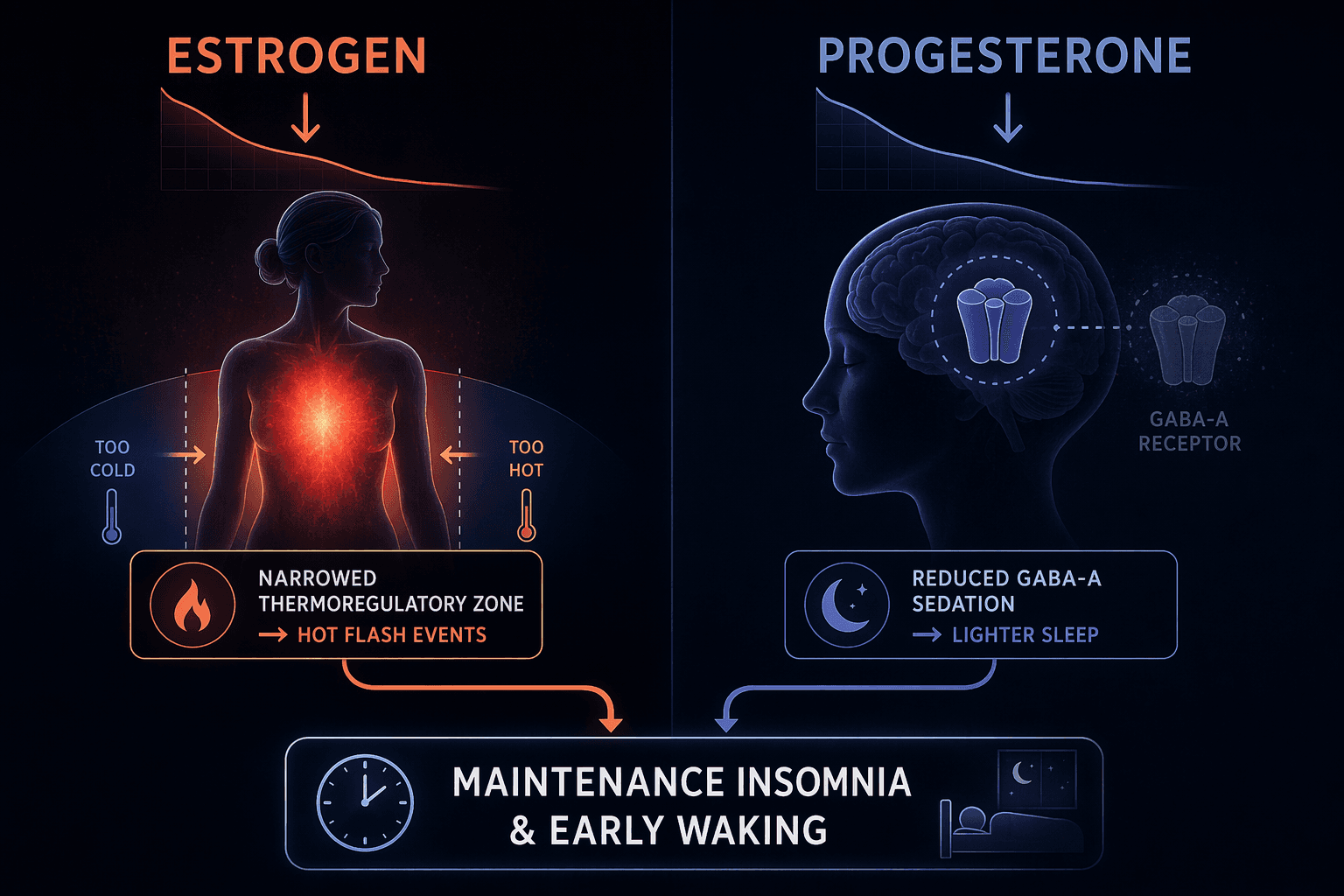
The cleanest way to understand the change is not “hormones affect sleep,” which is true but too vague to be useful. Two withdrawals are happening in parallel. Falling estrogen narrows the body’s thermoregulatory stability, making small temperature shifts more likely to trigger vasomotor events. Falling progesterone removes part of a natural calming signal that normally acts through GABA-A-related pathways. One pathway makes sleep easier to interrupt from the body; the other makes the brain less supported in staying asleep.
The sleep problem is usually maintenance, not onset
Classic primary insomnia is often imagined as lying awake for a long time at the beginning of the night. That can happen in perimenopause too, especially when anxiety, pain, alcohol, caregiving, or schedule strain enters the picture. But the signature complaint is often different: sleep begins, then fragments. The first half of the night may look acceptable. The second half becomes unstable.
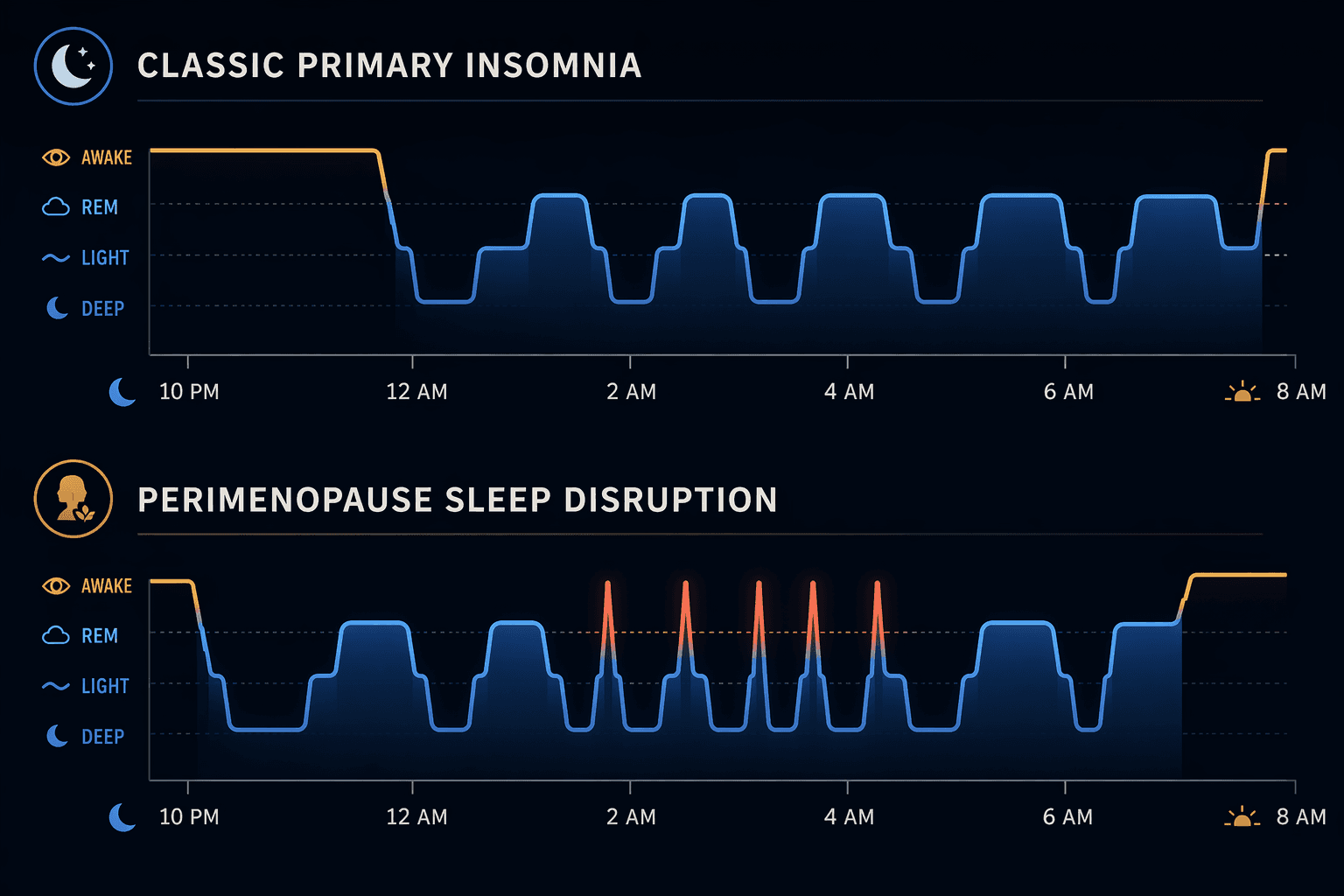
That distinction changes how the complaint should be heard. A woman who says, “I fall asleep, then I’m up over and over,” is not necessarily failing at sleep hygiene. She may be describing a physiology that has become easier to perturb. The usual advice — keep a regular bedtime, reduce screens, avoid late caffeine — can still help the sleep system carry less load. It just does not explain why a previously reliable sleeper suddenly wakes hot, alert, and unable to resume sleep.
For readers who want the broader symptom and treatment overview, Perimenopause and Sleep Disruption: Causes, Symptoms, and Evidence-Based Solutions covers that wider terrain. Here, the important question is narrower: why does the middle of the night become so fragile?
Estrogen withdrawal narrows the temperature margin for sleep
Sleep is not temperature-neutral. The body normally cools as sleep deepens, and the brain’s thermoregulatory system keeps internal temperature within a tolerable range. Estrogen helps stabilize that system through effects involving the hypothalamus, including regions linked to thermoregulation and circadian timing. As estrogen fluctuates and declines during the menopausal transition, the thermoneutral zone can narrow: a smaller rise in core temperature may be enough to trigger a heat-dissipation response.[1]
That heat-dissipation response is what many people recognize as a hot flash or night sweat: a sudden wave of heat, flushing, sweating, and sometimes a racing or pounding sensation. The important sleep detail is timing. If the event occurs during sleep, the body may have to wake the brain enough to coordinate the response — throw off covers, sweat, shift position, register discomfort, and then later cool down.
Objective sleep studies make this more concrete. In one polysomnography-based study summarized in the menopausal sleep literature, 69% of hot flashes coincided with PSG-confirmed awakenings, and hot flash-attributed wake accounted for about 27% of objective wake after sleep onset. Hot flashes were described as lasting 1 to 5 minutes, though some can last longer, and the body may take roughly 20 minutes to fully cool after an event.[1]
That last part is easy to underestimate. A hot flash does not need to last half an hour to damage half an hour of sleep. A short event can start a longer recovery sequence: wake, sweat, cool, notice the clock, feel irritated, search for a cooler patch of sheet, then try to re-enter sleep from a more activated state. If this happens more than once, the night begins to feel chopped into pieces rather than briefly interrupted.
This also explains why some women describe waking before they consciously notice heat. The awakening and the hot flash are tightly coupled, but subjective awareness is messy. You may wake first and then feel the heat. You may feel heat only after the brain is already online. You may remember the annoyance more than the sweating. The mechanism does not require the hot flash to be theatrical.
Hot flashes are a major pathway, but they are not the whole story
A common mistake is to make perimenopause sleep disruption synonymous with night sweats. That leaves too many women confused: if they are not soaking the sheets every night, why is sleep still lighter? The answer is that estrogen-related thermoregulation is only one part of the cascade.
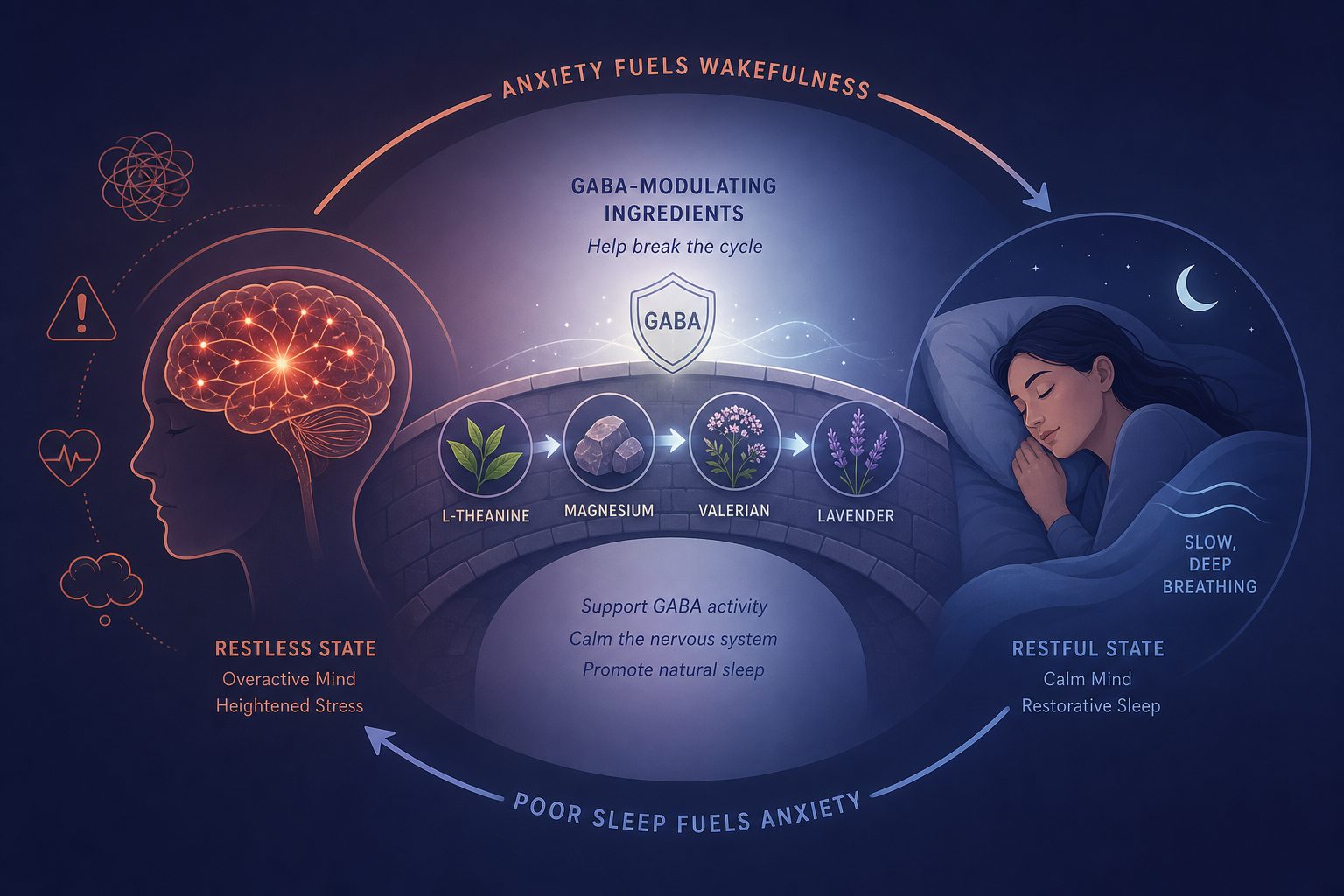
Progesterone also changes across the transition, often becoming more erratic as ovulation becomes less consistent. Progesterone is not just a reproductive hormone; one of its metabolites, allopregnanolone, positively modulates GABA-A receptors. GABA is the brain’s major inhibitory signaling system, and GABA-A modulation is one reason progesterone has been described as having sedative or hypnotic effects.[2]
When that signal declines, the night may feel different even without a dramatic heat event. Sleep can become shallower. A noise, a partner turning over, a full bladder, a small temperature shift, or a stress thought that once would have passed unnoticed can now become enough to wake you. The problem is not that progesterone is a sleeping pill; it is that the sleeping brain loses one of the background signals that helped it stay less reactive.
Progesterone has also been discussed in relation to respiratory drive, which matters because breathing stability and sleep continuity are linked. This does not mean every perimenopausal woman has sleep apnea, and it should not be used as a shortcut diagnosis. It does mean that the withdrawal of progesterone can plausibly affect more than mood or menstrual regularity; it can change the physiological conditions under which sleep is maintained.[2]
Why the 2–4 a.m. waking can feel so stubborn
The middle and later parts of the night are already more vulnerable. Deep sleep is more concentrated earlier, while lighter sleep and REM become more prominent later. For a refresher on how sleep stages normally cycle, see this guide to sleep architecture. When perimenopause adds vasomotor instability and less progesterone-related sedation, those lighter portions of the night can become easier to break.
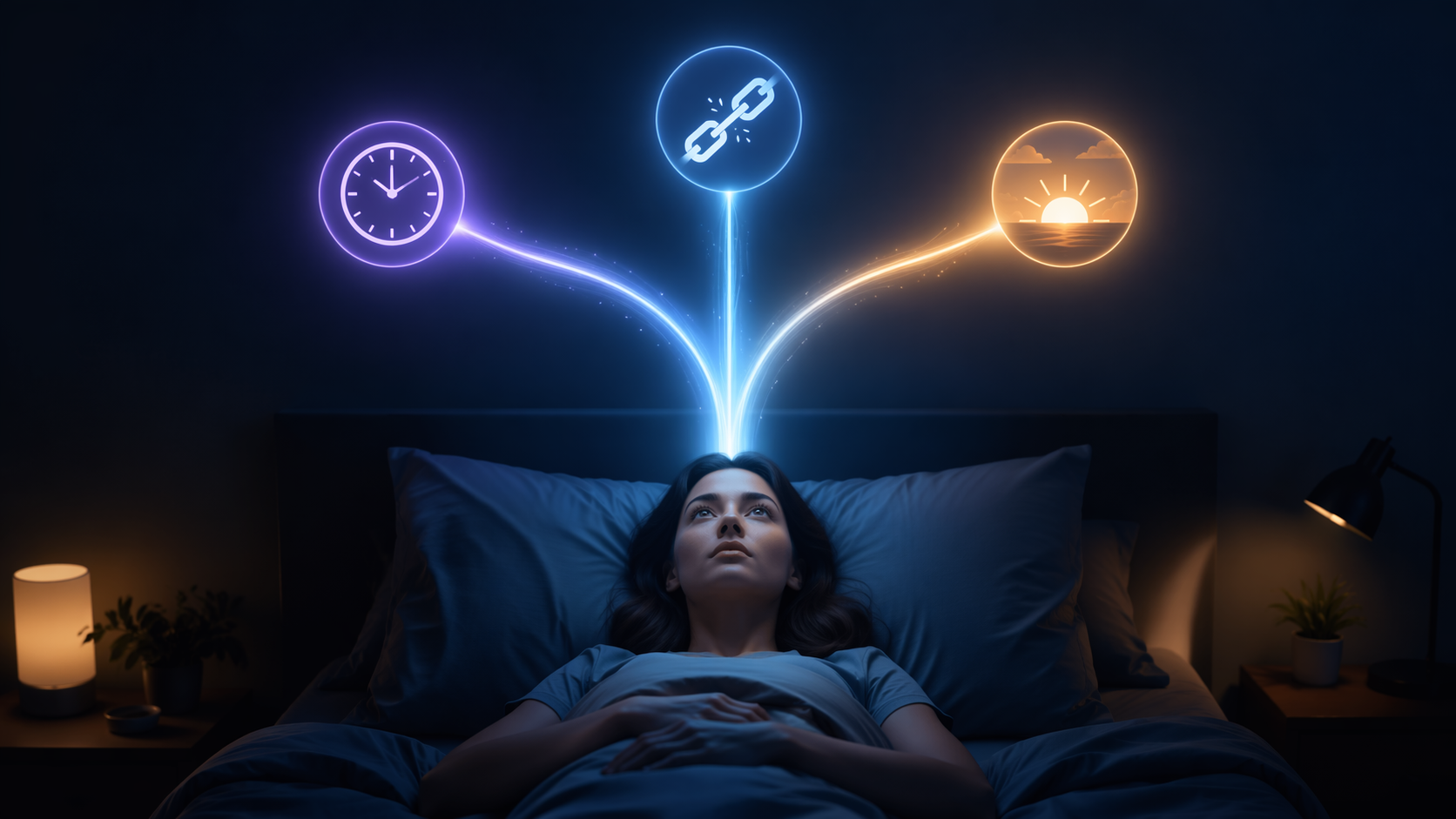
Then circadian timing can add a third pressure. Reviews of perimenopausal and menopausal sleep research describe changes including lower melatonin secretion and a tendency toward an advanced circadian phase, both of which can contribute to earlier morning awakening.[3]
An advanced phase means the body’s internal night may be shifting earlier. If sleep pressure has already been dented by awakenings, and the circadian system is beginning its morning rise earlier than it used to, returning to sleep at 4 or 5 a.m. can be unusually hard. This is one reason the experience can feel so unfair: you are tired enough to need more sleep, but your biology is no longer strongly pushing you back into it.
The pattern is a cascade, not a character flaw
Seen as a cascade, the complaint becomes less mysterious. Estrogen fluctuation narrows temperature tolerance. A small internal temperature shift can trigger a hot flash. The hot flash can wake the brain and require a cooling period. Progesterone decline removes some GABA-A-mediated sleep support, so the awakened brain may feel more alert and harder to settle. Circadian changes can make the early morning portion of the night less forgiving.
| What the sleeper notices | Likely physiological layer |
|---|---|
| Waking hot, flushed, or sweaty | Estrogen-related thermoregulatory narrowing and vasomotor events |
| Waking repeatedly without always feeling hot | Reduced sleep stability, including loss of progesterone-related sedative signaling |
| Feeling suddenly alert after waking | Arousal after fragmentation, with less inhibitory support for returning to sleep |
| Early morning waking that is hard to reverse | Circadian advance and lower melatonin layered onto fragmented sleep |
This is also why generic sleep advice can feel both reasonable and insufficient. A cool room may reduce one trigger, but it does not widen the thermoneutral zone back to its earlier baseline. A consistent bedtime may support circadian rhythm, but it does not replace progesterone’s neuroactive metabolites. Relaxation skills may lower cognitive arousal, but they do not make a hot flash imaginary.
None of this means behavior is irrelevant. Alcohol, late meals, irregular schedules, stress load, untreated sleep apnea, restless legs, pain, and medications can all worsen sleep fragmentation. The point is that in perimenopause, those factors may be acting on a sleep system whose threshold for disruption has changed. The same glass of wine, room temperature, or stressful week may produce a bigger sleep penalty than it did ten years earlier.
What this changes about interpreting your sleep
The practical value of the mechanism is not that every woman can self-diagnose the exact contribution of estrogen, progesterone, melatonin, and stress on a given night. The value is that the pattern stops being dismissed as vague midlife sleeplessness. New maintenance insomnia in the menopausal transition — especially with hot awakenings, lighter sleep, and early waking — deserves to be interpreted as a distinct hormonal-cascade problem.
That distinction can also make treatment conversations more precise. Cognitive behavioral therapy for insomnia may help reduce the conditioned arousal that builds after repeated awakenings, even if it does not directly stop every hot flash. Hormone-related options may be relevant for some women because vasomotor symptoms and sleep fragmentation are connected, though suitability depends on individual risks and medical history. Evaluation for breathing disorders or other sleep conditions may matter when symptoms point in that direction. The mechanism does not choose the treatment by itself, but it prevents the wrong starting assumption.
Perimenopause sleep problems are not simply lifelong insomnia wearing a new label. The hallmark is often sleep that starts but will not hold: awakenings, heat surges, lighter sleep, and a morning that arrives too early. Estrogen withdrawal, progesterone withdrawal, and circadian shift do not explain every bad night, but together they explain why the pattern is so recognizable — and why advice aimed only at “falling asleep faster” so often misses the problem.
References
- Sleep and sleep disorders in the menopausal transition — PMC, 2018.
- The role of ovarian hormones in the pathophysiology of perimenopausal sleep disturbances: A systematic review — PubMed, 2022.
- Sleep Disturbances During the Menopausal Transition and Menopause: A Narrative Review — Chronobiology in Medicine, 2024.


Comments
Join the discussion with an anonymous comment.