
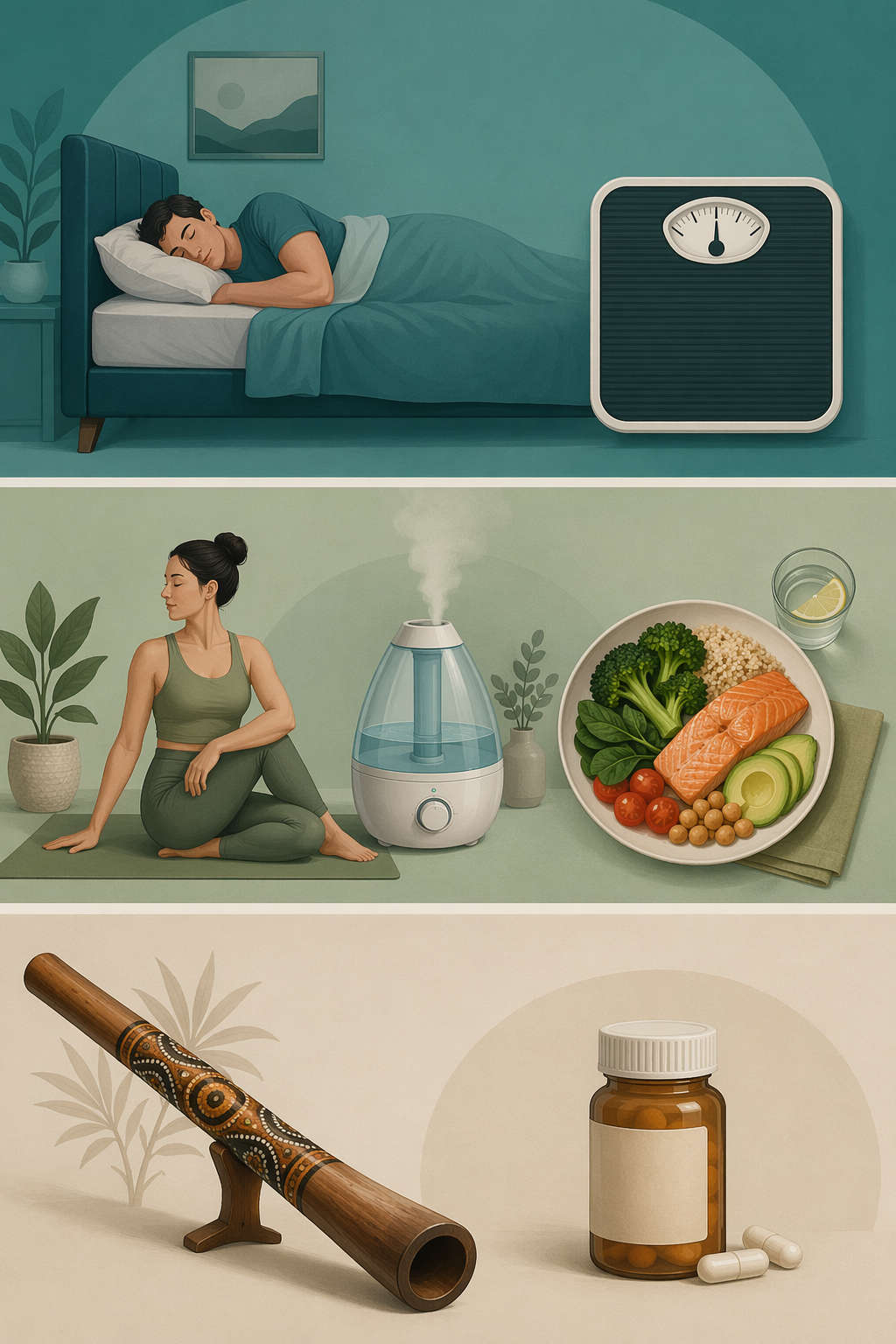
The useful question is not whether there are home remedies for sleep apnea. There are plenty. The useful question is whether a given remedy can lower apnea burden — usually tracked by apnea-hypopnea index, or AHI — or whether it mainly makes sleep feel less dry, congested, or fragmented while the airway problem remains.
That distinction matters most once obstructive sleep apnea moves beyond mild disease. Mild, supine-predominant OSA is the lane where selected self-care can sometimes change the night in a measurable way. Moderate-to-severe OSA is different: home strategies may still help, but they should not be used as replacements for CPAP, oral appliance therapy, surgery, or other clinician-directed care.
Start by sorting remedies by what they can actually change
| Remedy lane | What belongs here | Best fit | What to expect |
|---|---|---|---|
| Tier 1: Can directly reduce apnea burden in the right patient | Weight loss, positional therapy, myofunctional therapy, avoiding alcohol 3–4 hours before bed | Mild OSA, some moderate OSA, especially supine-predominant or weight-related OSA | May reduce AHI, but effect depends on severity, anatomy, adherence, and whether weight or sleep position is actually driving the obstruction |
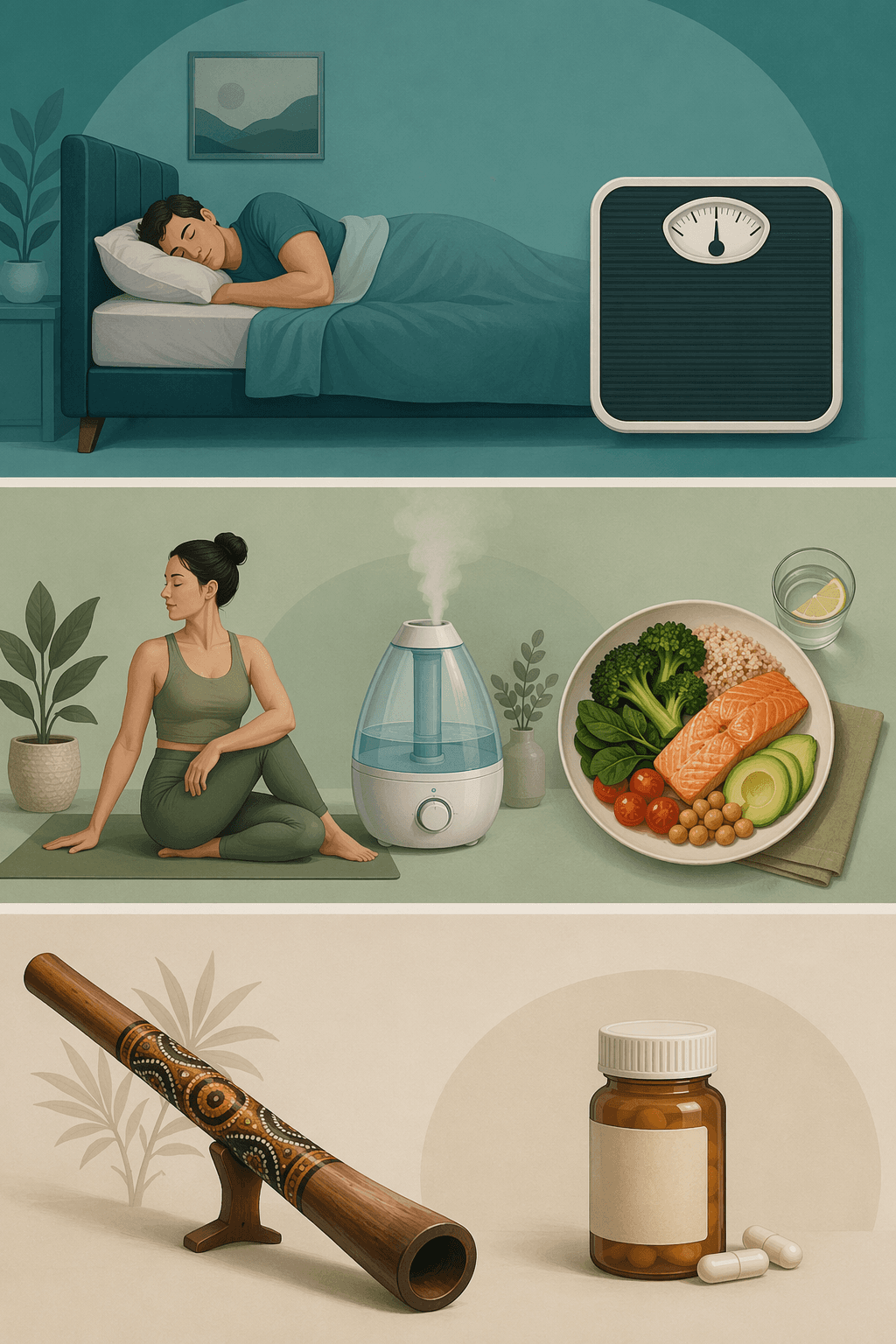
| Tier 2: Comfort or symptom support | Humidifier, yoga, treating nasal congestion, dietary adjustments | Adjunctive support for almost any severity | May improve sleep comfort, breathing through the nose, daytime routine, or CPAP tolerance; usually should not be expected to lower AHI much by itself |
| Tier 3: Promising but limited or not really a home remedy | Didgeridoo playing, singing, wind instrument practice, prescription GLP-1 medications such as Zepbound | Selective situations; medication requires medical care | Interesting evidence or emerging treatment context, but not a universal self-care plan |
| Not recommended as stand-alone apnea treatment | Nasal dilators alone, oxygen alone, herbal supplements | Not a substitute for diagnosis or treatment | May distract from care if used as an apnea treatment without evidence of meaningful obstruction control |
If you do not know your AHI or whether your events are worse on your back, this is where to pause. A home sleep test or lab study gives the sorting information that internet lists usually skip. For a refresher on symptoms, diagnosis, and severity categories, see the Sleep Apnea FAQ. If you are trying to infer risk from a wearable, treat that as screening context, not a diagnosis; the Apple Watch sleep apnea detection guide goes deeper on that boundary.
Weight loss: the strongest self-care lever when weight is part of the obstruction
Weight loss deserves more serious treatment than the usual “eat better” advice because it can change the airway, not just the sleep routine. Harvard Health notes that losing 10% of body weight can reduce apnea episodes, with one proposed mechanism being a reduction in tongue fat that helps narrow the airway less during sleep.[1]
That does not mean weight loss is a quick cure, and it does not mean every person with OSA has weight-driven OSA. But when excess weight is contributing to airway collapse, even a realistic target matters. In practice, a 5–10% body-weight loss goal is a more useful starting point than an abstract promise to “get healthy.” It is specific enough to track and large enough to plausibly matter.
The dose-response pattern is important. In the MIMOSA trial, Georgoulis and colleagues reported that at least 10% weight loss was needed to significantly reduce the prevalence of severe OSA.[2] That finding is not a reason to dismiss smaller changes; it is a reason to be honest about expectations. A small loss may improve snoring, sleep quality, blood pressure habits, or CPAP comfort before it meaningfully moves someone out of a severe category.
Weight regain is the quiet problem here. OSA can return when the weight that helped reduce airway obstruction comes back. So the more durable question is not “Can weight loss cure sleep apnea?” It is “Can this person maintain enough change to keep the airway benefit?” That is one reason moderate-to-severe OSA should stay under clinical follow-up even when weight loss is going well.
Bariatric surgery shows the same basic lesson at a larger scale. The European Respiratory Society guideline reports that bariatric surgery reduces AHI by about 77%, with cure rates of 64–86%, while also noting that many patients retain residual OSA.[3] That is a substantial effect, but it still does not justify assuming that weight loss automatically ends the need for sleep testing or treatment.
Positional therapy: most relevant when apnea is worse on your back
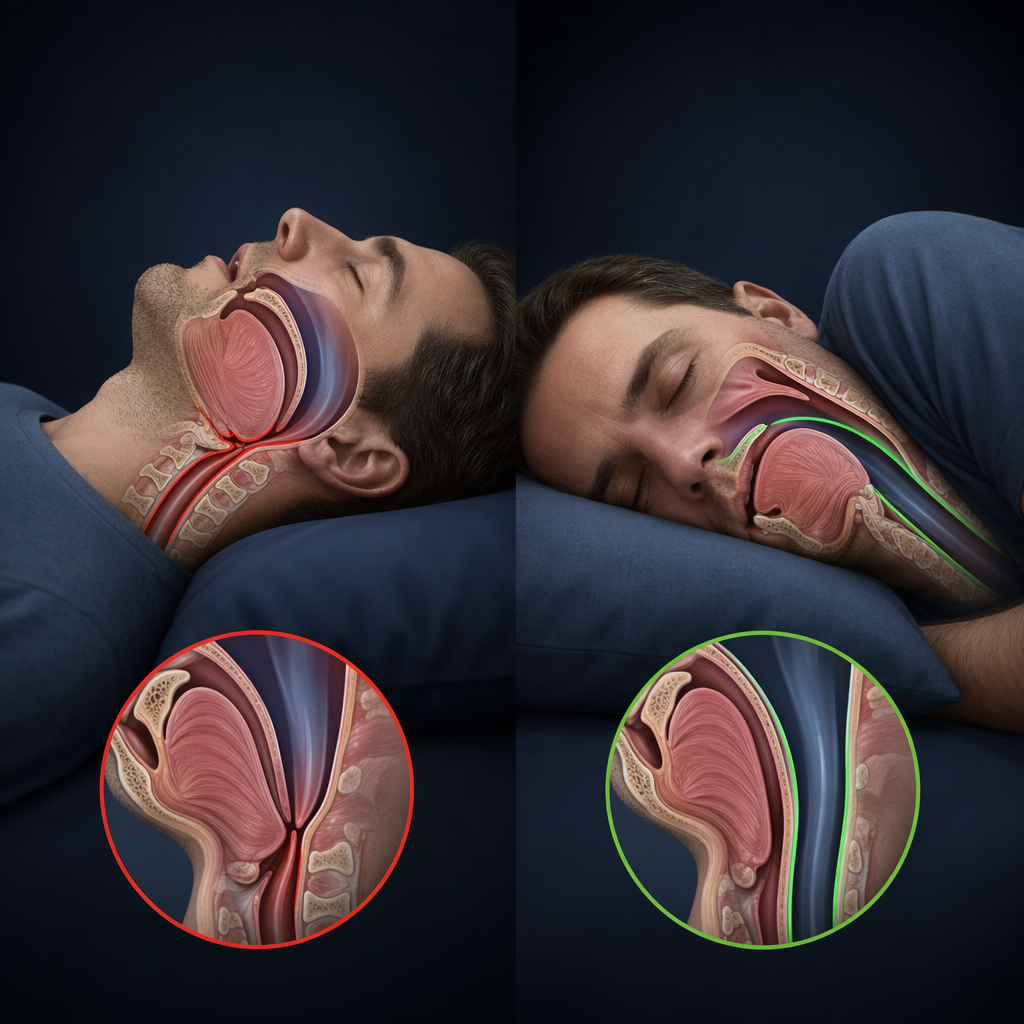
Some people have OSA that is much worse when they sleep supine. For them, side-sleeping is not just a comfort preference; it can be a disease-targeted intervention. Sleep Foundation reports that about 50–62% of OSA is supine-predominant, though the exact estimate varies because studies use different thresholds.[4]
That is why positional therapy belongs near the top of the home-remedy list — but only for the right pattern. If your apnea occurs in all positions, side-sleeping may reduce some events without solving the condition. If your events cluster heavily on your back, avoiding that position can be one of the cleaner self-care moves available.
The old tennis-ball technique illustrates both the appeal and the failure point. It is cheap, mechanical, and easy to understand: make back-sleeping uncomfortable enough that you roll to your side. But long-term adherence is poor; Sleep Foundation reports compliance with the tennis-ball technique drops to about 10% at 30 months.[4]
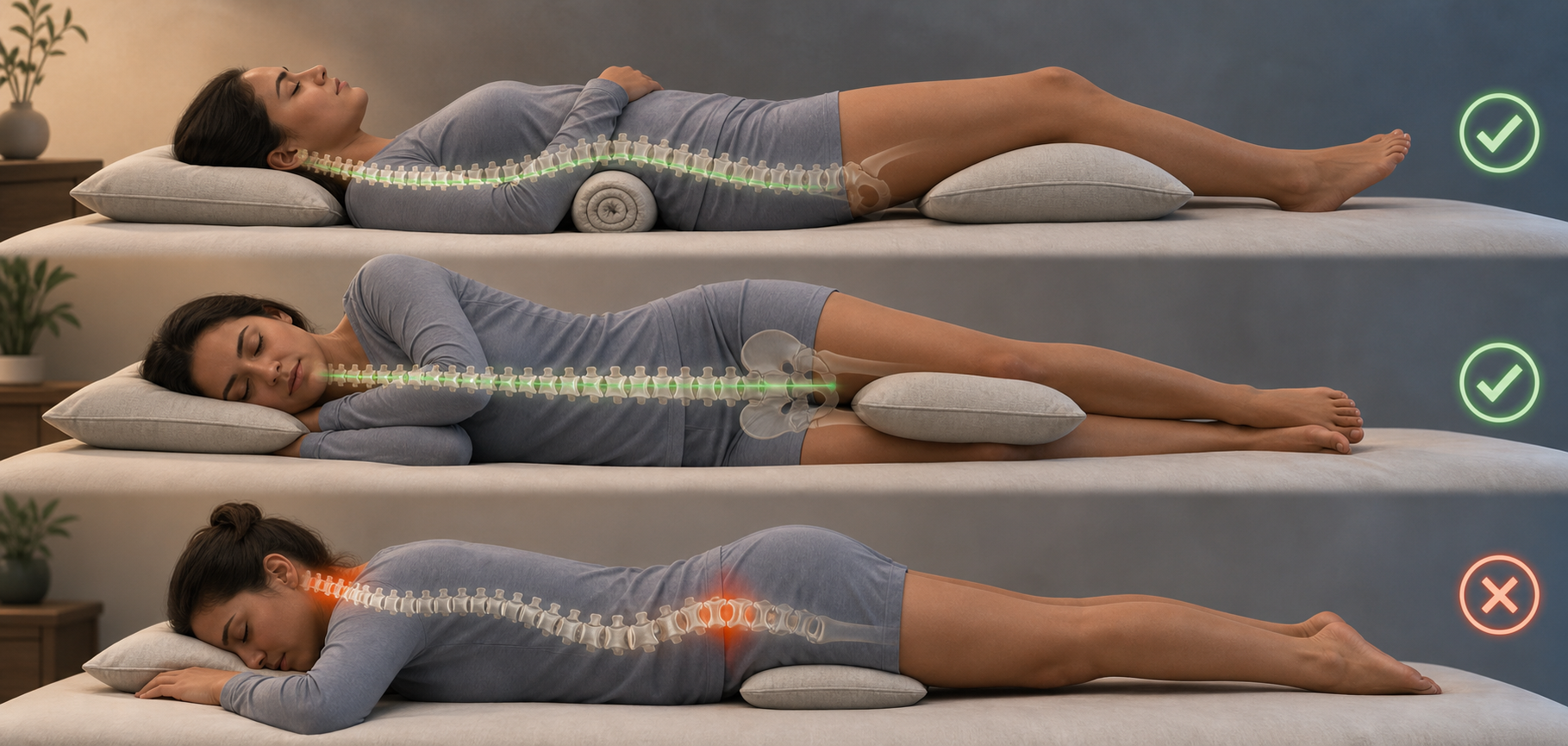
A positional plan is more likely to survive if it fits the sleeper instead of punishing them all night. That may mean a side-sleeping pillow, a wearable positional trainer, a body pillow, or a bed setup that makes side-sleeping easier. Head elevation or an adjustable base may help some people feel less obstructed or reflux-prone, but it should not be treated as equivalent to proven apnea control unless follow-up data show improvement. For a more detailed decision path, see Sleep on Your Back: A Decision Framework; for bed-positioning context, the Tempur-Pedic adjustable base review may be useful.
Myofunctional therapy: real signal, modest certainty, high patience requirement
Myofunctional therapy means repeated exercises for the tongue, soft palate, lips, and throat muscles. It is not a breathing meditation and not a one-night hack. The idea is to improve upper-airway muscle tone so the airway is less collapsible during sleep.
The evidence is interesting enough to take seriously, with limits. A 2020 Cochrane review of 9 randomized controlled trials including 347 participants found that myofunctional therapy probably reduces daytime sleepiness, with Epworth Sleepiness Scale scores improving by about 4.5 points, and may reduce AHI by about 13 events per hour compared with sham therapy.[5]
The catch is certainty. The review judged parts of the evidence as moderate-to-low certainty because of small sample sizes and blinding limitations.[5] That does not make the therapy useless. It means it belongs in the “reasonable adjunct” category, especially for people who can practice consistently and want a low-risk add-on while they pursue or continue formal treatment.
The practical test is boring but decisive: can you do the exercises most days for long enough to matter? If the answer is no, the mechanism is irrelevant. If the answer is yes, it may be worth discussing with a sleep clinician, dentist, speech-language pathologist, or therapist trained in orofacial myology — particularly if your OSA is mild-to-moderate or you are trying to improve tolerance of another treatment.
Alcohol avoidance is simple because the mechanism is simple
Alcohol relaxes upper-airway muscles and can worsen obstruction during sleep. Avoiding it for 3–4 hours before bed is one of the few low-cost changes that makes physiological sense and is easy to test against your own nights.
This does not need to become a moral lecture about drinking. The sleep-apnea question is narrower: does alcohol close to bedtime make your snoring, witnessed pauses, oxygen dips, awakenings, or morning symptoms worse? If yes, moving it earlier or skipping it on work nights may reduce the load on an already unstable airway.
For someone with moderate-to-severe OSA, alcohol avoidance is still an adjunct, not treatment. But it is a sensible adjunct because it removes a known airway-relaxing pressure at exactly the wrong time of day.
Exercise helps even when the scale is slow
Exercise is often folded into weight loss advice, but it deserves a separate mention because meta-analysis evidence indicates that exercise can reduce AHI independently of weight loss.[6] That matters for people whose weight changes slowly, whose medications affect weight, or whose main early gain is better conditioning rather than a lower number on the scale.
The reasonable goal is not to find the perfect “sleep apnea workout.” It is to build a sustainable pattern of physical activity that can support weight management, cardiometabolic health, fatigue resilience, and possibly apnea severity. If sleepiness is severe, exercise plans should also account for safety: no drowsy driving to the gym, no risky solo workouts when you are profoundly sleep-deprived.
Comfort remedies are fine — just do not give them the wrong job
Humidifiers, nasal care, yoga, and diet changes often appear beside weight loss and positional therapy as if they are equivalent. They are not. Some are useful; most are not primary apnea-reducing interventions.
- Humidifiers may help with dry mouth, dry nose, throat irritation, or CPAP comfort. They should not be expected to hold the airway open by themselves.
- Treating nasal congestion can make nasal breathing easier and may improve tolerance of CPAP or oral appliances. Congestion treatment alone usually does not resolve a collapsing throat airway.
- Yoga may support stress reduction, breathing awareness, and general fitness. It is best treated as a supportive habit, not an apnea treatment with predictable AHI reduction.
- Dietary adjustments matter most when they support sustainable weight loss, reduce late heavy meals, or limit alcohol. A special “sleep apnea diet” should not be oversold beyond those mechanisms.
These measures can still be worth doing. A person who sleeps less congested, tolerates CPAP longer, or wakes less parched has gained something real. The problem begins when comfort improvements are mistaken for disease control.
The promising-but-limited group
Didgeridoo playing, singing, and wind instrument practice get attention because they plausibly train upper-airway muscles. They sit near myofunctional therapy in concept, but they should not be treated as interchangeable with a structured therapy program or as a dependable substitute for clinical treatment. If you enjoy them, the downside may be low. If you are choosing them because you have been told they “cure” apnea, the claim has outrun the evidence.
Zepbound, the tirzepatide medication FDA-approved for OSA in January 2025, belongs in a different bucket. It is prescription medication, not a home remedy. Its arrival is important because it reflects how strongly weight and metabolic treatment can intersect with OSA care, but it should be discussed with a clinician rather than folded into a do-it-yourself list.
What not to use as stand-alone sleep apnea treatment
Some popular options are not just modest; they are easy to misuse because they feel medical enough to delay real care.
- Nasal dilators alone: They may help airflow through the nose, especially if the nostrils collapse or feel narrow. They do not reliably treat obstruction behind the tongue or soft palate, where OSA commonly occurs.
- Oxygen alone: Oxygen can raise oxygen levels without fixing airway collapse, arousals, pressure swings, or obstructive events. It should not be self-prescribed as an OSA workaround.
- Herbal supplements: The evidence base is not strong enough to recommend herbs or supplements as sleep apnea treatment. Sedating products can also be risky if they worsen airway relaxation or mask symptoms.
When home remedies are not enough
Home remedies should not be the main plan if you have moderate-to-severe OSA, major oxygen drops, significant daytime sleepiness, drowsy driving, resistant high blood pressure, heart rhythm problems, heart disease, stroke history, or witnessed pauses that alarm a bed partner. Those are not “try a humidifier first” situations.
They also should not be used to avoid follow-up testing. If you lose weight, stop drinking near bedtime, train yourself off your back, or practice airway exercises for months, the question is not whether you feel somewhat better. The question is whether the apnea burden has actually changed enough to alter treatment decisions.
The best use of home remedies is targeted and modest: weight loss when weight is contributing, positional therapy when events are supine-predominant, myofunctional therapy when you can adhere to it, alcohol avoidance when bedtime drinking is part of the pattern, and comfort measures when they help you sleep or tolerate prescribed therapy. Mild or supine-predominant OSA may genuinely improve with selected self-care. More serious disease still belongs in clinical treatment, with self-care supporting the plan rather than replacing it.
References
- Beyond CPAP: Other options for sleep apnea, Harvard Health.
- Mediterranean lifestyle intervention in overweight and obese patients with obstructive sleep apnoea: the MIMOSA randomised clinical trial, PubMed.
- European Respiratory Society guideline on non-CPAP therapies for obstructive sleep apnoea, PMC.
- Positional Therapy for Obstructive Sleep Apnea, Sleep Foundation.
- Myofunctional therapy (oropharyngeal exercises) for obstructive sleep apnoea, PMC.
- The effect of exercise training on obstructive sleep apnea and sleep quality: a randomized controlled trial, PMC.

Comments
Join the discussion with an anonymous comment.