Daily horoscope sleep advice has a particular kind of comfort built into it. It does not begin with a warning about blue light or a lecture about caffeine. It begins with recognition: your sign runs hot, your mind keeps circling, your bedroom needs to feel safer, your wind-down should be softer. Even when the advice is broad, it can land with the relief of being named.
That feeling is not foolish. Sleep problems often feel strangely private. Two people can both say “I can’t sleep,” while one is lying awake from a racing mind, another is drifting off too late, another is waking at 3 a.m., and another is sleeping enough hours but never feeling restored. A zodiac sleep tip offers a shortcut to specificity. It says: this is not just insomnia; this is your pattern.
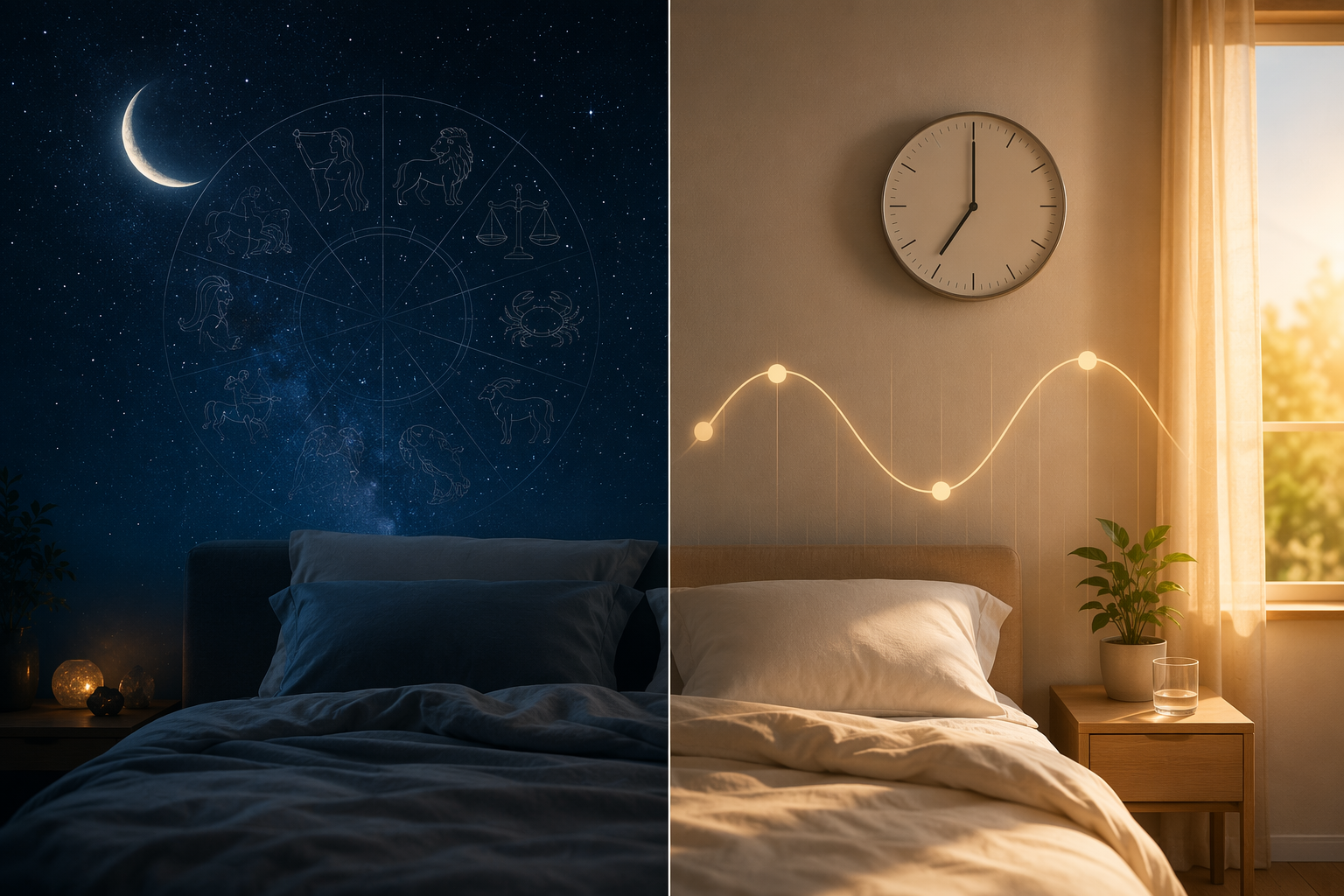
The trouble begins when emotional specificity is treated as medical specificity. A horoscope can help someone reflect on why they resist bedtime or why they crave a gentler evening. But if the claim is that a sleep recommendation works because a person is an Aries, Virgo, or Pisces, the advice needs more than resonance. It needs a mechanism, a measurable pattern, and some way for the reader to tell whether it actually improved sleep.
Why Zodiac Sleep Advice Feels So Accurate
A major reason horoscope-style advice feels personal is the Barnum effect, also called the Forer effect. It describes the tendency to accept broad, generally applicable statements as uniquely accurate when they appear to be tailored to us. Astrology is one of the common examples used to explain this effect: statements that mix flattering insight, soft vulnerability, and flexible language can feel uncannily specific because the reader supplies the missing details from their own life.[1]
Sleep advice is especially vulnerable to this effect because bad sleep gives people so much material to recognize. A line such as “your restless energy needs a calming ritual before bed” could apply to a student, a new parent, a manager after a tense meeting, or someone doomscrolling under the covers. Once it is attached to a sign, it feels less like generic advice and more like a mirror.
The advice also tends to be difficult to disconfirm. If a horoscope says a fire sign should avoid overstimulation before bed, a reader can remember the nights when stress, exercise, screens, or social plans made sleep harder. If it says an earth sign needs a grounded routine, the reader can remember the relief of a tidy bedroom or a predictable evening. The statement survives because it is elastic.
That does not mean the reader is inventing the feeling. It means the delivery format is doing psychological work. Zodiac language takes advice that could sound clinical — dim the lights, reduce stimulation, keep a consistent schedule — and wraps it in identity. For a tired person, that can feel kinder than another impersonal sleep hygiene list.
Astrology Often Understands the Mood Better Than the Measurement
This is why zodiac sleep content keeps appearing in mainstream wellness and lifestyle spaces. Articles that assign sleep tips by sign, including examples from the New York Post and Yoga Journal, are not usually selling a laboratory claim. They are offering a low-friction way to make a familiar problem feel personal.[2][3]
Astrology also tends to become more appealing during uncertain periods. Verywell Mind notes historical and contemporary examples of astrology interest rising during stressful moments, including the Great Depression and the COVID-19 pandemic.[1] That pattern should be handled carefully. It does not prove astrology causes better sleep, or that people who read horoscopes are more sleep-deprived. It does suggest why identity-based meaning systems become attractive when life feels hard to predict.
Sleep is one of the first places uncertainty shows up in the body. Worry stretches the evening. Irregular work and social demands push bedtime around. The bed becomes a place where unfinished thoughts arrive without an appointment. In that state, a sentence that seems to understand your temperament can feel more useful than a technically correct recommendation that ignores how you experience the night.
The useful question, then, is not whether a horoscope can feel meaningful. It can. The useful question is what kind of personalization can change sleep in a way you can observe.
What Real Sleep Personalization Looks Like
A better replacement for zodiac-based sleep categories is chronotype: a person’s natural tendency toward earlier or later sleep and wake timing. Chronotype is not a perfect label, and popular versions can oversimplify it, but it is tied to observable sleep-wake patterns rather than symbolic birth dates.
Sleep Foundation describes chronotype as partly influenced by genetics, including the PER3 gene, and notes that it is commonly assessed with tools such as the Morningness-Eveningness Questionnaire and the Munich Chronotype Questionnaire.[4] Those questionnaires are not personality quizzes in the horoscope sense. They ask about actual timing: when you prefer to sleep, when you feel alert, when you would wake without obligations, and how your body behaves across ordinary days.
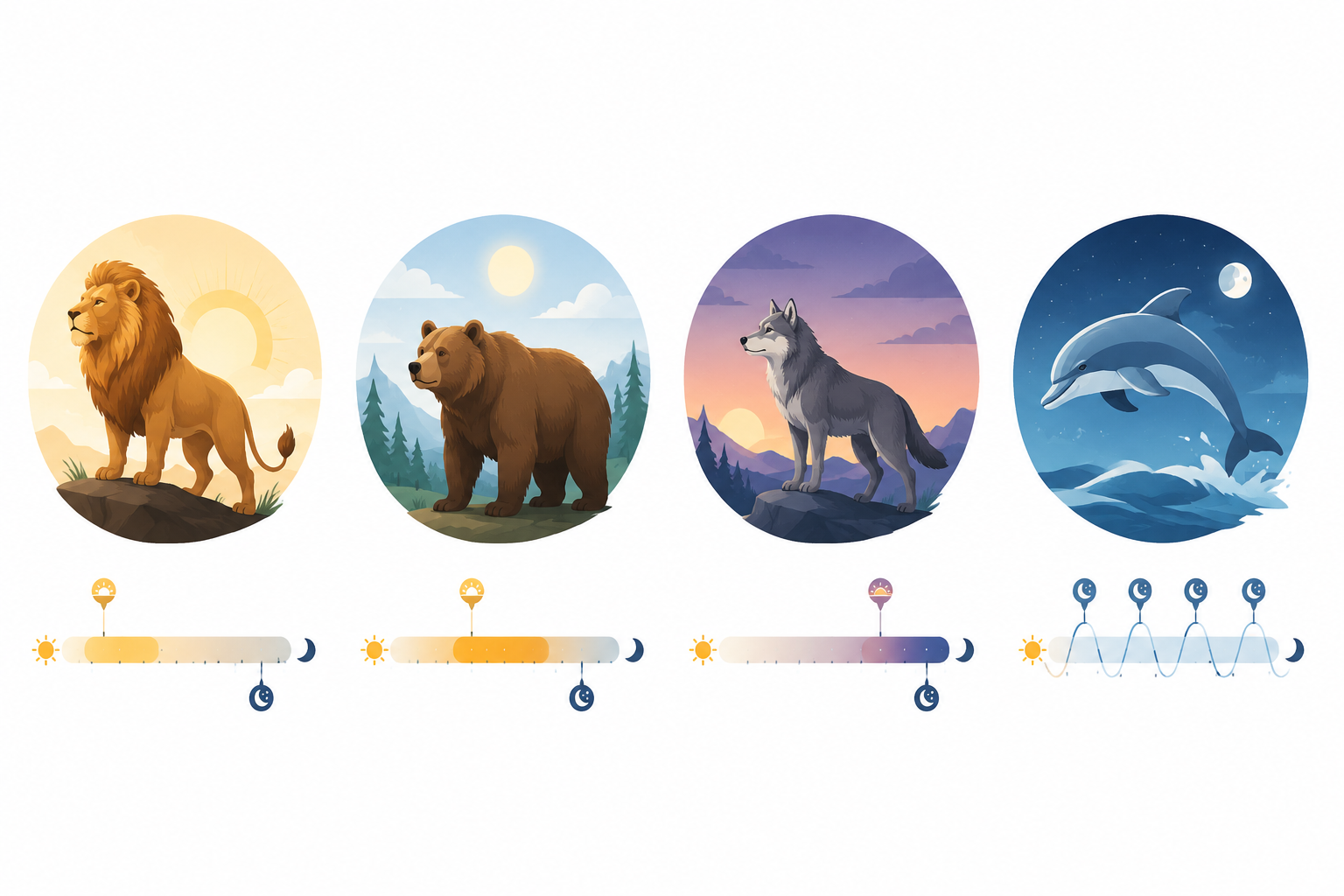
The popular four-animal chronotype model is easier to remember than questionnaire scores. In that model, Sleep Foundation reports that about 55% of people are “bears,” or intermediate types; about 15% are “wolves,” or evening types; about 15% are “lions,” or morning types; and about 15% are “dolphins,” often described as lighter or more insomnia-prone sleepers.[4] Those categories should not be treated as hard biological boxes. They are a simplified map of a more continuous pattern.
| If your main pattern is... | The useful sleep question is... |
|---|---|
| You get sleepy early and wake easily in the morning | Are you protecting your early bedtime from social and work spillover? |
| You feel sharper later and struggle with early obligations | Are your light exposure and schedule pushing your body clock even later? |
| You sleep best with a steady middle-of-the-road routine | Are inconsistent weekends creating avoidable social jet lag? |
| You are sensitive to noise, stress, or wake-ups | Are you treating arousal and expectation as part of the sleep problem? |
This is where the difference from daily horoscope sleep advice becomes practical. A zodiac tip might say a Gemini needs to quiet mental chatter. A chronotype-informed plan asks whether bedtime is mismatched to the body clock, whether morning light is strong enough, whether evening light is delaying melatonin timing, and whether the person is trying to sleep before they are biologically ready.
For an evening-leaning person, the first useful move is often not “relax more.” It may be anchoring a consistent wake time, getting bright light soon after waking, dimming light later in the evening, and avoiding a weekend schedule that drifts far from weekday obligations. For a morning-leaning person, the problem may be less about forcing an early routine and more about defending it: moving stimulating work earlier, resisting late social pressure, and accepting that the best sleep window may arrive before the rest of the household feels finished with the day.
These adjustments are still personal, but they are personal in a testable way. If morning light is helping, sleep onset may begin to shift earlier over time. If weekend drift is hurting, Monday morning may feel worse than other mornings. If a person is spending too much time awake in bed, the bed may start to feel like a place for effort instead of sleep. None of that requires rejecting symbolic rituals. It requires separating ritual from treatment.
The Moon Is Relevant, but Not Like a Horoscope Column Suggests
There is one place where the sky deserves a more careful answer: the moon. Sleep research has found modest associations between lunar phase and sleep timing, especially in the nights before a full moon. That does not validate zodiac-based sleep prescriptions, but it does keep the conversation from becoming too neat.
In research led by Horacio de la Iglesia and colleagues, reported by the University of Washington, sleep was shortest and bedtime was latest on the nights before a full moon. The reported sleep reduction was 46 to 58 minutes in rural settings and about 25 minutes in an urban setting.[5] The proposed explanation was not a mystical personality effect. The likely pathway involved evening light from the waxing moon, with modern artificial light complicating but not erasing the pattern.[5]
An earlier Current Biology study found changes around the full moon as well, including a 30% reduction in EEG delta activity during non-REM sleep, a marker associated with deep sleep.[6] Sleep Foundation’s synthesis presents lunar effects as possible but generally modest, with most people losing less than 30 minutes of sleep in studies that find an effect.[7]
That is a more interesting finding than “the moon affects your sign tonight,” and also a more limited one. A modest pre-full-moon sleep shift may matter to someone who is already sleep-restricted, highly light-sensitive, camping without artificial lighting, or tracking a stubborn pattern. It is not a reason to rebuild each night’s sleep plan around a lunar forecast.
Personality May Matter More Than Sun Sign
Another bridge between horoscope language and sleep science is personality. People do differ in ways that affect sleep behavior: how much stimulation they seek at night, how strongly they react to stress, how conscientious they are about routines, how easily they disengage from work or conflict. Those differences can shape bedtime choices even when the body clock is not the main issue.
This is where a horoscope sometimes feels emotionally accurate for the wrong reason. A person may recognize themselves in a sign-based description because it names a real behavior: overthinking, novelty seeking, conflict avoidance, perfectionism, restlessness. The useful next step is not to prove the sign caused the behavior. It is to ask what the behavior does to sleep.
If someone repeatedly delays bedtime because the quiet hours feel like the only time that belongs to them, the intervention is different from the one for someone whose bedtime is late because their circadian rhythm runs later. If someone wakes at night and starts monitoring whether they will function tomorrow, the problem is partly arousal and expectation. A sign label may make that pattern easier to talk about; it does not measure it.
How to Use Horoscope Sleep Advice Without Letting It Replace Evidence
If a daily horoscope sleep advice column helps you pause, reflect, or treat bedtime with more care, there is no need to turn that private ritual into a courtroom. The safer boundary is simple: let astrology suggest questions, not conclusions.
- If a horoscope says you need calm, ask what specifically raises arousal in your evening: work messages, conflict, exercise timing, noise, light, or worry.
- If it says you need structure, track whether bedtime and wake time are actually consistent across the week.
- If it says you need solitude, notice whether social obligations are pushing sleep later than your body prefers.
- If it says your energy is restless, separate mental busyness from circadian timing; they can feel similar at bedtime but require different fixes.
Then test the advice like a sleep experiment, not a prophecy. Pick one change for a week: a steadier wake time, morning outdoor light, dimmer evenings, a shorter late-night scroll, a written worry list before bed, or a more realistic bedtime. Watch what changes: time to fall asleep, number of awakenings, wake time, daytime sleepiness, and how much effort sleep seems to require.
A horoscope can make sleep advice feel intimate by attaching it to identity. Evidence-based sleep personalization works differently: it matches the advice to patterns you can observe and adjust. Enjoy the horoscope if it helps you listen to your night more gently. When you want better sleep, let the evidence decide what changes tomorrow.
References
- The Psychology Behind Why We Care about Astrology, Verywell Mind
- Get a great night’s sleep based on your zodiac sign, New York Post
- How to Sleep Better, According to Your Astrological Sign, Yoga Journal
- Chronotypes: Definition, Types, & Effect on Sleep, Sleep Foundation
- Research shows our sleep is synchronized with the moon’s cycles, University of Washington, January 27, 2021
- Evidence that the Lunar Cycle Influences Human Sleep, Current Biology, July 25, 2013
- Does the Moon Affect Sleep?, Sleep Foundation

Comments
Join the discussion with an anonymous comment.