
For disaster aid workers, stress-related insomnia relief starts with admitting a mismatch. The worker may be trained to move through ruined infrastructure, volatile shelters, violent weather, mass casualty scenes, or armed checkpoints. Then the sleep advice arrives as if the same worker has a quiet bedroom, a fixed bedtime, and a nervous system that can stand down on command.
Among first responders, a meta-analysis covering 100,080 participants estimated pooled insomnia prevalence at 28%.[1] That number does not mean every medic, firefighter, police officer, logistics lead, or case officer is destined for chronic insomnia. It does mean insomnia is not a fringe complaint in emergency work. It is common enough to treat as an occupationally patterned risk.
Humanitarian aid workers show the same warning signal from a different direction. A reported 47% of UNHCR staff said they had difficulty sleeping in a 2013 single-agency survey, a useful but limited figure because it should not be treated as a systematic estimate for all aid organizations.[2] Columbia Mailman School of Public Health reported that depression among international humanitarian workers roughly doubled from 10.4% before deployment to 19.5% after deployment, placing sleep trouble inside a broader post-deployment strain pattern rather than a simple bedtime problem.[3]
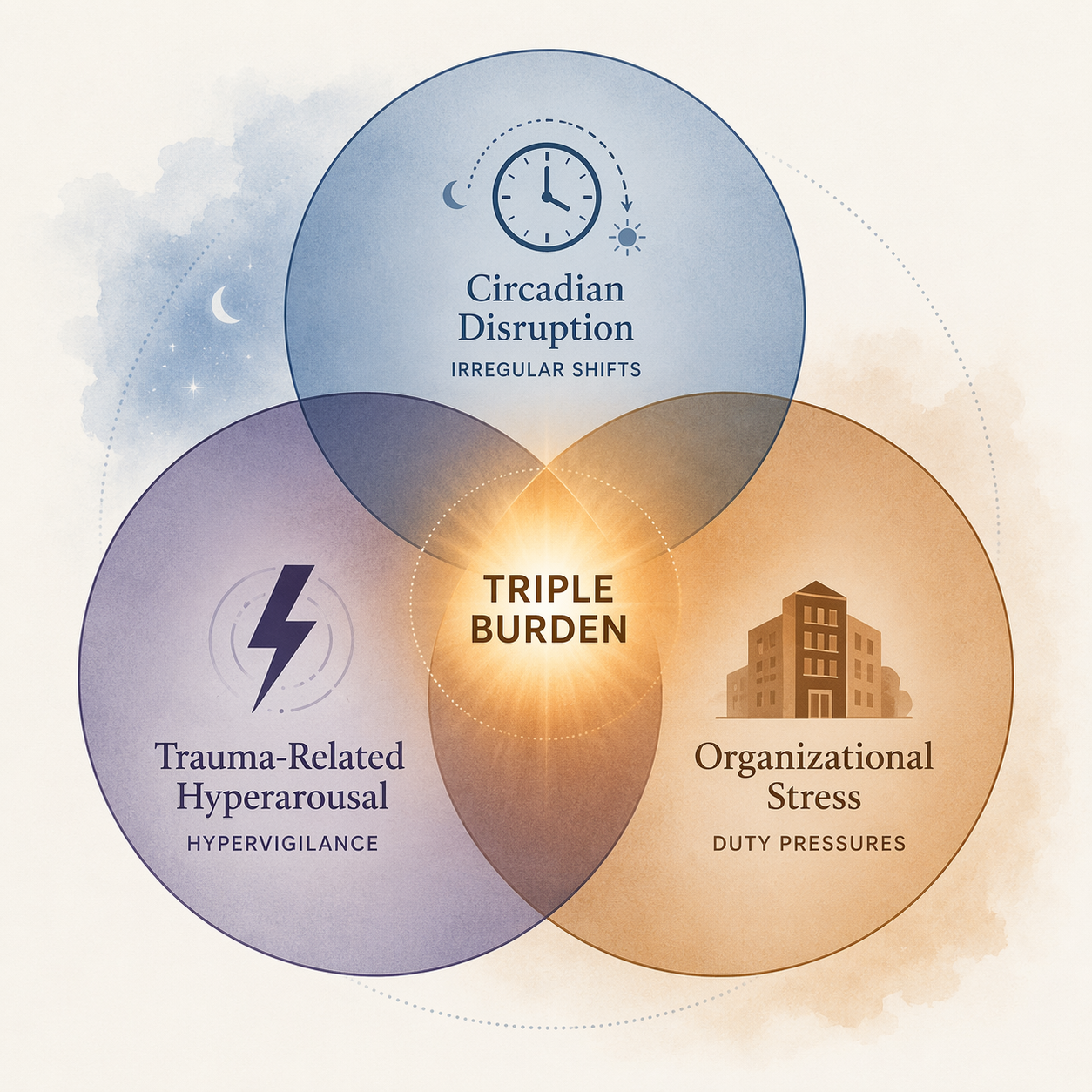
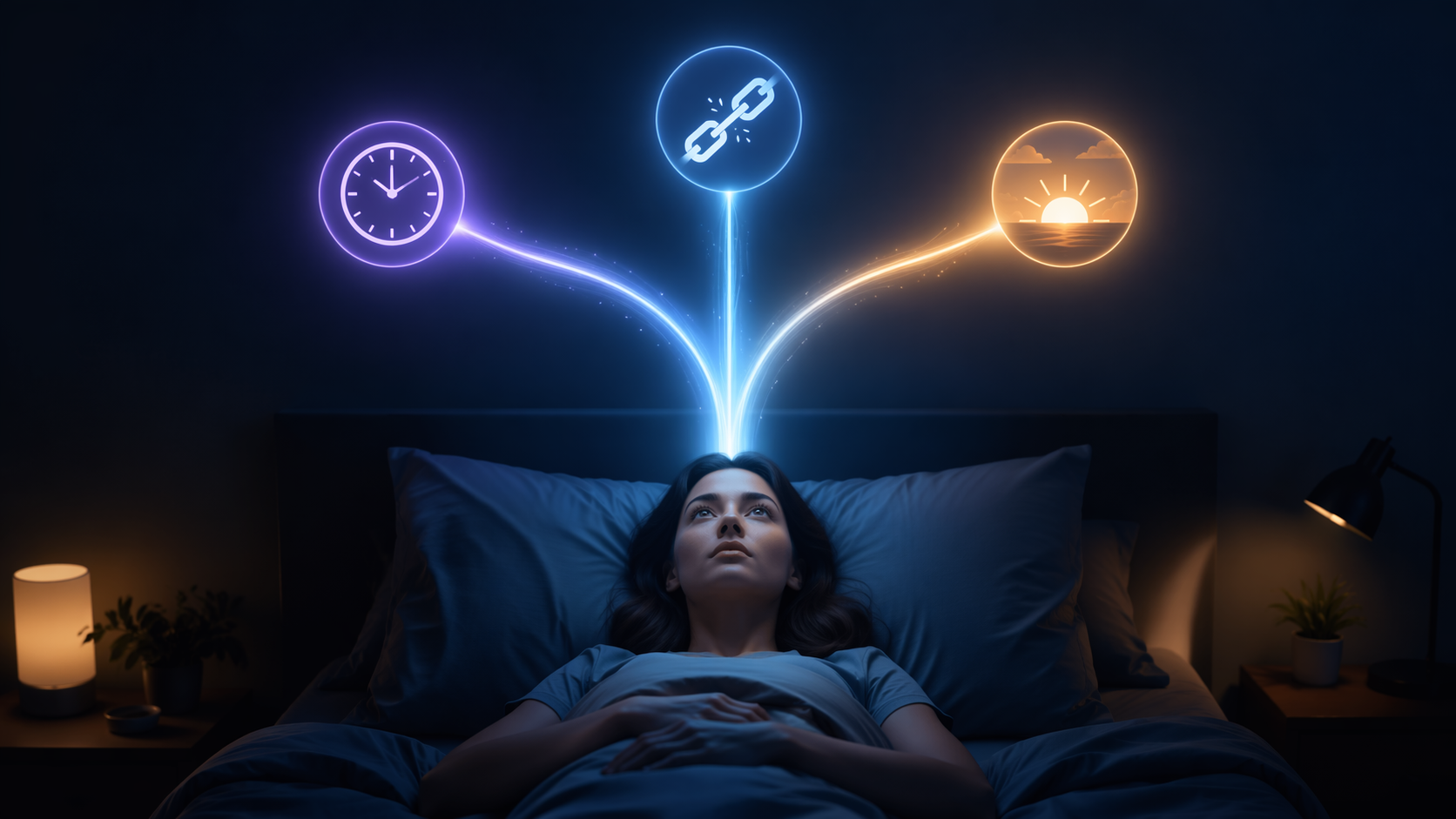
The load usually has three parts. Irregular schedules disrupt circadian timing. Trauma exposure keeps arousal high after the scene is over. Organizational stress decides whether recovery time is real or only written into a policy document. When those three pressures stack, insomnia is not a failure of discipline. It is a predictable response to a system that keeps asking the body to be ready.
Why ordinary sleep hygiene breaks down here
Standard sleep hygiene is built around control: keep a consistent schedule, reduce stimulation before bed, make the bedroom dark and quiet, avoid late caffeine, and reserve the bed for sleep. None of that is foolish. It is just too thin for a worker whose “bedroom” may be a tent, a shared room, a station bunk, a hotel beside a command center, or a vehicle seat between calls.
The usual checklist also assumes the worker can choose the timing of recovery. Rotating shifts, overnight calls, delayed demobilization, security briefings, transport windows, and on-call expectations can push sleep into whatever slot remains. A responder may finish a high-adrenaline incident near dawn, be told to rest, and still need to monitor radio traffic, write notes, attend a debrief, or prepare for the next operational period.
That is why advice like “just wind down” can land badly. The body may still be scanning. The mind may be replaying a scene. A worker may be listening for a phone, a radio, a child in a shelter, a team member in the next room, or a threat outside the perimeter. Even if the room is quiet, the nervous system may not believe it.
This is also where sleep hygiene misses one of the more important trauma-related mechanisms: for some workers, sleep itself becomes associated with danger. A study of 242 first responders examined “fear of sleep” as distinct from general insomnia and found it was most severe among first responders with both PTSD and insomnia symptoms; the construct was tied to hyperarousal and trauma-related nightmares.[4] Because the study was cross-sectional and used a convenience sample, it cannot prove which problem causes the other. It still names a pattern many generic articles leave out: the worker may not be merely restless. They may be avoiding the state in which nightmares, loss of vigilance, or being unreachable feel most likely.
Once sleep has become a threat cue, a darker room and a calming playlist are not enough. The intervention has to reduce conditioned arousal, make sleep feel safer, and handle nightmares directly when they are part of the cycle.
The stress-insomnia cycle is not only psychological
Insomnia in disaster work is often described as a mental strain problem, but the cycle is biological, behavioral, and operational at the same time. Circadian timing tells the body when to expect sleep and alertness. Threat exposure pushes the system toward vigilance. Repeated short sleep then lowers the worker’s margin for emotional regulation, decision-making, and recovery after the next exposure.
The first responder meta-analysis found depression and PTSD strongly associated with insomnia, with reported odds ratios of 9.74 for depression and 7.13 for PTSD.[1] The same review describes the relationship between sleep disturbance and PTSD as bidirectional, including evidence that sleep disturbance can predict worsening PTSD symptoms up to 9 months after treatment.[1] That point matters operationally: treating sleep is not a cosmetic add-on after the “real” mental health work. Sleep can be one of the levers that changes the rest of the system.
This does not mean every exhausted responder has PTSD, depression, or a diagnosable sleep disorder. It means persistent insomnia after repeated exposure deserves attention early, especially when it comes with nightmares, dread of going to sleep, panic on waking, heavy reliance on alcohol or sedatives, or a growing inability to recover between shifts.
What first-line treatment means when bedtime is not fixed
Cognitive behavioral therapy for insomnia, or CBT-I, is commonly recommended as a first-line treatment for chronic insomnia. In disaster and response work, the useful question is not whether CBT-I belongs in the toolkit. It does. The useful question is how to keep its core mechanisms intact when a worker cannot promise the same bedtime for the next two weeks.
CBT-I is often misunderstood as another version of sleep hygiene. It is more specific than that. It targets the behaviors and learned associations that keep insomnia running: too much time in bed awake, fear of not sleeping, irregular sleep opportunity, catastrophic thinking about the next day, and the body learning that the sleep space is a place for effort, monitoring, and frustration.
| CBT-I component | Deployment-compatible translation |
|---|---|
| Sleep window planning | Protect a realistic sleep opportunity around the current duty block instead of chasing an ideal civilian bedtime. |
| Stimulus control | If safe and feasible, leave the sleep space briefly when awake and escalating; if not, use a consistent low-stimulation reset that separates resting from threat scanning. |
| Sleep restriction or compression | Use only with clinical caution in safety-sensitive roles; avoid creating dangerous sleep loss before driving, patient care, weapons handling, or critical decisions. |
| Cognitive work | Target thoughts such as “If I sleep, I will miss something” or “A nightmare means I am back there,” not only generic worry. |
| Relapse planning | Expect disrupted sleep after calls, incidents, rotations, or redeployment; plan recovery windows instead of treating setbacks as failure. |
The part that needs the most care in safety-sensitive jobs is sleep restriction. In a quiet outpatient setting, limiting time in bed can consolidate sleep. In an emergency roster, careless restriction can make an already tired person more dangerous. For responders and aid workers, this component should be adapted by a clinician or trained sleep professional who understands duty risk, commuting risk, and operational fatigue.
Low-touch delivery can help when clinic access is unrealistic. App-based CBT-I, brief telehealth check-ins, and structured self-guided protocols can fit between shifts or during deployment, provided they are not treated as a substitute for higher-level care when nightmares, panic, suicidality, substance use, or severe PTSD symptoms are present. For workers comparing digital options, a practical starting point is how to choose a CBT-I app for chronic insomnia.
The practical target is not perfect sleep
In the field, the first target is usually reducing the number of nights where the worker spends hours awake, tense, and bargaining with the clock. A second target is reducing fear around sleep itself. A third is keeping the sleep plan flexible enough that one disrupted night does not collapse the whole effort.
That may look like anchoring sleep around a protected four-to-six-hour opportunity after a night shift when no longer responsible for immediate response, then adding a nap before the next duty period. It may look like using the same short pre-sleep sequence in three different locations because the sequence, not the room, becomes the cue. It may look like deciding in advance what to do after a nightmare so the worker is not inventing a plan at 0300 while flooded with adrenaline.
Tools that match the mechanisms
The best individual tools are not magic sedatives. They work because they match one of the forces keeping the insomnia alive.
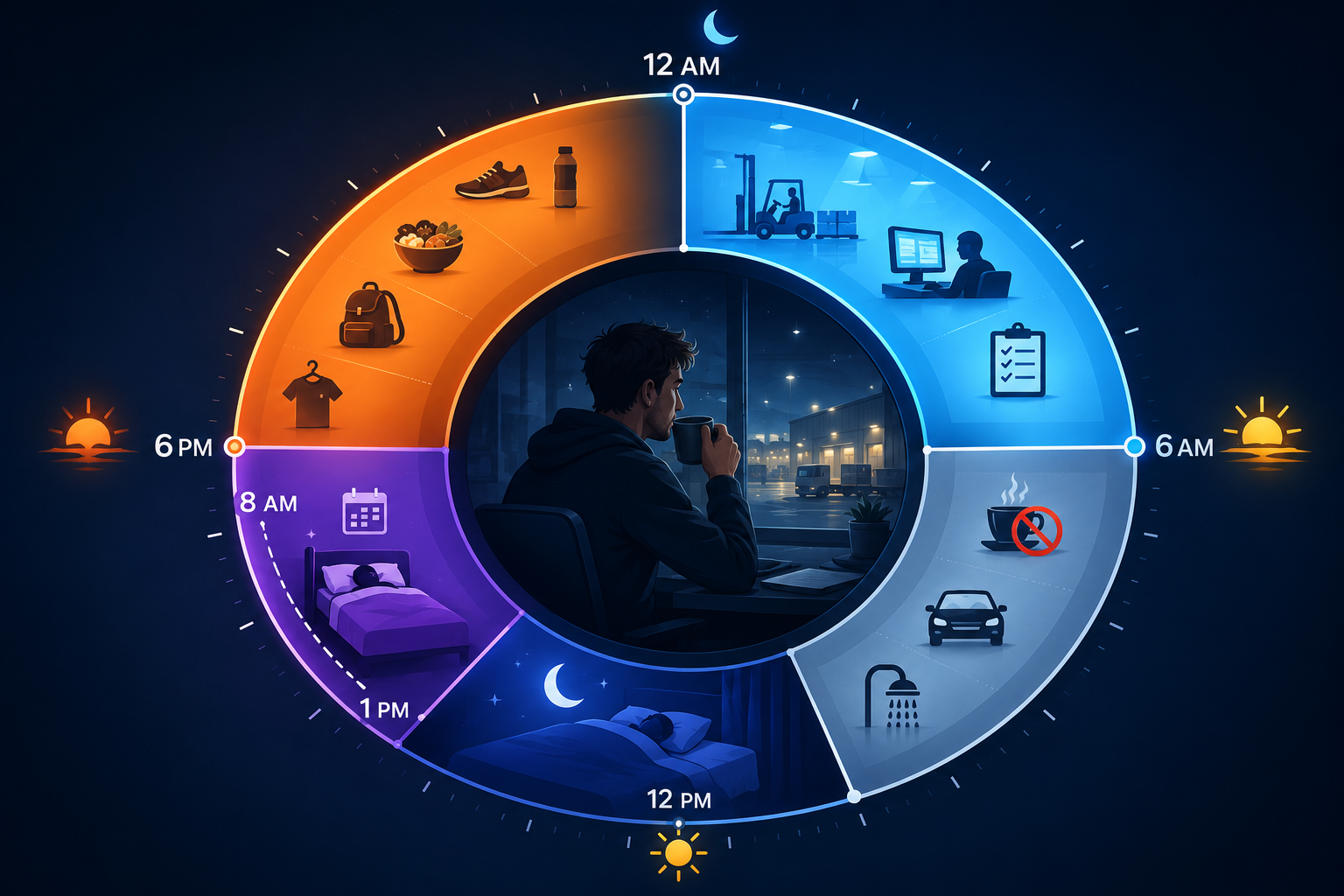
- For circadian disruption: use light, darkness, meal timing, and sleep windows deliberately around the current shift block rather than pretending every day can follow the same schedule.
- For acute sleep debt: use tactical naps before critical duty when allowed, with enough wake-up time to clear grogginess before driving, clinical care, or command decisions.
- For conditioned arousal: keep the bed or mat from becoming a place where the worker rehearses every operational failure, threat, or next-day consequence.
- For nightmares: use nightmare-targeted treatment rather than only general relaxation, especially when fear of sleep is present.
- For post-incident activation: build a short decompression sequence that is realistic after a call, not a long ritual that fails the first time the radio stays hot.
Shift workers often need a stepped approach because circadian strain and insomnia can overlap without being identical. A worker who sleeps well on leave but cannot sleep during rotations may need shift-timing strategies first. A worker who remains awake, panicked, and sleep-avoidant even after schedule pressure eases may need insomnia- and trauma-focused treatment. The difference matters; the wrong tool can waste the worker’s narrow recovery window. For more on the schedule side, see Shift Work Sleep Disorder Treatment: A Stepped-Care Guide.
Tactical napping deserves a sober place in the plan. A nap cannot repay repeated organizational understaffing, but it can reduce immediate pressure before a duty period. The useful version is planned, timed, and protected. The risky version is an accidental collapse in a chair before a dangerous commute.
Nightmare-targeted care also belongs closer to the center than many workplace sleep programs put it. If nightmares are teaching the body that sleep leads back to the scene, then treating only sleep timing leaves the threat association intact. The fear-of-sleep findings do not prove a single treatment pathway, but they do support asking directly about nightmares, sleep avoidance, and what the worker believes might happen if they let themselves sleep.[4]
When sleep relief becomes a clinical issue
Some insomnia can be handled with schedule protection, CBT-I tools, naps, light management, and better post-shift routines. Some should move quickly into clinical care. The line is not about toughness. It is about risk.
- Get clinical help when insomnia lasts for weeks despite real sleep opportunity and basic adjustments.
- Escalate sooner when sleep is avoided because of nightmares, panic, fear of being attacked, or fear of being unavailable.
- Treat heavy alcohol use, non-prescribed sedative use, or escalating medication reliance as a safety signal, not a private coping style.
- Seek urgent support when insomnia comes with suicidal thoughts, severe depression, dissociation, uncontrolled anger, or inability to perform safety-critical duties.
Medication may have a place under medical supervision, especially for short-term stabilization, but it should not be the only answer to a schedule and trauma problem. If the driver of insomnia is fear conditioning, circadian disruption, or repeated post-incident activation, the treatment plan has to address those drivers directly.
The organization is part of the sleep intervention
A worker can do many things right and still be kept awake by bad roster design, unclear rest expectations, unsafe accommodations, or a culture that treats exhaustion as proof of commitment. Once insomnia is tied to shift structure, trauma load, and institutional pressure, duty of care is not a wellness slogan. It is part of operational safety.
The CDC Yellow Book chapter on humanitarian aid workers explicitly recommends pre-deployment mental health screening and defined rest policies, alongside attention to stressors such as long work hours, security concerns, ethical dilemmas, and separation from family.[5] Those recommendations are modest on paper and difficult in the field. They still set a baseline: organizations should not wait until sleep collapse is obvious before they ask who is at risk and where rest is supposed to happen.
Research on humanitarian aid workers’ mental health and duty of care describes organizational responsibilities across the employment cycle, including preparation, support during assignment, and post-assignment care.[6] That matters because insomnia often shows up across the same timeline: anticipatory stress before deployment, fragmented sleep during deployment, and delayed symptoms after return when the worker is finally still enough to notice them.
A 2023 Harvard master’s thesis on international humanitarian aid workers found that sleep disturbance predicted burnout and post-traumatic stress symptoms, using validated instruments; because it is a thesis rather than a peer-reviewed journal article, it should be read as supporting evidence rather than a final institutional verdict.[7] Even with that caveat, the direction is hard to ignore: if leadership wants fewer burned-out workers, sleep cannot be treated as the worker’s private after-hours project.
What duty of care looks like in practice
The practical choices are not glamorous. They are roster rules, protected off-duty periods, safe sleep spaces, fatigue-aware transport plans, psychological support that is available before crisis, and supervisors who do not quietly punish people for using rest time. They are also deployment briefings that name insomnia, nightmares, and fear of sleep plainly enough that workers can report symptoms before they become career-threatening.
Pre-deployment screening should not become a blunt exclusion tool. Used well, it identifies workers who may need extra support, medication continuity, sleep planning, or a different rotation length. Used badly, it teaches workers to hide symptoms. The difference is whether the organization can offer help without making disclosure feel like professional self-sabotage.
Rest policies need the same honesty. A policy that says workers should rest, while the roster, staffing level, transport plan, and supervisor expectations make rest impossible, is paperwork. A real rest policy identifies who covers the role, when the worker is unreachable, how fatigue affects driving and clinical decisions, and what happens after a traumatic incident or extended operational period.
Breaking the cycle without blaming the worker
Disaster aid workers and first responders can break the stress-insomnia cycle, but the plan has to respect the job. It has to treat circadian disruption, conditioned arousal, nightmares, and fear of sleep as real mechanisms. It has to adapt CBT-I instead of handing over a civilian bedtime script. It has to use tactical naps and shift tools where they fit, and clinical care where risk is rising.
The worker still has choices to make: when to seek treatment, how to protect a sleep window, whether to use an app or clinician-guided CBT-I, how to handle nightmares, and when to stop treating exhaustion as normal. But organizations make choices too. They decide whether rest is protected, whether disclosure is safe, whether post-incident recovery is built into the operation, and whether sleep is treated as part of readiness.
Relief becomes realistic when both sides move. Evidence-based treatment has to be adapted to unstable environments, and operational systems have to stop outsourcing recovery to the most exhausted person in the room.
References
- Prevalence of sleep disorders among first responders for medical emergencies: A meta-analysis, PMC.
- Secret aid worker: stress and depression are rife in our industry, The Guardian, November 23, 2015.
- No Relief for Relief Workers, Columbia Mailman School of Public Health.
- Fear of sleep in first responders: associations with trauma types, psychopathology, and sleep disturbances, PMC.
- Humanitarian Aid Workers, CDC Yellow Book 2026.
- Humanitarian Aid Workers’ Mental Health and Duty of Care, PMC.
- The role of sleep disturbance in burnout and post-traumatic stress symptoms among international humanitarian aid workers, DASH Harvard, 2023.

Comments
Join the discussion with an anonymous comment.