
Who Is Inspire For? Understanding the Patient Profile
Inspire therapy is an implantable upper airway stimulation device approved by the FDA as a second-line treatment for obstructive sleep apnea (OSA). It is not a first-line option. The American Academy of Sleep Medicine and the American College of Physicians both recommend positive airway pressure (PAP) therapy — typically CPAP — as the initial treatment for moderate-to-severe OSA. Inspire is indicated specifically for adults who have tried CPAP and cannot tolerate it or have not benefited from it.
To be considered a candidate for Inspire, you must meet the following clinical criteria established by the FDA and adopted by Medicare and most commercial insurers:
- Age 18 or older (the FDA expanded the original 22+ age requirement in 2020)
- Moderate-to-severe OSA, defined as an apnea-hypopnea index (AHI) between 15 and 100 events per hour
- A body mass index (BMI) of 40 or lower (Medicare requires a BMI below 35)
- Documented CPAP intolerance or failure — meaning you have tried CPAP and cannot use it consistently or effectively
- A drug-induced sleep endoscopy (DISE) showing no complete concentric collapse of the airway, which would make the therapy ineffective
If you are new to sleep apnea and unsure whether you have the condition, start with our comprehensive guide to obstructive sleep apnea, which covers symptoms, diagnosis, and the full range of treatment options before you evaluate implantable devices.
The Full Cost Breakdown: What You Actually Pay For
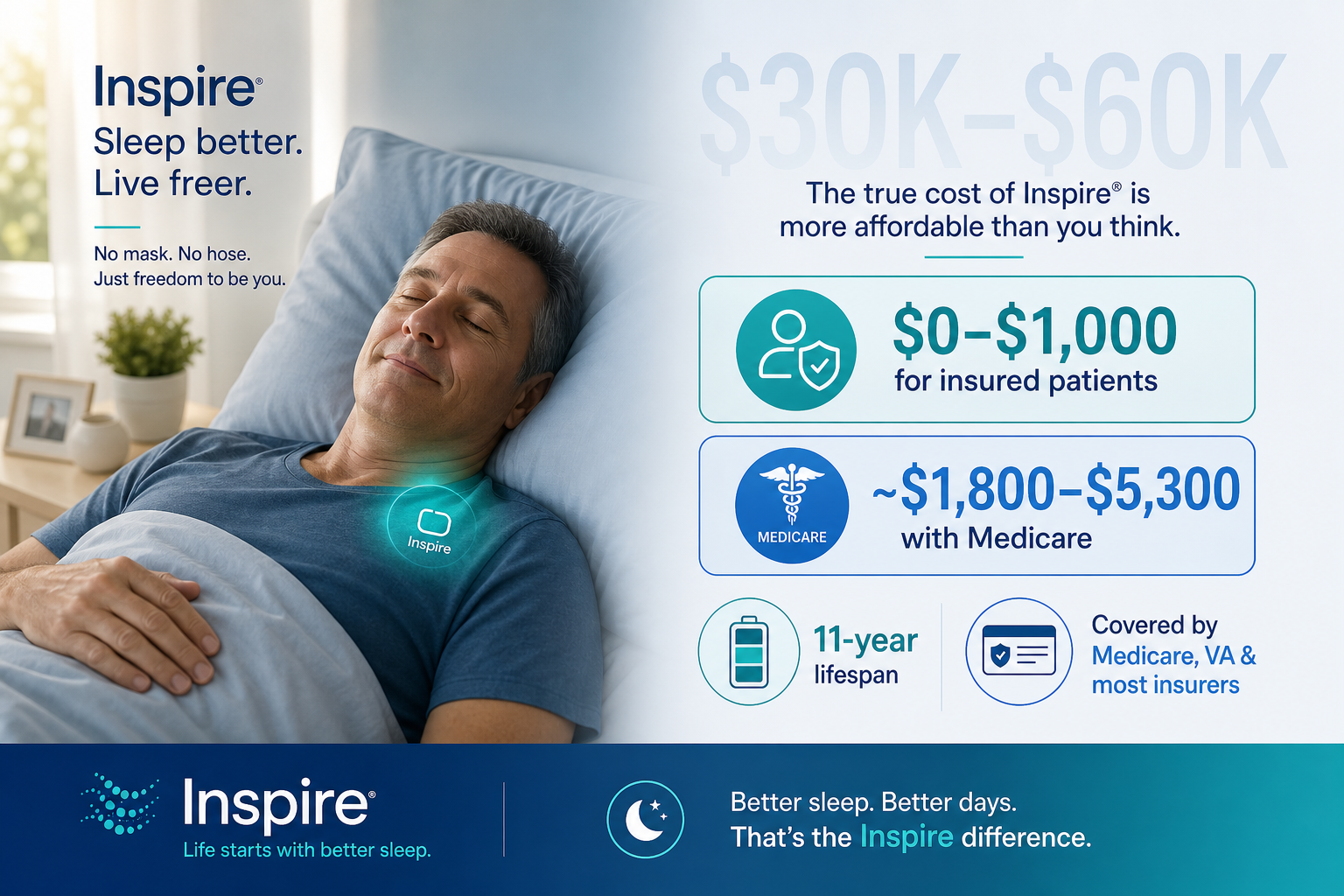
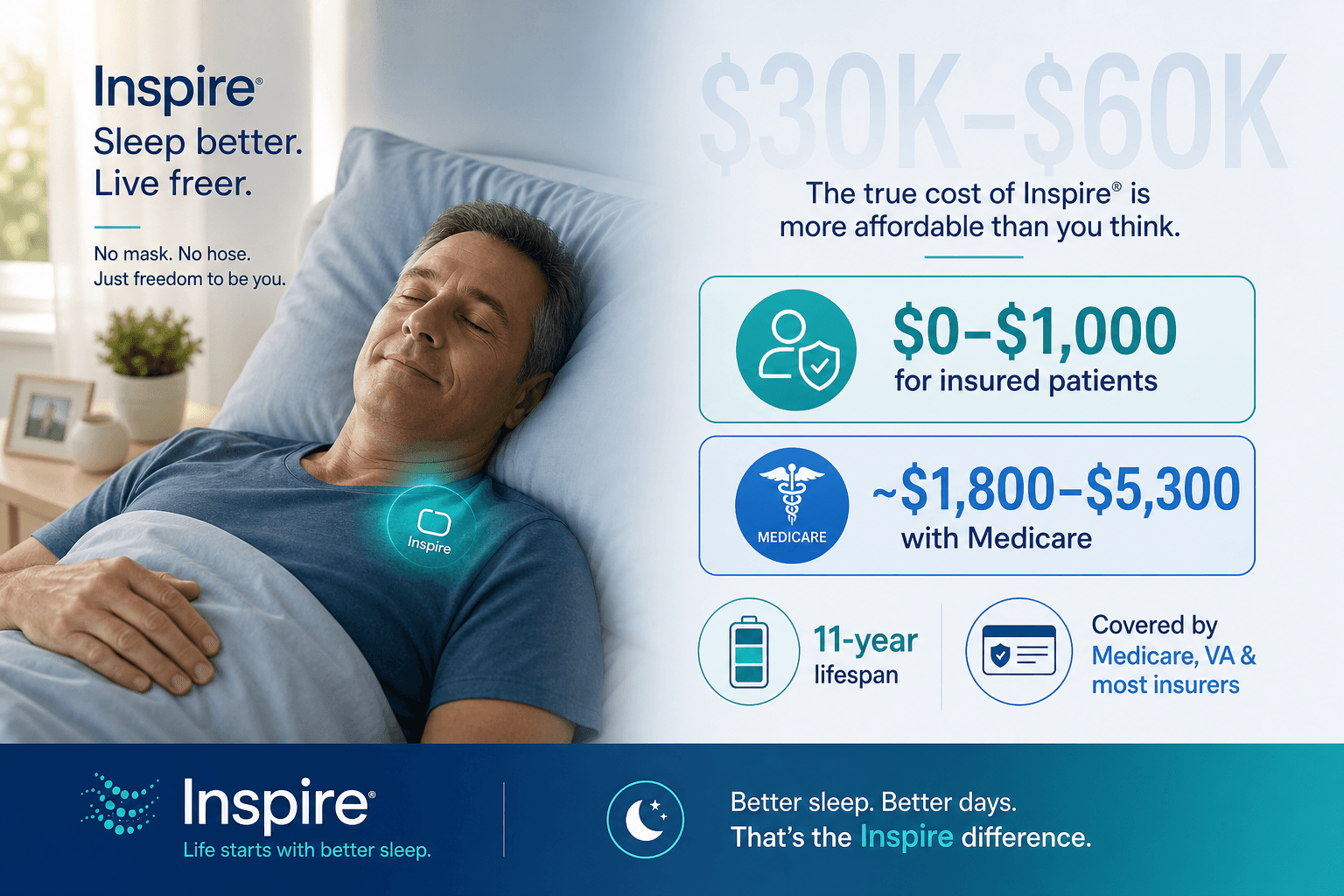
When you hear that Inspire therapy costs $30,000 to $60,000, that figure typically includes four distinct components: the device itself, the surgical implantation, the pre-operative evaluations required to qualify, and the follow-up care after implantation. Understanding each component separately is essential because insurance coverage and patient responsibility vary significantly across them.
| Cost Component | Estimated Cost Range | What It Covers |
|---|---|---|
| Inspire device | $20,000 – $30,000 | The implantable pulse generator and stimulation lead; the device itself accounts for the largest single cost |
| Surgical implantation | $10,000 – $15,000 | Surgeon fees, anesthesia, operating room time, and hospital or surgical center facility fees |
| Pre-operative evaluations | $2,000 – $5,000 | Sleep study (polysomnography) within 24 months, drug-induced sleep endoscopy (DISE), and upper airway examination |
| Follow-up care (first year) | $200 – $500 per visit | Device programming, titration adjustments, and routine check-ups; typically 2–4 visits in the first year |
The device itself is priced at roughly $25,000, according to multiple sources including North Mississippi Health Services and the Sleep and Sinus Centers. The surgical implantation adds another $10,000 to $15,000, bringing the combined device-plus-surgery cost to $30,000–$40,000. Pre-operative evaluations — which are mandatory to confirm candidacy — add $2,000 to $5,000, pushing the upper end of the total to $60,000 in some markets.
Battery Replacement: The Long-Term Maintenance Cost
The Inspire device is powered by an internal battery that is not rechargeable. The battery life is rated at 8 to 11 years, depending on the stimulation settings required for each patient. When the battery depletes, the entire pulse generator must be replaced in an outpatient surgical procedure.
The cost of battery replacement is estimated at $5,000 to $8,000, according to Doctronic. This is significantly lower than the initial implantation cost because the surgical procedure is less extensive — the device pocket is reopened, the old generator is exchanged for a new one, and the existing stimulation lead is reused if it is functioning properly. Most patients can return to normal activities within a few days.
When compared to CPAP, which requires ongoing supply purchases every month and a full device replacement every five years, the long-term maintenance cost of Inspire is modest. A single battery replacement at year 10 is roughly equivalent to the cumulative cost of CPAP supplies over the same period, but without the recurring monthly expense and the hassle of reordering masks, tubing, and filters.
Insurance Coverage: Medicare, VA, and Commercial Plans
The most important thing to understand about Inspire therapy costs is that the $30,000–$60,000 uninsured price is almost never what insured patients actually pay. Medicare, the Department of Veterans Affairs (VA/TRICARE), and most major commercial insurance plans cover Inspire therapy for qualifying patients. The out-of-pocket amount you pay depends on your specific plan, your deductible status, and the type of facility where the procedure is performed.
| Insurance Type | Typical Out-of-Pocket Cost | Key Eligibility Requirements |
|---|---|---|
| Medicare Part B (hospital outpatient) | ~$1,839 | BMI ≤35, AHI 15–65, >75% obstructive events, CPAP intolerant, no CCC on DISE |
| Medicare Part B (surgical center) | ~$5,329 | Same criteria as above; facility type determines patient cost |
| VA / TRICARE | $0 (typically) | Must meet standard clinical criteria; VA facilities often cover the full cost |
| Major commercial plans (BCBS, Cigna, Aetna, UnitedHealthcare) | $0 – $1,000 | Plan-specific; most require AHI 15–100, BMI ≤40, CPAP intolerance, and DISE |
Medicare Part B covers Inspire therapy for patients who meet specific criteria: age 18 or older, BMI of 35 or lower, AHI between 15 and 65 with more than 75% of events being obstructive, a sleep study within the last 24 months, documented CPAP failure or intolerance, and a drug-induced sleep endoscopy showing no complete concentric collapse. The 2026 Part B deductible is $283. After the deductible, Medicare pays 80% of the approved amount, and the patient is responsible for the remaining 20%.
However, the patient's 20% share varies dramatically by facility type. According to SleepApnea.org, the average patient cost at a hospital outpatient department is approximately $1,839, while at an outpatient surgical center it is approximately $5,329. This difference exists because hospital outpatient departments receive higher Medicare reimbursement rates, and the patient's 20% coinsurance is calculated on that higher base. If you have a Medicare supplement (Medigap) plan, it may cover some or all of this remaining 20%.
For patients covered by the VA or TRICARE, out-of-pocket costs are typically $0. The VA has been an early adopter of upper airway stimulation, and many VA medical centers perform the procedure at no cost to eligible veterans.
Real-World Out-of-Pocket Costs: Patient Ambassador Data
Inspire's own patient ambassador program provides real-world examples that illustrate how the sticker price diverges from actual patient costs. These are self-reported figures from patients who chose to share their experiences publicly on the Inspire website. While individual results vary, the pattern is consistent: most insured patients pay far less than the uninsured price.
- Lisa G. (59, BMI 28, Arizona, Blue Cross Blue Shield) — paid $0 out-of-pocket
- Nathan U. (39, BMI 36, Tennessee, TRICARE) — paid $0 out-of-pocket
- Nancy H. (66, BMI 27, Florida, Medicare supplement Part G) — paid $0 out-of-pocket
- Suzanne H. (51, BMI 34, California, Blue Cross Blue Shield) — paid less than $1,000 out-of-pocket
These examples span Medicare, TRICARE, and commercial insurance, and they include patients with and without supplemental coverage. The common thread is that all four patients had plans that covered Inspire therapy, and their out-of-pocket costs were either zero or under $1,000. This is consistent with the broader claim that over 300 million people in the United States have insurance coverage for Inspire, as reported by the manufacturer.
Inspire vs. CPAP: A Lifetime Cost Comparison
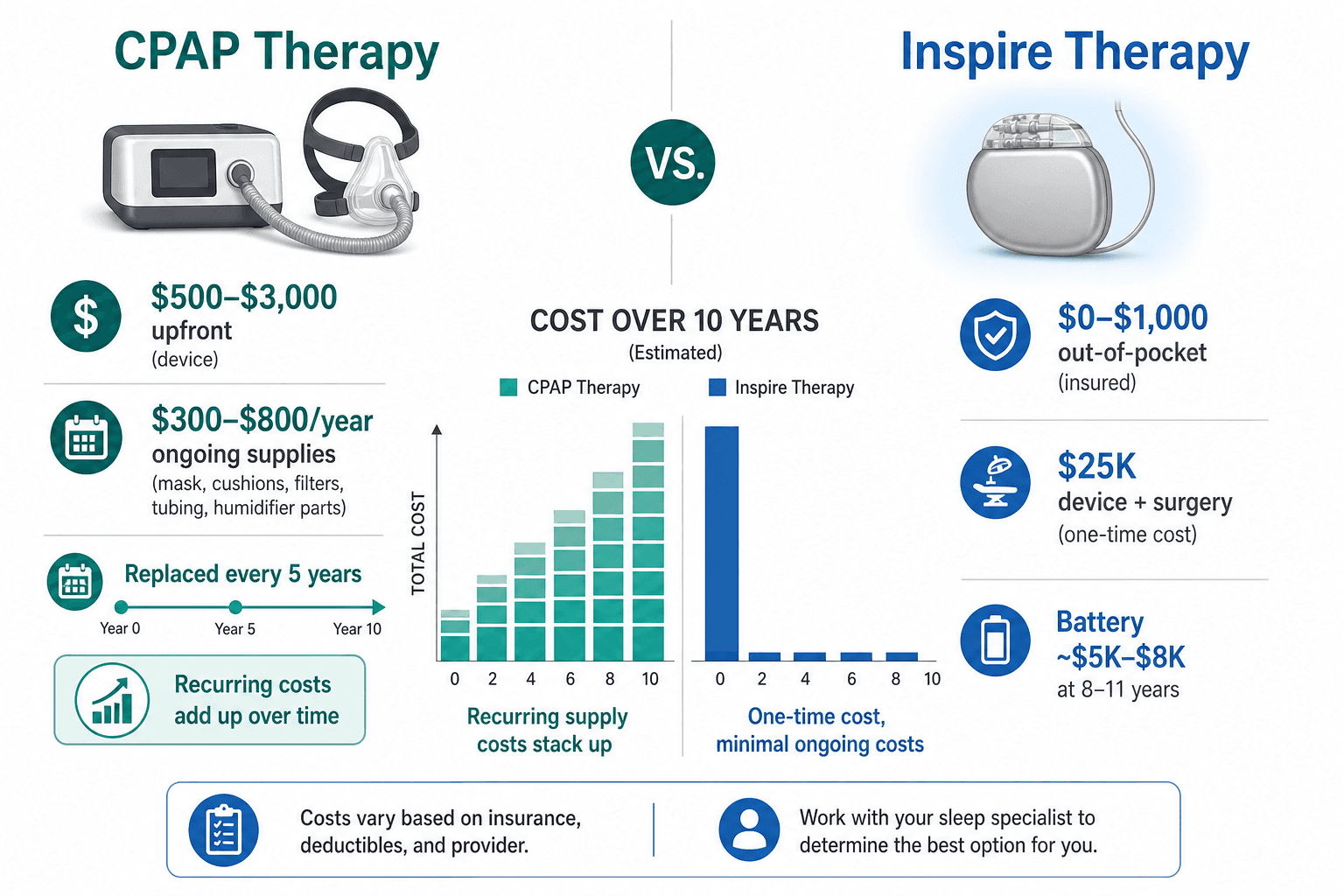
When evaluating whether Inspire therapy is worth the investment, it helps to compare its costs against CPAP over a meaningful time horizon — say, 10 years. CPAP has a lower upfront cost but carries ongoing supply expenses and a mandatory device replacement every five years. Inspire has a high one-time cost but minimal ongoing expenses beyond the battery replacement at 8–11 years.
| Cost Category | CPAP Therapy | Inspire Therapy |
|---|---|---|
| Upfront device cost | $500 – $3,000 (machine + mask + humidifier) | $30,000 – $60,000 (device + surgery + pre-op) |
| Annual supply costs | $300 – $800 (masks, tubing, filters, cushions) | $0 – $600 (follow-up visits, remote control replacement) |
| Device replacement | Every 5 years ($500 – $3,000) | Every 8–11 years ($5,000 – $8,000 battery replacement) |
| 10-year total (insured, typical) | $3,500 – $11,000 (including supplies and one replacement) | $0 – $1,000 (most insured patients) |
| 10-year total (uninsured) | $3,500 – $11,000 | $35,000 – $70,000 (including one battery replacement) |
The key insight from this comparison is that for insured patients, Inspire therapy can be significantly cheaper over 10 years than CPAP, despite the intimidating upfront price tag. A patient with good insurance who pays $500 out-of-pocket for Inspire will spend less over a decade than a CPAP user who pays $300–$800 per year on supplies plus a machine replacement at year five. For uninsured patients, however, CPAP remains the far more affordable option.
It is also worth noting that CPAP therapy requires consistent daily use to be effective, and the ongoing supply costs can be a barrier to adherence. If you stop using CPAP because you cannot afford replacement masks or find the therapy uncomfortable, the clinical benefits — and the cost savings from avoiding untreated OSA complications — are lost entirely. Inspire, by contrast, requires no daily consumables and has high long-term adherence rates. The STAR trial and ADHERE registry data show that 72–75% of patients maintain significant AHI reduction at one and five years post-implantation, and 86% of patients continue using the device long-term.
Is Inspire Cost-Effective? The Evidence Behind the Price Tag
Beyond the question of what patients pay out-of-pocket, there is a broader health-economic question: is Inspire therapy worth the cost to the healthcare system? This matters because insurers and Medicare use cost-effectiveness data to determine coverage policies and reimbursement rates.
The most frequently cited cost-effectiveness analysis for upper airway stimulation was published by Pietzsch et al. in SLEEP in 2015. The study used data from the STAR trial — the pivotal clinical trial that led to FDA approval — to model the lifetime costs and health outcomes of Inspire therapy versus no treatment. The model assumed an 83% male cohort with a mean age of 54.5 years and a mean baseline AHI of 32.0.
The study found a lifetime incremental cost-effectiveness ratio (ICER) of $39,471 per quality-adjusted life year (QALY) gained. In health economics, an ICER below $50,000 per QALY is generally considered good value, and below $100,000 per QALY is considered acceptable. At the $50,000/QALY threshold, Inspire was cost-effective 73% of the time in the male cohort; at the $100,000/QALY threshold, it was cost-effective 96% of the time.
The model also projected that Inspire therapy would reduce 10-year relative risks for serious complications of untreated OSA: myocardial infarction by 37%, stroke by 25%, and motor vehicle collisions by 66%. The total incremental lifetime cost of Inspire therapy in the model was $42,953, with a discounted QALY gain of 1.09.
For context, the ICER for Inspire therapy compares favorably to many other commonly accepted medical interventions. Bariatric surgery for obesity, for example, has an ICER of approximately $7,000–$12,000 per QALY, while many cancer therapies exceed $100,000 per QALY. The finding that Inspire falls well within accepted cost-effectiveness thresholds supports the argument that the therapy provides meaningful health value relative to its cost — at least for the specific patient population that meets the eligibility criteria.
Your Pre-Authorization Decision Framework: Questions to Ask Before Committing
Before you schedule Inspire implantation, you need to navigate the pre-authorization process with your insurance company. This is the step where many patients encounter delays or denials, not because their plan excludes Inspire, but because the documentation requirements are stringent and often misunderstood. Use the following checklist to prepare for conversations with your insurer and your surgeon's office.
- Does my specific insurance plan cover Inspire therapy? — Do not assume coverage based on what a friend or online forum reports. Call your insurer and ask whether upper airway stimulation (CPT code 64582) is a covered benefit under your specific plan.
- What documentation of CPAP intolerance is required? — Most insurers require objective data showing CPAP usage of fewer than 4 hours per night on at least 70% of nights, or a documented clinical note stating you cannot tolerate CPAP. Ask whether a compliance report from your CPAP machine is sufficient.
- Is drug-induced sleep endoscopy (DISE) covered? — DISE is a mandatory pre-operative test, but not all plans cover it separately. Ask whether DISE is included in the pre-authorization or requires a separate approval.
- What is my estimated out-of-pocket cost at my chosen facility? — Ask for a cost estimate based on your specific plan, deductible status, and the facility where the surgery will be performed. Remember that hospital outpatient departments and ambulatory surgical centers have different cost structures.
- What is the pre-authorization timeline? — Pre-authorization can take 2–8 weeks. Ask your surgeon's office to submit the request as early as possible and to follow up regularly.
- Does my surgeon meet the insurance company's qualification requirements? — Medicare requires that the procedure be performed by a board-certified otolaryngologist (head-and-neck surgeon) with specific Inspire training who is enrolled in Medicare. Commercial plans may have similar requirements.
If you are still in the early stages of evaluating your sleep apnea treatment options and want to understand the full diagnostic and treatment journey before committing to Inspire, our Sleep Apnea FAQ covers symptoms, diagnosis, CPAP therapy, and when to see a doctor. If you are exploring non-surgical alternatives to CPAP, our guide on whether home remedies can replace CPAP separates evidence-based self-care strategies from ineffective treatments.

Comments
Join the discussion with an anonymous comment.