
If heavy rain noise helps you fall asleep, you probably do not need to throw it out. The more useful answer is narrower: heavy rain noise can improve sleep quality when the problem is getting calm enough to drift off or blocking a neighbor, street, hallway, or household sound. It is less defensible as an all-night soundtrack played at a normal listening volume, because continuous sound may affect sleep architecture even when it feels soothing.
That distinction matters because “better sleep” can mean several different things. One person means they fell asleep in 15 minutes instead of staring at the ceiling. Another means they woke up fewer times. Another means they woke feeling restored. A sleep lab may mean something more specific: how much time the person spent in REM sleep, deep sleep, lighter non-REM stages, and awakenings across the night.
| What you may notice | What heavy rain noise may help with | Where the evidence gets thinner |
|---|---|---|
| Falling asleep faster | Masking distracting sound and lowering arousal | Most direct for sleep onset, not the whole night |
| Fewer noise-related wake-ups | Covering inconsistent outside noise with a steadier sound | Masking studies are not always rain-specific |
| Feeling calmer in bed | Nature sounds may shift the body toward parasympathetic activity | Calm does not automatically prove better sleep architecture |
| More restorative sleep | Possible if the sound removes the main obstacle | REM and sleep-stage effects need more caution |
Why Heavy Rain Can Feel Like It Works
Heavy rain is not just “nice background audio.” A good rain track is steady enough to cover small intrusions: a car passing, a pipe knocking, a roommate closing a cabinet, a TV murmuring through a wall. The sound does not need to be loud to do this. It only needs to raise the acoustic floor enough that sharper, more meaningful sounds are less likely to pull attention back to the room.
This is the practical strength of rain noise: it gives the brain less to monitor. Intermittent sounds are hard to ignore because they may signal something worth checking. A continuous rain bed can make those interruptions less distinct. That is why the same person may sleep better with rain noise in an apartment with thin walls, but notice no benefit in a quiet bedroom.
Nature-sound research also gives water sounds more substance than the usual “ambient vibes” language. A 2021 PNAS synthesis of nature-sound studies found that water sounds, including sounds such as rain and streams, showed the largest health and positive affective outcomes among the sound categories analyzed, with a Hedges’ g of 1.63, described as a 184% improvement across 18 studies.[1]
That does not mean a rain app is a treatment for insomnia. It does mean the comfort many people report has a plausible pathway. Rain sounds are predictable, nonverbal, and emotionally low-demand. They do not ask you to follow a plot, decode lyrics, or wait for the next loud event. In bed, that can be the difference between letting attention soften and staying half-alert.
The Calm Is Not Only Psychological
There is also a body-level explanation for why rain sounds can feel different from random machine noise. A 2017 Brighton and Sussex Medical School fMRI study in 17 adults found that nature sounds were associated with greater parasympathetic nervous system activity, while artificial sounds did not produce the same pattern.[2]
Parasympathetic activation is the boring phrase for something many tired people recognize immediately: the body stops bracing quite so hard. Breathing may feel easier. The jaw may unclench. Thoughts may still be present, but they have less physical voltage behind them. That can matter at sleep onset, when the goal is not to force sleep but to stop repeatedly re-alerting yourself.
The details of the sound matter. “Heavy rain” that includes sudden thunder, hard volume jumps, sirens in the recording, birds arriving at dawn, or a loop with a visible seam may be pleasant during the day and irritating at 2 a.m. A sleep sound should be boring on purpose. Steady rainfall, low variation, and no surprise peaks are usually better than a dramatic storm track. If thunder is the issue rather than the solution, a separate strategy for sleeping through storms makes more sense than turning the storm louder.
Masking Can Reduce Awakenings, With an Important Caveat
Auditory masking is the cleanest reason to use heavy rain noise. If your bedroom is exposed to uneven sound, a steady broadband sound can make the environment less jagged. Harvard Health, discussing white noise research, notes that consistent broadband sound reduced nighttime awakenings by up to 38% in high-noise environments.[3]
That finding should be kept in its lane. It was about white noise, not a rain recording. It supports the masking principle, not a claim that every rain playlist prevents awakenings. Rain tracks vary widely: some are close to a smooth noise profile, some are full of texture, and some are essentially miniature storm dramas.
Masking also solves an external problem, not an internal one. If the thing waking you is a truck route, upstairs footsteps, or a partner’s irregular schedule, a rain track may reduce the number of times your brain has to process the room. If the thing waking you is panic, reflux, alcohol-related sleep fragmentation, circadian misalignment, hot flashes, or a pattern of waking at the same time every night, rain noise may still feel comforting, but it is no longer aimed at the main driver.
The 2026 REM Caution
The caution comes from a 2026 Penn Medicine study published in Sleep and discussed in The Conversation. In that study, 25 adults were exposed to continuous broadband pink noise at 50 dB over 7 nights. They had about 19 minutes less REM sleep per night. Earplugs performed better than pink noise at protecting sleep architecture from environmental noise disruption.[4]
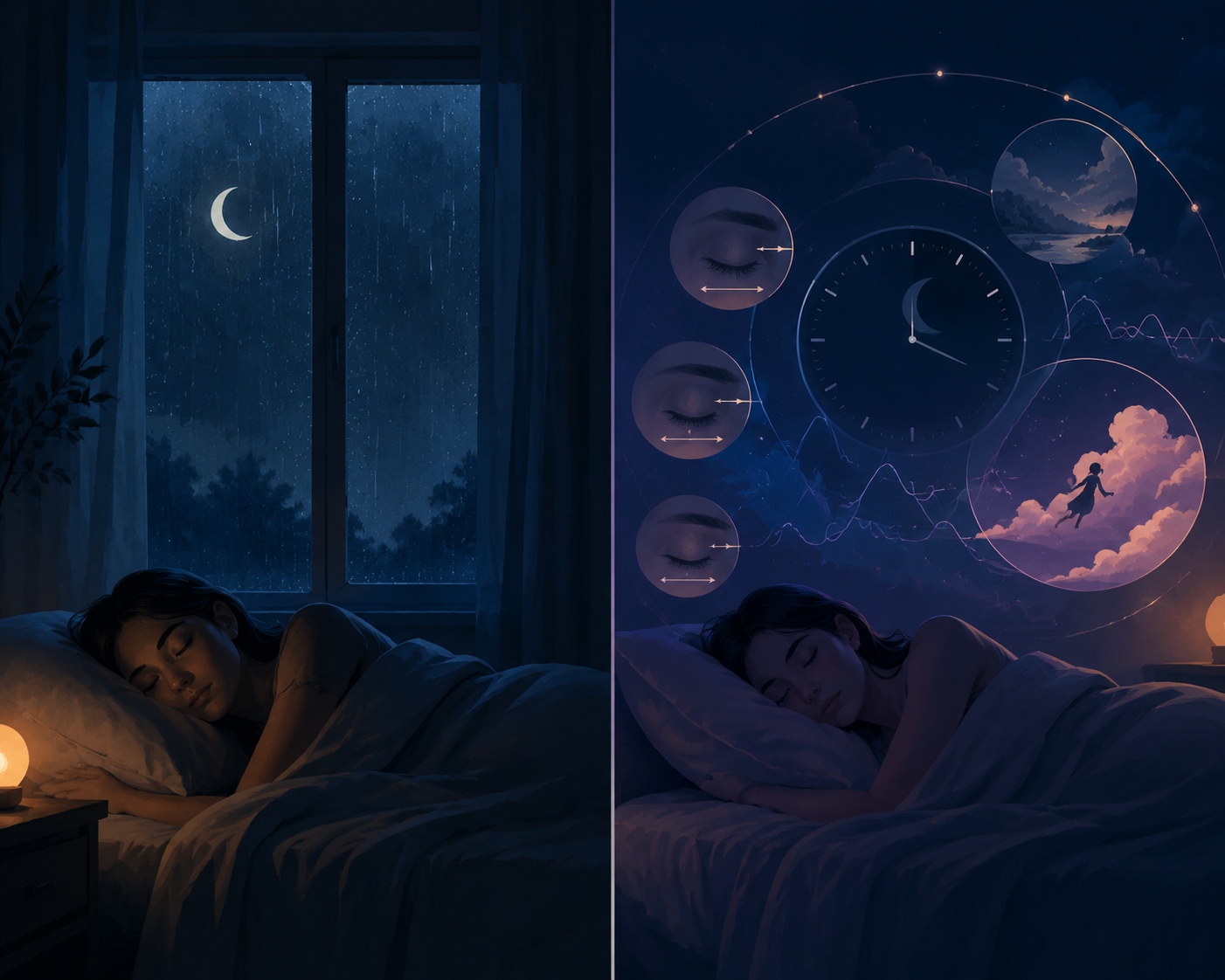
This is not the same as proving that every heavy rain track damages REM sleep. The study tested engineered pink noise, not actual rain recordings. It was small. It used a specific volume, a specific continuous exposure, and a specific study design. Rain sounds may approximate pink or green noise, but a phone speaker playing a rain loop beside a bed is not acoustically identical to a controlled lab stimulus.
Still, the result is hard to ignore because it targets the exact habit many people adopt casually: press play, let it run until morning, repeat for months. A sound can make the first part of the night feel easier and still have a measurable effect later. That is the mismatch worth respecting. Sleep onset and REM preservation are not the same outcome.
The earplug comparison is useful for one narrow reason. If your main problem is external noise, adding sound is not the only route. Reducing incoming noise may protect sleep with less full-night auditory exposure. Earplugs are not perfect for everyone: some people dislike pressure, occlusion, safety concerns, or hearing their own heartbeat. But the study is a reminder that “more sound” is not automatically the gentlest intervention.
How To Use Heavy Rain Noise More Precisely
The most evidence-aligned use is simple: choose steady rain, keep it low, and put it on a timer. The sound should help you cross the threshold into sleep, not necessarily accompany every REM cycle until morning.
- Choose steady rainfall rather than thunderstorms, hard rain on metal, or tracks with sudden thunderclaps.
- Set a timer for 30 to 60 minutes so the sound covers sleep onset without automatically running all night.
- Keep the volume audible but easy to ignore; if you are listening to it, not through it, it is probably too loud.
- Place the speaker away from your head when possible, especially if you use the sound nightly.
- If the track loops, test the seam before bedtime; a tiny click or reset can become enormous in a quiet room.
For volume, sleep specialists commonly advise keeping sleep sounds in the audible-but-not-intrusive range. Stanford sleep specialist Dr. Rafael Pelayo has recommended sleep sound volume around 50 to 60 dB.[3] In light of the Penn Medicine finding at 50 dB, it is reasonable to stay at or below that range rather than treating 50 dB as a target to exceed.
A practical test is whether the rain disappears from attention once you settle. If you keep turning it up because your mind is racing, the sound may be standing in for a different sleep tool. That is not a moral failure; it is useful diagnostic information. Rain can be a bridge out of arousal, but it should not be the only plan for chronic anxiety-driven bedtime wakefulness.
When All-Night Playback May Still Be Reasonable
There are situations where all-night playback may be a reasonable temporary compromise. A hotel room beside an elevator, a short-term construction period, a new baby in another apartment, or a partner working irregular hours can make the choice less theoretical. If the alternative is repeated startle awakenings, a low, steady rain track may be the better night-by-night option.
But the goal should be to use the smallest effective intervention. That might mean a quieter rain track, a timer that restarts only if needed, earplugs, moving the speaker farther away, sealing a window gap, changing bedroom layout, or combining low-volume masking with environmental fixes. The point is not to make the bedroom silent. It is to stop solving a temporary sound problem with a permanent full-night exposure by default.
When Rain Sounds Are the Wrong Main Tool
Rain sounds are least likely to solve the problem when the problem is not sound. If you need the rain because silence makes anxious thoughts louder, it may still help tonight. If you need it every night because bedtime has become the only place where your nervous system finally has room to panic, the sound is doing emotional labor it was not built to carry alone.
The same is true for repeated night waking. Someone who falls asleep easily with rain but wakes at 3 a.m. most nights may be dealing with sleep maintenance insomnia, sleep drive, alcohol timing, circadian rhythm, temperature, medication effects, pain, or another internal trigger. A rain loop can mask a hallway noise. It cannot rebuild sleep pressure or correct a disrupted circadian pattern.
This is where a stepped sleep-hygiene approach is more useful than hunting for the perfect noise color. Keep the rain sound if it lowers friction at bedtime, but also look at wake time consistency, light exposure, caffeine timing, alcohol, naps, room temperature, and what happens during the hour before bed. If the pattern persists, especially with daytime impairment, the issue deserves more than a better playlist.
So, Does Heavy Rain Noise Improve Sleep Quality?
Heavy rain noise can improve sleep quality in the ways many people actually mean when they say it helps: it can make sleep onset easier, reduce attention to disruptive environmental sounds, and create a calmer physiological state before sleep. The best evidence for it is strongest when the sound is functioning as masking or as a nature-sound cue that lowers arousal.
The caution is all-night use. The 2026 Penn Medicine finding does not ban rain sounds, but it does weaken the claim that continuous nighttime audio is automatically harmless sleep optimization. If you love heavy rain, use it like a tool: steady track, low volume, 30 to 60 minute timer, and enough honesty to notice whether it is masking a truck outside or postponing a deeper sleep problem.
References
- A synthesis of health benefits of natural sounds and their distribution in national parks — PNAS, 2021.
- Can Rain Sounds Help You Sleep? — Oura Ring.
- Can white noise really help you sleep better? — Harvard Health.
- Pink noise: what is it and can listening to it make your sleep worse? — The Conversation, 2026.


Comments
Join the discussion with an anonymous comment.