
The sleep question around BFR training is tempting because it connects two things tired athletes already care about: getting a real training signal without heavy loading, and sleeping without the dull ache that turns every position change into a small negotiation. The cautious answer is that blood flow restriction training may improve self-reported sleep quality, especially in clinical populations, but it has not yet been shown to deepen sleep, increase slow-wave sleep, or improve sleep architecture measured in a sleep lab.
That distinction matters. A person can report better sleep because they wake less often, feel less discomfort, or perceive the night as more restorative. Those are real outcomes. They are not the same as proving that a training method changes REM sleep, slow-wave sleep, or the timing of overnight growth hormone pulses.
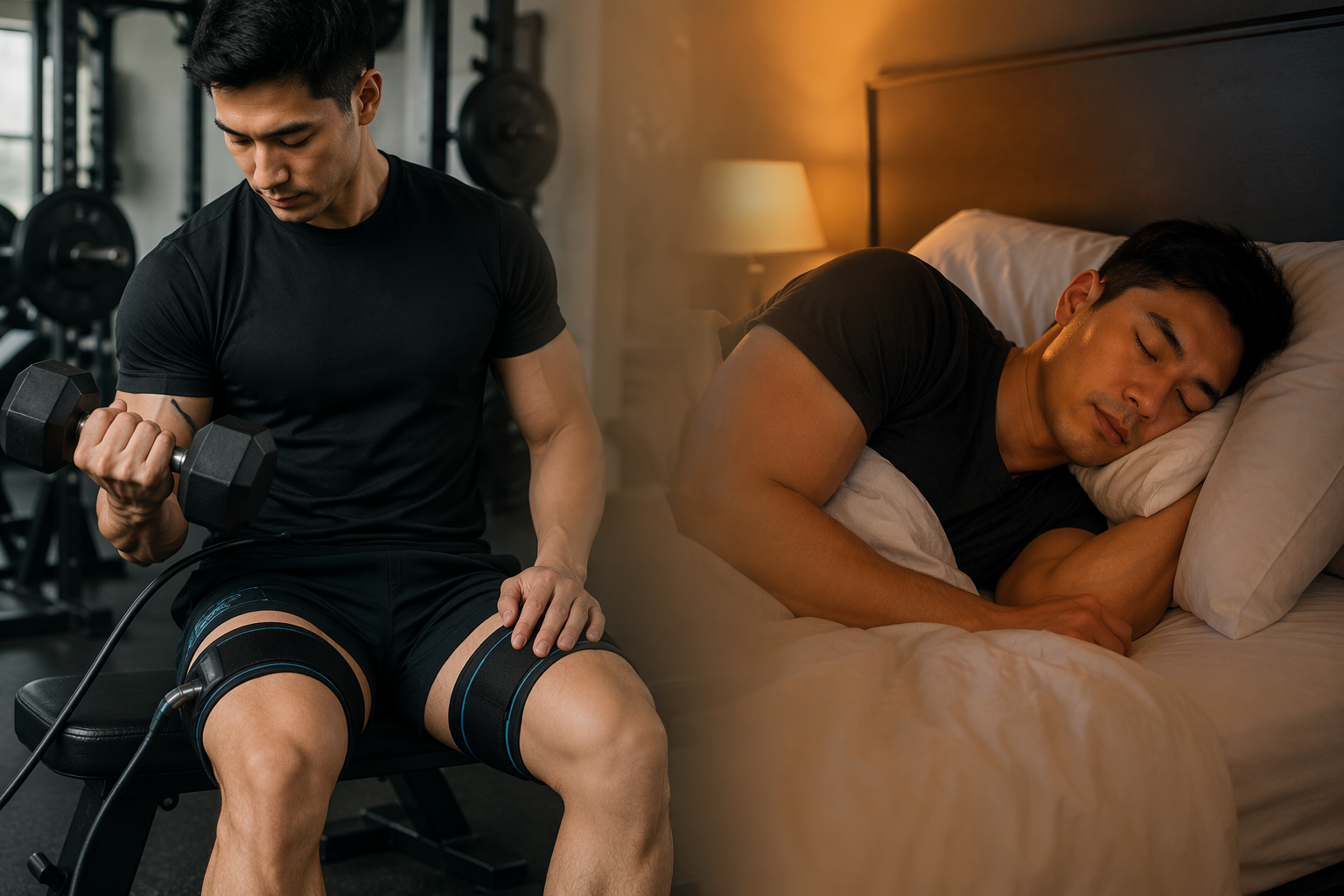
Blood flow restriction training uses cuffs or bands placed near the top of the limbs to partially restrict blood flow during low-load exercise. The practical appeal is obvious: lighter loads can feel metabolically demanding. For someone rebuilding a knee, protecting a tendon, or trying to keep training while soreness is already high, that lower mechanical load is the whole point. The sleep question begins there, not with the cuffs themselves: if the session creates a strong physiological signal while reducing some of the tissue cost of heavier training, can the night after training become easier?
What the direct sleep studies actually show
The most direct evidence comes from clinical populations, not from healthy runners, lifters, or recreational athletes testing an evening BFR session after work. In a 12-week program involving middle-aged adults with multiple sclerosis, BFR training improved self-reported sleep quality using the Pittsburgh Sleep Quality Index, commonly shortened to PSQI.[1] That is worth attention because sleep disruption in MS is not a branding problem around recovery. It is a meaningful burden layered onto fatigue, mobility limitations, and daily symptom management.
The same measurement boundary follows the result around. PSQI is a questionnaire. It captures how people rate sleep quality, latency, duration, disturbances, medication use, and daytime dysfunction. It does not tell us whether BFR increased slow-wave sleep, reduced micro-awakenings, or changed overnight autonomic patterns. If a participant says the night was better, the questionnaire can register that. It cannot show the machinery of the night.
A 2024 study in people with restless legs syndrome reported that BFR training lessened RLS symptoms and improved sleep quality and sleep duration.[2] That finding is especially interesting because the pathway is easy to picture without inventing much: if unpleasant leg sensations decrease, sleep may become less interrupted. For RLS patients, the legs are not a side note. They are often the thing preventing sleep from settling in.
But again, this is not a clean handoff to the healthy athlete. A runner with post-hill-repeats soreness and a patient with restless legs syndrome are not the same population. A lifter using BFR curls during deload week is not a middle-aged adult with MS. The clinical studies make BFR plausible as a sleep-supporting intervention in people whose symptoms interfere with sleep. They do not prove that BFR is a general sleep upgrade for active adults.
The growth hormone signal is real; the sleep claim is not automatic
The number that tends to grab attention is the growth hormone response. In a randomized trial of young physically active men, BFR resistance training with active recovery between sets produced a 423% increase in growth hormone, compared with 151% in the passive recovery condition.[3] That is not a subtle laboratory blip. It is the kind of acute response that makes BFR feel physiologically serious despite the lighter external load.
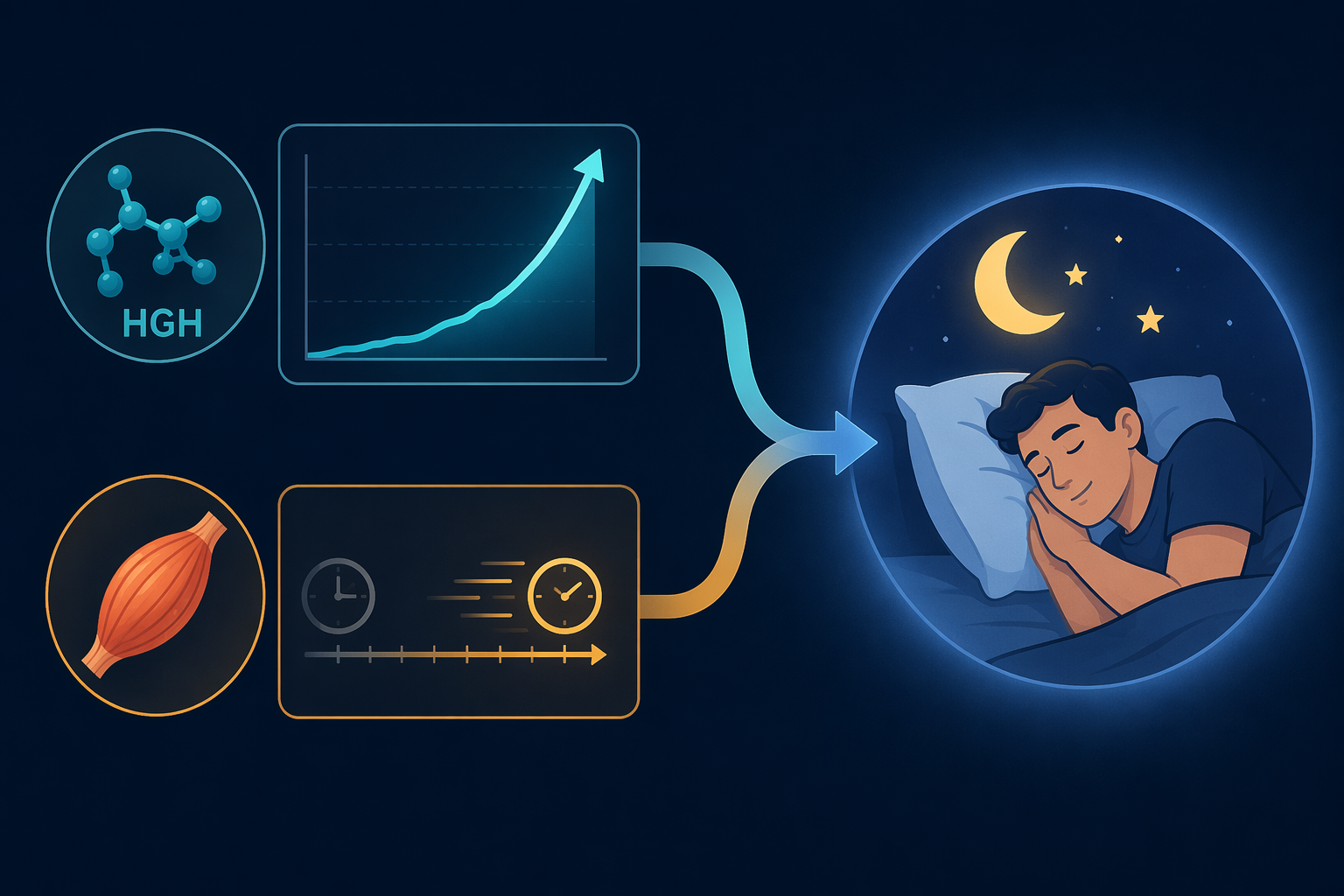
The sleep connection is biologically appealing because growth hormone is already tied to sleep physiology, especially the early-night period when slow-wave sleep is most prominent. A training method that acutely raises growth hormone can reasonably make a recovery-minded person wonder whether it supports the same overnight repair environment that good sleep normally helps provide.
Still, a hormone spike after training is not evidence of better sleep architecture. The BFR trial measured an endocrine response after a specific protocol in young physically active men.[3] It did not show that participants slept longer, spent more time in slow-wave sleep, or woke feeling more restored. The correct reading is narrower: BFR can provoke a large acute growth hormone response under studied conditions, and that response fits a plausible recovery pathway. It does not turn BFR into a proven sleep-stage intervention.
Less soreness may matter more than the hormone headline
For everyday sleep after training, soreness may be the less glamorous but more practical mechanism. Page and colleagues reported that BFR accelerated recovery from exercise-induced muscle damage by about 24 hours compared with placebo.[4] That kind of result does not need to promise deeper sleep to matter. If the quadriceps stop complaining sooner, the night may involve fewer uncomfortable turns, less bracing before standing up, and less low-level awareness of damaged tissue.
This is where BFR becomes more useful as a recovery-sleep idea. It may not need to directly alter the brain’s sleep stages to help the sleeper. It may help by reducing one of the things that keeps the body noisy at night: muscle damage, tenderness, and the restless scanning that comes with them.
That also connects BFR to a broader recovery problem. Poor sleep and injury risk sit close together for active people, and the relationship is not only about discipline or bedtime routines. A sore, under-recovered body is harder to train well and harder to sleep in. For a deeper look at that loop, Restful Ground’s guide to how poor sleep increases your risk of sports injury is the more direct place to start.
The evidence chain, without overselling it
| Question | What current evidence supports | What it does not yet prove |
|---|---|---|
| Does BFR improve sleep quality? | Improved self-reported sleep quality in MS and RLS clinical studies. | Better sleep architecture in healthy athletes. |
| Does BFR create a strong recovery signal? | Large acute growth hormone increases in a trial of young physically active men. | That the GH spike causes better sleep. |
| Does BFR reduce post-exercise disruption? | Faster recovery from exercise-induced muscle damage by about 24 hours compared with placebo. | That every user will feel less nighttime soreness. |
| Can BFR backfire near bedtime? | BFR can acutely raise perceived exertion and mood disturbance. | A universal cutoff time that works for all people. |
This is the cleanest way to hold the evidence: direct sleep findings are promising but self-reported and clinical; mechanistic findings are strong enough to be interesting but indirect; recovery findings are practical but not identical to sleep outcomes. The pieces fit together better than a random supplement claim, but they do not yet form a sleep-treatment claim.
There is also a theoretical adenosine angle that should stay in the “possible” drawer. Exercise can influence sleep pressure, and BFR is metabolically demanding despite low loads. It is reasonable to wonder whether that metabolic stress affects sleep drive. But the current BFR sleep evidence does not directly establish an adenosine-specific mechanism, so it should not be treated as one of the proven pathways.
Timing matters because BFR can feel harder than it looks
The low-load label can mislead people into treating BFR as automatically bedtime-friendly. That is not a safe assumption. Evidence summarized in a systematic review notes that BFR can acutely increase perceived exertion and mood disturbance.[5] Anyone who has finished a deceptively light session with burning limbs and a slightly irritated nervous system will recognize the problem.
This creates a practical tension. The same session that may reduce mechanical strain and support recovery can still be an acute stressor. If it is placed too close to bedtime, the sleeper may be dealing with elevated effort, discomfort from the cuffs, or residual agitation instead of settling down. The better use case is not “do BFR at night to sleep better.” It is “use BFR intelligently within a training or rehab plan so the total recovery burden is lower.”
- If BFR leaves you mentally keyed up, avoid placing it in the final part of the evening.
- If the goal is rehabilitation or reduced joint loading, treat sleep improvement as a possible downstream benefit, not the primary dose target.
- If soreness is what disrupts your sleep, track nighttime comfort and next-morning recovery alongside training load.
- If you have MS, RLS, vascular disease, clotting risk, or other medical concerns, BFR belongs in a clinician-guided plan.
Who should be most cautious with the conclusion
Healthy athletes should be especially careful about borrowing confidence from clinical findings. The MS and RLS studies matter because they show sleep-related improvements where sleep disruption is already clinically meaningful.[1][2] They do not tell us whether a healthy cyclist, CrossFit athlete, or recreational lifter will see the same PSQI change after adding BFR accessories twice a week.
Sex differences are another weak point. The growth hormone trial behind the 423% figure studied young physically active men.[3] Protocols built heavily from male samples may not transfer cleanly to women, older adults, or people with different hormonal and recovery profiles. That does not make the findings useless. It makes them narrower than the marketing version.
The best current judgment is modest but useful: BFR training may support sleep recovery indirectly by combining a strong acute recovery signal with less muscle-damage burden than some heavier training routes. It is more defensible as a recovery tool that may help sleep than as a direct sleep-improvement method.
For the active adult deciding whether to try it, the question is not whether BFR hacks sleep. It does not have that evidence. The better question is whether lower-load training can help you keep doing the remedial work, reduce soreness, and arrive at bedtime with less physical noise. That is a quieter claim, but it is the one the current evidence can actually carry.
References
- Effects of Blood Flow Restriction Training on Sleep Quality in Middle-Aged Adults with Multiple Sclerosis, MDPI, 2023.
- Effect of Blood Flow Restriction Training on Restless Legs Syndrome Symptoms and Sleep Quality in Patients with Restless Legs Syndrome, IJFMR, 2024.
- Effects of blood flow restriction resistance training with different rest intervals on hormonal responses and muscle damage in young men, BMC Sports Science, Medicine and Rehabilitation, 2022.
- Blood flow restriction accelerates recovery from exercise-induced muscle damage, PubMed, 2017.
- Perceptual responses to blood flow restriction resistance exercise: a systematic review, PMC.


Comments
Join the discussion with an anonymous comment.