
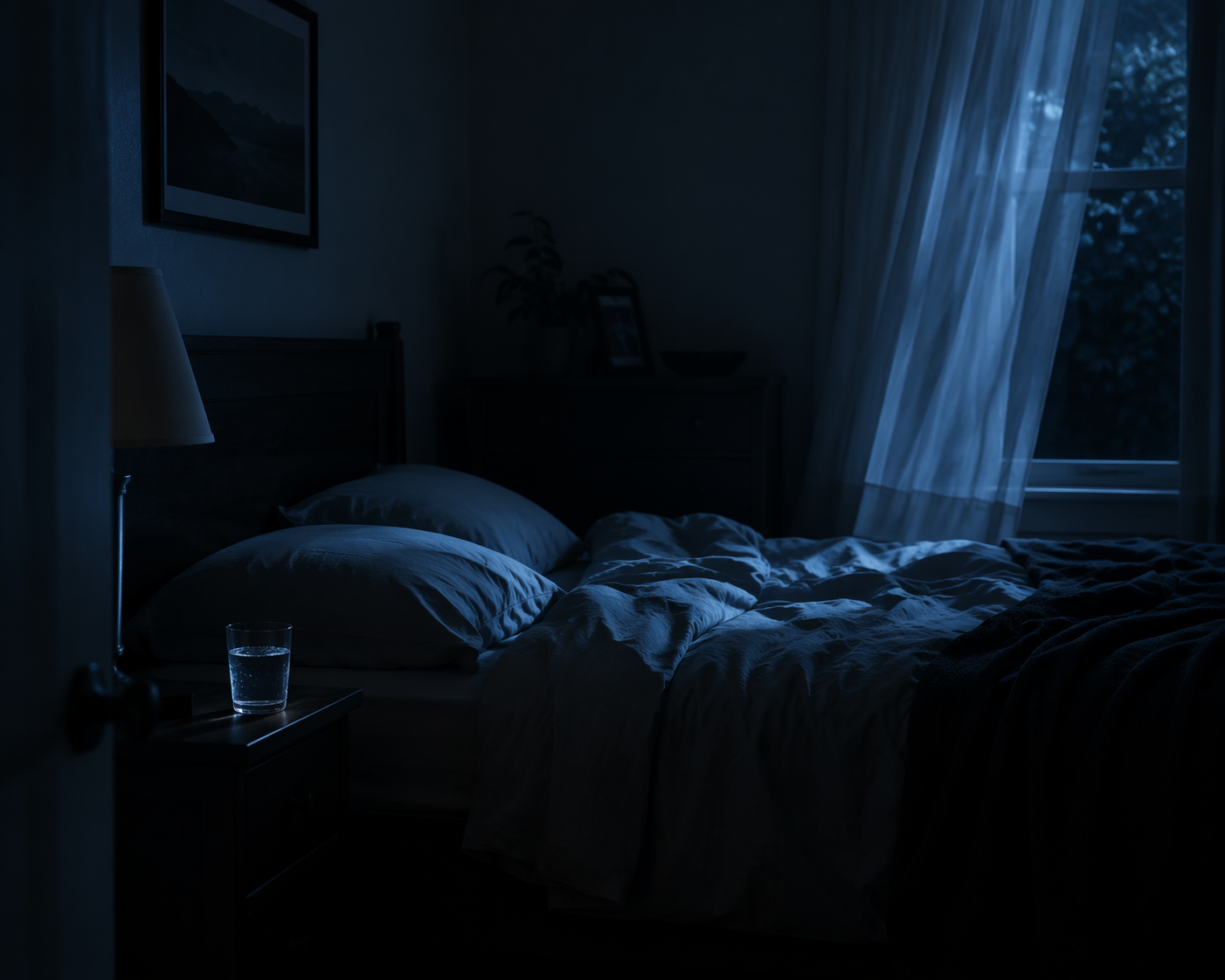
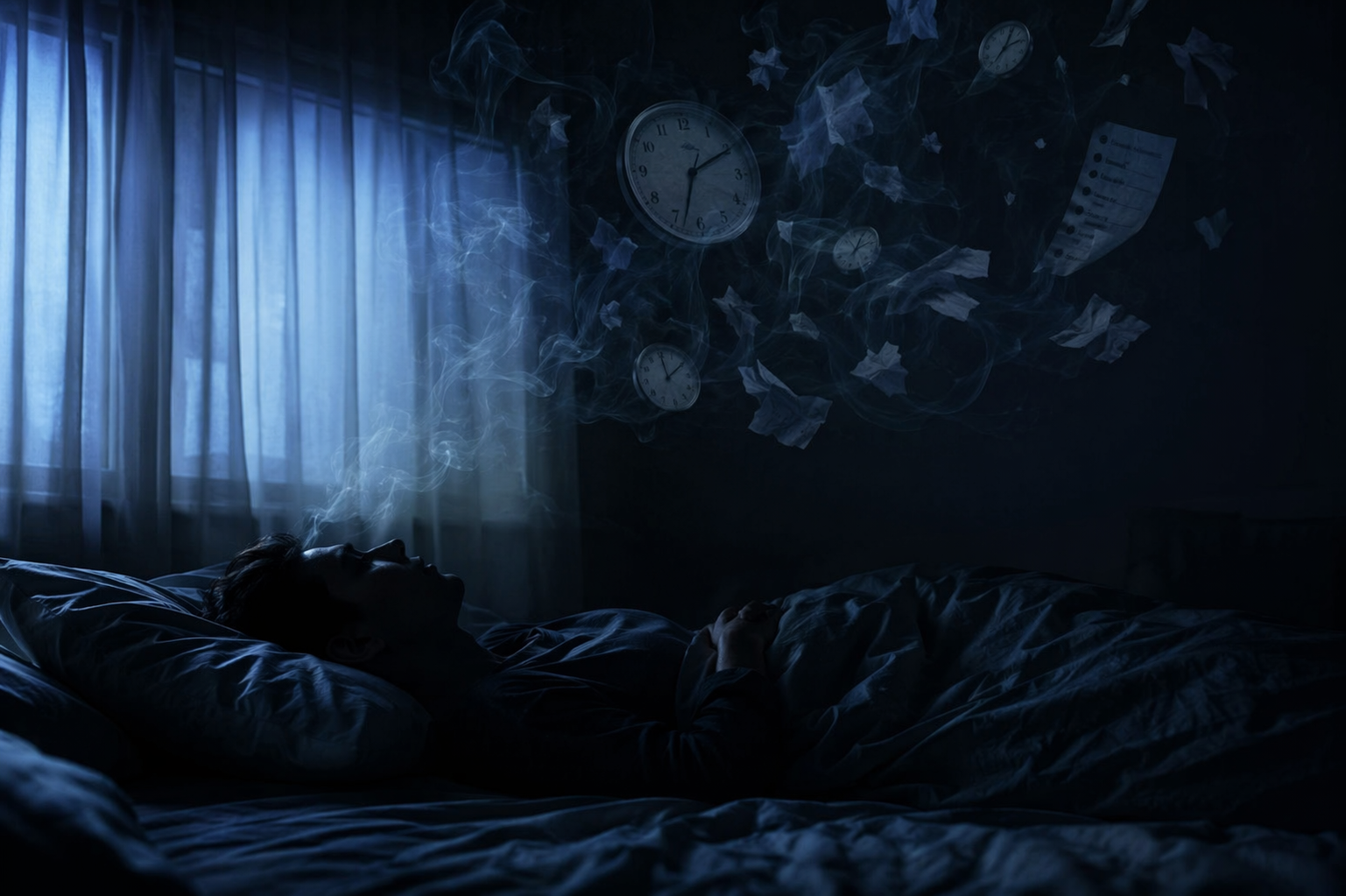
The bedroom can look unchanged after an earthquake. The lamp is still upright. The ceiling has not cracked. The bed is the same bed. But at night, the room may stop behaving like a place where the body stands down.
A truck passes outside and the mattress seems to answer. The water glass on the nightstand becomes something to check. A settling wall, a heater click, a curtain moving in the dark—ordinary sounds begin arriving with a question attached. For many people, sleep quality in the earthquake aftermath changes in exactly this private, hard-to-explain way: the danger has passed, but sleep now feels like a poor time to be unavailable.
That change is not limited to people whose homes collapsed or who were physically injured. After the 2010 Haiti earthquake, 94% of surveyed survivors reported insomnia symptoms in a study of 165 people, and a synthesis cited by the American Academy of Sleep Medicine noted that 69% to 83% of earthquake survivors across multiple studies scored above the clinical threshold for poor sleep quality on the Pittsburgh Sleep Quality Index, or PSQI.[1] Those numbers come from self-reported sleep questionnaires, not overnight laboratory recordings, so they should be read as evidence of perceived sleep disruption rather than proof of specific sleep-stage changes. Still, the pattern is difficult to dismiss.
Why the body keeps watch after the shaking stops
Sleep depends on more than tiredness. It depends on permission. The brain has to believe that dropping awareness is safe enough. An earthquake attacks that permission at its most basic level because it makes the resting place itself feel unreliable. The floor, walls, bed, and nighttime silence—usually background cues of safety—can become reminders that the environment once moved without warning.
This is where hyperarousal and hypervigilance enter. Hyperarousal is the body’s raised alarm state: faster readiness, lighter sleep, more scanning, more difficulty shifting into sustained rest. Hypervigilance is the attention pattern that goes with it. At bedtime, a person may listen for low rumbles, monitor hanging objects, mentally rehearse where to stand, or keep one part of awareness attached to the room even while trying to fall asleep.
That behavior can be exhausting without being irrational. During an earthquake, rapid detection matters. Afterward, the same safety logic can become costly because sleep requires the opposite: reduced monitoring, reduced muscle readiness, and enough trust in the surroundings to let perception narrow.
Fear of recurrence is especially disruptive because earthquakes do not come with a clean psychological ending. The first event may be over, but aftershocks, news alerts, inspection reports, and visible cracks can keep the nervous system oriented toward the next one. Research on earthquake survivors has linked fear of death after an earthquake with poorer sleep quality, although the source confirms the finding through the title and abstract rather than fully accessible full text.[2]
Living conditions can compound the same mechanism. Someone sleeping in a shelter, car, crowded relative’s home, or room with visible damage is not simply “stressed.” They may be trying to sleep in a setting with noise, light, temperature swings, shared space, interruptions, and fewer familiar cues. Even when the body wants to rest, the environment may keep supplying reasons to stay partially alert.
The sleep disruption zone can be wider than the damage zone
One of the most useful findings for understanding earthquake-related sleep is that poor sleep does not map neatly onto visible destruction. The 2009 L’Aquila earthquake study followed this problem by distance from the epicenter and found clinically significant sleep disturbance within about 70 kilometers, while disruptive nocturnal behaviors were observed within about 40 kilometers.[3] That is a larger and stranger footprint than a simple damage map would predict.
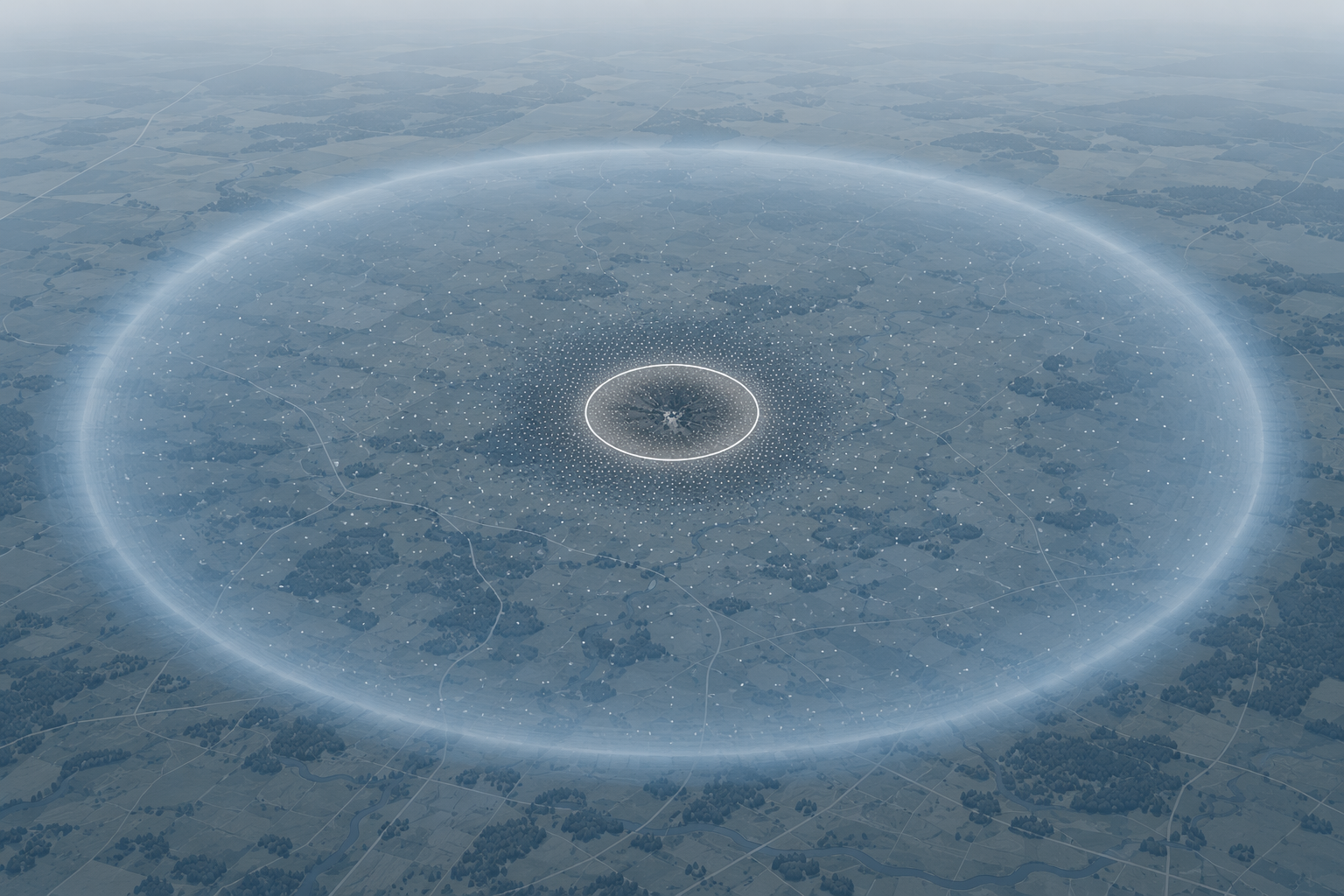
Two years after the L’Aquila earthquake, people living within 70 kilometers still had PSQI scores above the clinical cutoff, with an average score of 6.33 compared with 4.52 in controls.[3] The study does not mean every person in that radius slept badly, and it does not prove that distance alone caused each sleep problem. It does show that sleep disturbance can remain measurable well beyond the area where outsiders would expect the aftermath to be concentrated.
| Evidence | What it helps explain |
|---|---|
| 94% of surveyed Haiti earthquake survivors reported insomnia symptoms | Post-quake sleeplessness can be common among exposed survivors, not a rare personal reaction |
| 69% to 83% of survivors across multiple studies scored above the PSQI poor-sleep threshold | Questionnaire-based poor sleep appears repeatedly across earthquake settings |
| L’Aquila sleep disturbance extended within about 70 km of the epicenter | The sleep impact can reach beyond the most visibly damaged zone |
| L’Aquila PSQI scores remained above cutoff two years later | The aftermath can persist long after the event itself |
The PSQI matters here because it captures how people experience their sleep: quality, duration, latency, disturbance, medication use, daytime dysfunction, and related domains. It is not the same as polysomnography, which records brain waves and sleep architecture. For a reader trying to understand why sleep feels worse, however, subjective sleep quality is not a trivial outcome. It is the lived problem.
Poor sleep can persist even when people seem resilient
The Haiti findings are also important because they resist a comforting assumption: that psychological resilience automatically protects sleep. Two years after the 2010 earthquake, 42% of surveyed survivors had clinically significant PTSD and 22% had depression, and the study reported that resilience did not buffer sleep disturbance.[1] That does not make resilience meaningless. It means sleep can remain vulnerable even when a person is functioning, coping, or not outwardly falling apart.
Longer-term evidence points in the same direction. Sleep disturbance has been documented two years after L’Aquila and 10 years after the Wenchuan earthquake.[3][4] These time spans should be interpreted carefully because communities, housing recovery, health systems, and cultural context differ across Italy, China, Haiti, Türkiye, and the United States. But the repeated signal is that earthquake sleep disruption is not necessarily confined to the first frightened nights.
Recent Türkiye earthquake studies add another piece. Reported mean PSQI scores around 9 to 11 have been observed in affected populations, including a reported 11.10 ± 3.44 among Türkiye 2023 survivors.[5][6] Since PSQI scores above 5 are commonly treated as indicating poor sleep quality, those averages describe a population-level burden, not just a few outliers.
Some groups carry more of the sleep burden
Age and life stage change what earthquake aftermath asks of sleep. Older adults may face medical vulnerability, mobility concerns, medication disruption, bereavement, and a sharper loss of familiar routines. Research focused on older earthquake-affected populations has reported worse sleep deterioration after earthquakes.[5]
Adolescents show another version of the problem. In one post-earthquake study, 65.7% of adolescents were sleeping less than seven hours per night 9 to 12 months after the quake.[7] Short sleep in that age group is not just a nighttime complaint; it can spill into attention, mood regulation, learning, family conflict, and daytime recovery.
These findings do not mean every older adult or teenager will sleep poorly after an earthquake. They do mean that “the house is standing” is too narrow a way to judge who may still be affected. The body’s sense of safety is shaped by dependence, mobility, caregiving responsibilities, school demands, health status, and where a person has to sleep after the event.
Anxiety and sleep can start feeding each other
After an earthquake, anxiety can disturb sleep directly: a person lies down, remembers the shaking, anticipates another event, and becomes physiologically alert. Then poor sleep can make the next day’s anxiety more likely. Fatigue lowers emotional bandwidth. Normal sensations feel harder to interpret. A small vibration becomes more convincing. The next bedtime arrives with more evidence that sleep is unsafe.
The association can be large. In a study of adolescents after an earthquake, earthquake anxiety was associated with a 5.721-times higher risk of poor sleep after controlling for other factors.[7] That odds ratio should not be read as proof that anxiety alone causes all post-quake sleep problems. It does show that quake-specific anxiety is not a side detail when sleep deteriorates.
This loop is also why advice that begins and ends with “relax before bed” often feels inadequate. The problem is not only a busy mind. It is a conditioned nighttime alarm response, reinforced by aftershocks, disrupted routines, environmental uncertainty, and the memory that the room once failed to be still. Readers looking specifically at how treatment can interrupt that loop may find a fuller discussion in CBT-I for earthquake anxiety and sleep.
What the evidence can and cannot say
The research base is strong enough to take post-earthquake sleep worsening seriously, but it has boundaries. Much of the published evidence comes from non-US disasters, including earthquakes in Haiti, Italy, China, and Türkiye. Physiological arousal after threat is not unique to one country, but housing quality, insurance systems, shelter arrangements, family structure, media exposure, and disaster response can all shape how sleep is affected and how long the disruption lasts.
The measurement issue also matters. Many studies rely on the PSQI, which asks people to report their sleep quality and related problems. That is appropriate for studying perceived sleep burden, but it does not tell us whether a person has less slow-wave sleep, more awakenings on an EEG, or a particular change in REM sleep. The evidence is clearest on this point: survivors often experience their sleep as worse, and that worsening can be clinically meaningful.
Even with those cautions, the convergence is notable. High rates of insomnia symptoms, elevated PSQI scores, distance-dependent findings, vulnerable age groups, and long follow-up windows all point away from the idea that post-quake sleep trouble is merely a short-lived overreaction.
The changed bedroom is part of the aftermath
The person jolting awake in an intact room is not inventing a problem because the worst did not happen to them. Earthquake aftermath sleep quality can worsen through a cascade: the body stays vigilant, the mind anticipates recurrence, mortality threat becomes harder to dismiss, familiar safety cues lose authority, and the sleeping environment may become noisier, colder, brighter, more crowded, or less private.
Understanding that cascade does not make sleep return on command. It does something more modest and necessary: it places the symptom where it belongs. Post-earthquake sleep worsening is common, measurable, biologically plausible, and sometimes long-lasting, even when the building is still standing and the person appears resilient.
References
- Disturbed sleep linked to mental health problems among earthquake survivors, American Academy of Sleep Medicine
- The Effect of Fear of Death on Sleep Quality After Earthquake, Journal of Psychosocial Nursing and Mental Health Services, 2024
- Sleep and Emotional Processing in the Aftermath of the 2009 L’Aquila Earthquake, PLOS ONE, 2013
- Sleep disturbances among survivors of the Wenchuan earthquake 10 years after, Sleep Medicine, 2021
- Sleep quality and related factors in older adults after the 2023 Turkey earthquake, Nursing Open, 2025
- Sleep quality after the February 6 earthquakes in Türkiye
- Post-earthquake sleep quality and earthquake anxiety among adolescents, Scientific Reports, 2025
Comments
Join the discussion with an anonymous comment.