
You can know, perfectly well, that the earthquake is over and still feel your bed tilt, sway, buzz, drop, or pulse in the dark. That is the particular cruelty of post-earthquake sleep disturbance: the room is still, the phone says there is no new alert, but your body keeps checking the floor.
This sensation is often described as a phantom earthquake sensation. It can show up as rocking, floating, low vibration, a tiny elevator-drop feeling, or the sense that the mattress moved when nothing around you did. It is not a diagnosis by itself, and it is not proof that anything dangerous is happening in the room. It is also not well explained by telling yourself to “just calm down.” The balance system can keep reporting movement after a quake, especially when you are lying still at night and your brain has fewer visual cues to correct the signal.
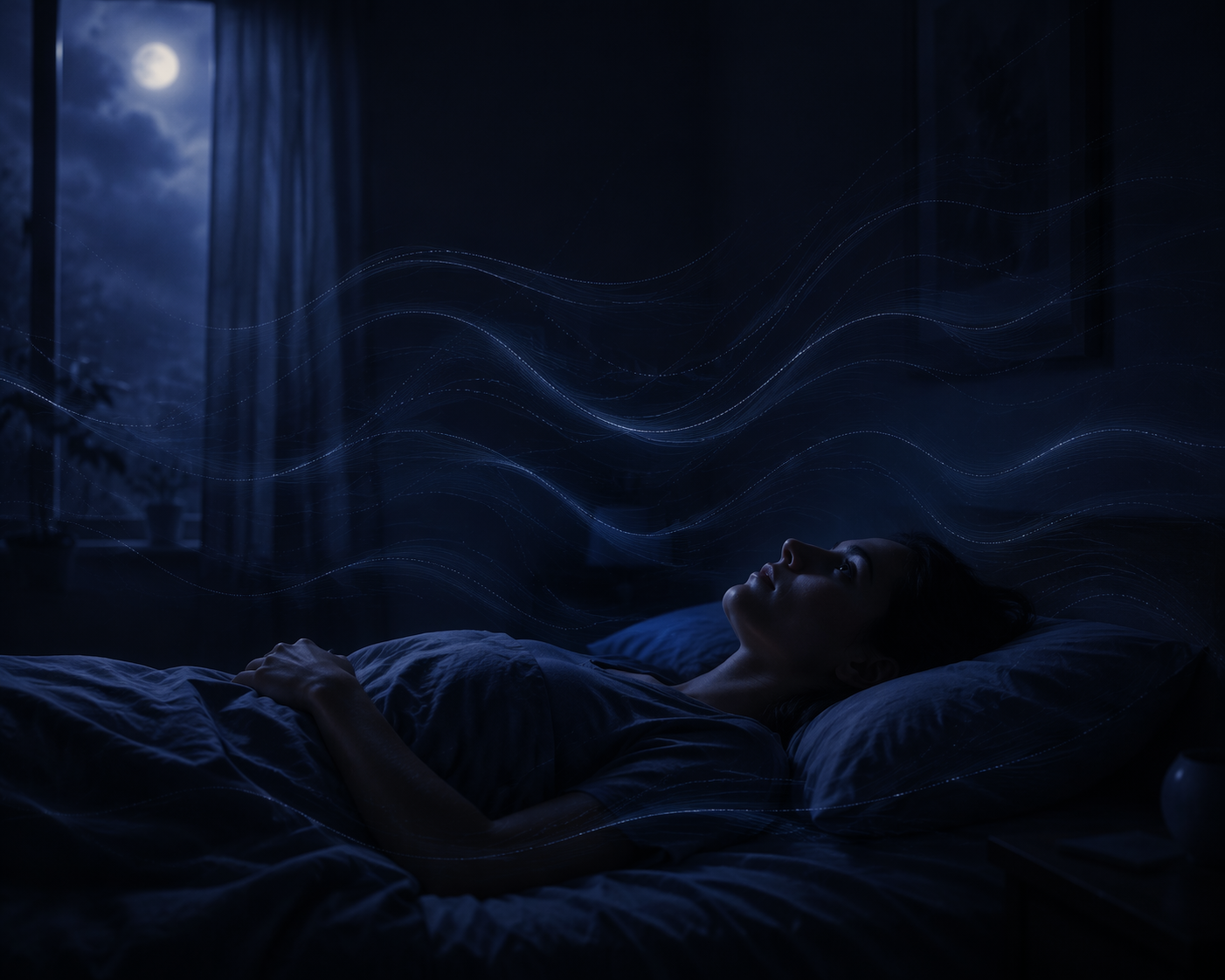
The useful question is not whether you are anxious after an earthquake. Many people are. The useful question, at 2 a.m., is why the feeling gets louder when you lie down and what can interrupt it without turning bedtime into another round of threat monitoring.
Why Stillness Can Feel Like Motion After an Earthquake
Your inner ear is not only for spinning dizziness. Part of it, the otolith organs, helps detect gravity and linear acceleration: forward and back, up and down, side to side. During an earthquake, the body receives low-frequency vibration input in a range reported as 0.1–3.5 Hz, the kind of slow movement that can be felt as swaying or rocking rather than sharp shaking.[1]
After the event, that system may remain sensitized. Ordinary body signals—breathing, heartbeat, small muscle shifts, the tiny adjustments that happen when you lie still—can become ambiguous. In daylight, while standing or looking around, your eyes and body position provide competing evidence: the wall is not moving, the chair is stable, the floor is flat. In a dark bedroom, those anchors disappear. The brain has less visual information available to overrule the vestibular signal, so a small internal sway can be interpreted as external motion.
That is why this symptom can feel so physical. It may be happening in the same sensory machinery that normally tells you where gravity is. Calling it “imagined” misses the point. The movement is not actually in the room, but the perception is being assembled from real signals.
A 2026 cross-sectional study in Frontiers in Public Health tied phantom earthquake sensations to context, perceptual ambiguity, and cognitive intrusion. One of its most practical findings was that people who experienced the earthquake at home reported more frequent and prolonged phantom sensations than people who were at work.[1] That matters because home is not a neutral setting afterward. The bedroom, the floor, the mattress, the quiet hour when the quake happened or could have happened again—these can all become cues.
This does not mean your home is unsafe. It means your nervous system may be treating the place where the body first registered danger as a place that still deserves special monitoring. At bedtime, monitoring has very little to do except listen inward.
The Anxiety Piece Is Real, but It Is More Specific Than “You’re Stressed”
Post-earthquake sleep disruption is common enough that your insomnia does not need to be treated as a personal failure. In earthquake-affected populations, reported average Pittsburgh Sleep Quality Index scores have ranged from 9.28 to 11.10, above the clinical cutoff of 5.[1] An American Academy of Sleep Medicine report on survivors of the 2010 Haiti earthquake described insomnia in 94% of survivors.[2]
Still, those broad sleep numbers do not explain the strange bed-motion feeling by themselves. The more revealing clue is the type of distress linked to the sensation. The 2026 Frontiers study reported that earthquake anxiety correlated specifically with the cognitive intrusion or re-experiencing dimension of post-traumatic stress, with ρ = 0.375 and p = 0.004, rather than with generalized hyperarousal.[1]
In plain language: the problem is not simply that your body is “too wound up.” The sensation may spike when the earthquake memory intrudes into the half-awake, half-asleep state. A tiny body sway becomes a cue; the cue brings the quake back; the memory sharpens the monitoring; the monitoring makes the next tiny sway easier to notice.
That loop is different from ordinary worry. It is also why generic sleep advice can feel insulting. If the mattress seems to move every time you relax, being told to relax harder does not give your balance system new information.
Other research supports the broader link between earthquake anxiety and poor sleep, though it does not prove that anxiety alone causes phantom sway. A 2025 study of adolescent survivors 9–12 months after the great earthquakes in Türkiye found that high earthquake anxiety was associated with 5.7 times the odds of poor sleep quality.[3] Among older survivors of the Tōhoku disaster, PTSD symptoms and sleep quality have also been studied as bidirectionally linked over time, which fits the clinical reality that bad sleep can intensify threat processing, and threat processing can further damage sleep.[4]
A Targeted Reset for the Balance System
If you are in immediate danger, smell gas, see structural damage, receive an evacuation alert, or feel a new earthquake, follow emergency guidance first. The suggestions here are for the more maddening situation where you have checked that the room is still and safe enough, but your body keeps reporting motion.
The goal is not to argue with the sensation. The goal is to give the brain cleaner sensory input and stop the bed from becoming the place where you repeatedly rehearse the quake.
| If the main problem is... | Try this first | Why it fits |
|---|---|---|
| The room feels like it is rocking when you lie still | Gaze stabilization | It gives the vestibular system a clear visual target while the head moves |
| The sensation returns whenever you notice it | Gentle habituation | It lets the brain meet the feeling in a controlled, non-emergency setting |
| You keep checking whether another quake is starting | A bounded safety check plus stimulus control | It separates reasonable preparation from repeated threat rehearsal |
| Your muscles feel braced or ready to run | Progressive muscle relaxation | It reduces the body tension that can mimic alarm physiology |
Gaze Stabilization: Give Your Brain a Fixed Point
Sit upright on the edge of the bed or in a stable chair. Choose one stationary object at eye level: a light switch, a small mark on the wall, a door handle, a sticky note. Keep your eyes fixed on that object. Then turn your head slowly side to side while your gaze stays locked on the target.
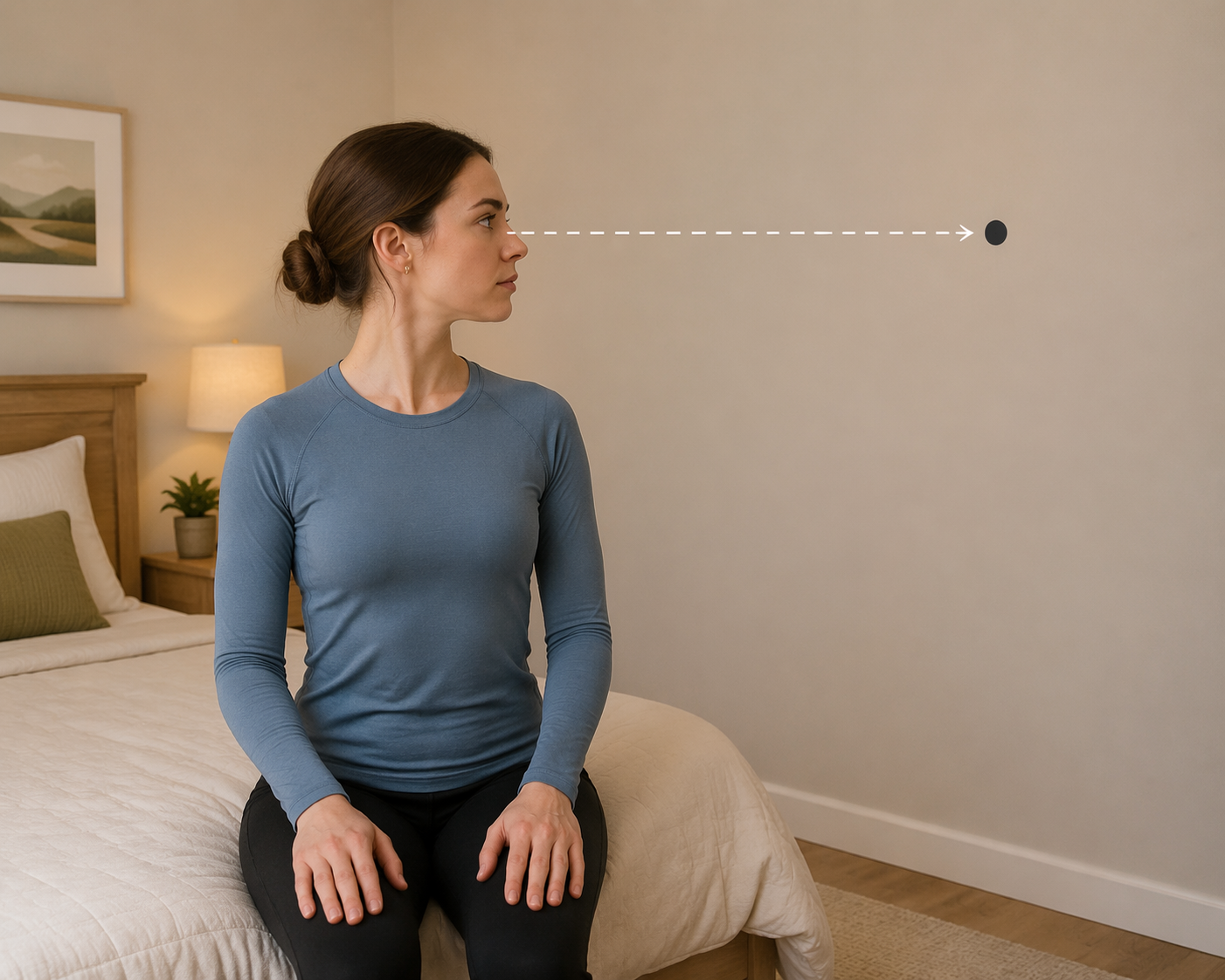
- Start with 10 slow turns to each side, or fewer if symptoms rise quickly.
- Keep the target clear enough that your eyes do not drift around the room.
- Use a small head turn at first; this is not a neck stretch or a speed test.
- Pause if you become strongly dizzy, nauseated, faint, or unsafe.
This is different from general relaxation. Gaze stabilization works through the vestibular-ocular reflex, the reflex that helps keep vision steady while the head moves. After an earthquake, the brain may be over-weighting ambiguous inner-ear motion signals in the dark. A fixed visual target plus controlled head movement gives the system a cleaner pairing: my head is moving, my eyes can stay stable, the wall is not moving.
A 2025 case report described a patient with chronic post-earthquake dizziness whose pharmacological treatment failed, but who fully recovered after vestibular rehabilitation that included gaze stabilization exercises, balance training, and habituation protocols.[5] That is one case, not a guarantee and not a randomized trial. It is still useful because the treatment matched the mechanism. The symptom was approached as a vestibular problem, not only as distress that needed to be sedated.
Habituation: Meet the Sensation Without Letting It Take Over
Habituation is the part people often misunderstand. It does not mean provoking yourself into panic. It means deliberately touching a mild version of the sensation in a setting you control, then letting the nervous system learn that the feeling can rise and fall without requiring emergency action.
For a bedtime version, sit on the bed with your feet on the floor and gently sway your upper body a small amount from side to side for a few seconds. Stop. Let the room come back into focus. Notice whether the after-sensation fades. If that is too activating, do it while seated in a chair instead of on the bed. The aim is mild familiarity, not endurance.
Some people do better using standing balance work during the day, when the room is well lit and there are stable visual references. For example, standing near a counter and gently shifting weight from one foot to the other can give the vestibular system controlled movement practice without pairing the exercise with the dark bedroom.
A Bounded Safety Check, Not an All-Night Watch
After an earthquake, some checking is reasonable. The trouble begins when checking becomes the bedtime ritual that teaches the brain: we are still in the event. If you have been lying awake and scanning for movement for more than about 20 minutes, get out of bed briefly. Do one small, practical safety check: confirm your phone is charged, your flashlight is reachable, and any emergency bag or shoes are where you intend them to be. Then stop.
The boundary is the treatment. A two-minute check can answer the reasonable part of the alarm. Re-checking the same objects every few minutes feeds the intrusion loop. If you return to bed and the sensation starts again, use the gaze target or a short muscle relaxation sequence rather than reopening the safety audit.
Progressive Muscle Relaxation Can Help, but It Is Supporting Cast
Progressive muscle relaxation is worth using when your body feels braced. Starting at the feet and moving upward, tense one muscle group gently for a few seconds, then release it. Calves, thighs, hands, shoulders, jaw. Keep the effort moderate; clenching hard can make you more alert.
This can reduce the ready-to-run muscle tone that often follows a frightening event. It may also make internal body sensations less sharp. But if your main symptom is the false perception that the mattress is moving, muscle relaxation alone may not be enough. Pair it with a vestibular reset rather than treating it as the whole answer.
What Not to Overread
The science on phantom earthquake sensations is still young. The most directly relevant studies and case literature are recent, and the vestibular rehabilitation evidence includes case-level support rather than large randomized trials. Cross-sectional findings can show associations and patterns; they cannot prove every person’s symptom has the same cause or that one exercise will work for everyone.
Commercial sleep-tracker data can be timely but should be read with extra caution. For example, Sleeptracker reported Bay Area sleep-pattern changes after a 4.2 earthquake in 2026, but that kind of platform analysis comes from a proprietary device dataset, not a peer-reviewed clinical study.[6] It can suggest that sleep changes after a local quake are visible at scale; it should not be used to diagnose your individual vestibular symptoms.
Vitamin D sometimes comes up because otolith function depends on calcium-related inner-ear biology, and deficiency has been linked in vestibular literature to some balance disorders. That makes screening reasonable if symptoms persist or if you already have risk factors for deficiency. It is not a same-night fix for phantom swaying after a quake, and it should not replace evaluation for ongoing dizziness.
When the Symptom Belongs With a Clinician
Most post-earthquake phantom sway that appears in bed, comes and goes, and improves with light, visual anchoring, or vestibular exercises is understandable as a context-sensitive sensory problem. Still, some symptoms should not be handled by another night of searching.
- Seek urgent care for new weakness, facial droop, trouble speaking, severe sudden headache, fainting, chest pain, or new confusion.
- Get medical evaluation for persistent spinning vertigo, worsening imbalance, repeated vomiting, falls, hearing loss, or one-sided ear symptoms.
- Ask about vestibular rehabilitation if dizziness or phantom motion keeps disrupting sleep after the immediate post-earthquake period.
- Seek trauma-informed mental health care if intrusive memories, avoidance, panic, or sleeplessness are expanding rather than settling.
Medication may have a role for some people, especially when insomnia, panic, or another medical condition needs treatment. But for the specific feeling that the bed is moving when it is not, the more precise target is often the vestibular-reexperiencing loop: give the eyes a fixed point, give the balance system controlled practice, and keep safety checking bounded. The promise is not instant sleep on command. It is that the sensation has a body-based logic, and that logic gives you something better to do than lie still and wait for the floor to confess.
References
- Phantom earthquake sensations: a cross-sectional analysis of context, perceptual ambiguity, and cognitive intrusion, Frontiers in Public Health, 2026.
- Disturbed sleep and mental health problems in natural disaster survivors, American Academy of Sleep Medicine.
- Earthquake anxiety and sleep quality among adolescent survivors 9–12 months after the great earthquakes in Türkiye, Nature, 2025.
- Bidirectional associations between PTSD symptoms and sleep quality among older Tōhoku survivors, Yazawa et al., 2023.
- Phantom earthquake syndrome presenting with chronic dizziness after an earthquake: A case report, 2025.
- How the 4.2 2026 Bay Area Earthquake Impacted Sleep Patterns, Sleeptracker.com, 2026.



Comments
Join the discussion with an anonymous comment.