
The strange part is not that you are awake at midnight. The strange part is that you may be exhausted, fully aware that tomorrow will be worse, and still feel a small rush of relief when you open the app, start the next episode, make the snack, or sit in silence after everyone else has stopped needing you.
That hour can feel irrational from the outside. From the inside, it often feels like the first honest hour of the day. No meeting is starting. No child is asking. No inbox is rearranging your mood. No one is turning your attention into a shared resource. Ending the day can feel less like resting and more like handing over the last unclaimed piece of yourself.
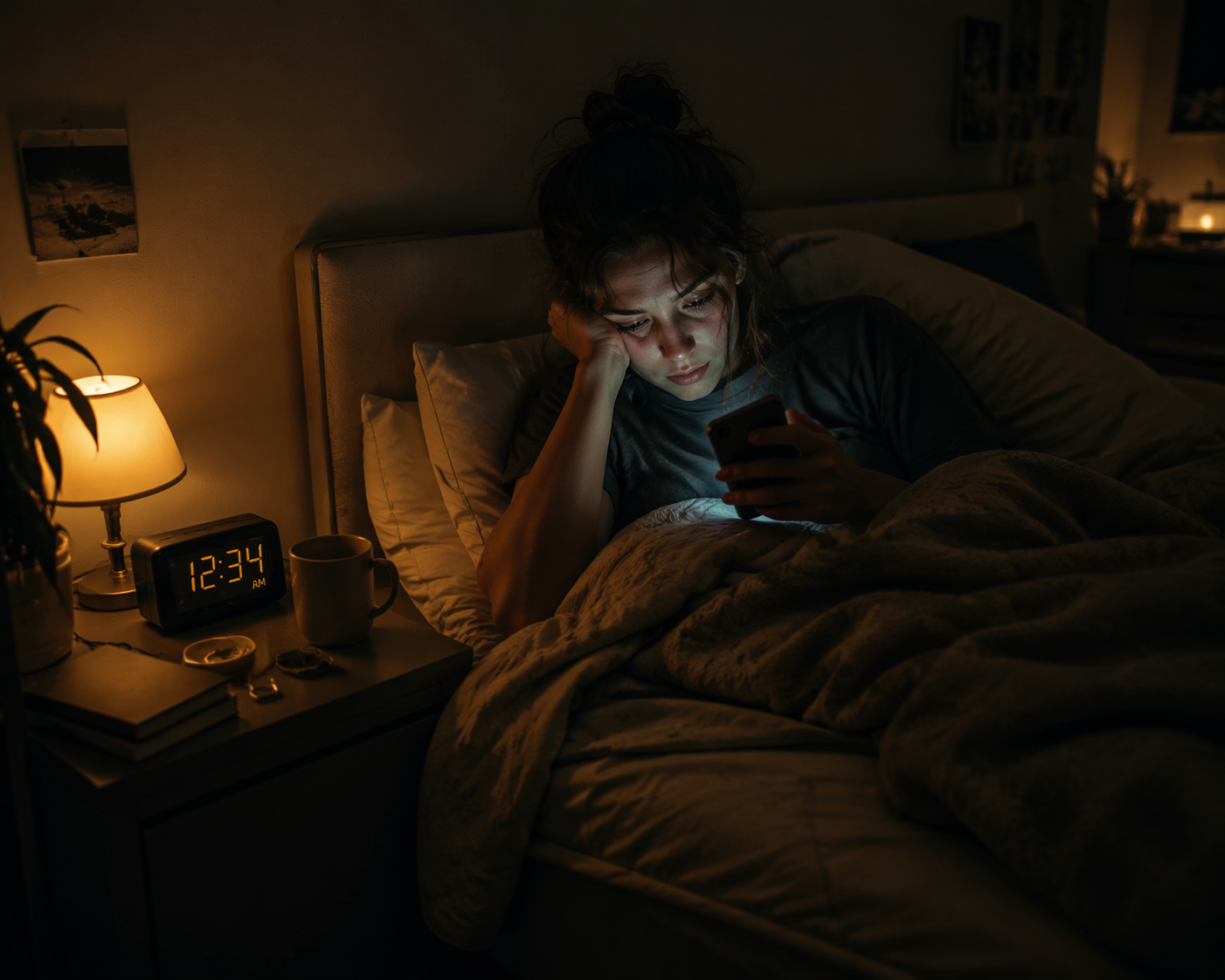
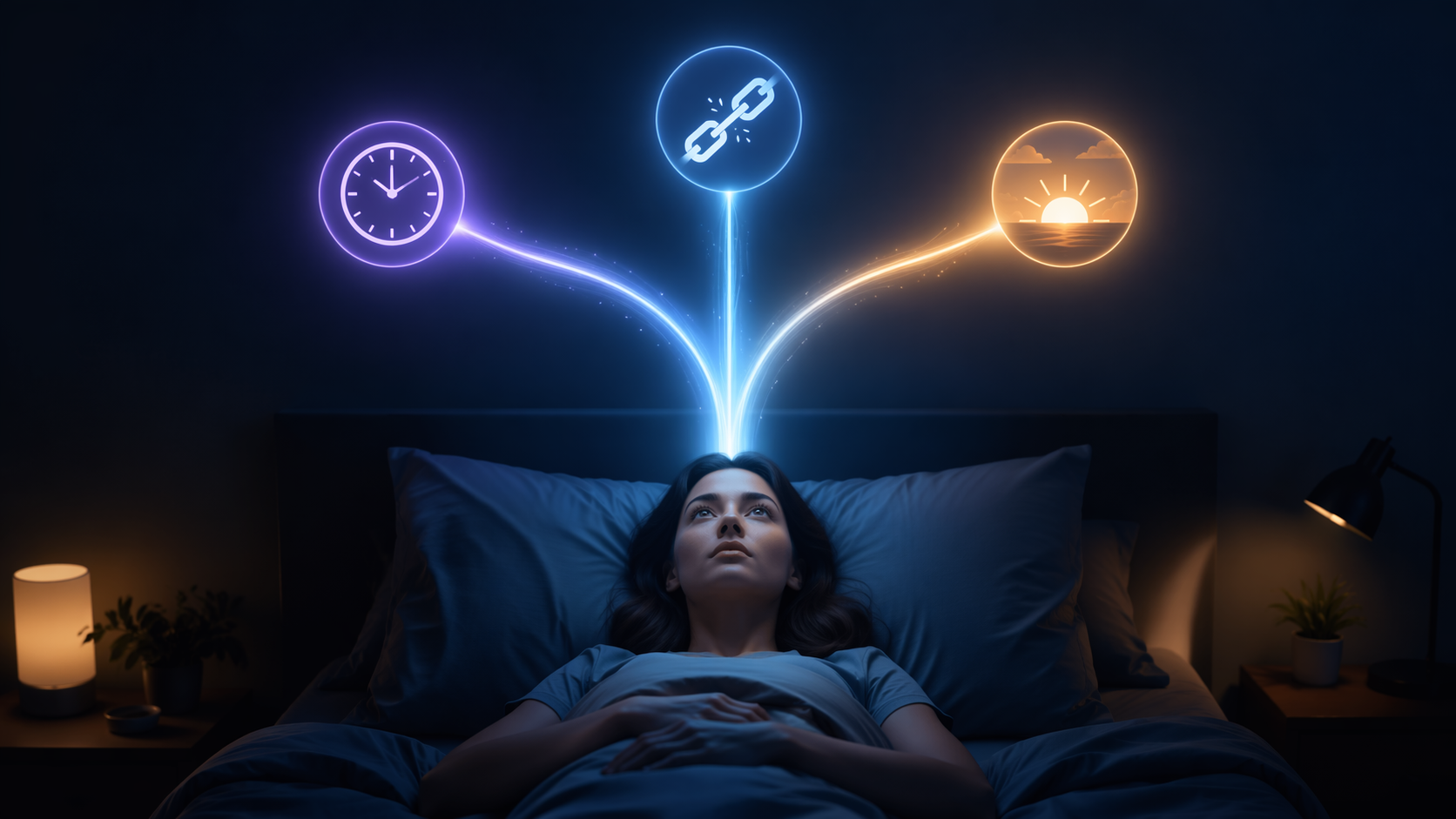
Revenge bedtime procrastination names that conflict. Sleep researchers generally distinguish it from an ordinary late night by three features: bedtime is delayed without an external reason, the person expects the delay to have negative consequences, and the person still chooses to delay sleep anyway.[1] The term is often traced to the Chinese phrase bàofùxìng áoyè, commonly translated as revenge bedtime procrastination, which captured the feeling of staying up late as a kind of retaliation against a day that left too little personal freedom.[1]
That definition matters because not every late bedtime belongs in this category. A nurse coming home after a late shift is not procrastinating. A parent awake with a sick child is not choosing delay without an external reason. Someone who lies in bed for hours unable to sleep may be dealing with insomnia rather than revenge bedtime procrastination. And someone whose body clock consistently drifts much later may need to think about circadian timing, not just habit change.
For many adults, though, the pattern is painfully specific: there is no emergency, sleep is possible, the consequences are obvious, and the delay still feels emotionally necessary.
The Problem Is Not That You Forgot Sleep Matters
Most advice about breaking bad habits for better sleep assumes the missing ingredient is seriousness. It says to put the phone away, keep a bedtime, stop scrolling, make better choices. Technically, much of that advice is not wrong. It is just badly timed. It asks for more discipline at the exact point in the day when discipline has already been spent.
A 2025 survey commissioned by Avocado Green Mattress and conducted by Talker Research found that 96% of 2,000 American adults reported engaging in revenge bedtime procrastination, with an average reported sleep loss of 332 hours per year. The same survey found that 63% of respondents said nighttime was the only time they had for themselves.[2] Because the survey was commissioned by a mattress company, it should not be treated as the final scientific measurement of the problem. Still, the second number is the one that explains why the behavior has such a grip.
The late night is not always about entertainment. Sometimes it is about ownership. The show, the game, the scroll, the quiet kitchen, the long shower, the aimless internet loop—these are often vehicles for a deeper claim: I get to choose something now.
That is why the usual command to “just go to bed” can land like one more demand. If the whole day has trained a person to respond, accommodate, produce, and absorb interruption, bedtime may become the first moment when refusing the sensible option feels like proof of freedom.
How the Loop Feeds Itself
Revenge bedtime procrastination usually has a simple surface sequence and a more punishing hidden one.
| Part of the loop | What it can feel like | What it does to tomorrow |
|---|---|---|
| Daytime autonomy deficit | Everyone else’s needs arrive first | Personal time starts to feel scarce |
| Evening reclaim urge | The night finally feels open | Sleep begins to look like another obligation |
| Late-night wakefulness | The scroll, show, snack, or quiet hour feels deserved | Sleep time shrinks |
| Poor sleep and reduced self-control | The next day starts foggier and more reactive | The next night’s choices get harder |
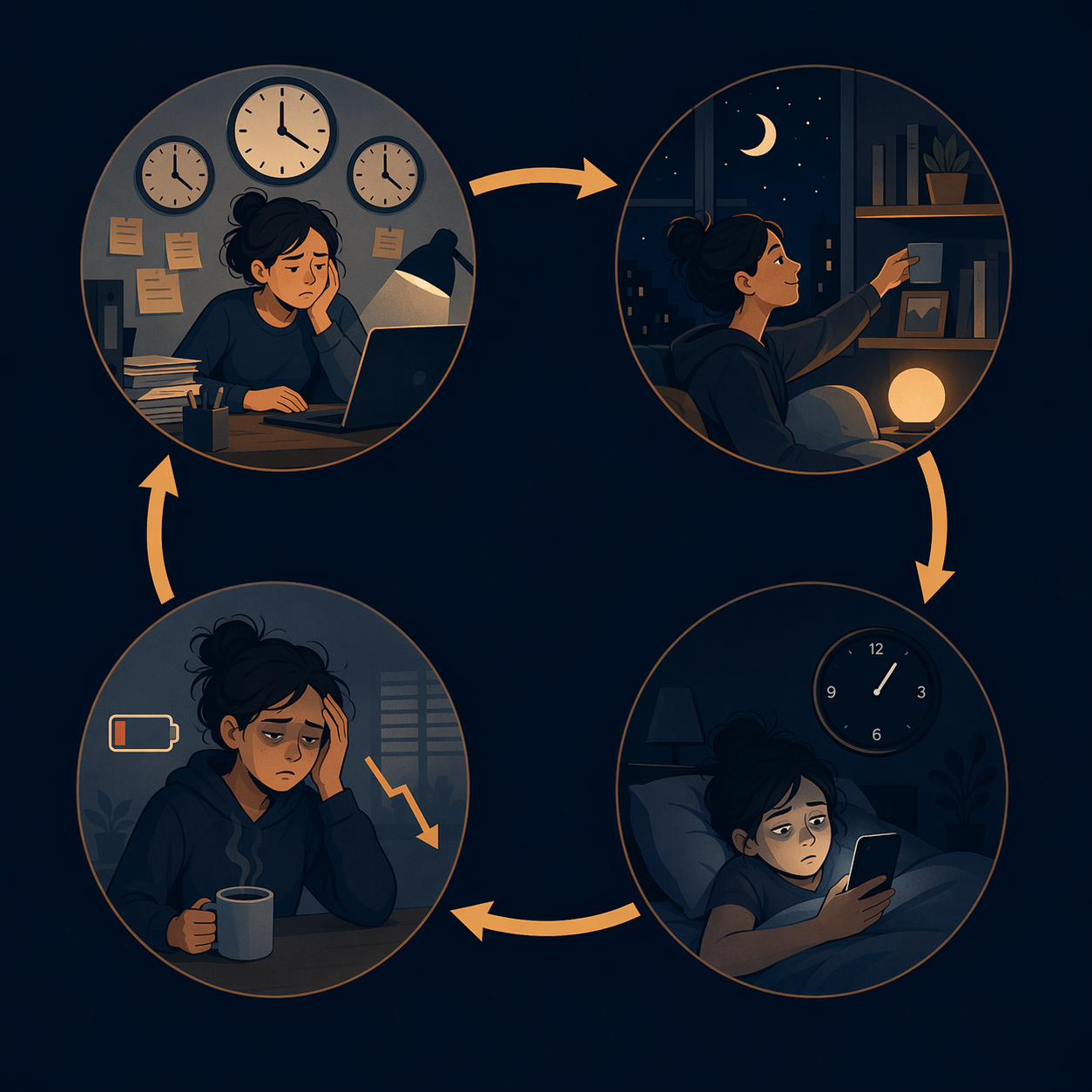
The cruel part is that the behavior borrows from the same system it needs to repair. A bad night does not just make the next morning unpleasant. Sleep loss can weaken the self-control needed to stop the pattern the next evening, creating the negative spiral described in sleep procrastination research.[1]
That does not mean the person is helpless. It means the target is different. If the late-night habit is doing an emotional job, the solution has to account for that job. Removing the phone, canceling the show, or setting a stricter bedtime may work for a few nights. But if no other part of the day protects private time, the old bargain returns: tomorrow’s body pays for tonight’s autonomy.
Screens are a common delivery system for this bargain because they are private, portable, rewarding, and endless. They also create sleep problems through more than one pathway, including stimulation and bedtime displacement. If the device is the main vehicle for your delay, it may help to look separately at how technology affects sleep. But the device is rarely the whole story. The more important question is what the device is letting you avoid, reclaim, or feel.
Find the Need Hidden Inside the Habit
Breaking this habit starts with a more respectful diagnosis than “I lack discipline.” The behavior is costly, but it is usually not random. It may be providing decompression, privacy, stimulation, transition, comfort, control, or a sense that the day included at least one chosen thing.
A useful first pass is not a sleep tracker. It is a short inventory of what the late-night delay is doing.
- If you scroll because no one can interrupt you there, the need may be privacy.
- If you watch one more episode because the day felt all duty and no pleasure, the need may be reward.
- If you snack, shop, or game because you feel emotionally flat, the need may be stimulation.
- If you resist getting into bed because it means tomorrow is coming, the need may be transition or control.
- If you stay up doing nothing in particular, the need may simply be unscheduled time.
This distinction changes the plan. A person who needs stimulation does not need the same substitute as a person who needs quiet. A person who needs privacy may resent a family wind-down routine that looks healthy on paper. A person who needs transition may not benefit from being told to leap from chores straight into sleep.
The point is not to justify the lost sleep. It is to stop treating the late-night behavior as if it exists for no reason.
Move the Reward Earlier, Not Out of Your Life
The replacement has to preserve the reward while lowering the cost. If the only plan is subtraction—no phone, no show, no snack, no fun—the plan creates the same deprivation that made the habit attractive.
A better question is: where can the need for personal time go so it stops stealing sleep?
For many people, the answer is not a dramatic evening overhaul. It is a protected, earlier, lower-friction version of the same emotional function. The activity should be satisfying enough to count, but not so open-ended that it quietly becomes the new midnight.
| If the late-night habit gives you... | Try moving this earlier... | Why it may work better |
|---|---|---|
| Privacy | A 20-minute closed-door reset after dinner | It gives solitude before exhaustion makes boundaries harder |
| Reward | One planned episode, chapter, hobby block, or game round with a defined stop | It keeps pleasure in the evening without making sleep the enemy |
| Stimulation | Music, a puzzle, light tidying with a podcast, or a short creative task | It gives the brain something to engage with before the danger zone |
| Transition | A repeated sequence such as shower, tea, dim lights, then reading | It gives the day an exit ramp instead of a hard stop |
| Unscheduled time | A deliberately blank block with no productivity goal | It protects the feeling of freedom without pushing it past bedtime |
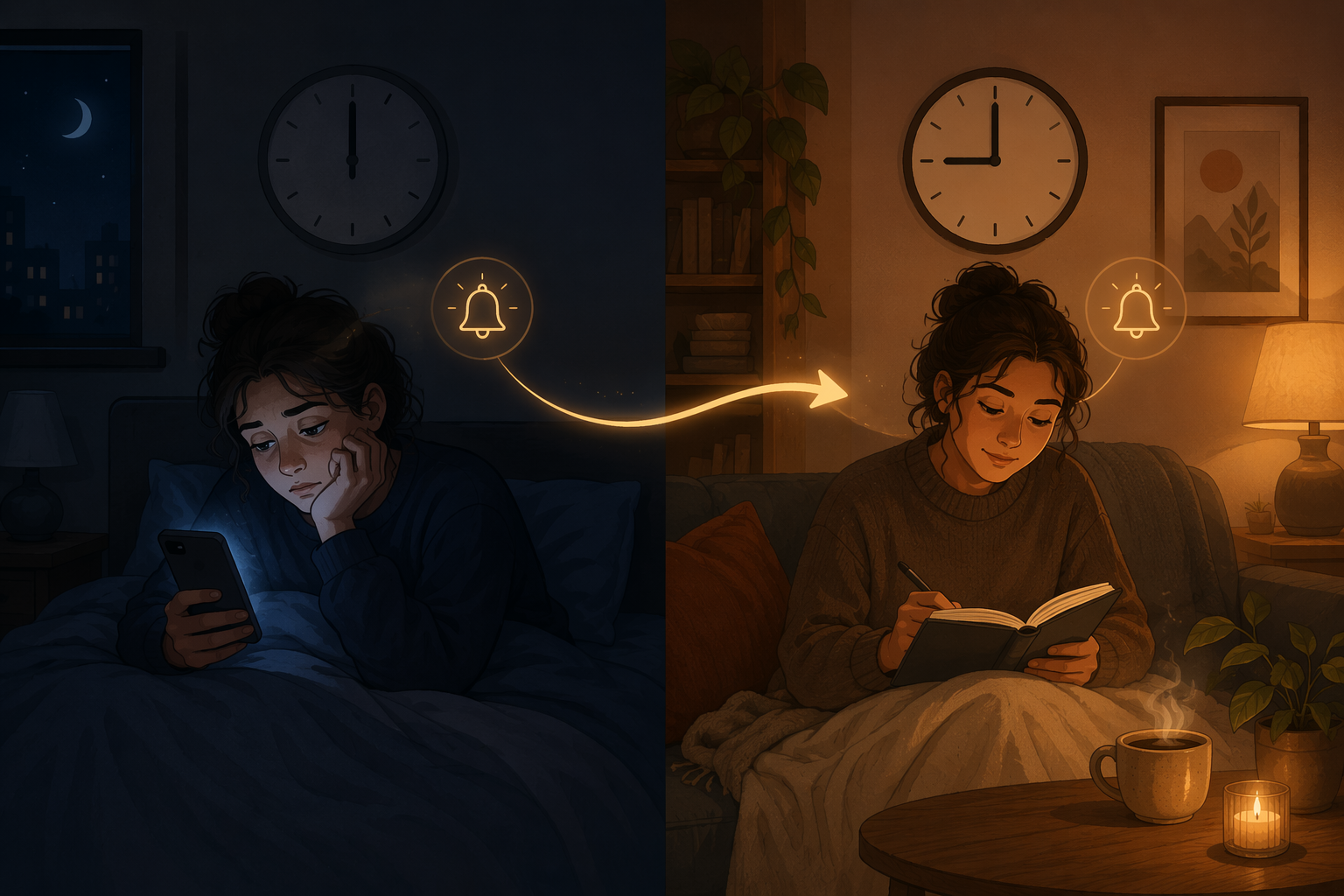
The word “earlier” is doing real work here. A reclaim-time ritual that begins when you are already in bed, tired, and resentful has to compete with algorithms, cliffhangers, impulse, and the feeling that stopping means losing. A ritual that begins before the final collapse of the evening has a better chance of remaining chosen rather than compulsive.
The substitute should also be easier than the habit it replaces. If the old routine is thumb, screen, reward, then the new routine cannot require twelve steps, a perfect mood, and a clean living room. Put the book where the phone usually lands. Download the podcast before evening. Leave the tea mug out. Set the puzzle on the table. Make the desired action visible and low-effort before the part of you that negotiates at midnight takes over.
Anchor the New Routine to a Cue You Already Have
Habits become more automatic when a behavior is repeated in a consistent context. Gardner and Lally’s review of habit formation in general practice describes how repetition in stable circumstances helps actions become less dependent on active deliberation.[3] That is the useful part for bedtime procrastination: the goal is not to win a nightly debate forever. The goal is to make the better sequence start with less debate.
Choose a cue that already happens most nights. It might be loading the dishwasher, closing a laptop, putting a child to bed, taking medication, feeding a pet, brushing teeth, or plugging in the phone. Then attach the reclaim-time substitute to that cue.
- After I close my laptop, I sit somewhere that is not my bed for 20 minutes of chosen downtime.
- After the kitchen is done, I make tea and read one chapter.
- After the kids are asleep, I take 15 minutes alone before starting the rest of the evening tasks.
- After I plug in my phone outside the bed, I switch to the lower-stimulation activity I already picked.
The cue matters because “I will go to bed earlier” is too vague to survive a tired brain. A cue turns the plan into a specific sequence: when this happens, I do that. It also moves the decision earlier, before the late-night version of you has to make the whole choice from scratch.
Research on habit formation is often simplified into a magic timeline, but the better reading is more patient. One study frequently cited in habit research found that automaticity developed after an average of 66 days, while also finding wide variation between people and behaviors; importantly, missing one performance did not prevent habit formation.[3] That study was not specifically about sleep routines, so 66 days should not be treated as a bedtime guarantee. It is a useful warning against expecting a three-night personality change.
Missing a night is not evidence that the plan failed. It is part of the terrain. Shame is a poor sleep tool. It keeps the old story alive: I already ruined it, so I may as well stay up. A more useful response is boring and immediate: return to the cue the next night, make the substitute smaller if needed, and keep the chain ordinary.
Design the Stop Before You Start
A replacement routine still needs an edge. Without one, the earlier reward simply expands until it becomes the old problem in a nicer outfit.
The stop should be decided before the activity begins, not negotiated during it. That might mean one episode, one chapter, one playlist, one cup of tea, one puzzle section, one timed block, or one room reset. The cleaner the ending, the less the tired brain has to invent a reason to stop.
For screen-based habits, the stopping point has to be especially concrete. “A little scrolling” has no natural bottom. A show with autoplay, a feed with refresh, or a game with rolling rewards is built to keep offering the next small reason. This is where a practical boundary can be kinder than a motivational one: decide the endpoint while you still respect tomorrow.
If the first boundary feels too strict, shrink the target rather than abandoning it. Moving a midnight habit to 11:30 p.m. is not a complete repair, but it may be the first honest evidence that the loop can move. Once it moves, it can move again.
Protect the Earlier Window Like It Counts
This is the part that often gets skipped. Earlier downtime only works if it is treated as real time, not optional fluff that gets eaten by chores, messages, and one more useful task. If the replacement window is always the first thing sacrificed, the body learns the old lesson again: the only safe personal time is late.
That may require a small act of household or workplace honesty. A parent may need to say that after a certain point, non-urgent requests wait. A remote worker may need to close the laptop before the night becomes a second shift. A caregiver may need a predictable handoff, even a short one. A person living alone may need to stop converting every quiet evening into overdue administration.
The window does not need to be luxurious. It needs to be believable. Ten minutes that actually happen can do more than an ideal hour that is always postponed until you are too tired to use it well.
If the knowing-doing gap is the hardest part—if you understand exactly what would help and still cannot seem to do it—it may be useful to separate knowledge from execution. That distinction is central to getting a good night’s sleep when knowing is not enough. Revenge bedtime procrastination lives in that gap.
When It May Not Be Revenge Bedtime Procrastination
Self-managed habit change is a reasonable place to start when the pattern is clear: you can sleep, you delay sleep, and the delay is tied to reclaiming time. But some sleep problems need a different frame.
- If you get into bed and cannot sleep despite wanting to, insomnia may be a better explanation than procrastination.
- If your natural sleep timing is consistently much later and earlier sleep feels biologically unreachable, a circadian rhythm issue may be involved.
- If daytime sleepiness is severe, persistent, or unsafe, the problem deserves clinical attention rather than another round of self-blame.
- If anxiety, depression, pain, medication effects, or caregiving demands are driving the nights, the bedtime habit may be only one part of the picture.
Cognitive behavioral therapy for insomnia, often called CBT-I, is an evidence-based treatment approach for chronic insomnia and is typically more structured than general sleep hygiene advice.[4] If the issue is persistent sleeplessness rather than chosen delay, that route is worth considering, along with guidance from a qualified clinician or a sleep specialist.
Breaking revenge bedtime procrastination does not mean eliminating evening pleasure. It means refusing to keep placing that pleasure in the danger zone where tiredness, screens, resentment, and tomorrow’s obligations make the worst bargain look reasonable. The need for personal time is real. The repair is to move that need earlier, give it a cue, make it repeatable, and stop asking tomorrow’s body to pay for tonight’s only freedom.
References
- Revenge Bedtime Procrastination: Why You Self-Sabotage at Night — Sleep Foundation
- Bedtime procrastination is stealing hundreds of hours of Americans' sleep: survey — NYPost, Jan 12, 2026
- Making health habitual: the psychology of 'habit-formation' and general practice — British Journal of General Practice, 2012
- CBT-I: How It Works — Sleep Foundation



Comments
Join the discussion with an anonymous comment.