
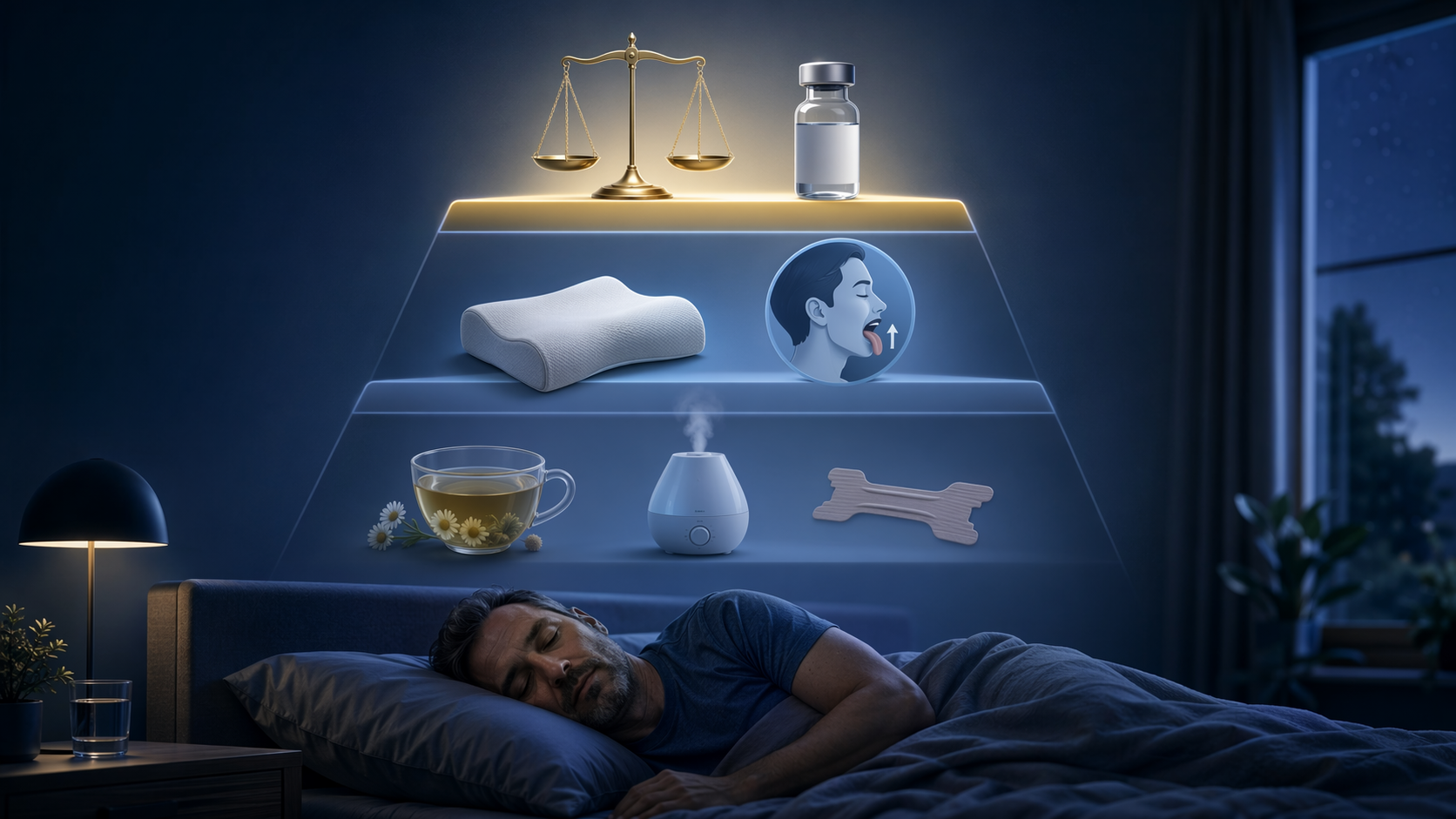
“Natural remedies for sleep apnea” is a messy category. It can mean losing weight, taking an FDA-approved obesity medication, sewing a tennis ball into a shirt, doing tongue exercises, buying a drugstore mouthguard, drinking tea, or rubbing mentholated ointment near the nose. Those things do not belong in the same evidence bucket.
This article belongs in the Sleep Conditions path, not the wellness-hacks aisle. Obstructive sleep apnea should be diagnosed and followed medically, especially if symptoms are severe, oxygen levels drop, or daytime sleepiness affects driving or work. If you need the basics first, start with the Sleep Apnea FAQ. If you are using a watch alert or app as your starting point, treat it as a screening clue, not a diagnosis; the same distinction matters in Apple Watch sleep apnea detection.
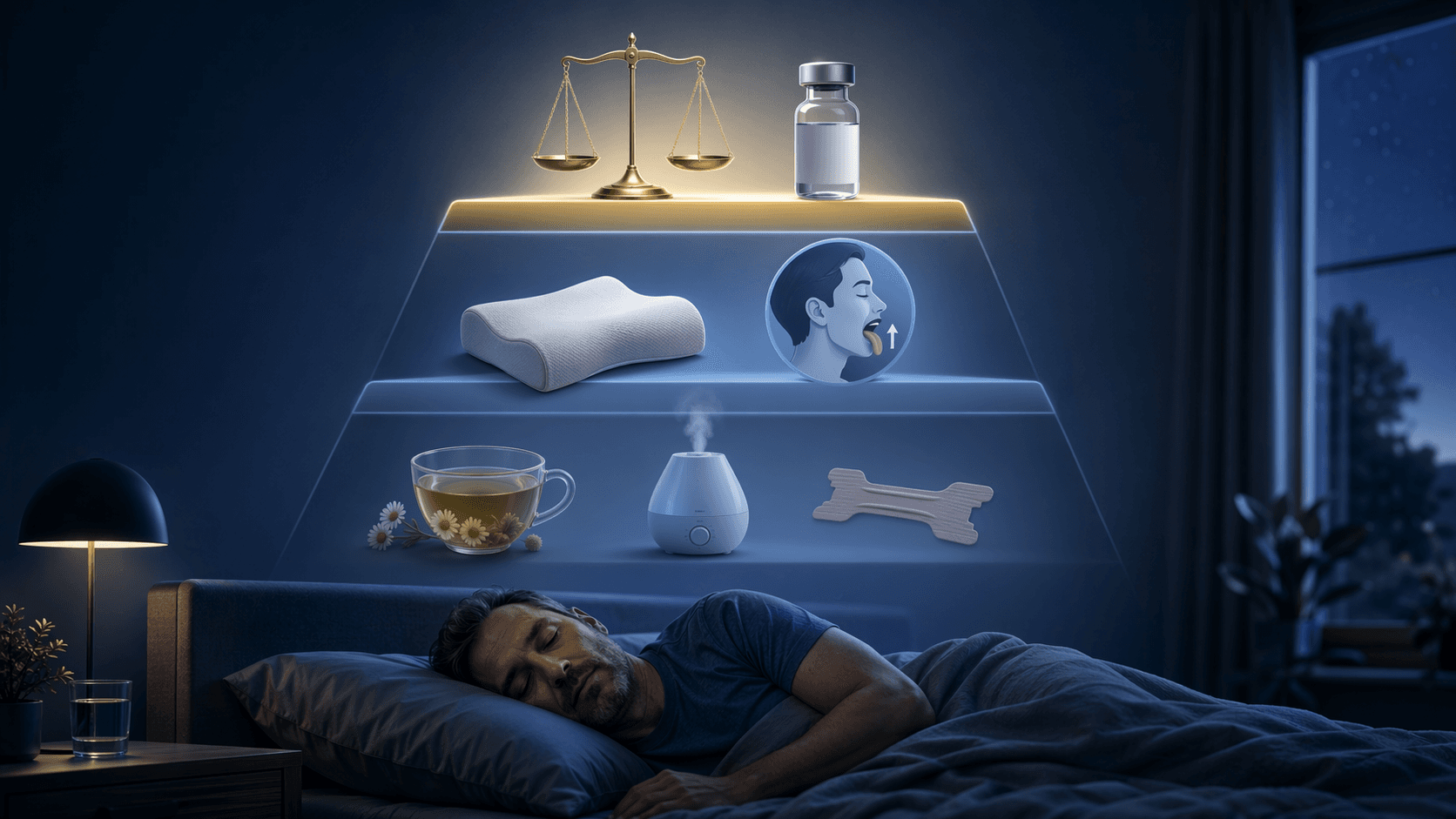
The useful question is not whether a remedy sounds natural. It is whether it reduces airway obstruction enough to change the apnea-hypopnea index, or AHI, in a meaningful way. AHI is not the only outcome that matters, but it is the metric most online remedy lists quietly avoid when the evidence gets thin.
| Evidence tier | Intervention | What the evidence supports | Best use |
|---|---|---|---|
| Strongest | Weight loss for people whose OSA is weight-related | A 10% weight loss was associated with about a 26% AHI reduction in the Wisconsin Sleep Cohort; lifestyle RCTs showed a smaller average AHI reduction versus control. | Core treatment target, often alongside CPAP or another prescribed therapy |
| Strongest for eligible patients with obesity | Tirzepatide / Zepbound | FDA-approved in 2024 for moderate-to-severe OSA with obesity; 52-week trials reported large AHI reductions. | Medical option to discuss with a clinician, not a casual supplement |
| Conditional | Positional therapy | Can help when OSA is clearly worse on the back, especially mild positional OSA. | Adjunct or targeted option after confirming positional pattern |
| Conditional and adherence-heavy | Oropharyngeal / myofunctional exercises | May improve sleepiness or sleep quality; adult AHI effects are less convincing unless training time is substantial. | Adjunct for motivated patients, not a replacement for care |
| Supportive but not primary | Diet changes, humidifiers, nasal strips, nasal comfort measures | May support weight loss, nasal comfort, or CPAP tolerance, but are not proven stand-alone OSA treatments. | Comfort and adherence support |
| Weak or inappropriate as treatment | Herbal teas, essential oils, Vicks VapoRub, OTC oral appliances | Little credible evidence for treating OSA itself; OTC mouthguards can be risky substitutes for fitted medical oral appliances. | Do not use as OSA treatment |
Weight Loss Changes the Scale of the Conversation
For adults whose obstructive sleep apnea is tied to excess weight, weight loss sits in a different evidence class from most “natural” remedies. The classic Wisconsin Sleep Cohort analysis found a dose-response pattern: a 10% weight loss predicted about a 26% decrease in AHI, while a 10% weight gain predicted about a 32% increase in AHI.[1]
That study is old; it was published in 2000. It is also still foundational because it describes something remedy marketing often skips: sleep apnea severity moves with body weight in a measurable direction for many patients. It does not prove that every person’s OSA will resolve with weight loss, and it does not mean thin people cannot have OSA. Jaw structure, airway anatomy, age, sex, alcohol, medications, nasal obstruction, and sleep position can all matter. But when weight is a major driver, the effect size is large enough to deserve first attention.
Randomized lifestyle trials show a more modest average effect. A 2013 meta-analysis in SLEEP pooled seven randomized controlled trials with 519 participants and found that lifestyle interventions reduced AHI by 6.04 events per hour versus control.[2] That is not a miracle number. It may be clinically useful, especially in milder disease or as part of combination treatment, but it also shows why vague advice to “eat clean” should not be presented as a cure.
The age of the evidence matters here. The 2013 review remains useful, but it is not a modern umbrella review of today’s obesity-treatment landscape. It predates the current era of highly effective anti-obesity medications. The safest reading is narrow: structured weight-loss interventions can reduce AHI on average, and larger, sustained weight loss can matter more, but patients still need follow-up testing rather than assuming symptoms equal disease control.
Zepbound Is Not a Home Remedy, but It Belongs in This Discussion
Tirzepatide, sold as Zepbound for this indication, complicates the word “natural.” It is not natural in the herbal-remedy sense. It is a prescription GLP-1/GIP medication. But if the reader’s real question is “what non-CPAP options reduce OSA severity,” it belongs near the top of the evidence map.
In December 2024, the FDA approved Zepbound as the first medication for moderate-to-severe obstructive sleep apnea in adults with obesity.[3] In the SURMOUNT-OSA trials, the FDA reported AHI reductions at 52 weeks of 25.3 events per hour in the non-PAP group and 29.3 events per hour in the PAP group.[3] The trial publication appeared in the New England Journal of Medicine in 2024.[4]
Those are large AHI changes. They are also specific changes in a specific population: adults with moderate-to-severe OSA and obesity. They should not be generalized to every person who snores, every person who dislikes CPAP, or every person with mild positional apnea. The approval is recent, and long-term real-world data beyond the 52-week trial window are not yet available.[3][4]
That uncertainty is not a reason to pretend the result is small. It is a reason to keep the category clean. Zepbound is a medical obesity treatment with OSA data, not a supplement, and it requires prescribing, monitoring, side-effect discussion, cost discussion, and a plan for what happens if the medication is stopped. Sleep Foundation’s GLP-1 overview makes the same basic distinction: these medications are part of medical care for selected patients, not an over-the-counter workaround.[5]
Positional Therapy Helps When Position Is the Problem
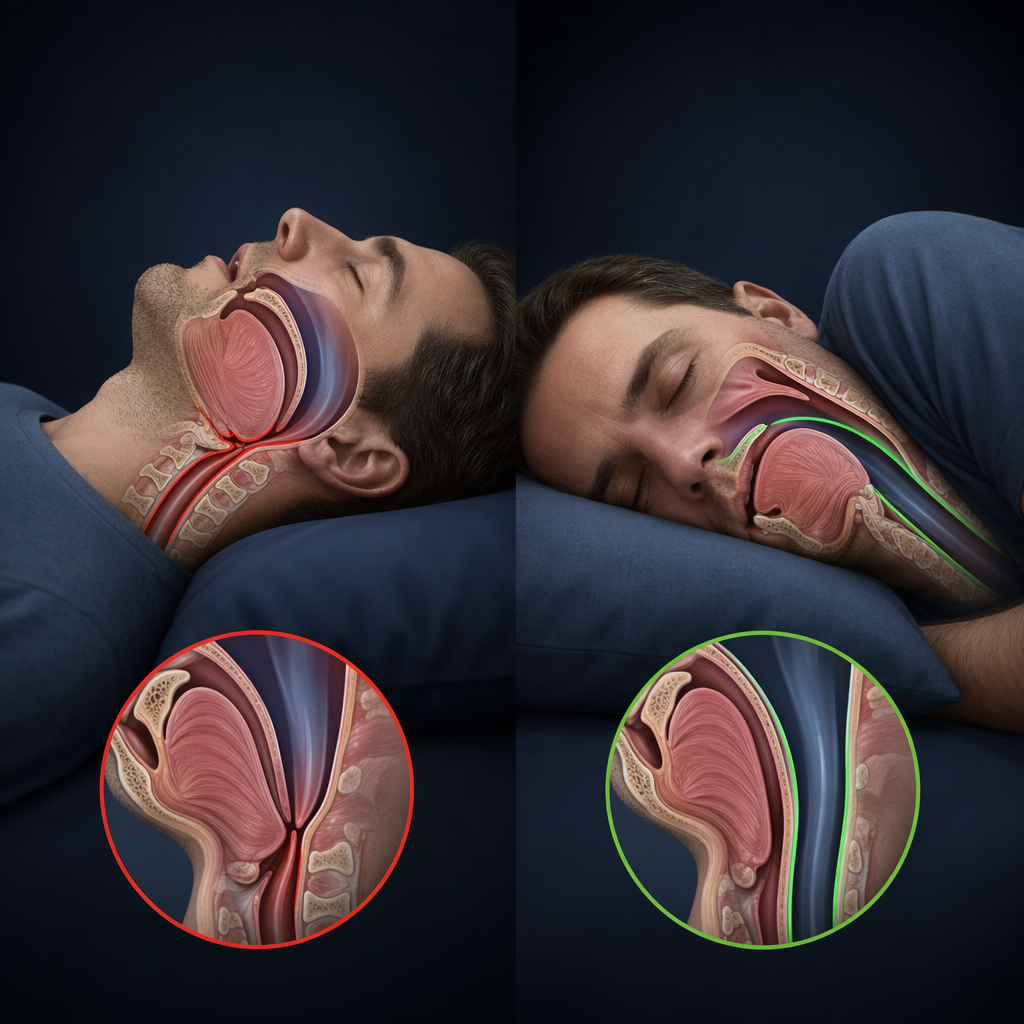
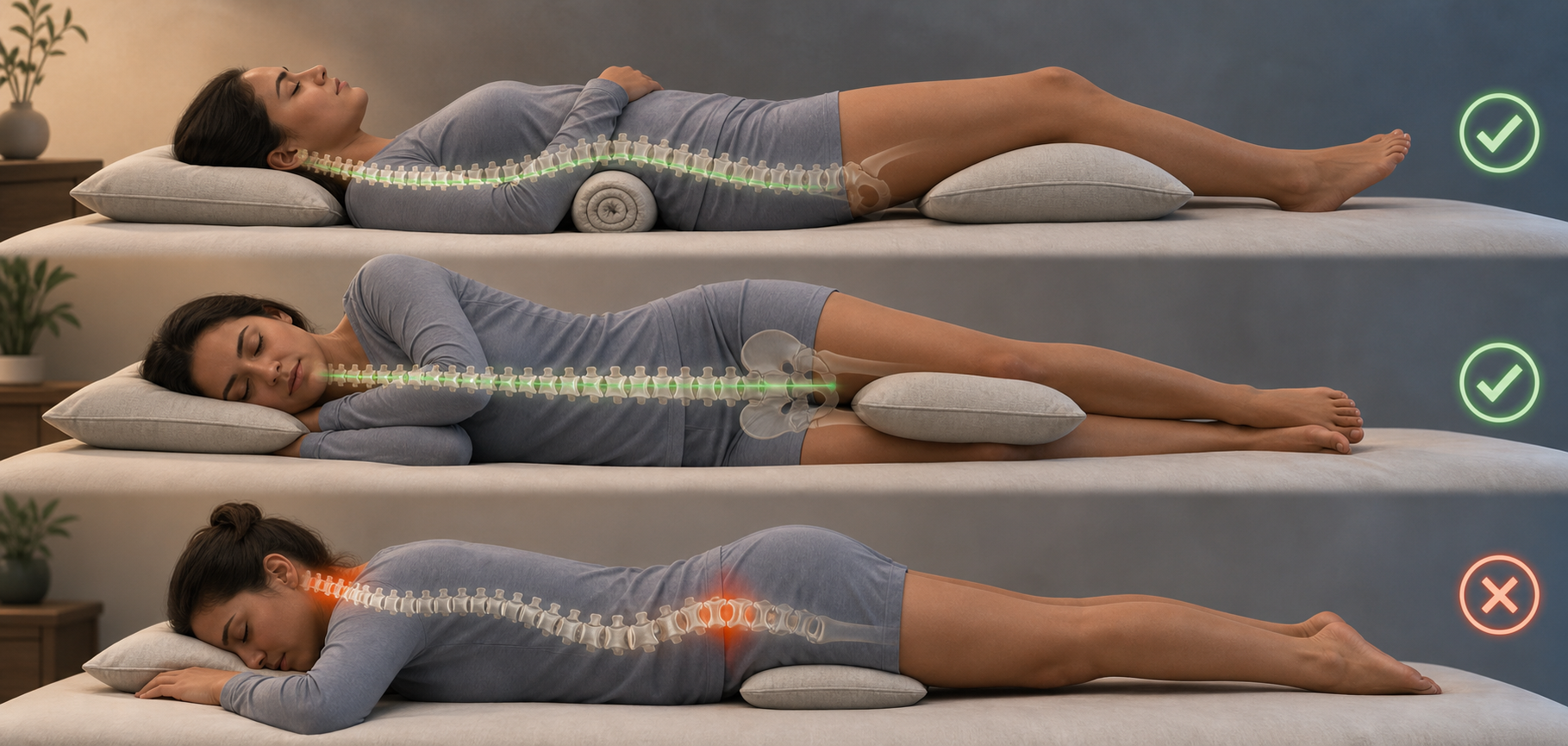
Some people have obstructive sleep apnea that is much worse while sleeping on the back. For them, positional therapy can be more than a sleep-hygiene tip. It can reduce exposure to the posture that collapses the airway most often. If you need a broader framework for when back-sleeping helps or hurts, see Sleep on Your Back: A Decision Framework.
The strongest version of this approach is not simply “try side sleeping.” It is identifying positional OSA on a sleep study and then using a device or behavior that actually keeps the person off the back. In a 2014 long-term positional therapy study, supine sleep fell from 45.6% to 5.3%, and about 48% of people with mild positional OSA met the study’s cure definition.[6]
That is meaningful, but the boundaries matter. The cure rate came from a specific mild positional group. It does not mean positional therapy treats severe non-positional OSA. It also does not mean a pillow, adjustable base, backpack device, or vibration trainer works if the person does not keep using it. Positional aids, including adjustable-bed strategies like those discussed in a Tempur-Pedic adjustable base review, are best judged by whether they change the sleeping position that worsens the apnea, not by whether they feel intuitively therapeutic.
This is where a follow-up sleep test can be clarifying. If side sleeping improves comfort but the AHI remains high, the body may feel less disturbed while the airway is still repeatedly obstructing. That is not a failure of effort; it is information.
Tongue and Throat Exercises Are Not as Simple as the Claims
Oropharyngeal or myofunctional therapy sounds appealing because it asks the patient to train the muscles around the tongue, soft palate, and throat rather than wear a device all night. It is also heavily promoted online, often by providers who sell the service. Some patients may feel better with it. The problem is the leap from “may improve symptoms” to “treats sleep apnea.”
A 2025 network meta-analysis found improvements in Epworth Sleepiness Scale and Pittsburgh Sleep Quality Index outcomes, but no statistically significant AHI reduction in adults unless training exceeded 30 minutes per day.[7] That distinction matters. Sleepiness and perceived sleep quality are important, especially for exhausted patients. But AHI is the measure that tells us whether airway obstruction itself is falling.
The adherence burden is not small. More than 30 minutes a day is a serious daily assignment, particularly for someone already managing work, family, fatigue, appointments, and maybe a CPAP mask they dislike. If the effective dose requires that much practice, then adherence is part of the treatment, not a footnote.
Shorter protocols are being studied. A 2024 Scientific Reports study examined a 10-minute oropharyngeal exercise protocol, which is useful because shorter routines are more realistic for many adults.[8] But shorter and easier does not automatically mean enough to reduce apnea severity. The honest position is that exercises may be a reasonable adjunct for motivated patients, especially if symptoms improve, but they should not be sold as a stand-alone replacement for proven OSA treatment.
Diet Helps Most When It Produces Sustained Weight Loss
Dietary change is often listed as its own sleep apnea remedy, but the evidence is stronger when diet is part of a weight-loss strategy. A Mediterranean-style diet, lower-calorie plan, reduced alcohol intake, or less late-night eating may improve general health or sleep comfort. For OSA severity, the key question is whether the change reduces the physiological drivers of obstruction, especially weight-related airway collapsibility.
Alcohol deserves special caution because it can relax upper-airway muscles and worsen snoring or obstructive events in susceptible people. Reducing evening alcohol is sensible. But it should not be framed as equivalent to a therapy that has demonstrated large AHI reductions in a diagnosed OSA population.
Comfort Measures Can Still Matter, but They Are Not OSA Treatment
Humidifiers, saline rinses, nasal strips, and allergy management can make breathing feel easier. They may also make CPAP more tolerable for some people by reducing dryness or nasal irritation. That is a legitimate goal. CPAP intolerance is common enough that dismissing comfort problems as trivial only pushes people toward less reliable substitutes.
But nasal comfort is not the same as treating obstructive sleep apnea. A nasal strip can reduce nasal resistance for some people. A humidifier can reduce dryness. Neither should be expected to hold open a collapsing throat during sleep. Harvard’s overview of non-CPAP options similarly separates comfort and alternative treatment discussions from the idea that simple home measures can replace proper care.[9]
This distinction is especially important for people trying to salvage CPAP. If dryness, congestion, mask leak, pressure intolerance, or claustrophobia is the barrier, the answer may be heated humidification, a different mask, pressure adjustment, desensitization, or a different prescribed device. The answer is not to declare the apnea treated because a bedroom humidifier made the night feel less harsh.
What to Move Quickly Past
Some remedies are not dangerous because they are soothing; they are dangerous when they become substitutes. Herbal teas may help a person wind down. Essential oils may smell pleasant. Vicks VapoRub may create a cooling sensation around the nose. None of these has credible evidence as a treatment for obstructive sleep apnea itself.
- Herbal teas: reasonable as a bedtime ritual if safe for the individual, but not an apnea treatment.
- Essential oils: not evidence-based for reducing AHI and should not be used near the airway in ways that irritate breathing.
- Vicks VapoRub or mentholated ointments: may change nasal sensation, not airway collapse during sleep.
- Over-the-counter mouthguards: not equivalent to clinician-fitted mandibular advancement devices and may worsen jaw, bite, or dental problems.
Prescription oral appliances are a different category from OTC mouthguards. A properly fitted mandibular advancement device can be part of legitimate OSA care for selected patients, usually through a sleep clinician and trained dental professional. If you are comparing non-CPAP device options, including more invasive choices, Inspire sleep apnea therapy cost gives a useful point of comparison for how different the device pathway is from home remedy shopping.
A Note on the Medication Pipeline
The medication landscape for sleep apnea is changing, but that does not mean readers should experiment. A 2026 pipeline overview discusses investigational or emerging drug approaches, including AD109, sulthiame data reported in The Lancet in 2025, and acetazolamide with an approximately 38% AHI reduction figure.[10] This is context, not a shopping list.
Medication development is important because it challenges the old assumption that every non-CPAP option must be mechanical, behavioral, or surgical. It also raises the bar for claims. If a therapy is going to be presented as an OSA treatment, it should be able to show what happens to obstructive events, oxygenation, symptoms, safety, and adherence over time.
How to Use This Evidence Without Getting Stuck
The practical order is simple, even if the execution is not. First, confirm whether you have OSA and how severe it is. Second, identify what seems to drive it: weight-related risk, positional worsening, anatomy, nasal obstruction, medication or alcohol effects, or a mix. Third, choose interventions that match the driver rather than the remedy label.
For a patient with obesity and moderate-to-severe OSA, weight-loss treatment and a discussion of GLP-1/GIP medication eligibility may belong near the center of care. For a patient with mild positional OSA, positional therapy may be worth testing seriously. For a patient who wants to add exercises, the time commitment and follow-up measurement should be explicit. For a patient whose CPAP fails because of dryness or congestion, comfort measures may help keep the proven therapy usable.
The hard part is not respecting patient preference. The hard part is refusing to let frustration with CPAP downgrade the disease. Untreated or undertreated obstructive sleep apnea is not just bad sleep architecture; repeated airway obstruction can fragment sleep night after night, a mechanism discussed more broadly in common disruptors of sleep architecture. A softer-feeling night is welcome, but it is not the same as controlled apnea.
If the goal is meaningful AHI reduction, weight loss and FDA-approved GLP-1/GIP medication for eligible patients with obesity are in a different evidence class from most natural remedies. Positional therapy and oropharyngeal exercises can help selected people, but they are conditional tools. Teas, oils, nasal strips, humidifiers, and mentholated rubs belong in the comfort category unless better evidence says otherwise.
The safest next step is not to buy the most convincing remedy. It is to confirm diagnosis and severity, ask whether your OSA is weight-related or positional, discuss medical options if CPAP is intolerable, and treat low-evidence remedies as comfort measures rather than treatment.
References
- Longitudinal study of moderate weight change and sleep-disordered breathing, JAMA, 2000.
- Effectiveness of Lifestyle Interventions on Obstructive Sleep Apnea (OSA): Systematic Review and Meta-Analysis, SLEEP, 2013.
- FDA Approves First Medication for Obstructive Sleep Apnea, U.S. Food and Drug Administration, December 2024.
- Tirzepatide for the Treatment of Obstructive Sleep Apnea and Obesity, New England Journal of Medicine, 2024.
- GLP-1 for Sleep Apnea, Sleep Foundation.
- Long-Term Effectiveness and Compliance of Positional Therapy with the Sleep Position Trainer in the Treatment of Positional Obstructive Sleep Apnea Syndrome, 2014.
- Comparative efficacy of oropharyngeal exercise training in patients with obstructive sleep apnea: A network meta-analysis, 2025.
- Effects of 10-minutes oropharyngeal exercises on obstructive sleep apnea, Scientific Reports, 2024.
- Beyond CPAP: Other options for sleep apnea, Harvard Health Publishing.
- Sleep Apnea Medication Latest Update, The ENT Doctor.


Comments
Join the discussion with an anonymous comment.