
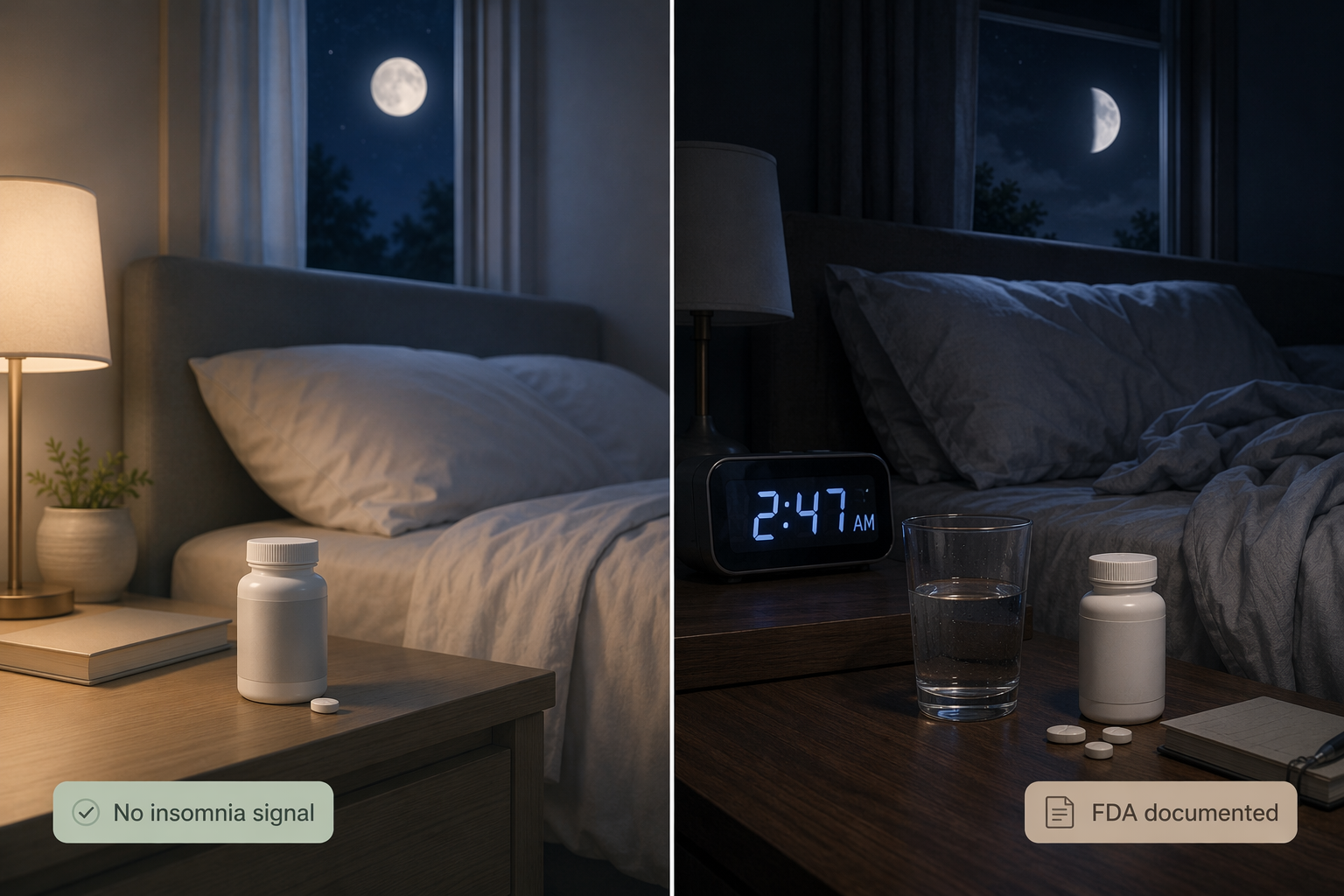
Insomnia is not listed as an adverse reaction in the FDA-approved prescribing information for enlicitide, sold as Lipfendra. In the Phase 3 safety data available at approval, sleep-related adverse reactions also did not appear above placebo. That is the most direct answer to the question “does enlicitide cause insomnia?” based on current evidence.[1]
There is one important boundary around that reassurance: Lipfendra was approved by the FDA on July 16, 2026, so there is not yet real-world post-marketing sleep data for enlicitide specifically.[2] The current answer comes from the label and the CORALreef clinical trial program, not from years of routine prescribing.

What the FDA label actually shows
For a newly approved medication, the label is the first place to look because it is where adverse reactions from the reviewed trial data have to be stated plainly. For Lipfendra, insomnia does not appear as a listed adverse reaction.[1]
The adverse reactions worth naming are not sleep problems. In CORALreef HeFH, the trial in adults with heterozygous familial hypercholesterolemia, dizziness occurred in 9% of participants taking enlicitide versus 4% taking placebo, and diarrhea occurred in 7% versus 2%.[1] Those differences are visible enough to belong in a medication-safety conversation. Insomnia is not in that same category.
| Evidence source | What it says about insomnia |
|---|---|
| FDA-approved Lipfendra prescribing information | Insomnia is not listed as an adverse reaction. |
| CORALreef Lipids | Overall adverse events were similar with enlicitide and placebo; no sleep-related signal was identified. |
| CORALreef HeFH | Dizziness and diarrhea were more common than placebo; no sleep-related adverse reaction was identified. |
| Post-marketing reports | Not yet available for enlicitide because approval occurred on July 16, 2026. |
The CORALreef trials are reassuring, but not unlimited
The larger safety base comes from CORALreef Lipids, which included 2,904 participants. Overall adverse events were reported in 64% of participants taking enlicitide and 62% taking placebo; serious adverse events were reported in 10% and 12%, respectively.[3] Those numbers do not suggest a broad tolerability imbalance.
CORALreef HeFH was smaller, with 303 participants, but it is useful because the label identifies the adverse reactions that were more common than placebo there: dizziness and diarrhea.[1] If sleep disturbance had appeared as a consistent excess event in the reviewed data, this is the kind of place where a patient would expect to see it reflected.
That still does not mean insomnia is impossible. Clinical trials are good at finding common and moderately common problems, especially when they separate drug from placebo. They are less able to settle rare effects, effects that appear only in certain routines, or symptoms that emerge after broader real-world use. The ongoing CORALreef Outcomes trial, planned for more than 14,500 participants, may give a larger safety view over time.[3]
Dizziness also deserves a practical note. It is not insomnia, and the trial data do not show that it caused sleep disruption. But a person who feels dizzy may become more cautious about getting up at night, may worry more at bedtime, or may change evening habits. Those are plausible indirect sleep effects, not documented enlicitide insomnia.
Why this may feel different if a statin affected your sleep
Many people asking about enlicitide side effects and insomnia are not asking in a vacuum. They may have taken atorvastatin, simvastatin, or another cholesterol medication and then found themselves awake at 2 a.m. That experience should not be brushed aside just because a new drug has a cleaner sleep signal so far.
The statin sleep story is more complicated than either “statins cause insomnia” or “it was all in your head.” Atorvastatin prescribing information has reported insomnia at 5.3% with atorvastatin 40 mg versus 2.9% with placebo. At the same time, a 2026 Lancet meta-analysis covering 23 trials and about 150,000 patients found that sleep disturbances were often reported at similar rates by placebo patients, supporting a substantial nocebo component at the population level.[4]
Those two facts can both matter. A population-level nocebo finding means expectations and background sleep problems can inflate medication-attributed symptoms. It does not prove that a particular person’s sleepless week after starting a statin was meaningless, imagined, or irrelevant to future prescribing decisions.
Enlicitide is not a statin. It is an oral PCSK9 inhibitor, and the FDA-reviewed enlicitide data do not show the same labeled insomnia issue. For someone who previously stopped or avoided statins because of sleep symptoms, that distinction is clinically relevant, even though it is not a guarantee.
What about injectable PCSK9 inhibitors and insomnia reports?
Injectable PCSK9 inhibitors are useful context, but they should not be treated as direct proof about enlicitide. Large randomized trials of injectable PCSK9 inhibitors did not find an insomnia signal, while pharmacovigilance data contain spontaneous reports that include insomnia among psychiatric adverse-event reports.[5]
A 2024 pharmacovigilance study of PCSK9 inhibitors found about 500 insomnia reports, representing 7.72% of psychiatric adverse-event reports in that analysis, but disproportionality analyses did not establish a statistically significant causal signal.[5] That means the reports are worth watching, not worth translating into “PCSK9 inhibitors cause insomnia.”
They are also not enlicitide-specific. The injectable drugs are monoclonal antibodies; enlicitide is a macrocyclic peptide taken by mouth. Class comparisons can raise useful questions, but they cannot replace drug-specific outcomes.
The mechanism does not make insomnia especially likely
Mechanism is supporting evidence here, not the main evidence. The main evidence is still the label and clinical trials. But the mechanism does help explain why a central nervous system sleep effect is not especially plausible.
Enlicitide is described as a macrocyclic peptide, with a molecular weight of about 1,722 Da.[6] Materials summarized for approval state that it does not cross the blood-brain barrier in clinically relevant concentrations. That lowers the plausibility of a direct brain-mediated insomnia effect, although biology never makes a side effect impossible by logic alone.
Its dosing routine also matters. Lipfendra is taken once daily in the morning on an empty stomach.[1] That avoids one common source of confusion with sleep complaints: a bedtime medication that becomes psychologically or physically linked to the act of trying to sleep.
If insomnia starts after your first doses
If sleep worsens after starting enlicitide, do not ignore it, but do not assume causation from timing alone. New medications often begin during a week when diet, anxiety, caffeine, illness, pain, travel, or sleep schedule changes are also shifting.
- Write down the date and time of each enlicitide dose and whether it was taken as directed in the morning on an empty stomach.
- Track bedtime, wake time, nighttime awakenings, caffeine, alcohol, naps, and unusual stressors for at least several nights.
- Note dizziness, diarrhea, or other symptoms separately from insomnia so your prescriber can see whether there is a broader tolerability pattern.
- Contact the prescribing clinician before stopping abruptly, especially if you are taking enlicitide because other LDL-lowering options were not tolerated.
- Seek urgent care if sleep loss is accompanied by severe allergic symptoms, chest pain, fainting, confusion, or any symptom that feels medically unsafe.
The fairest current judgment is narrow: FDA-approved prescribing information and Phase 3 trial data show no insomnia signal for enlicitide. Because the drug is newly approved, rare sleep-related effects, if they exist, will depend on larger follow-up, the ongoing outcomes trial, and post-marketing surveillance rather than certainty on day one.
References
- Lipfendra, Drugs.com, https://www.drugs.com/lipfendra.html
- FDA Approves First Oral Therapy that Inhibits PCSK9 to Lower Bad Cholesterol, FDA, https://www.fda.gov/drugs/news-events-human-drugs/fda-approves-first-oral-therapy-inhibits-proprotein-convertase-subtilisinkexin-type-9-pcsk9-lower
- Merck's LIPFENDRA® (enlicitide) is the First and Only Once-Daily Oral PCSK9 Inhibitor Approved by the U.S. FDA, Merck, https://www.merck.com/news/mercks-lipfendra-enlicitide-is-the-first-and-only-once-daily-oral-pcsk9-inhibitor-approved-by-the-u-s-fda-to-reduce-ldl-c-in-adults-with-hypercholesterolemia/
- 2026 Lancet meta-analysis of 23 statin trials and sleep disturbance, The Lancet
- Psychiatric disorders associated with PCSK9 inhibitors: A real-world, pharmacovigilance study, CNS Neuroscience & Therapeutics, https://onlinelibrary.wiley.com/doi/10.1111/cns.14522
- Enlicitide decanoate, Wikipedia, https://en.wikipedia.org/wiki/Enlicitide_decanoate


Comments
Join the discussion with an anonymous comment.