

Many people know, in theory, that ongoing sleep problems deserve medical help. Far fewer actually make the appointment. In Resmed’s 2026 Global Sleep Survey, 66% of respondents said they would likely seek professional help for sleep issues, while only 23% had done so.[1] Resmed has a commercial stake in sleep-disordered breathing, so that survey should not be treated as neutral epidemiology. Still, the gap it points to is familiar: people keep adjusting pillows, buying teas, cutting coffee, or blaming stress long after trouble sleeping at night has started to affect the next day.
A practical rule is better than another vague reminder to “listen to your body.” Trouble sleeping at night warrants a doctor’s visit if any one of these is true: it happens at least 3 nights a week, has lasted at least 3 months, and causes daytime impairment; it comes with red flags such as loud snoring with gasping, witnessed breathing pauses, strong urges to move the legs at night, or falling asleep while driving; or it is already interfering meaningfully with work, caregiving, school, safety, mood, or daily functioning even before the 3-month mark.

The 3/3/3 threshold: frequent, persistent, and affecting the day
The National Heart, Lung, and Blood Institute describes insomnia diagnosis around a clear pattern: difficulty sleeping at least 3 nights per week, lasting at least 3 months, with daytime impairment.[2] That is the “3/3/3” threshold: 3 or more nights a week, for 3 or more months, with a 3rd piece that matters just as much as the calendar — the next-day consequences.
| Question | What makes it clinically important |
|---|---|
| How often is it happening? | Three or more nights per week points beyond an occasional bad night. |
| How long has it been going on? | Three or more months fits the chronic insomnia time frame used by NHLBI. |
| What is happening the next day? | Impaired function — sleepiness, poor concentration, irritability, performance problems, or safety concerns — is what turns nighttime struggle into a daytime health issue. |
That last piece prevents the threshold from becoming a sterile counting exercise. In an American Medical Association interview, sleep physician Dr. Fariha Abbasi-Feinberg Almadhoun emphasized that daytime function is the key criterion: “If you wake up feeling refreshed despite difficulty falling or staying asleep, it is not insomnia.”[3] The point is not that lying awake never matters unless the next day is ruined. It is that a clinician needs to know whether the sleep problem is changing how you function.
So if the pattern is: awake for long stretches, several nights a week, month after month, and then dragging through meetings, forgetting tasks, snapping at family, or relying on risky amounts of caffeine to get through the day, the question is no longer whether the problem is “serious enough.” It is enough to bring to a clinician.
The threshold also should not be used to delay care when the impairment is significant. Someone who is falling asleep while driving, nodding off in unsafe settings, or unable to perform essential responsibilities does not need to wait politely until a 3-month anniversary. Duration helps define chronic insomnia; safety and function determine urgency.
Red flags that change the decision
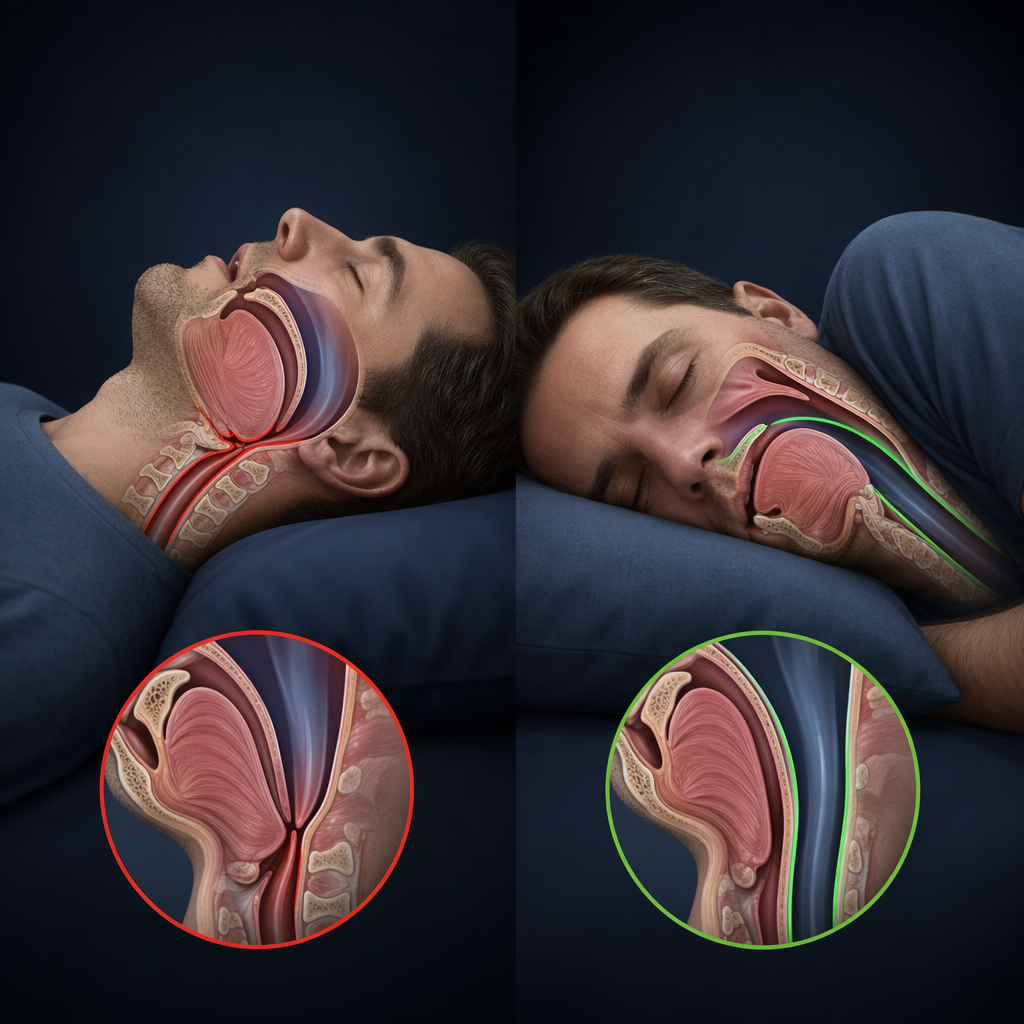
Some sleep symptoms point away from straightforward insomnia and toward another sleep disorder that deserves prompt evaluation. Duke Health advises seeing a sleep specialist for signs such as loud snoring with gasping or choking, witnessed pauses in breathing during sleep, strong urges to move the legs at night, or falling asleep while driving or during meetings.[4] The National Sleep Foundation similarly flags symptoms such as breathing pauses, choking or gasping, and excessive daytime sleepiness as reasons to talk with a healthcare provider.[5]
These signs matter because the solution is not simply “try harder to sleep.” Loud snoring with gasping or witnessed breathing pauses can suggest obstructive sleep apnea. A strong urge to move the legs at night can point toward restless legs syndrome. Repeated dangerous sleepiness during the day raises the stakes even if the person is not sure what is happening overnight.
- Make an appointment promptly if a bed partner has noticed breathing pauses, choking, or gasping during sleep.
- Do not treat falling asleep while driving as a normal consequence of being busy. That is a safety warning.
- Mention leg sensations clearly: urge to move, worse at rest, worse at night, and relieved by movement are different from simply “not getting comfortable.”
- If snoring and gasping are part of the picture, bedtime tips and over-the-counter sleep aids are not an adequate substitute for evaluation.
A person with possible sleep apnea may still have insomnia symptoms. They may dread bedtime, wake repeatedly, and feel exhausted in the morning. But if the story includes gasping, choking, or witnessed pauses, the appointment should include that information near the beginning. For readers trying to understand what lifestyle measures can and cannot do in suspected apnea, natural remedies for sleep apnea is best read as background, not as a replacement for diagnosis.
Three common paths: insomnia, another sleep disorder, or a gray-zone sleep problem
Not every person with trouble sleeping at night is on the same path. Sorting the pattern helps you ask for the right kind of help.
Likely chronic insomnia
This path fits someone who has difficulty falling asleep, staying asleep, or waking too early at least 3 nights a week for at least 3 months, with daytime impairment.[2] The person may not snore loudly or have breathing pauses. The main pattern is persistent sleeplessness plus next-day consequences.
For insomnia alone, diagnosis is usually based on a medical history and symptom assessment rather than automatically sending every patient to a sleep lab.[2][3] That distinction matters. Some people avoid care because they picture wires, overnight testing, and a complicated workup. Often, the first step is a careful conversation.
Possible sleep apnea or movement-related sleep disorder
This path fits someone whose sleep trouble comes with loud snoring, gasping, choking, witnessed breathing pauses, strong urges to move the legs, or extreme daytime sleepiness.[4][5] In this situation, the clinician may consider a sleep study, especially when sleep apnea or periodic limb movement disorder is suspected.[2][3]
A sleep study is not a punishment for reporting symptoms accurately. It is a way to observe what cannot be reliably reconstructed from memory: breathing, oxygen levels, limb movements, arousals, and sleep stages. If a partner has been hearing gasps at night, their observations may be as important as the patient’s own memory of the night.
Sub-threshold but still disruptive sleep trouble
Some people fall into a less tidy zone: maybe the problem happens 2 nights a week, or it has lasted 6 weeks rather than 3 months, or daytime function is affected but not dramatically. That does not make the symptoms imaginary. It means the decision is more individualized.
In this gray zone, it is reasonable to tighten the basics for a short period if there are no red flags and no major safety concerns. A consistent wake time, a wind-down routine, less alcohol near bedtime, and a cooler, darker sleep environment may help some people. For a structured starting point, see Sleep Hygiene Fundamentals and an Evidence-Based Bedtime Routine.
But a gray zone should have an endpoint. If the pattern is worsening, creeping toward the 3/3/3 threshold, or beginning to affect driving, work, caregiving, mood, or health, it is appropriate to bring it up with a primary care clinician rather than continuing to self-manage indefinitely.
Trouble sleeping is common; clinical insomnia is narrower
There is a reason this decision feels confusing: sleep symptoms are common. A CDC National Center for Health Statistics Data Brief published in April 2026 reported that 15.4% of adults had trouble falling asleep most days or every day, and 18.1% had trouble staying asleep most days or every day.[6] Those figures describe symptoms, not a clinical insomnia diagnosis.
The AMA article reports that about 25–30 million Americans, roughly 8–10%, have insomnia at any given time.[3] The difference between those figures is not a contradiction. Many people have sleep symptoms. A smaller group meets the clinical pattern of persistent sleep difficulty with daytime impairment.
That distinction can reduce both overreaction and minimization. A few rough nights during a stressful week do not automatically mean chronic insomnia. Months of poor sleep with next-day impairment should not be dismissed as a personality flaw, poor discipline, or just “getting older.”
What the appointment usually tries to find out
A sleep appointment is not only about how many hours you slept. The clinician is trying to identify the pattern, rule in or out other sleep disorders, and understand what is making the problem continue.
- Timing: when you go to bed, when you try to sleep, when you wake up, and whether the schedule changes on weekends.
- Frequency and duration: how many nights per week this happens and how long the pattern has lasted.
- Sleep pattern: trouble falling asleep, waking during the night, waking too early, or feeling unrefreshed.
- Daytime function: sleepiness, concentration problems, mood changes, work errors, school problems, drowsy driving, or caregiving strain.
- Breathing symptoms: snoring, gasping, choking, dry mouth, morning headaches, or witnessed pauses.
- Movement symptoms: leg discomfort, urge to move, twitching, kicking, or symptoms that worsen at rest.
- Substances and medications: caffeine, alcohol, nicotine, cannabis, supplements, prescriptions, and over-the-counter sleep aids.
- Medical and mental health context: pain, reflux, menopause symptoms, anxiety, depression, shift work, or recent life stressors.
If the story fits chronic insomnia without signs of apnea or another sleep disorder, the clinician may diagnose and treat based on history and symptoms.[2][3] If the story includes breathing pauses, choking, gasping, or suspicious limb movements, testing becomes more likely.
How to prepare without turning it into a project
A 1–2 week sleep diary is enough for many first appointments. It does not need to be perfect. Estimates are useful because the pattern matters more than exact minute-by-minute precision.
- Bedtime and the time you actually tried to sleep
- Estimated time to fall asleep
- Number of awakenings and roughly how long they lasted
- Final wake time and time out of bed
- Naps, including time of day and approximate length
- Caffeine, alcohol, nicotine, cannabis, sleep supplements, or sleep medications
- Daytime symptoms: sleepiness, irritability, low mood, concentration problems, errors, or drowsy driving
- Snoring, gasping, leg symptoms, or partner observations
If someone sleeps beside you, ask what they notice. Bed partners often hear snoring, gasping, or pauses that the sleeper does not remember. Duke Health specifically notes that bringing a bed partner can help when symptoms such as snoring or breathing pauses are part of the concern.[4]
Also bring the bottles or names of anything you are using to sleep: melatonin, antihistamine sleep aids, pain relievers with nighttime formulations, herbal products, cannabis products, or prescription medications. The point is not to confess failure. It is to help the clinician see what might be helping, harming, masking symptoms, or interacting with other conditions.
Where sleep hygiene, supplements, and medication fit
Sleep hygiene is useful as a foundation, especially for sub-threshold sleep trouble. It is less reliable as a complete treatment for chronic insomnia. If someone meets the 3/3/3 threshold or has significant daytime impairment, more bedtime rules are unlikely to be the whole answer. For more on that boundary, see .
For chronic insomnia, cognitive behavioral therapy for insomnia, or CBT-I, is considered first-line treatment. The AMA reports a 70–80% favorable response rate for CBT-I, and NHLBI describes CBT-I as a treatment that helps people change thoughts and behaviors that interfere with sleep.[7][8] Medications may be discussed, but they are generally not the first or only treatment path. Readers who want to understand what a clinician might consider can review CBT-I for Insomnia FAQ and Prescription Sleep Medications Compared.
Melatonin is often treated as a general insomnia fix, but the AMA article states that it is ineffective for insomnia and is more appropriate for circadian rhythm problems such as jet lag.[3] The same article notes that a JAMA study found 88% of melatonin products were inaccurately labeled.[3] That does not mean no one should ever use melatonin. It does mean months of escalating supplements should not delay an evaluation when the pattern is chronic, impairing, or mixed with red flags.
The same caution applies to prolonged self-treatment with over-the-counter antihistamine sleep aids. They may make a person drowsy, but they do not diagnose why sleep is failing, and they can blur the picture when daytime grogginess is already part of the problem. If you are comparing OTC options, should be read with that limit in mind.
A short decision recap
Make a doctor’s appointment for trouble sleeping at night if the pattern meets the 3/3/3 threshold: at least 3 nights per week, for at least 3 months, with daytime impairment.[2] Make the appointment sooner if sleepiness is creating safety risks or making work, caregiving, school, driving, or daily life difficult.
Do not wait on the insomnia threshold if there are red flags: loud snoring with gasping or choking, witnessed breathing pauses, strong urges to move the legs at night, or falling asleep while driving.[4][5] Those symptoms may need a different evaluation than insomnia alone.
Before the visit, keep a simple 1–2 week sleep diary, list anything you use to sleep, and bring a partner’s observations if breathing pauses, loud snoring, gasping, kicking, or unusual movements are part of the story.
References
- 2026 Global Sleep Survey, Resmed, 2026.
- Insomnia - Diagnosis, National Heart, Lung, and Blood Institute.
- What doctors want patients to know about insomnia, American Medical Association, 2025.
- Do I Need a Sleep Specialist?, Duke Health.
- Not Sleeping Well? It Might Be Time to See a Healthcare Provider, National Sleep Foundation.
- NCHS Data Brief No. 559, Centers for Disease Control and Prevention, April 2026.
- What doctors wish patients knew about sleep health, American Medical Association, 2025.
- Insomnia - Treatment, National Heart, Lung, and Blood Institute.



Comments
Join the discussion with an anonymous comment.