
Yes. A single bout of food poisoning can plausibly lead to months of insomnia or non-restorative sleep, especially when the infection leaves behind post-infectious IBS, persistent gut microbiome disruption, or lingering inflammatory activity. That does not mean every sleepless night after a stomach bug is caused by the infection. It does mean the connection is biologically credible enough that it should not be brushed off as ordinary stress, especially when sleep changed after the illness and never returned to baseline.
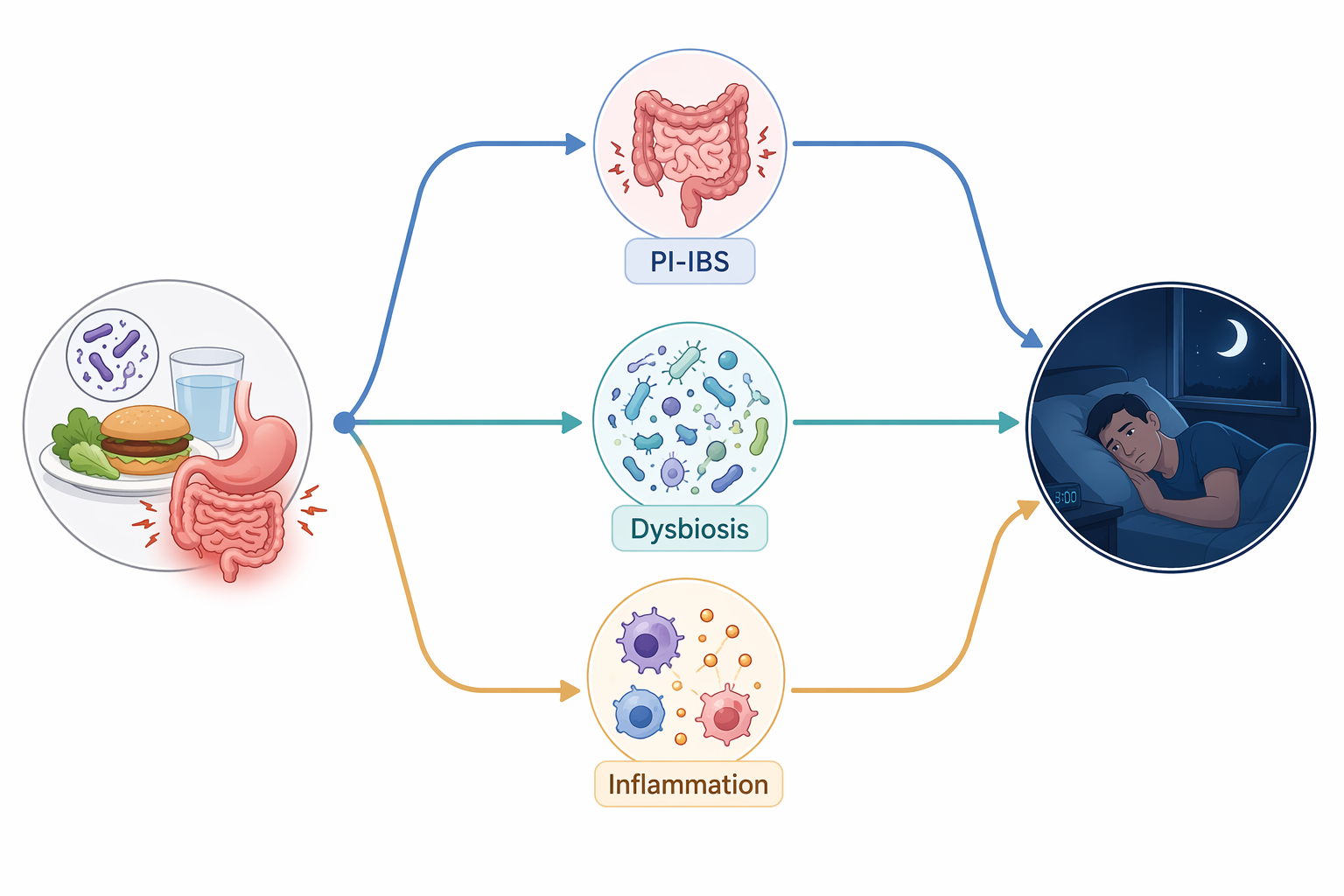
The strongest clinical bridge is post-infectious IBS. Severe food poisoning can be followed by PI-IBS in up to 30% of cases, and a meta-analysis of 36 studies including 63,620 participants found that 37.6% of people with IBS had clinically significant sleep disorders.[1] Those are separate findings from separate populations, so they should not be multiplied into a neat personal risk estimate. But together they explain why someone can stop having obvious diarrhea and still spend weeks or months waking at 3 a.m. with a body that does not feel recovered.
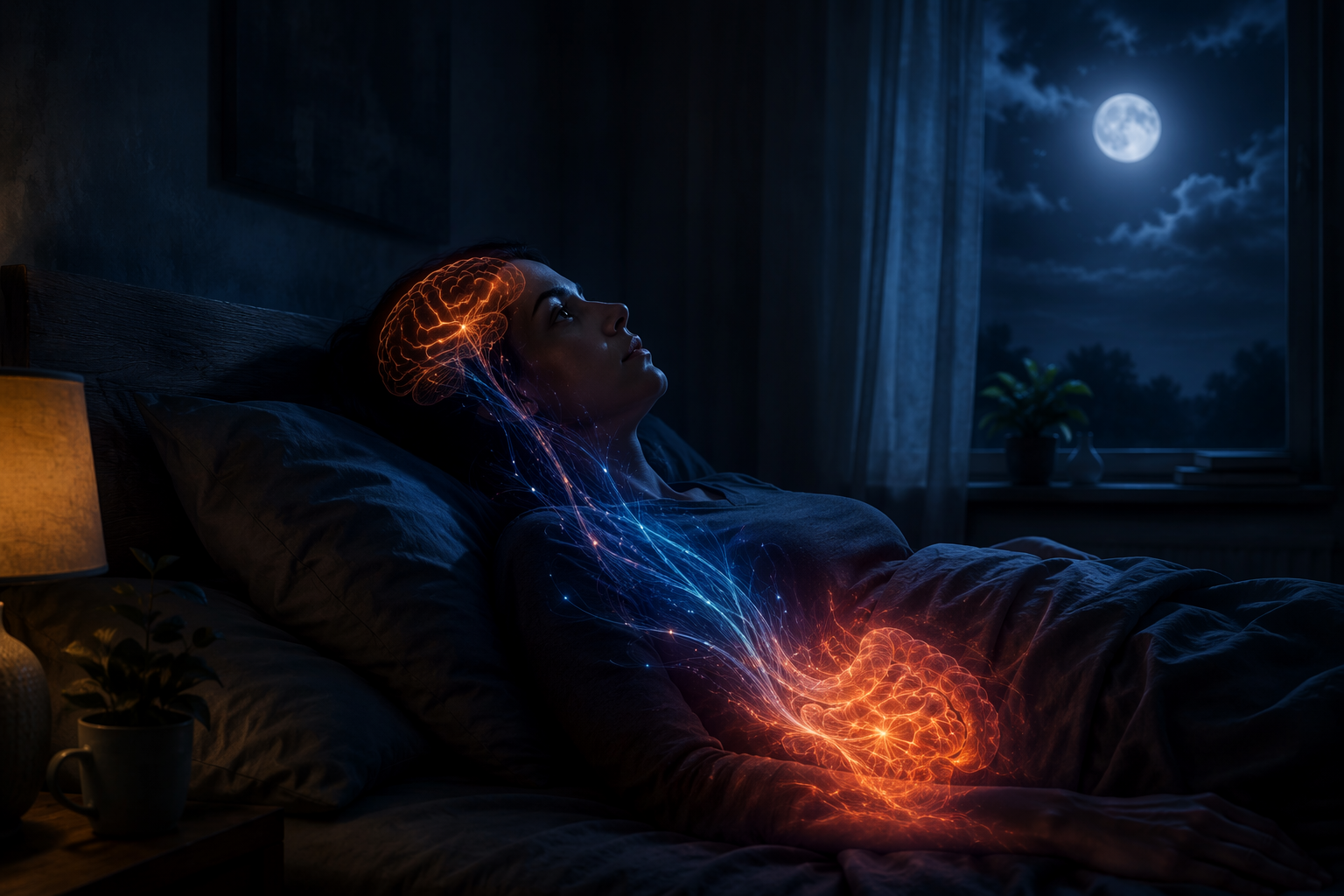
The July 2026 iceberg lettuce outbreak makes this question less theoretical. Federal investigators linked 1,644 cyclosporiasis cases and 94 hospitalizations across five states to Taco Bell iceberg lettuce.[2] Cyclosporiasis is not always a tidy two-day stomach bug: clinical descriptions include watery diarrhea, sometimes 10 to 15 times per day, profound fatigue, and a remitting-relapsing course that can last weeks to months.[3] For people who were part of that outbreak, the sleep problem may have arrived after the visible food poisoning story seemed to be over.
The Most Recognizable Pathway: Post-Infectious IBS
PI-IBS is the name clinicians use when IBS symptoms begin after an episode of infectious gastroenteritis. The acute infection clears, but bowel habits, abdominal pain, urgency, bloating, or food sensitivity do not reset. In sleep terms, the important point is not just that the gut remains uncomfortable. IBS is strongly associated with disordered sleep, and that association has been measured across a large body of studies rather than inferred from scattered anecdotes.[1]
That 37.6% figure matters because it gives shape to a symptom patients often describe in vague, apologetic language: “I’m not sick anymore, but I don’t sleep right.” In IBS, sleep problems can include insomnia symptoms, poor sleep quality, frequent awakenings, and sleep that does not feel restorative. The relationship can move in both directions. A sensitive, inflamed, or over-reactive gut can interrupt sleep; poor sleep can lower pain thresholds, increase gut sensitivity, and make daytime GI symptoms harder to tolerate.
The infection does not have to be dramatic enough to become a medical horror story. What matters is whether it disturbed the gut lining, immune signaling, motility, and microbial community enough to create a longer-running disorder. The same IBS meta-analysis noted that the increased risk of IBS after infectious gastroenteritis can persist for 2 to 3 years.[1] That does not predict any one person’s course, but it does argue against the idea that all post-food-poisoning symptoms should vanish as soon as the first week ends.
Several proposed PI-IBS mechanisms help explain why symptoms can continue after the pathogen is gone. Some research and clinical education materials describe anti-CdtB and anti-vinculin antibodies after certain bacterial infections, small intestinal bacterial overgrowth, and dysbiosis patterns as possible contributors to ongoing IBS-like symptoms.[4] These mechanisms are not a home diagnostic checklist. They are a reminder that “the stool test is negative now” and “the gut is back to normal” are not the same sentence.
| After food poisoning, what persists? | How it can disturb sleep |
|---|---|
| Abdominal pain, urgency, bloating, or altered bowel habits | Nighttime awakenings, lighter sleep, anxiety about symptoms returning during the night |
| Post-infectious gut sensitivity | Lower threshold for discomfort that can break sleep or prevent sleep onset |
| Ongoing fatigue after relapsing GI illness | Longer time in bed without restorative sleep, irregular sleep timing, daytime naps that can weaken sleep drive |
| Food restriction or fear of eating | Disrupted meal timing and nutrient intake, which can further disturb circadian and gut rhythms |
Dysbiosis Gives the Gut-Brain Axis a Practical Meaning
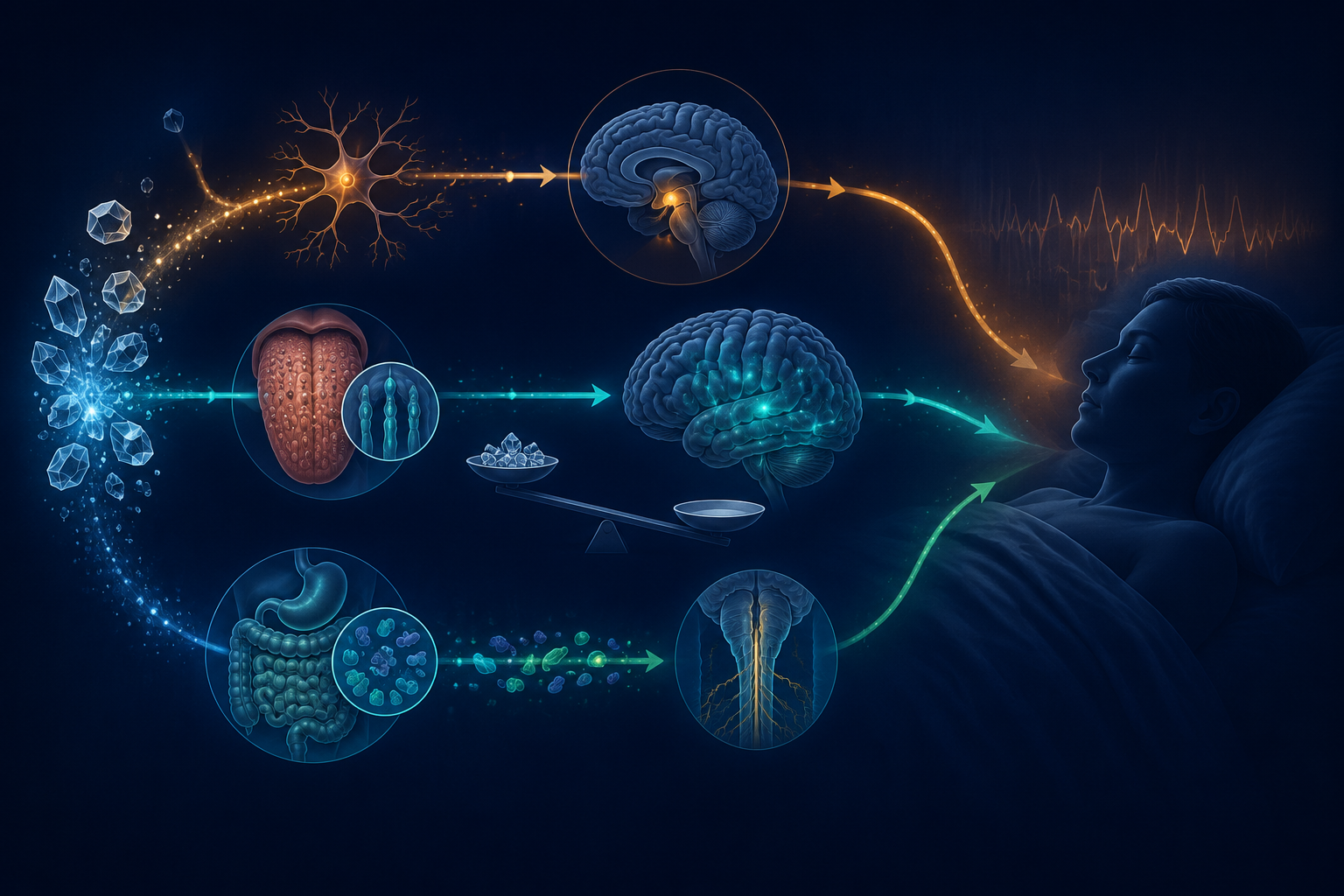
The phrase “gut-brain axis” is easy to overuse, but after a gut infection it points to a concrete problem: the intestine is not just a tube that absorbs food. It is an immune organ, a microbial habitat, and a signaling system that communicates with the brain through neural, immune, endocrine, and metabolic routes.
Gut microbes participate in the production or regulation of compounds that matter for sleep and arousal, including serotonin, melatonin precursors, GABA, and short-chain fatty acids. More than 90% of the body’s serotonin is produced in the gut, and reviews of the microbiome-sleep literature describe pathways by which microbial changes may influence sleep-wake regulation through these metabolites and neurotransmitter systems.[5]
This is where the evidence needs careful handling. It is reasonable to say that food poisoning can disrupt the gut microbiome and that the microbiome is involved in sleep-relevant signaling. It is too strong to claim that a specific lettuce-linked infection has been shown to lower a person’s nighttime melatonin or serotonin in a way that directly causes chronic insomnia. Some of the cleanest cause-and-effect evidence comes from animal models, while human data are still messier and more indirect.[5]
Still, “indirect” does not mean imaginary. If the infection changed bowel motility, diet, microbial diversity, bile acid handling, immune activity, or fermentation patterns, the downstream effects can be felt outside the bathroom. Sleep can become lighter. Sleep timing can drift. The person may feel wired at night and exhausted by day, especially if they are eating defensively, avoiding normal meals, or waking to monitor their gut.
Inflammation Can Fragment Sleep After the Diarrhea Stops
During a gut infection, the immune system releases inflammatory cytokines. Sleep and inflammation are closely linked; cytokines such as TNF-alpha, IL-1, and IL-6 can alter sleep architecture, change sleep depth, and contribute to fatigue and fragmented rest.[6] In ordinary recovery, those signals quiet down. In a prolonged or relapsing illness, or in a person who develops ongoing gut sensitivity, the inflammatory conversation may not end neatly when the most obvious GI symptoms improve.
This helps explain one of the more maddening post-infection patterns: the person is exhausted enough to think sleep should be easy, but their sleep is shallow, broken, or unrefreshing. Fatigue and insomnia can coexist. Fatigue means the system is depleted; it does not guarantee that the nervous system is calm enough to enter and maintain stable sleep.
Poor sleep can then push back on the gut. Reviews of food intake, sleep disturbance, and the gut microbiota describe a bidirectional relationship: sleep disruption can alter microbial composition and function, while microbiota changes can influence sleep-related physiology.[7] That loop is one reason waiting passively for sleep to “catch up” may fail when the body is stuck in a post-infectious pattern.
Where the Lettuce Recall Fits—and Where It Does Not
For someone searching “food poisoning lettuce recall sleep problems,” the recall matters because it identifies a plausible starting point. If the timing is clear—acute GI illness after the implicated lettuce exposure, followed by weeks of fatigue, relapsing bowel symptoms, and new insomnia—the sequence deserves attention. It is not proof, but it is not a coincidence to dismiss without thought.
Cyclosporiasis also has a symptom profile that can wear down sleep indirectly. Recurrent watery diarrhea, appetite changes, weight changes, cramping, gas, and marked fatigue can disturb sleep schedules and physical recovery.[3] A relapsing course is particularly disruptive because the person may start rebuilding normal routines, then get pulled back into symptoms. That stop-start recovery can train the body into lighter sleep, nighttime vigilance, and irregular eating or resting patterns.
What the current evidence cannot say is equally important: there are no direct studies showing a measured rate of chronic insomnia specifically among people with cyclosporiasis from the July 2026 iceberg lettuce outbreak. The sleep concern is inferred from broader evidence on post-infectious IBS, dysbiosis, inflammation, and the known clinical course of cyclosporiasis. That is enough to make the question medically reasonable. It is not enough to label every exposed person as destined for chronic insomnia.
How to Think About Your Symptoms Without Minimizing Them
The useful question is not “Is this all in my head?” It is “Which post-infection pattern fits what is happening now?” Insomnia after food poisoning is more concerning when it travels with ongoing abdominal pain, altered bowel habits, food intolerance, relapsing diarrhea, unintentional weight loss, persistent fatigue, or a clear change from your previous sleep baseline.
- Track timing: when the food poisoning started, when GI symptoms improved or relapsed, and when insomnia began.
- Track pattern: trouble falling asleep, repeated awakenings, early-morning waking, non-restorative sleep, or sleep disruption linked to GI symptoms.
- Track gut changes: bowel frequency, urgency, pain, bloating, food triggers, and whether symptoms come in waves.
- Track consequences: daytime fatigue, missed work, inability to exercise, mood changes, or fear of eating normally.
This kind of record is not busywork. It helps separate a short-term sleep reaction to being sick from a post-infectious condition that needs evaluation. It also gives a clinician something better than “I haven’t slept right since the lettuce thing,” even though that sentence may be entirely accurate.
Basic sleep hygiene can still help at the edges: regular wake time, morning light, limiting alcohol, and avoiding long daytime naps. But if the driver is PI-IBS, relapsing cyclosporiasis symptoms, dysbiosis, or inflammation, sleep hygiene alone may be too small for the problem. A dark room cannot treat persistent diarrhea. A bedtime routine cannot diagnose PI-IBS. Hydration and rest are not a full recovery plan when the body is still signaling distress.
When to Get Medical Help
Persistent insomnia after food poisoning deserves medical attention when it lasts for weeks, impairs daytime functioning, or appears alongside ongoing GI symptoms. It is especially important to seek care for relapsing watery diarrhea, signs of dehydration, blood in stool, fever, unintended weight loss, severe abdominal pain, or symptoms in someone who is pregnant, immunocompromised, older, or medically fragile.
For people affected by the July 2026 outbreak, the key clinical question is not only whether the original infection happened. It is whether there is persistent or recurrent cyclosporiasis, a post-infectious bowel disorder, another diagnosis unmasked by the infection, or a sleep disorder that now needs treatment in its own right.
Food poisoning can be a real trigger for chronic insomnia, especially through PI-IBS, dysbiosis, and inflammatory sleep disruption. The evidence is strongest for the broader post-infectious IBS and gut-sleep pathways, not for cyclosporiasis-specific sleep outcomes. That distinction matters: it protects you from both false certainty and false dismissal. If your gut infection ended on paper but your sleep and digestion did not return, the next step is evaluation—not self-blame, and not endless waiting for “rest” to somehow fix a system that is still unsettled.
References
- Prevalence of sleep disorder in irritable bowel syndrome: A systematic review with meta-analysis, Saudi Journal of Gastroenterology, 2018.
- Outbreak Investigation of Cyclospora: Iceberg Lettuce, U.S. Food and Drug Administration, July 2026.
- Clinical Overview of Cyclosporiasis, Centers for Disease Control and Prevention.
- Understanding Post-Infectious IBS: Causes, Symptoms, and Treatment, Rupa Health.
- Gut Microbiota and Sleep: The Role of Microbiome in Sleep Regulation, PMC.
- Sleep Dysfunction and Gastrointestinal Diseases, PMC.
- Impact of Food Intake and Sleep Disturbances on Gut Microbiota, PMC.
Comments
Join the discussion with an anonymous comment.