
Minnesota’s new “Grandparents’ Happy Hour” law gives assisted living communities a simpler way to host social drinking: the bill was signed in July 2026 and takes effect Aug. 1, allowing these communities to hold happy hours without a liquor license.[1][2] For residents who have spent years being told what they can no longer do, that matters. A glass of wine in a dining room can be less about alcohol than about being treated like an adult in a room full of adults.
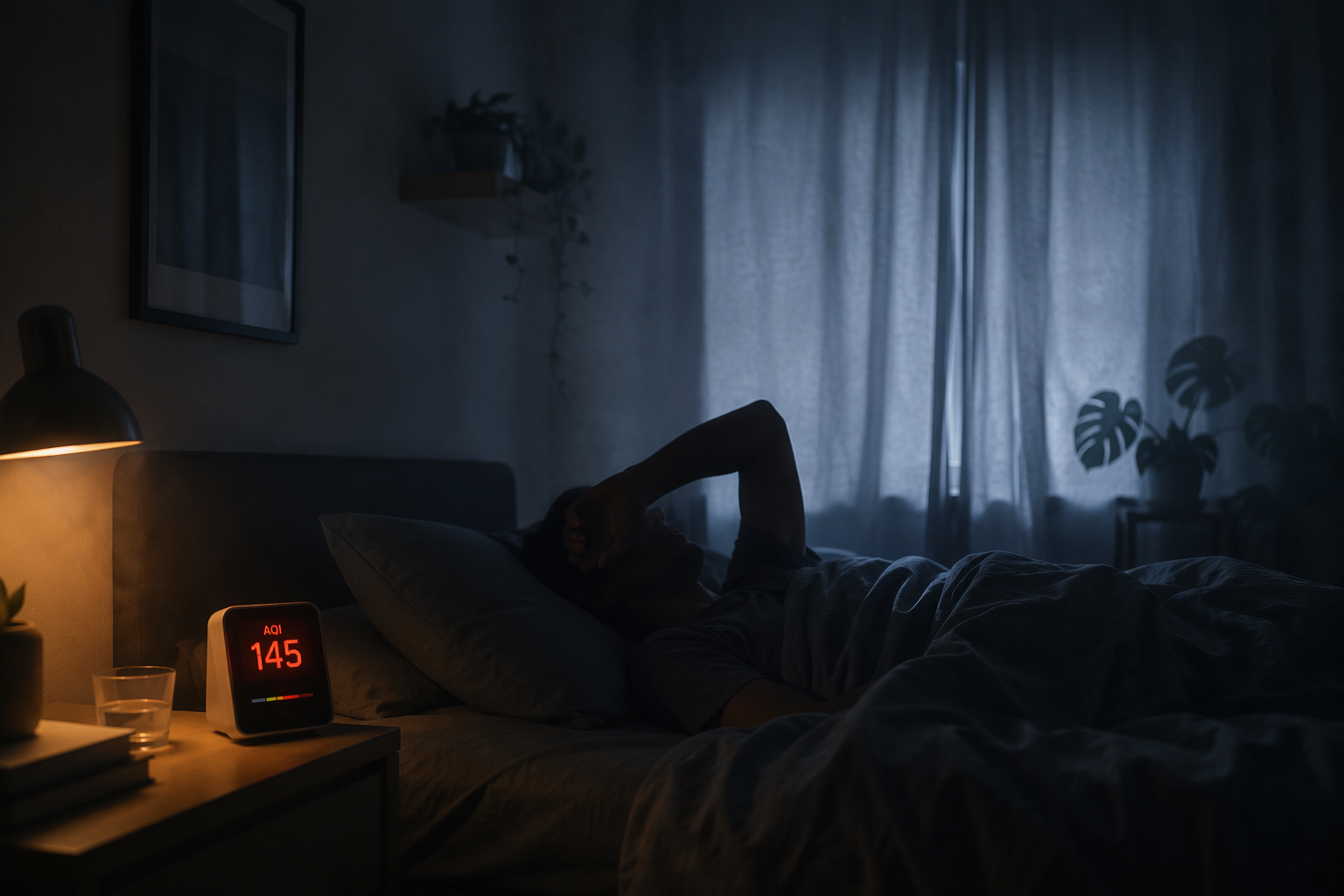
The harder question is not whether that ritual should exist. It is whether people are being given an accurate choice. A drink at 4 or 5 p.m. feels safely distant from bedtime. Sleep physiology is less reassured by the clock.
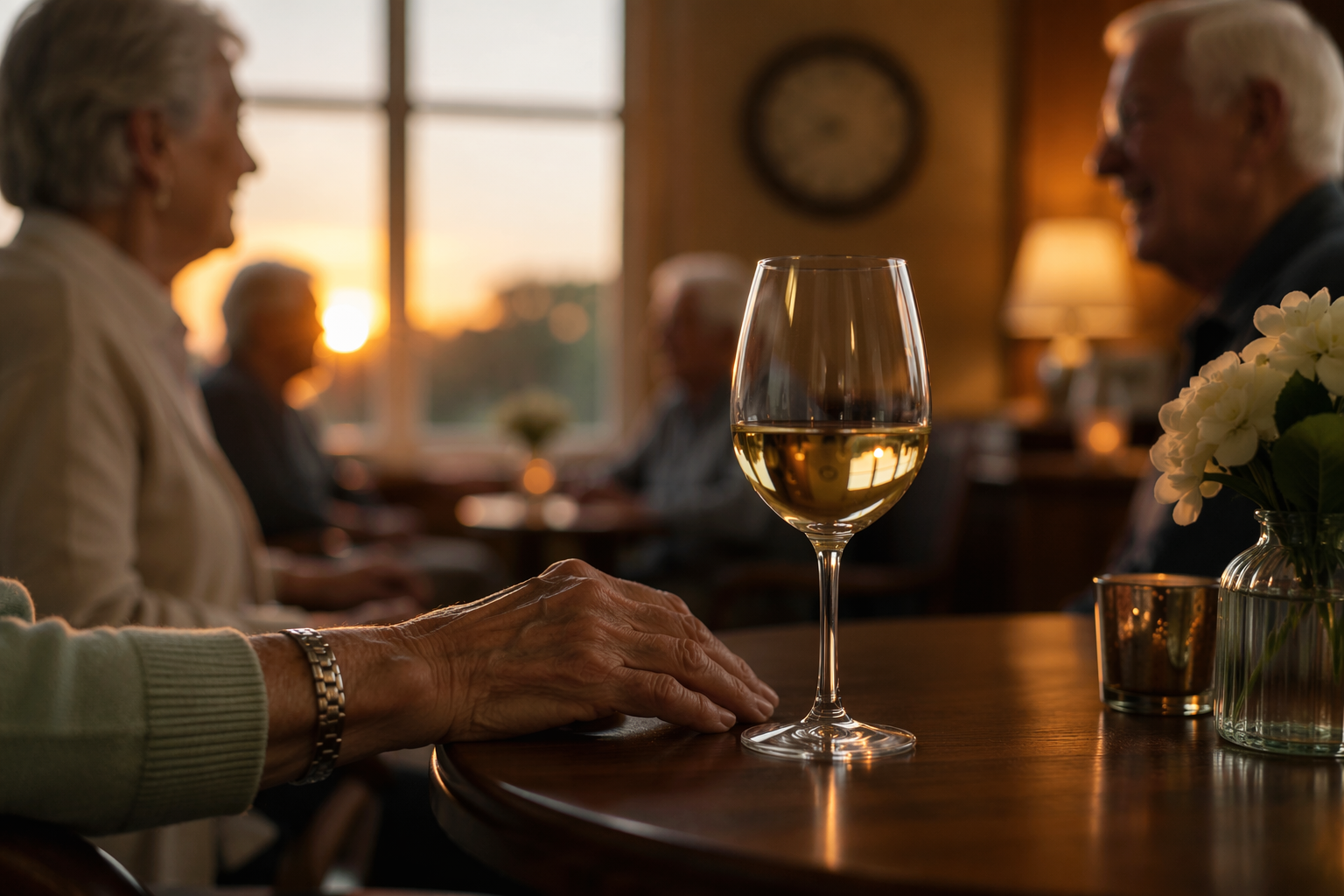
The best available sleep evidence suggests that happy-hour timing is still close enough to matter. Alcohol consumed as much as six hours before bedtime has been shown to disrupt nocturnal sleep and sleep EEG, including more wakefulness in the second half of the night.[3] That finding does not come from a perfect assisted-living trial in adults in their late 70s or 80s. It comes from a study of middle-aged men, and that limitation matters. But it punctures the common assumption that alcohol stops being sleep-relevant once dinner is over.
Why one drink lands differently after 65
The same pour is not the same exposure across a lifetime. The National Institute on Alcohol Abuse and Alcoholism warns that aging changes how the body handles alcohol, and that older adults can become more sensitive to its effects.[4] One reason is distribution: alcohol mixes with body water, and total body water tends to decline with age as lean muscle mass decreases. Cleveland Clinic notes that lean muscle mass declines by about 3% to 8% per decade after age 30.[5]
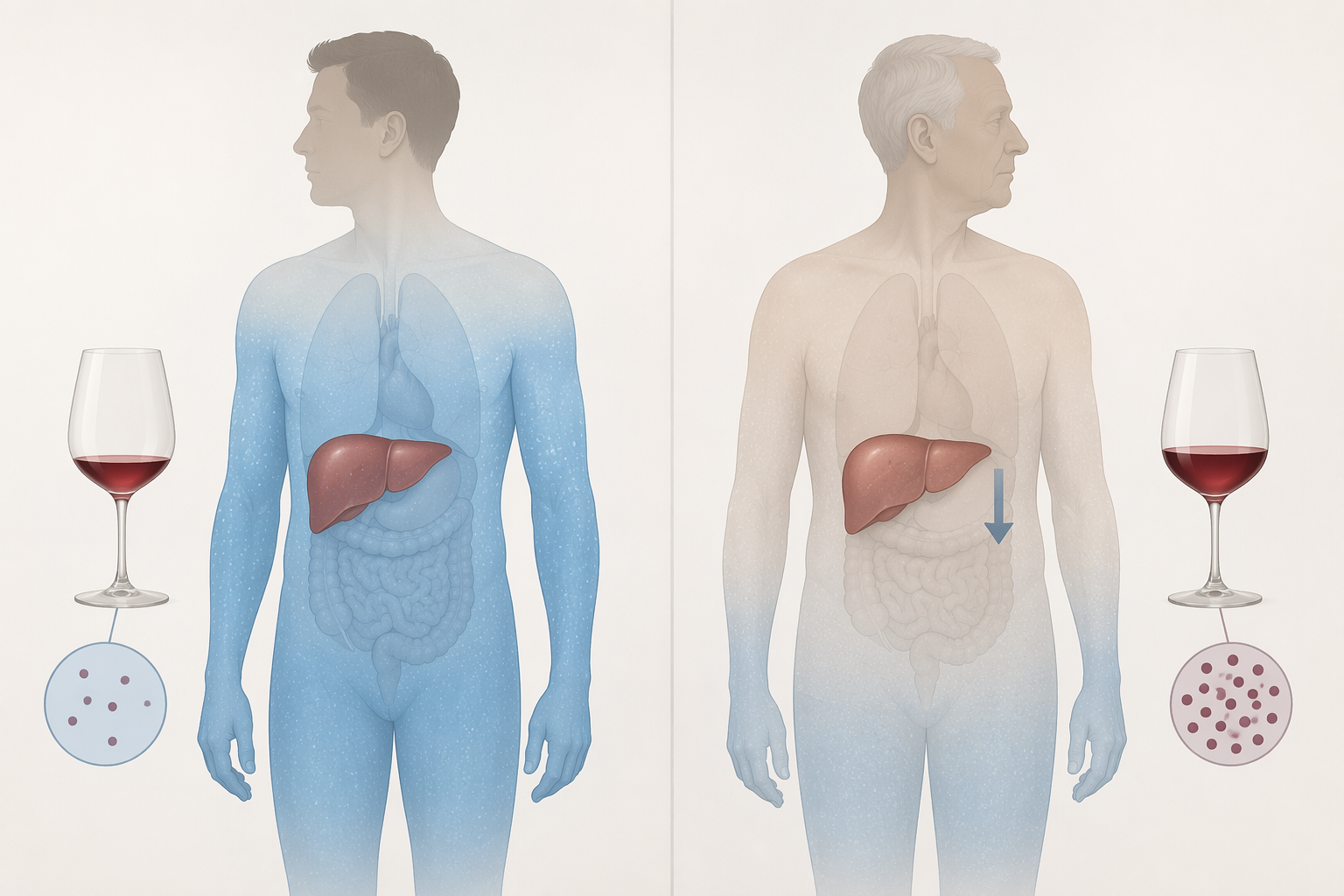
Less body water means the same amount of alcohol is diluted into a smaller volume. Slower liver enzyme activity can add to the problem. The practical result is familiar to many older adults even before they have language for it: one drink may feel stronger, last longer, or produce more next-day fog than it used to.[4][5]
That is the first reason Minnesota’s happy hour law cannot be judged by the habits of a 35-year-old. The second reason is what alcohol does once the brain enters sleep.
The sedative effect is the misleading part
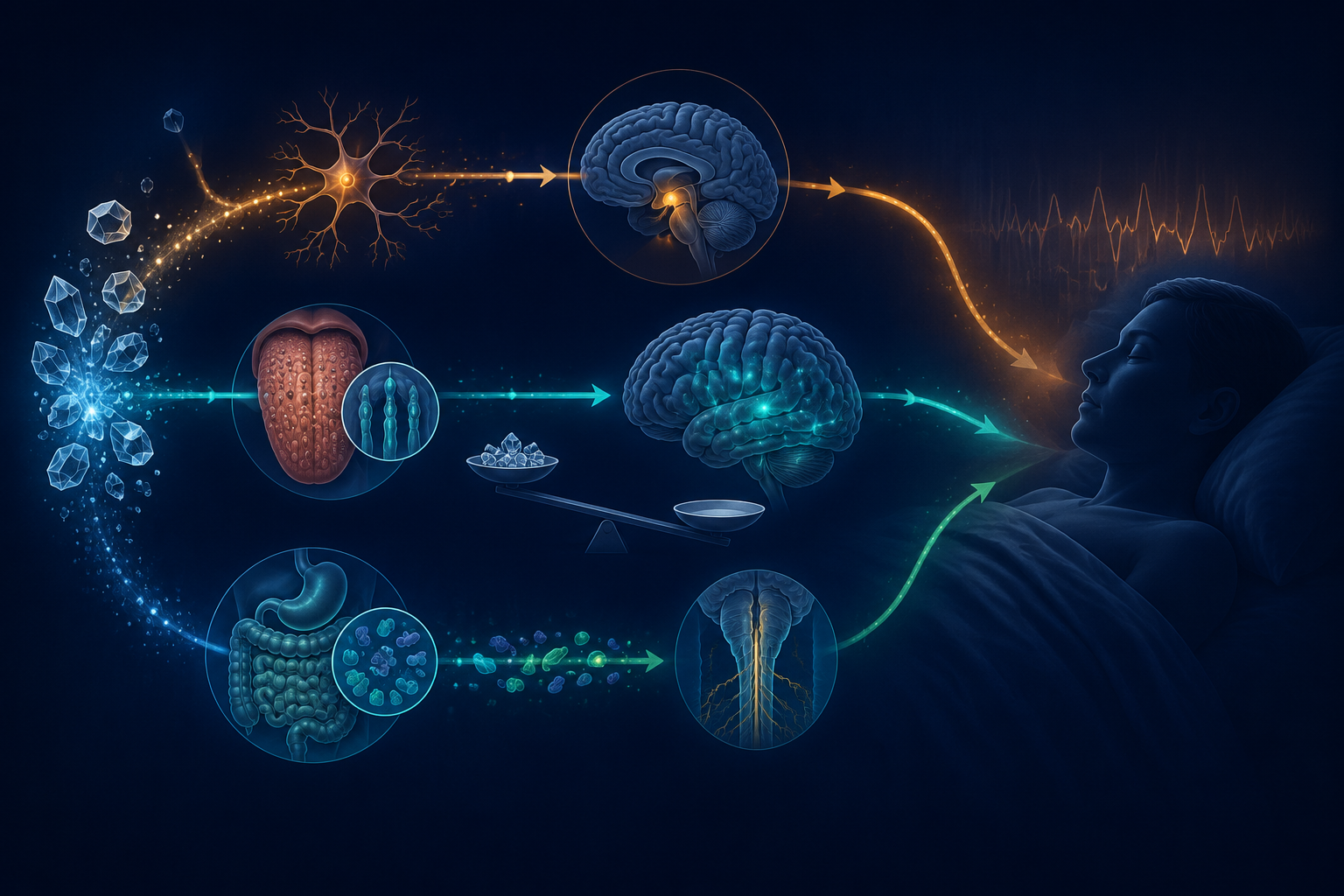
Alcohol can make sleep onset feel easier. That is why it is so tempting as a nightcap, and why a late-afternoon drink may feel harmless if the resident gets drowsy later. But sedation is not the same as healthy sleep architecture. Alcohol changes the pattern of sleep stages, suppresses REM sleep, and is associated with more fragmented sleep later in the night.[6]
For a clearer primer on the stages being disrupted, see Sleep Architecture: NREM and REM Stages Explained. The short version is that a good night is not just unconscious time. The brain cycles through lighter sleep, deeper non-REM sleep, and REM sleep. Alcohol may help push someone into sleep earlier, then leave the second half of the night more unstable.
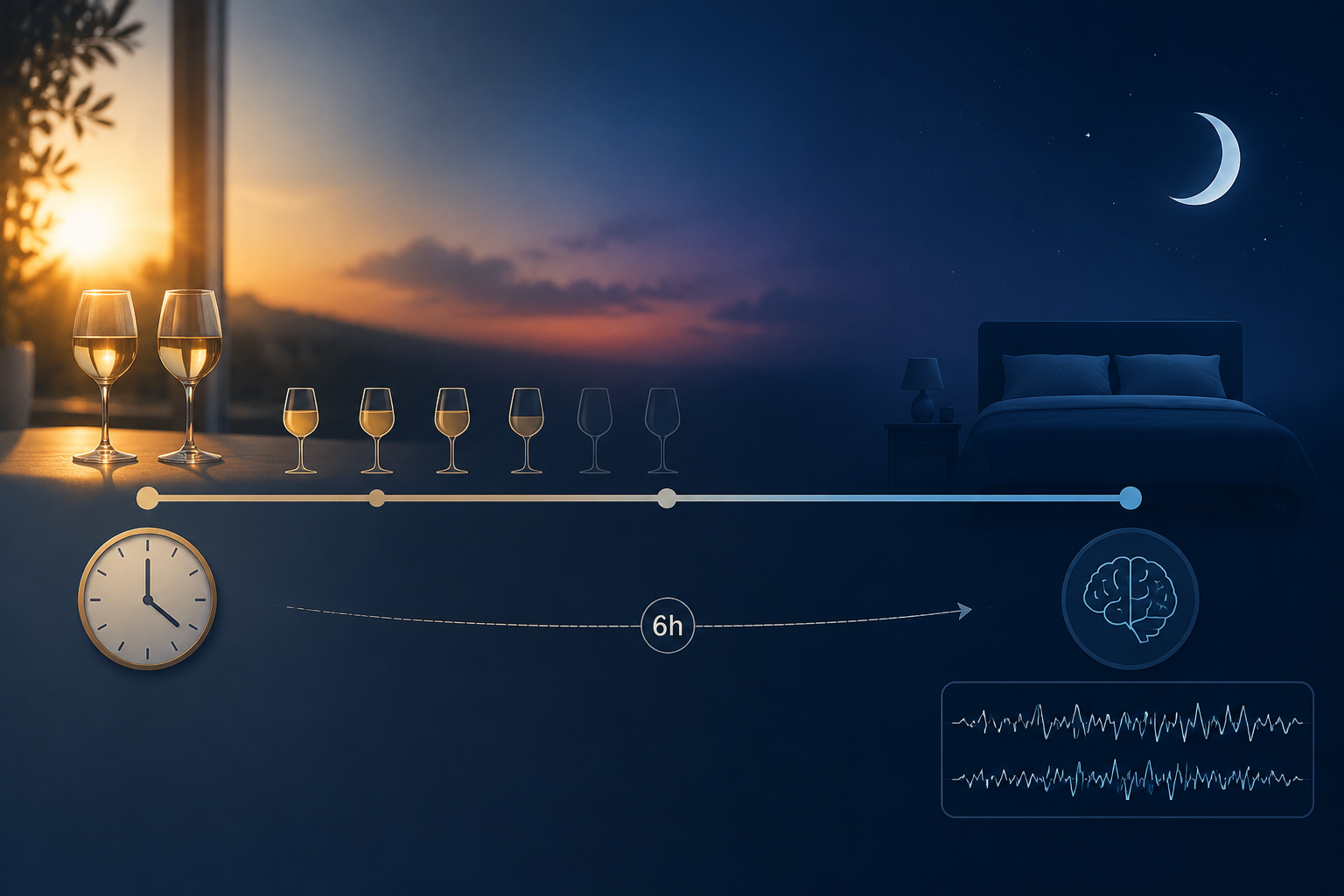
This is where the Landolt timing finding matters most. In that experiment, alcohol taken in the late afternoon still altered sleep EEG at night, even though it was not consumed immediately before bed.[3] A happy hour that ends at 5 p.m. may feel like a daytime activity to the activities director and a social pleasure to residents. To the sleeping brain, it can still be part of the night’s biology.
The downstream consequence is not abstract. More wakefulness in the second half of the night means more time awake after midnight or 2 a.m., more trips to the bathroom, more confusion in a dark room, and more reliance on the aide who answers the call light. It also means the resident who enjoyed the party may be the same person facing a more fragile night.
What the broader evidence adds
The most direct timing evidence is narrow, so it should not be inflated into a claim that every older adult who has one drink at happy hour will sleep badly. But the surrounding evidence points in the same direction: heavier or more frequent alcohol use is linked with worse sleep in older populations.
In an analysis of 4,970 adults age 55 and older from the Health and Retirement Study, frequent binge drinking, defined as more than two days per week, was associated with 84% greater odds of insomnia symptoms.[7] This is not the same as a single assisted-living happy hour drink. It is a behavior pattern with a different dose. Still, it shows that alcohol and insomnia symptoms travel together in older adults often enough to be clinically worth noticing.
The Whitehall II cohort adds a longer view. In a study of 6,117 participants, men aged 61 to 81 who drank more than 21 UK units per week had 30% higher odds of waking several times a night than non-drinkers, and stable heavy drinking over 30 years predicted worse sleep.[8] Again, this is not a one-glass happy-hour trial. It is evidence that sustained higher alcohol exposure and sleep disruption are connected over time.
The sleep-aid pattern is especially revealing. The National Council on Aging reports that 30% of older adults with persistent insomnia use alcohol as a sleep aid, yet 67% of those people still report trouble sleeping.[9] That finding captures the trap: alcohol can feel like it solves the first step of sleep while worsening the night as a whole.
The risks that show up after bedtime
Assisted living administrators already think about falls, medications, diabetes, swallowing, hydration, transportation, and staffing. Sleep should be part of that same operational picture. Alcohol-related sleep fragmentation does not stay politely inside a sleep chart.
Sleep apnea is one example. A meta-analysis found that alcohol consumption increased the risk of obstructive sleep apnea by 25%, and alcohol can worsen sleep-disordered breathing by relaxing pharyngeal muscles.[10] For a resident who already snores loudly, uses CPAP inconsistently, or wakes gasping, the relevant question is not whether the drink was legal. It is whether the drink made the airway more collapsible during sleep.
Falls are the other late-night consequence that deserves plain language. Mayo Clinic reports that alcohol contributes to 65% of fall deaths in older adults.[11] That statistic is not specific to happy hour, and it should not be used to frighten every resident away from a toast. But it belongs in the room when alcohol, nocturnal waking, bathroom trips, sedating medications, and impaired balance overlap.
| Resident factor | Why it changes the sleep decision |
|---|---|
| Baseline insomnia | Alcohol may shorten sleep onset while increasing later wakefulness. |
| Known or suspected sleep apnea | Alcohol can relax airway muscles and aggravate sleep-disordered breathing. |
| Fall history or nighttime bathroom trips | More fragmented sleep can mean more movement in the dark. |
| Sedating medications or alcohol-interacting drugs | The same drink may have stronger or less predictable effects. |
| Low body weight or frailty | A standard serving may produce a higher effective exposure. |
What a fair happy hour policy can say
A fair policy does not need to pretend that wine is medicine or poison. It can treat alcohol as a sleep-relevant exposure while still preserving the dignity of a shared social ritual.
- Make timing visible: a 4 p.m. drink may still affect a 10 p.m. bedtime, so residents should not hear “early” as “sleep-neutral.”
- Make serving size boringly clear: “one drink” should mean a standard serving, not a generous pour.
- Offer appealing nonalcoholic versions without making them feel like the children’s table.
- Flag residents with insomnia symptoms, sleep apnea, fall history, or medication interactions for individualized guidance rather than blanket rules.
- Watch the night after, not just the event itself: new awakenings, confusion, unsteadiness, or CPAP trouble are part of the feedback loop.
These are not moral tests. They are the same kind of practical guardrails that belong in any honest discussion of what sleep hygiene actually means: not a purity code, but a way to reduce avoidable friction around sleep.
The evidence is strongest for the mechanism, not for a one-size-fits-all rule. Older adults often experience higher alcohol exposure from the same drink. Alcohol can suppress REM sleep and fragment the night. Late-afternoon timing is not automatically protective. The groups who deserve the most caution are the ones already living close to the edge of poor sleep: residents with insomnia symptoms, sleep apnea, fall risk, frailty, or medication interactions.
Minnesota’s law may make assisted living feel a little more normal, and that is not a small thing. The sleep science simply asks that the normal adult choice be an informed one: a pleasant glass at happy hour can still have a measurable biological afterlife at bedtime.
References
- Minnesota's 'Grandparents' Happy Hour' bill signed into law, CBS News.
- New Minnesota Law Lets Assisted Living Communities Have Happy Hours, Sans Liquor License, Senior Housing News.
- Late-afternoon ethanol intake affects nocturnal sleep and the sleep EEG in middle-aged men, Journal of Clinical Psychopharmacology, 1996.
- Aging and Alcohol, NIAAA.
- What To Know About Alcohol and Aging, Cleveland Clinic.
- Alcohol and Sleep, Sleep Foundation.
- Frequent binge drinking is associated with insomnia symptoms in older adults, AASM.
- The association between alcohol consumption and sleep disorders among older people in the general population, Scientific Reports, 2020.
- Does Alcohol Impact Your Sleep?, NCOA.
- Alcohol and the risk of sleep apnoea: a systematic review and meta-analysis, Sleep Medicine, 2018.
- Drinking alcohol and getting older, Mayo Clinic.
Comments
Join the discussion with an anonymous comment.